
TL;DR: Women live in a constant state of guilt about everything—from work performance to dinner choices—treating it as our default emotional setting. This guilt isn’t just exhausting; it’s actively undermining our careers by keeping us stuck fixing imaginary problems instead of advancing strategically. The solution is to recognize guilt as a systems trap, not a personal failing.
Hello there 👋
Last week I had this text exchange with Vic, the artist who illustrates this newsletter (and my pal since 6th grade):
VIC: “Hi. I’m reading this book and I feel like she lays out her information similarly to you and does a good job being both gently instructive while also sharing her personal feelings. It’s also a lot of good advice, though I even feel guilty reading it, which is probably why I need to read it!”
ME: “What’s making you feel guilty????”
VIC: “I always feel guilty—not working enough, not creating art enough, not taking my kids on vacation or apple picking, not going to protests, turning down invites to go out, resting...shall I go on......”
ME: “No lol I get the picture 😂
(pause)
ME: “I think this needs to be next week’s topic btw”
VIC: “Yes!”
Here’s what hit me: My brilliant, accomplished friend feels guilty about reading a self-help book. Not binge-watching Netflix. Not doom-scrolling Instagram. Reading something that might actually help her.
In other words, we’re guilt-spiraling about our guilt-management strategies...!
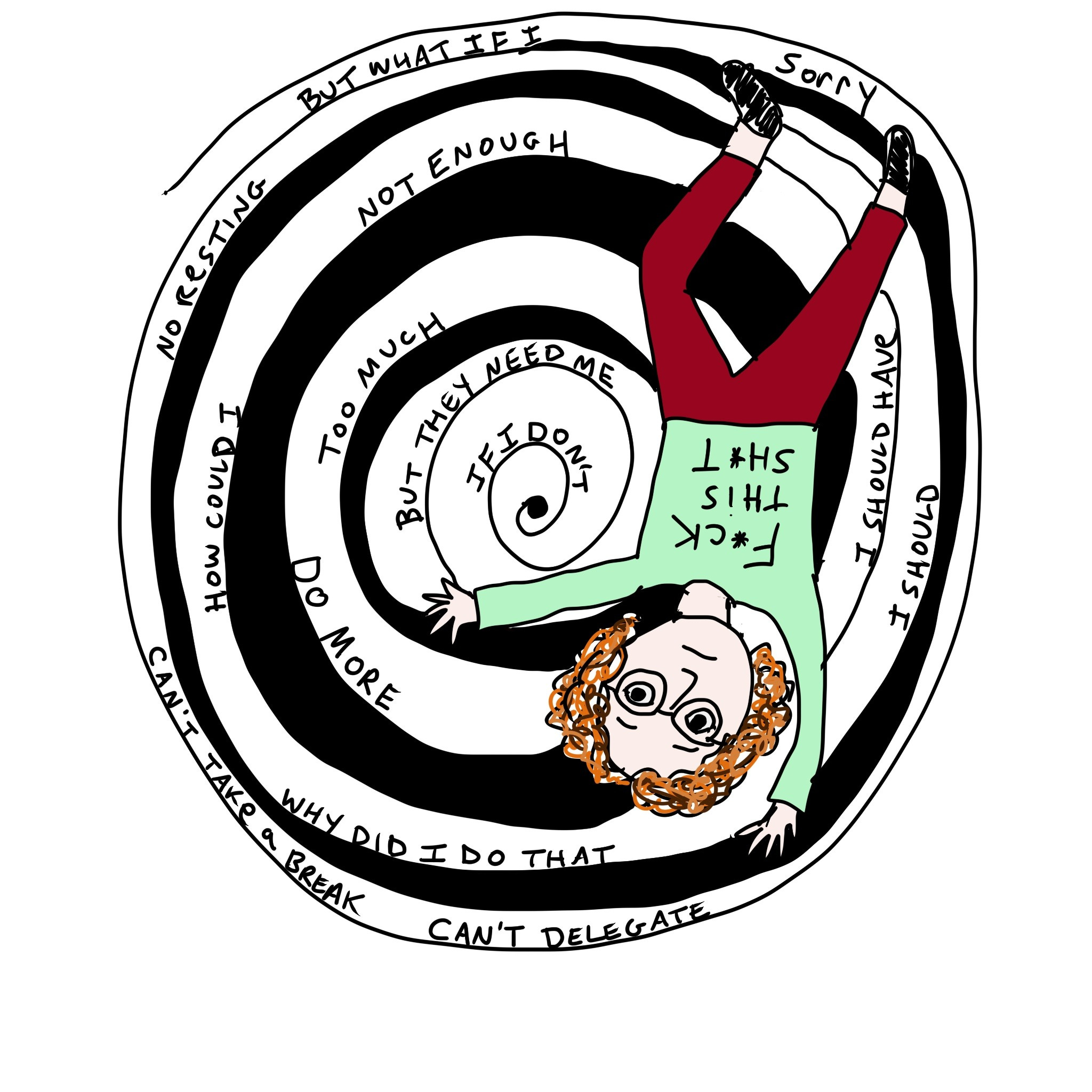
According to psychologist Nancy Colier’s research, women believe everything that goes wrong is their fault—past, present, and future. If something or someone isn’t okay, we’ve caused it and must fix it. Meanwhile, we feel guilty for needing anything for ourselves.
This emotional baggage is a career killer. Here’s why:
When you’re the office’s designated guilt-absorber, you become the go-to for emotional management, not strategic leadership. Remember that Harvard Business Review stat about office housework? Women who take on invisible work are 48% less likely to get promoted. Guilt is the gateway drug to that invisible work.
Think about your last workday. A project hit a snag? You immediately cataloged everything you could have done differently. A colleague seemed upset in a meeting? You spent an hour wondering if you said something wrong. Your boss seemed stressed? You started preemptively fixing problems that might not even exist.
The neurological reality is that women are wired for relational awareness—we’re biologically designed to be attuned to others’ experiences. But here’s where it goes sideways: We’ve weaponized this beautiful capacity for empathy against ourselves, believing we’re bad if we fail to keep everyone happy.
The standard advice about guilt falls into three equally useless categories:
The “Just Stop Feeling Guilty” Approach: This is like telling someone with insomnia to “just sleep.” Guilt isn’t a choice we’re making; it’s a deeply conditioned response that served as an emotional survival strategy. Through cultural conditioning, we learned that emotional safety and belonging come from being likable. Taking blame keeps us likable. Even when there’s nothing to take blame for.
The “Practice Self-Care” Method: Sure, take that bubble bath while mentally reviewing every conversation from the day and pre-apologizing for tomorrow’s imaginary transgressions. The problem isn’t lack of self-care; it’s that guilt follows us everywhere, including into that candlelit bathroom. You can’t meditate your way out of systemic conditioning.
The “Set Boundaries” Solution: This advice ignores that guilt is often our way of maintaining control. If everything is our fault, then we can fix it by being better, doing more, trying harder. Boundaries threaten this illusion of control. They force us to accept that things happen for infinite reasons beyond our influence, and that’s terrifying for those of us trained to be everyone’s emotional shock absorber.
What nobody tells you is that guilt is also an avoidance strategy. While you’re ruminating on all the ways you’ve failed, you don’t have to feel the actual feelings about what’s happening. The frustration about being passed over for promotion. The anger about unequal domestic labor. The grief about dreams deferred. Guilt keeps us busy without requiring us to change anything.
Here’s what actually works (I mean, not perfectly, but better than the eternal guilt loop):
Recognize guilt as information, not instruction. When guilt hits, ask: “What system is this protecting?” Usually, it’s either protecting others from discomfort or protecting you from uncertainty. Neither is your job.
Practice the Two-Touch Rule for workplace guilt. You get two attempts to address any situation. After that, it’s not yours to fix. Someone’s upset after a meeting? Check in once, offer support once, then move on. This is simply you recognizing that other adults are responsible for their own emotional regulation.
Flip the guilt script with specificity. Guilt loves vague accusations. It whispers “you’re a bad mother” not “you forgot to pack the permission slip.” Get specific about what you’re actually responsible for versus what you’re assuming responsibility for.
Instead of: “I’m terrible at my job”
Try: “That one report had an error. I’ll fix it and add it to my checklist for next time.”
Instead of: “I’m letting everyone down”
Try: “Three people have three different priorities. I’ll clarify with my manager which comes first.”
Instead of: “I should be doing more”
Try: “I completed five projects this week. The sixth can wait.”
Document your guilt patterns. For one week, track every guilt spiral. You’ll notice most circle around the same 3-4 triggers. Once you know your patterns, you can interrupt them before they become full productions.
Choose your highest-frequency guilt trigger—the one that shows up daily. For me, it’s the 3pm “I should be more productive” guilt, despite having worked since 7am.
Create a pre-written response for when this guilt hits. Keep it in your notes app. When guilt arrives (and it will), read your response out loud:
This feeling is familiar but not factual. I’ve already accomplished [specific things] today. This guilt is a system trying to extract more labor from me. I’m choosing to redirect this energy toward [specific strategic work] instead.
Set a daily reminder for your guilt o’clock. When it pings, read your statement before guilt can gain momentum. Track for one week how this shifts your afternoon productivity from guilt-driven busy work to actual strategic progress.
Guilt isn’t personal failure. It’s systemic programming designed to keep women managing everyone’s emotions instead of advancing strategically
The “fix yourself” solutions miss the point entirely: You can’t self-care your way out of cultural conditioning that profits from your exhaustion
Strategic guilt disruption means getting specific: Vague guilt keeps you stuck; specific accountability lets you move forward
Bottom line: We’re not going to get rid of guilt. So let’s work with it in a way that doesn’t defeat us. It’s a systems problem, and we can apply a systems solution.
- With you all the way,
Kara
P.S. Next week: Performance season is here. Let’s make sure your self-eval doesn’t undersell your impact (or paycheck!)
Comments
Nothing yet. Say the first thing.
Sign in to join the conversation.