
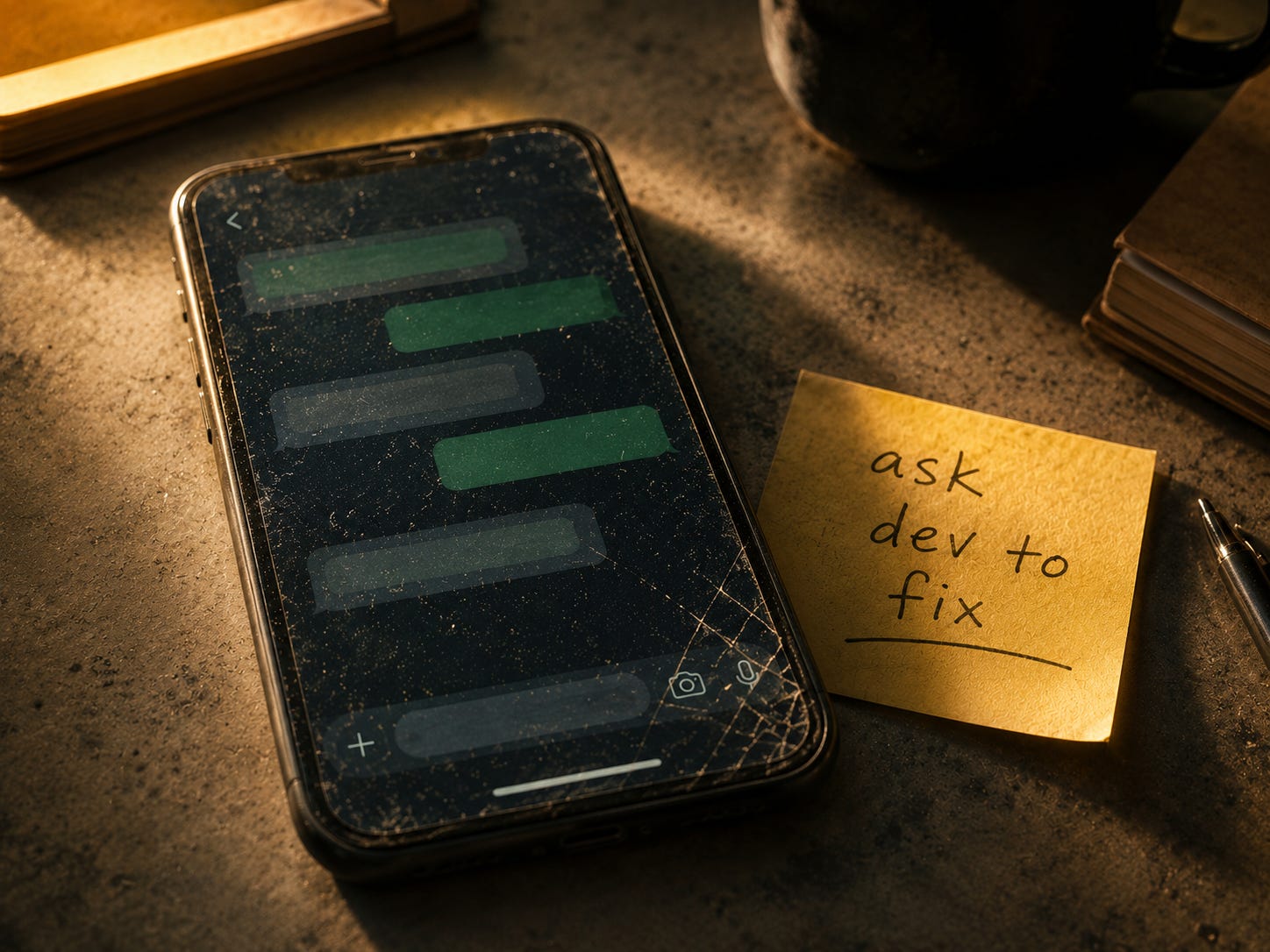
A freelancer builds your WhatsApp bot. It takes a weekend. The demo looks good. Questions get answered. The team is excited.
Six months later, here is what your business looks like:
Month 1
Bot is live. Team is happy. Customers are getting responses.
Month 2
Product catalog changes. Someone means to update the bot. Nobody does.
Month 3
Pricing changes. The bot is still quoting old prices. Customers are confused.
Month 4
The developer is unreachable. A new branch opened. The bot does not know it exists.
Month 5
New regulations introduced. The bot says something it should not. Nobody can fix it quickly.
Month 6
Customers stop trusting the bot. The team stops updating it. It becomes expensive decoration.
Nobody lost money because the bot could not reply. They lost money because nobody could maintain it.
That is the real chatbot problem. Not the build. The after.
Most companies buy chatbots by evaluating the wrong things.
What buyers evaluate
How nice the bot looks
Whether it answers questions
Whether it integrates with WhatsApp
Whether the demo impressed the manager
What they should evaluate
Can non-technical staff update it?
Can we audit conversations?
Can we measure business outcomes?
What happens when the developer disappears?
A chatbot is not software you deploy once. It is more like an employee. Employees improve. Chatbots must improve too. The freelancer approach is build once, deploy once, forget. That is not a product. That is a time bomb.
The real competition for serious chatbot infrastructure is not another platform. It is the freelancer who built something impressive and then disappeared.
01 Knowledge management without a developer
Your business changes every week. Prices change. Products change. Policies change. A freelancer-built bot has hardcoded answers and static prompts. When things change, every update requires calling the developer, paying again, and waiting days. A serious platform lets your team update knowledge, upload new documents, and modify answers without touching code. That is the difference between a bot that survives three months and one that survives three years.
02 Conversation visibility
Most chatbot projects have a hidden problem: nobody knows what customers are actually asking. The bot is running. Messages are coming in. Management sees nothing. Conversation history, failed questions, escalation patterns, and popular topics are not just chatbot features they are customer intelligence. Companies discover missing products, pricing confusion, and new opportunities from conversations. Only if they can see them.
03 Graceful human handover
Freelancer bots usually fail at one specific point: when the AI does not know. The customer gets stuck. They leave. A serious business agent should not try to answer everything it should know when to stop and hand over cleanly. Agent takeover, escalation routing, human intervention, and team collaboration are not nice-to-have features. They are what separates a bot from a support system.
04 Multi-person ownership
The biggest structural weakness of a custom-built bot: one person understands everything. Usually the developer. If they leave, nobody knows the prompts, the APIs, the logic, or the infrastructure. The company becomes a hostage. Real institutional ownership means marketing can update content, operations can review conversations, support teams can intervene, and management can see reports. No single point of failure.
05 Continuous improvement
A chatbot should evolve alongside the business reviewing conversations, finding failures, improving responses, updating knowledge, measuring what changed. The freelancer approach has no feedback loop. The platform approach is the loop itself.
06 Channel maintenance
WhatsApp changes. Meta changes API versions. Templates change. Webhook requirements change. Phone number policies change. A freelancer delivers version one and then disappears. Channel integrations require continuous maintenance that is invisible until it breaks. And when it breaks, the bot goes silent.
07 Governance and audit trails
Most companies never ask “who changed this answer?” until something goes wrong. For a bank chatbot, an insurance chatbot, or a government service, an incorrect answer creates real liability. Access controls, team permissions, and audit trails are boring features. They are also exactly why enterprises buy platforms instead of projects.
08 Business outcome measurement
Most chatbot vendors report messages sent, conversations handled, AI accuracy scores. Businesses care about leads generated, tickets resolved, orders placed, payments collected, and costs reduced. A bot disconnected from business processes can be busy and useless at the same time. The metric that matters is whether the business is better not whether the bot is active.
A chatbot is easy to build. Maintaining it as your business evolves as your team changes, your catalog updates, your channels shift, and your customers ask new things that is the hard part. Sarufi solves that problem.
Not by making the bot smarter on day one. By making it survivable at month six, month twelve, and year three.
The 5-minute bot will impress in the demo. It will struggle in the field. It will die quietly when the developer moves on.
The question is never whether you can build it. The question is whether you can still operate it when the business needs it most.
No posts
Comments
Nothing yet. Say the first thing.
Sign in to join the conversation.