
“History doesn’t repeat itself, but it often rhymes” is surely one of the most overdone quotes around. Yet, like it or not, there simply are situations where the truth in it is hard to ignore. One of those became apparent while watching the harrowing police bodycam video showing the death of British teenager Henry Nowak: handcuffed by the police on the concrete while bleeding to death, he repeatedly says “I can’t breathe,” inevitably echoing the last words of George Floyd and the whole cultural earthquake that shook the West at the height of the woke frenzy in 2020. I was hesitant to write on the topic at first, since it is one of those issues everyone will immediately write about, and every new piece on it risks being the 26th “hot take” milking the current thing everyone sees in their feed with a growing sense of fatigue. Yet here we are, and I decided to write it in the end, so I shouldn’t pat myself on the back too hard for being so considerate about it. Henry Nowak was an 18-year-old British student of partial Polish ancestry who was stabbed to death by a Sikh man, Vickrum Digwa, in December. Digwa had falsely told police at the scene that he himself had been the victim of a racist attack, which many assume led officers—relentlessly trained in the indispensable arts of policing with racial equity in mind—to ignore the dying Nowak’s pleas that he had been stabbed and couldn’t breathe, handcuffing him instead. The reason I decided to write about it is that the whole issue somewhat ties back to my very beginnings as someone creating politics-related content online. And there is no more British way to start this than with football.
“Of all the unimportant things, football is the most important” is a quote allegedly said by Pope John Paul II that I have always liked a lot. Now, as most of my readers on Substack probably know, I started publishing my content on YouTube. In my very first video ever, I described an incident that happened during the round-of-16 tie of the 2020/2021 Europa League between Glasgow Rangers and Slavia Prague. I know you might be asking yourself why the hell you are reading about some five-year-old football match, but bear with me—it will all come together. The match was played in Glasgow and it was not going well for the home team. Emotions were running high. Slavia’s goalkeeper Ondřej Kolář was hospitalised after striker Kemar Roofe, chasing a through ball, drove his studs into the keeper’s face in a brutal high challenge, leaving him with a fractured skull and a three-inch gash on his forehead. Roofe was shown a straight red card.
Another Rangers player, Leon Balogun, was sent off for two yellow cards. Many thought there was a sense of frustration in the air at being outclassed by some “obscure” Eastern European team. After another ugly act of aggression by a Rangers player—kicking a Slavia player who was already lying on the ground—one of the Czech players, Ondřej Kúdela, covered his mouth with his hand, which is usually done so that what you say can’t be lip-read, and said something to Glen Kamara, a black Rangers player. Kamara immediately claimed that Kúdela had used a racial slur against him, calling him a “fucking monkey.” The conflict continued after the match. Kamara was accused of punching Kúdela in the tunnel afterwards, and Slavia said it had been denied access to its dressing room immediately after the game. Slavia’s leadership even claimed that the club doctor was not allowed to treat Kolář on the spot until dozens of minutes after the final whistle. UEFA’s Control, Ethics and Disciplinary Body ruled as follows: Ondřej Kúdela was suspended for ten matches for “racist behaviour,” which included the one-match provisional ban he had already served, and Glen Kamara was banned for three matches for assaulting another player.
In the Czech public debate, all hell broke loose. There was a widespread sense of injustice that was, quite astonishingly, shared by people of vastly different political persuasions. From the populist, anti-progressive President Zeman to the politicians of the progressive-left Pirate Party, everyone thought that getting a penalty three times harsher for allegedly saying something racist than for physically attacking an opponent with punches was simply unjustifiable. When did a real, physical attack become worse than a verbal one, racist or not? Moreover, how can you punish someone for something that was not proven against him, since it was simply word against word—Kamara said he was racially offended, Kúdela denied it?
Now, some important caveats. While it is true that the slur cannot be proven, it also cannot be disproven—that is the problem with speaking quietly behind your hand. In a tense, high-adrenaline moment, a man with likely shaky English mutters something to another; Kamara may even have misheard what was said. We will never know. That he was angry enough to attack Kúdela in the tunnel afterwards, earning his own three-match ban, suggests he really was furious. But UEFA’s disciplinary body is not a criminal court—it is the custodian of the multibillion-euro machine that is European football, and it need not prove anything beyond reasonable doubt. Racism is poison to a global product, so the rules mandate heavy punishments for offences with racist connotations, and Kúdela got one at the lower end of the range. He is a well-paid professional who should be able to control himself. Fair enough.
The incident had a sort of bizarre aftermath when Glasgow Rangers visited Prague about half a year later to face Sparta, the other big Prague team. Sparta’s home stadium was supposed to be empty: in an earlier match, Sparta fans had racially abused a Monaco player with monkey chants, and the punishment was to play before an empty ground. All right—maybe the view held by most Britons at the time, that we are a bunch of Eastern European racist hicks, was not summoned out of thin air after all. Eventually, UEFA allowed 10,000 children into the stadium. Even though Slavia and Sparta fans absolutely hate each other—it is the biggest rivalry in Czech football—Kamara was booed every time he touched the ball. Rangers manager Steven Gerrard called it racism by Czech children and contacted UEFA demanding another inquiry; the Czech foreign minister, in turn, summoned the British ambassador over the insults aimed at Czech children. Kamara’s lawyer, Aamer Anwar, said that instead of summoning British diplomats, “maybe his Government should take the opportunity to address the deep rooted racism that exists in their country.” What can I say: our apparent racism can bridge even the divisions between generations and football rivalries.
What was much more interesting to me was to observe the completely different reactions of the broader public and the commentator classes in the Czech Republic and in the UK. I watched many British football studio debates, and pretty much universally they called for an even harsher punishment for Kúdela. There was no acknowledgement of the aggressive and dangerous way the Scottish players had behaved beforehand—only of the alleged slur, as if it had happened in a vacuum. Some even proposed that Slavia be banned outright from the Europa League, and Scottish police, for a time, talked about criminal prosecution. But I went deeper: I read through British sports forums to get a feel for what “the public” thought—the part that cares, at least, which is football fans, and never a group I would associate with an overtly “politically correct” outlook. It was all the same. “Imagine genuinely thinking Kúdela wasn’t a lying racist shitebag,” or “Slavia should get absolutely hammered for covering up racist behaviour and slandering the victim and Rangers”—those are some of the reactions I found, anecdotal as they are.
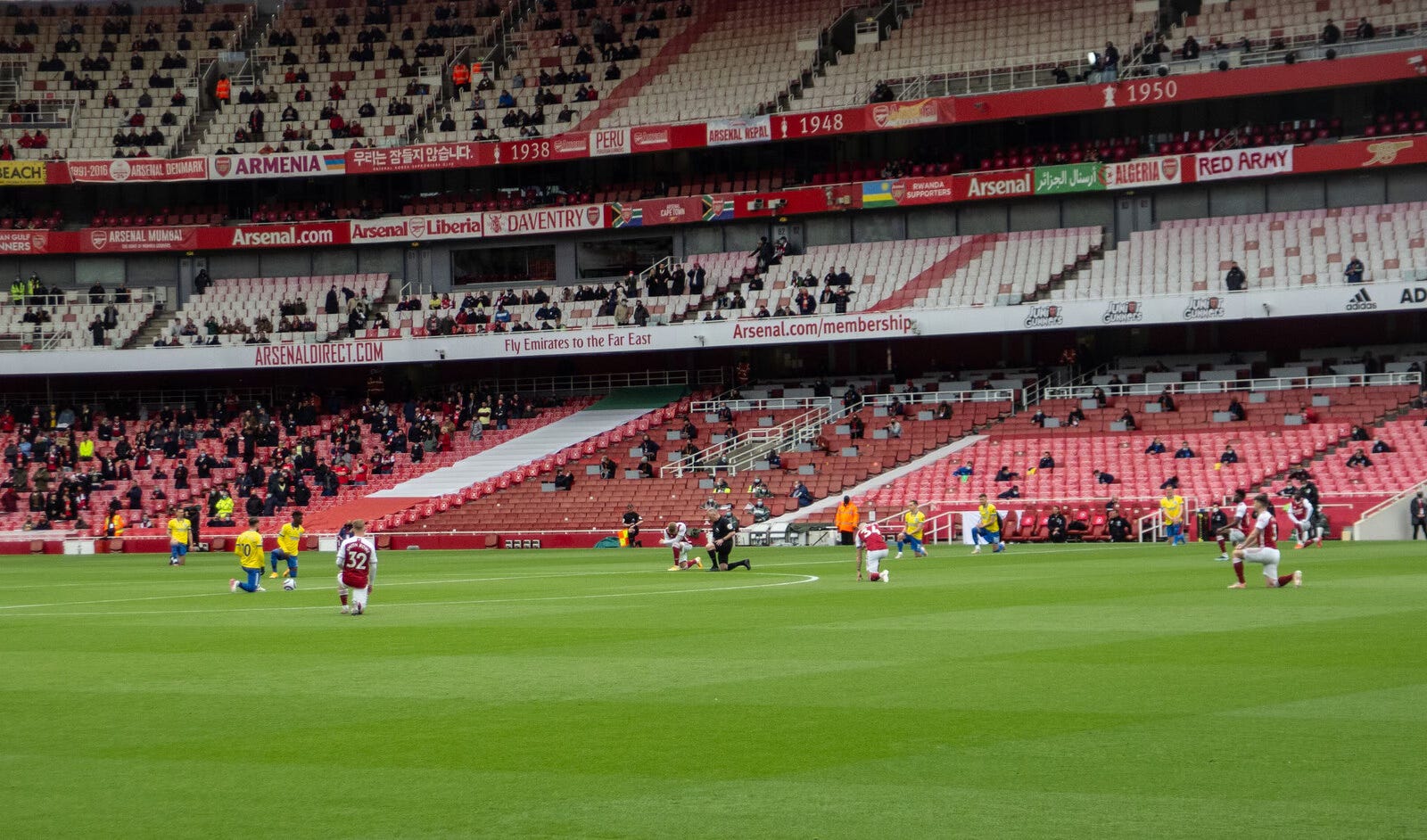
Of course, as we approach more current events, this whole affair did not occur in a vacuum, but in the aftermath of the George Floyd murder (I am sure some will voice their disagreement with that qualification in the comments, but the court decided it that way, so I am using the term) and the whole massive wave of riots, statue vandalizing and removal, and the ever-present kneeling of everyone everywhere. This was a highly American phenomenon, yet it was its transposition to Europe that really did bear the signs of mass moral panic. Football players, and even referees, in the British Premier League—and then in a number of other European leagues—knelt before every match in solidarity with George Floyd and the BLM movement. It was a bizarre case of the complete Americanization of European discourse: whatever one might have thought about the American situation, it made very little sense in a European context. Even in countries with substantial African minorities, those minorities were the product of recent immigration waves and thus had no part in the long and painful history of American race relations. Czech teams never knelt before matches, and so the difference between the kneeling, racial-justice-conscious players of Glasgow Rangers and the “reactionary” Czechs was visible even before the aforementioned match with Slavia. The English national team was also kneeling at the 2021 Euros, even though discontent with it was beginning to bubble up among English fans too.
It made me really interested in the ideological gulf that seemingly opened up between Western Europeans—in this case mostly Brits—and Czechs and the broader post-communist Europe. That is what my very first video was about. Given an identical set of facts, the two publics seemed to arrive at very different conclusions about who had done the more harmful thing: the person saying something racist, or the one reacting to it with physical violence. Fundamentally, it was a clash between a society seemingly dominated by a worldview in which racism stands at the apex of the proverbial pyramid of sin, and one that held that while racism—which we can, conservatively, define as treating someone negatively a priori based on their race, without examining their individual “track record” as a person—is indeed undesirable, it is simply not principally worse than other negative, especially violent, behavior and it does not excuse such behavior even as a reaction to racism, particularly if only in verbal form. Words can certainly hurt a person, but they simply do not hurt as badly as getting hit in the head with a baseball bat. That is the whole “sticks and stones may break my bones, but words will never hurt me” ethos.
And it was precisely this principle—the one that implicitly or explicitly declares that racist behavior, even if it is only a verbal “attack,” outranks every other social wrong and is so unacceptable that it more or less justifies whatever form the counter-reaction to it might take: rioting, looting, physical violence, and disorder—that underpins the whole darkly poetic arc stretching from George Floyd and the BLM riots, through the comparatively harmless yet symbolically telling football escapades, all the way to the murdered Henry Nowak. The incentives of the representatives of the British state, warped in a Kafkaesque manner by the ever-present fear of being accused of racism, connect several of the most explosive scandals in Britain over the past year—the grooming-gangs scandal, the Southport murders, and the murder of Henry Nowak—like a perverse thread.
Of course, we cannot claim with certainty that it was anti-racism training, or the fear of being accused of taking a racist attack too lightly, that produced the appalling behaviour of the officers. One cannot see inside a person’s head, and it may simply have been incompetence. But a force in which officers can stand over a stabbed, suffocating teenager and do nothing has had its instincts shaped by something—and a great many Britons have concluded that the something is a culture so terrified of appearing racist that it second-guesses the pleas of a young man dying on the concrete. Whether or not they are right in every case, that conviction is now a political fact in its own right, and it can no longer be ignored. According to information from the judicial process, the pathologist concluded that Henry Nowak would have died even if the police had proceeded properly, due to the severity of the injuries inflicted. There will, however, be a further investigation into the matter, the results of which should be known next year. I hope that the pathologist’s initial finding is correct, because it marks the difference between police whose conduct toward the dying Henry was unjustifiably undignified and police who were actually co-responsible for his death—which would make the whole affair far more serious.
Britain exhibits certain “late socialism” vibes. It does not seem like a system whose orthodoxy is truly believed by more than an ever-diminishing minority of zealots. People follow it out of opportunism and a lack of options; they are simply trying to navigate the warped incentive structure. In The Power of the Powerless (1978), the Czech dissident and later president Václav Havel described the late-communist system not as a regime of belief but as a regime of ritual. His famous example was a greengrocer who places a sign reading “Workers of the world, unite!” in his shop window. He does not believe it and he may not even think about what it means. He displays it because not displaying it would be noticed and would cost him. Everyone around him does the same, for the same reason, and everyone knows that everyone else is doing it for the same reason: it is essentially empty virtue signalling.
In the Soviet Union, if a nail factory had its quota set in tonnes, it would produce a few enormous, heavy nails that nobody needed. When the planners switched to counting by units, the factory churned out tiny, millimetre-sized nails, equally useless. Railways were assessed by the tonne-kilometres they covered; the result was that freight was hauled along needlessly long routes, because a longer journey meant higher fulfilment of the target. The beliefs of the individuals serving as cogs in the system were not all that important; what mattered was the incentive structure. The purpose of a system is what it does. If the official goal drilled into police officers and other representatives of the state is simply “go hard on racism,” then they act accordingly, sometimes with tragic results, while failing at the prevention of the far more serious violent crimes that cost human lives. And this inevitably fuses with the most mundane day-to-day concerns. The often-cited, shocking figure of some 13,000 people arrested annually in Britain over online communication—the vast majority never sentenced—also stems from the simple fact that visiting an easily identifiable person at home to ask about their Facebook post is just a very easy way to spend a police shift. It is indeed true that the communist regimes were incomparably more oppressive even in their final years—the West is not totalitarian by any stretch. Yet certain similarities, connected to a strange systemic sclerosis, are hard to miss.
The leadership of Britain increasingly resembles not the government of a nation state but some kind of imperial administration trying to deescalate tensions threatening to spiral out of control by reconciling the disputes of the various ethno-religious “tribes” under its suzerainty—maintaining a dialogue with so-called “community leaders,” the sanitised modern term for the tribal chieftains of old. Like many such administrations, it often finds that concession buys not gratitude but the next demand. What has been lacking up to now is the same consideration toward one particular “tribe”: the native working class. And while political developments seem to be leading toward this group finally gaining strong representation in Reform UK—a party that appeals to older, working-class, less-educated voters with a strong English identification—one does not get the sense that it will lead to a brighter future for the country.
When following developments in Britain—and, to a certain extent, in other Western European countries, most notably France—I have for some time had a certain fatalistic sense of inevitability. As if the grand forces of history were already set in motion, the die is cast. The confluence of great socio-economic factors—ranging from demographic change through ideology and economic decline all the way to technological developments—has set these societies on a course toward some kind of inevitable collision, even though I do not know what shape such a collision might take. But maybe that is just the natural human inclination to anticipate a catharsis that is not, in fact, inevitable. Every time a new scandal emerges, like the current murder of Henry Nowak or the riots following the Southport murders in 2024, there is a wave of dark excitement running beneath the outrage in the online debate, as if this were the event that would finally lead to some kind of socio-political earthquake. Yet perhaps that is misguided, and these sorts of public riots will simply become a routine part of British political life. Still, I hope these convulsions find a productive political resolution.
I am, in a sense, an Anglophile. A lot of Czechs are. We love the English sense of humour, which we feel is close to our own. We love English rock music thoroughly—The Beatles, the Rolling Stones, The Who, Pink Floyd, Led Zeppelin, Oasis, and many more. We are football fans, and the Premier League is the best league in the world, without question. I have supported Arsenal since I was a child (which, this season, I learned is apparently the lamest club to support—all those set-pieces—but we won the title, so who cares). When Britain voted for Brexit, there was a widespread sense that post-communist Europe had lost a powerful ally—one that blocked the centralising tendencies stemming from the Franco-German core. Of the great Western states, Germany was always the closest and most important one for us, yet that closeness also brought a great deal of historical baggage. France is somewhat suspect to Czechs, with a sense of grandeur and self-centredness that, for many here, translates into arrogance—perhaps stemming from a lack of mutual understanding. But Britain was just close enough to be relevant and just far enough to escape resentment. When Czechs were finally able to visit London in the 1990s, most came back completely enchanted. The French novelist Michel Houellebecq said that “if France dies, Europe dies.” Well—that just sounds like something a Frenchman would say, doesn’t it? But in our worldview, it might apply more to Britain.
No posts
Comments
Nothing yet. Say the first thing.
Sign in to join the conversation.