

I have just returned from a week-long trip to Denmark, specifically from the coastal region in Central Denmark not far from the small port town of Ebeltoft. It is a beautiful and picturesque land — the rolling green hills and the coast full of pine trees and recreational cabins done in the characteristic Danish style of tasteful, cozy decency. The trip took us also to the lovely lake town of Neuruppin in Brandenburg, Germany — a town called “the most Prussian of all Prussian towns” — where anyone expecting battalions of soldiers marching as one man under the strict orders of their officer would have been disappointed. The only battalions I encountered were of retirees.
I think the average age of the people I met throughout the trip, in both Germany and Denmark, was firmly in the sixties. Of course, the character of our trip clearly incentivised this. We did not visit any large city, staying clear of Berlin, Hamburg, or Aarhus. The calm spa town of Neuruppin, where you can hardly go a few kilometres without passing some Second World War memorial site — some of the old fellows strolling around looked as though they might have memories of the Battle of Berlin at the age of thirteen — or the peaceful Danish coast are exactly the kinds of destination that the elderly surely appreciate. And of course, these were a peculiar kind of elderly, such as we are still not all that used to in post-communist Europe: healthy-looking even in their advanced age, nicely dressed, driving a new sleek EV and strolling along the Baltic Sea. In other words, the prosperous Western European boomers that tend to get a fair share of hate in the public debate.
The “boomer hate” discourse, which is ubiquitous throughout the Western world, takes some time to really understand for a person from post-communist Europe, since this is one of the social aspects where the forty years of communism truly did diverge from the Western European experience. Partly, this is caused by purely demographic factors — the post-war generations are simply less dominant in the population structures of post-communist countries. But even more so, it is driven by socioeconomic factors. The indispensable part of the story is the idea of entitled people born at just the right time to profit from the long post-war years of economic prosperity — people who were able to buy houses for the money earned from a summer of part-time work mowing the neighbour’s lawn or selling lemonade by the road, and who now do whatever they can to block new construction and profit from asset price increases, while being unwilling to accept reductions in their pensions and thus creating more public debt for future generations, and who even advocate for bringing in more immigrants to prop up those same pensions.
While pension costs are growing and straining public budgets with deficits, which leads to some degree of resentment towards pensioners, the image that comes to most people’s minds when they think of a typical retiree in the Czech Republic — and I believe this holds in other countries of the region as well — is not one of the well-dressed EV-driving tourist. It is rather that of a shabbily dressed elderly person, slightly limping as they push a shopping cart to Lidl, clutching a leaflet with the discounted products circled so as to save as much money as possible. One of the biggest shocks for me when I first visited various Western European countries as a child was how different the elderly looked there — stylish French and Spanish seniors with pointed leather shoes and scarves around their necks, sitting unhurriedly in café terraces. Now, I have always thought that the boomer hate phenomenon is somewhat overblown — driven by the human tendency to explain complex social issues with simple, easy answers, and the tendency to view the past through an idealised lens. Yet there is one aspect of the current sociopolitical debate where population ageing is truly clashing with the limits of our economic and political system, and that area is pensions. I think that Otto von Bismarck, who famously enacted the first pay-as-you-go pension system in late nineteenth-century Germany — deliberately designed in such a way that very few people would actually receive anything from it and it would cost next to nothing — would roll in his grave if he saw what a headache his invention has become.
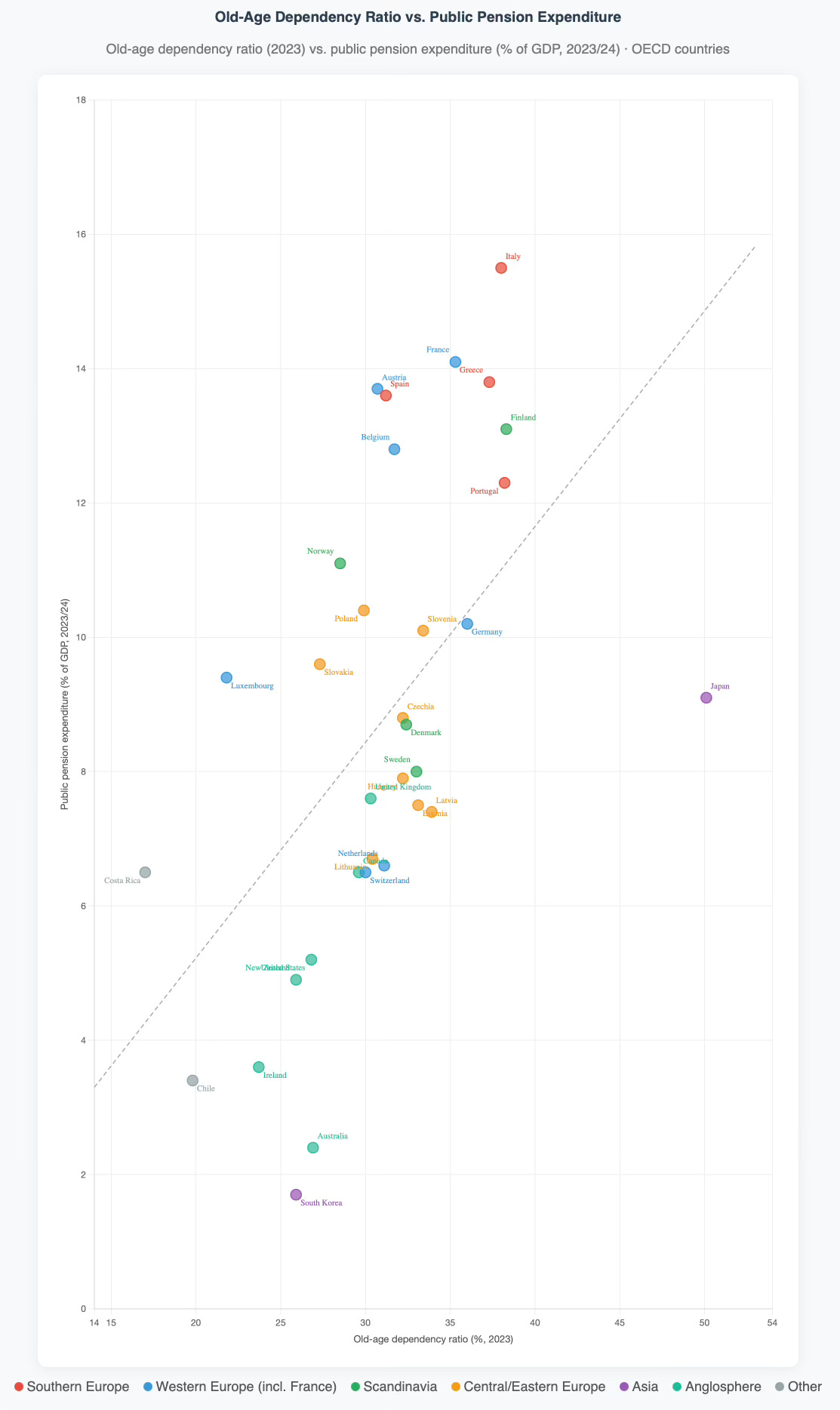
But not all boomers are the same, and not all deserve the same level of resentment. I have dived deep into pension systems data to find out which countries are best positioned to survive the pension apocalypse and in which the entitlement of the elderly drags them down like a cannonball tied to the wrist of a sailor. One thing emerges clearly: the relationship between ageing and pension expenditure is far less straightforward than you might expect. The country with the highest old-age dependency ratio in the world is, as is well known, Japan, where there are 50 retirees per 100 workers. Yet Japanese expenditure on pensions as a percentage of GDP is not the highest, standing at around 9% of GDP — above average, but not even close to the top. South Korea has an old-age dependency ratio of 25, not terrible yet rising faster than anywhere else in the world. Yet Korean public pension expenditure is staggeringly low — only 1.7% of GDP in 2024. For comparison, Slovakia has a very similar dependency ratio to Korea yet spends 9.6% of GDP on public pensions, almost five times as much. What this shows is that how pension systems are built matters a great deal.
Comments
Nothing yet. Say the first thing.
Sign in to join the conversation.