
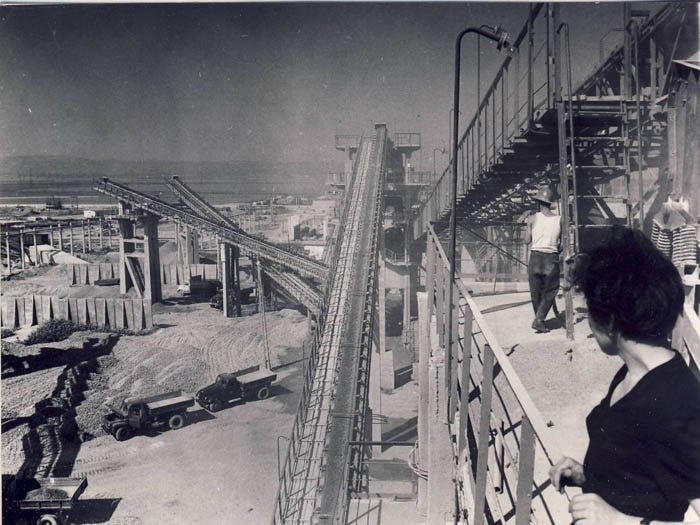
It is the summer of 1989, and across a prosperous, democratic eastern Europe families are preparing for the usual vacation season. The highways of Poland — the fastest-growing economy in postwar Europe — are choked with traffic as tens of thousands of Volkswagens, Hyundais and Škodas crawl southward; fathers unfold big, coffee-stained road maps across their dashboards and stop at filling stations to use the payphone, calling a colleague who made the journey the day before to find out which route had the lighter traffic on the way to the Yugoslav Adriatic coast. Many skip the long drive altogether and fly instead to Greece, Italy or Spain, or to the Black Sea coast of Romania and Bulgaria, where vast new tourist resorts rise every year in cities like Constanța and Varna.
Lesek, his wife and their two children, however, love the Adriatic coast around the town of Crikvenica, in the northern part of Yugoslavia. They have travelled there every summer for the past five years, to an apartment they rent from Ante and Marija, an earthy Croat couple with whom they have struck up a real friendship. This past year the mood inside Yugoslavia has grown tense, with mounting quarrels between its nations, the Serbs and Croats above all. Ante, an ardent Croat nationalist, has taken to talking about independence for Croatia — even, now and then, about war. But that, surely, is just the rakija talking; not even the hotheads of the Balkans would really take up arms. Lesek drives a new Škoda, which he got at a discount as an engineer at the new Škoda plant in his hometown of Wrocław, where the Czech company is one of the largest employers.
Lately there has been much talk of developments to the east, where rumours circulate of political change coming to the Soviet Union. The peoples of the Soviet state — the Ukrainians, the Belarusians, the Lithuanians — have not been spared the pleasant worries of their western neighbours. Ever since the Second World War, the nations of central and eastern Europe have been free to run a free-market economy under the “Finnish model,” provided they stay politically neutral; the peoples of the Soviet Union, meanwhile, have lived in deepening poverty under communist central planning. One can only hope the change comes peacefully, and that they too will find their way to prosperity in the years ahead.
Of course, none of this really happened. It is merely how many might picture the alternative development of central and eastern Europe: a counterfactual in which the region, never having turned communist, was free to develop under the superior capitalist system and inevitably reached a prosperity — if not equal to western Europe, then far closer to it, to its southern members like Spain or Italy, if not to the level of the Netherlands or Germany. The vision flows from a widely held belief: that communism was the cause of the region’s deep economic backwardness. Yet reality, as usual, is more complicated. In one of the stranger paradoxes of modern history, the very system we blame for that backwardness may have been what finally dragged the region out of it.
The idea that communism is to blame is a mentally soothing one. It outsources the roots of backwardness onto communism — an ideology imposed forcibly and violently on the region as part of the broader package of Soviet domination after the Second World War. It neatly fuses economic failure with external imperial subjugation, and so absolves the nations of the region of a set of more painful questions: about their own historical and cultural inheritance, and about the possibility — for which there is a serious case to be made — that in many of these countries communism was not the cause of their lag behind western Europe, but the very impulse that created the conditions for their present success.
So let me ask a different, more provocative question. Did communism, in fact, save eastern Europe?
Before you, dear reader, grow nervous that I have become an avid fan of Hasan Piker and am about to campaign for the nationalization of Substack and the redistribution of paid subscribers from larger accounts to smaller ones, let me assure you that this is not at all the case. I will start from the very beginning.
Eastern Europe has been poorer and less developed than western Europe more or less since time immemorial, and the question of why has always mattered. Every attempt to establish why a given region failed to become as rich as the West is really just an inverted way of asking why the West itself grew so rich, relative to the rest of the world, from the early modern period onward — after which one can investigate why those same factors did not apply elsewhere. This is among the most heavily researched questions in all of the social sciences; whole bibliographies have been written on it.
There are books like Guns, Germs and Steel by Jared Diamond, or the similar Why the West Rules—For Now by Ian Morris, which essentially locate the answer in the claim that global wealth and power were determined not by race or culture but by geography and environment, whose deep effects accumulated over thousands of years. Another celebrated book — whose authors later received the Nobel Prize for their contribution to economics — is Why Nations Fail, by Daron Acemoglu and James A. Robinson. They ground their thesis in the importance of institutions, distinguishing two basic types, extractive and inclusive. Inclusive institutions spread political power and economic opportunity broadly — securing property rights, open markets, and a level playing field that rewards effort and innovation — whereas extractive institutions concentrate power and wealth in a narrow elite that exploits the majority; which is why, on their account, the former generate sustained prosperity and the latter breed stagnation.
And there are countless other anthropological and cultural explanations. There is the notion of WEIRD people, advanced by Joseph Henrich, which holds that the Western Church’s medieval ban on cousin and arranged marriage dissolved Europe’s tight kin-based clans, producing populations that are psychologically WEIRD — Western, Educated, Industrialized, Rich, and Democratic — that is, more individualistic, analytical, trusting of strangers, and impersonally rule-following, which in turn laid the cultural groundwork for impersonal markets, the rule of law, and the rise of the West. There are the family-systems theories of Emmanuel Todd, and behind them Max Weber’s older claim that the Protestant work ethic was an elemental ingredient of the Western ascent.
Now, many of these theories — Diamond’s above all — are fiercely criticized, often from the right, for overlooking what those critics regard as the obvious elephant in the room: the markedly different average IQ scores measured across different parts of the world, possibly at least partly genetically determined. In Diamond’s case the criticism finds an easy target, since both in the book and in interviews he is candid that he undertook the research precisely to disprove any kind of “biological-fundamentalist” explanation for the success of nations and regions. “We better understand and explain it [that Europeans conquered the rest of the world] because we can’t provide a correct explanation for it. People can assume it’s because Europeans are bright, intelligent, white-skinned and higher IQs, and if you don’t know what the real explanation is, you fall back on those racist explanations.“
There are two problems with this reasoning. The first is that readers naturally come away suspecting he simply decided a particular hypothesis was wrong on ideological grounds and then built the research around that assumption. The second is that the broad array of factors Diamond describes — the differing availability of domesticable plants and animals; the fact that Eurasia runs east–west, so that crops, animals, and inventions diffused easily across shared latitudes and climates, while the Americas and Africa run north–south, where climate belts blocked diffusion; the way that living alongside livestock bred zoonotic diseases to which Eurasians grew immune and others did not — are certainly powerful and surely did shape the development of different peoples. But that does not automatically mean other forces, such as the aforementioned differences in IQ, could not also matter. Then again, the same cuts the other way: that Diamond may have deliberately excluded the possible importance of “human biodiversity” does not mean his work should be dismissed wholesale, for it contains many important findings. These developments are enormously complex and multicausal, and one ought to look at them from every angle.
Likewise, the institutional thesis of Why Nations Fail is often criticized as circular: we recognize inclusive institutions by the presence of growth, and then explain the growth by the institutions. Without a measure of “inclusiveness” independent of the outcome it is meant to explain, the theory becomes almost impossible to falsify.
And that brings us to eastern Europe.
The case of eastern Europe is interesting precisely because it is the one where any “human biodiversity” explanation falls short. To my limited understanding of the genetics — though this much seems clear — the most important genetic gradient in Europe runs north to south, not west to east. If we look at the various “national IQ” maps, the average figures for Poland, Russia or Hungary fall in the same range as those for Germany, Sweden or Norway, while Belarus or Latvia sit roughly where France does. When people chart the relationship between average IQ and GDP per capita, they tend to conclude swiftly that the underperformers are simply the countries damaged by communism — repeating the very fallacy that it was all communism’s fault.
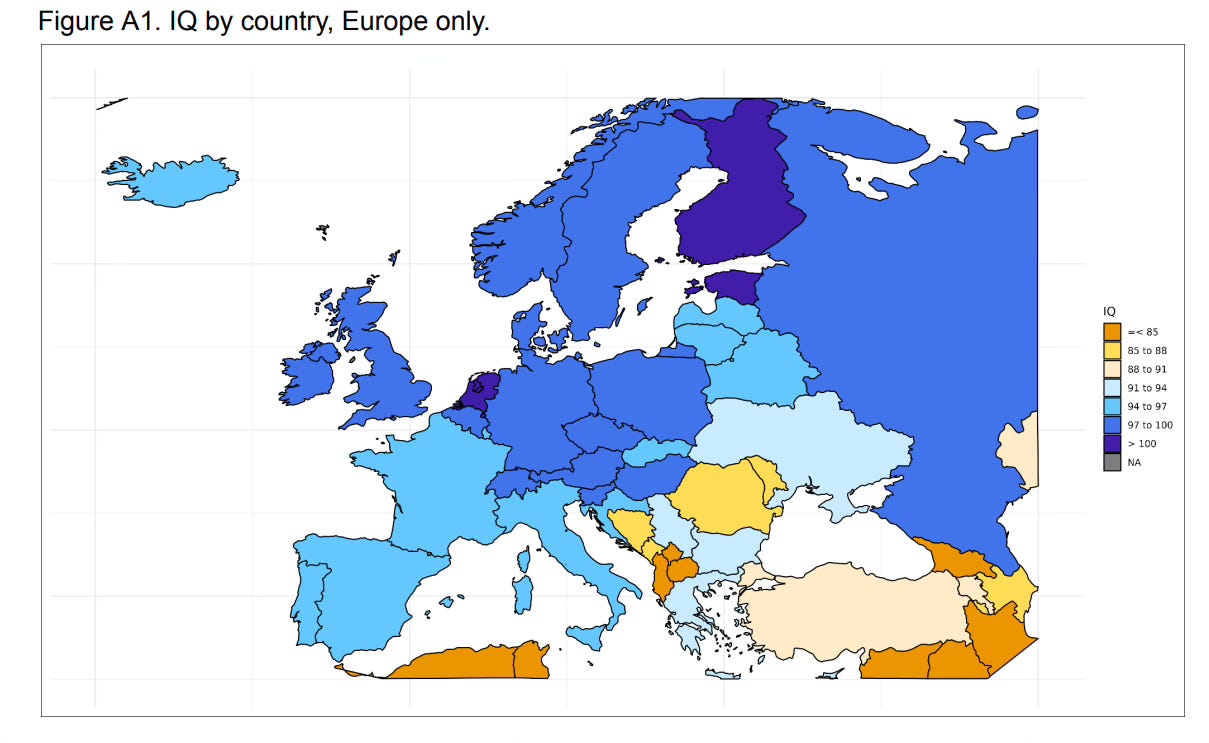
Map is from one of essays on Sebastian Jensen Substack
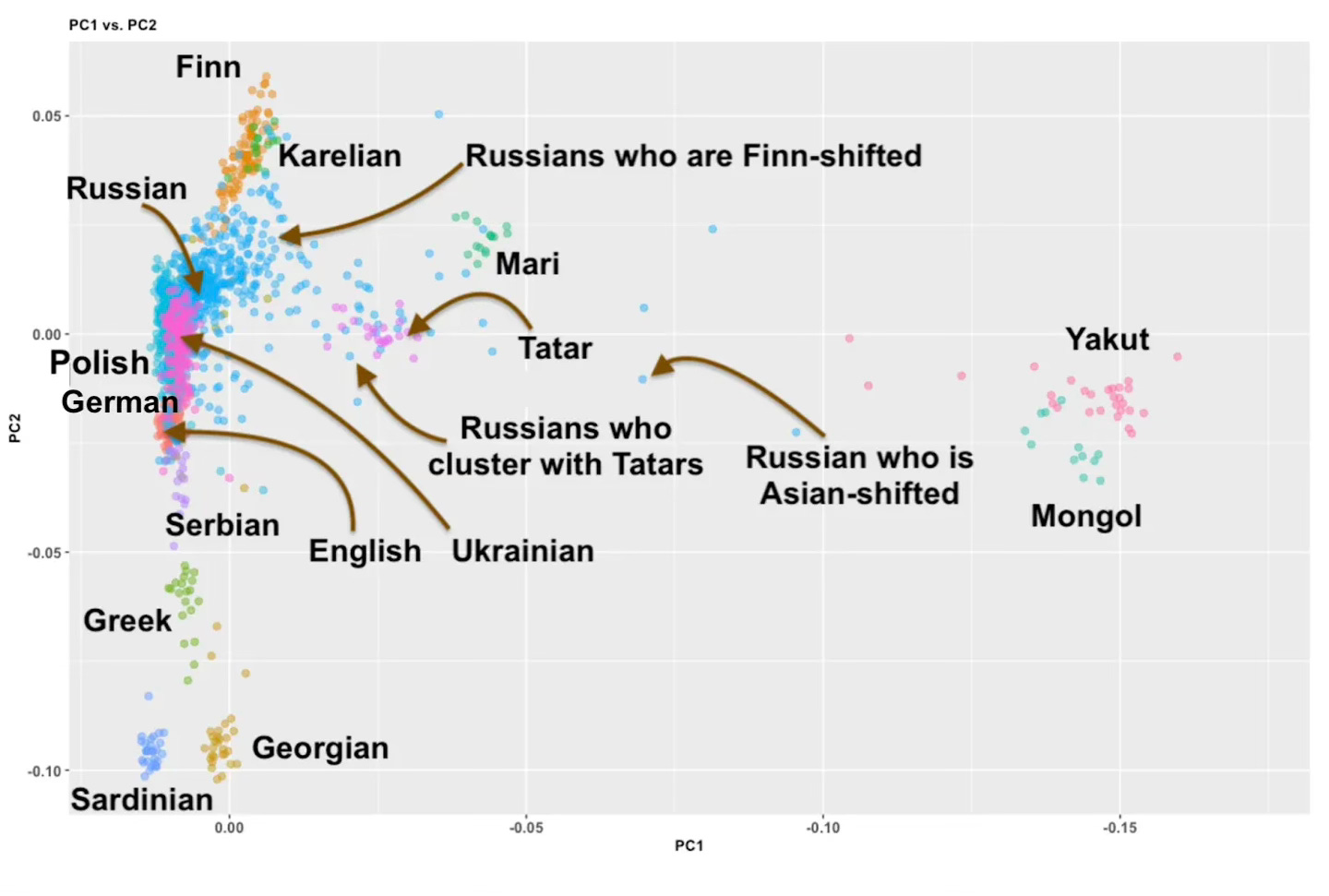
Genetic distance map from essay by Razib Khan
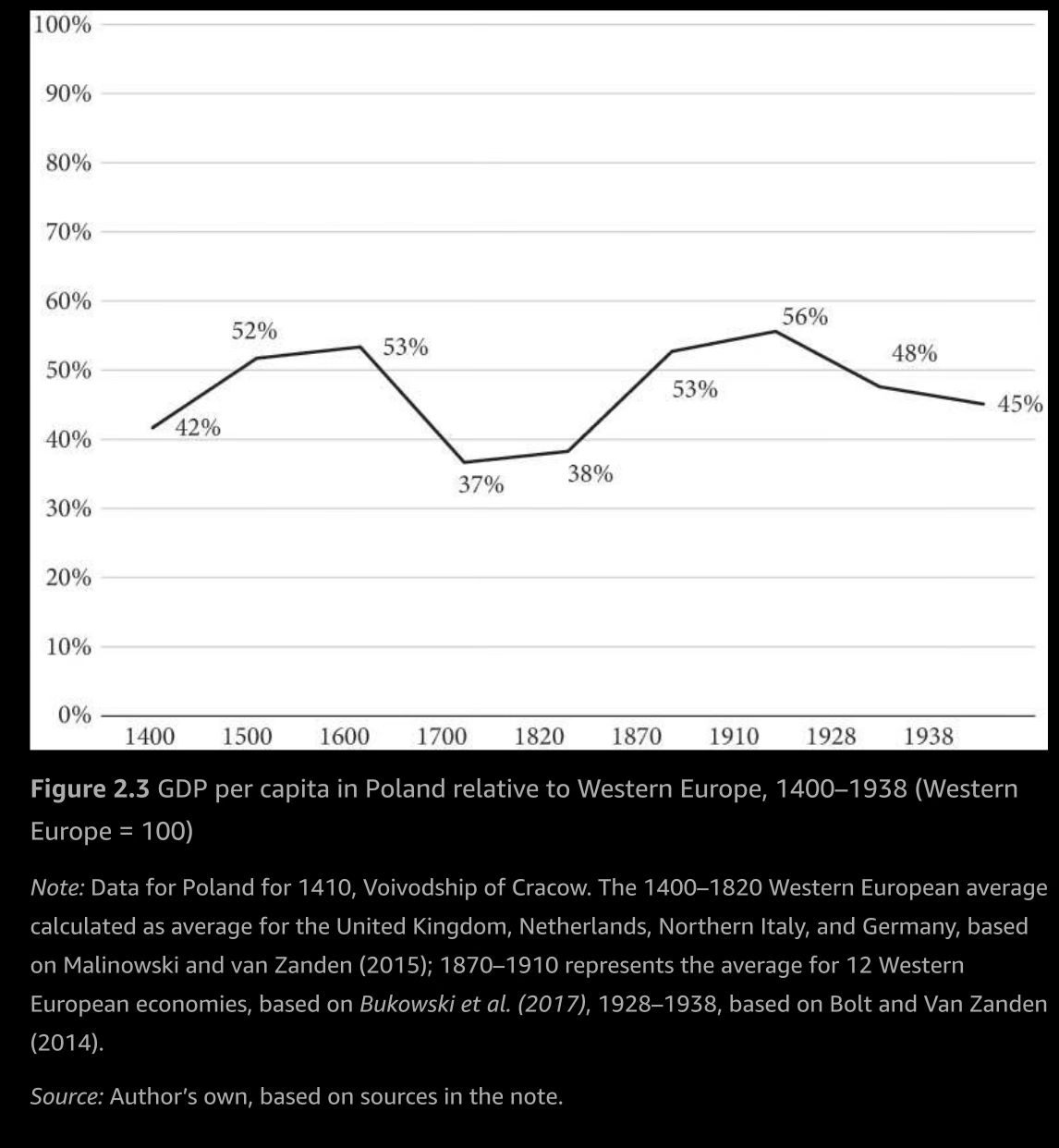
Yet the region was far poorer than western Europe for centuries before communism — probably throughout recorded history. Historical estimates suggest the gap in earlier periods was even wider than at the height of the communist era. According to the Maddison Project database, British GDP per capita was over four times the Polish level in 1850, but only roughly 2.5 times higher by 1970. Other estimates put Polish GDP per capita, relative to western Europe, oscillating between 37 and 56 percent of the Western level between 1400 and 1938; for most of the rest of eastern Europe the ratio would be similar. Around 1900, an English or Dutch villager lived in a brick or stone house with a chimney and glazed windows, ate meat and cheese pretty regularly, read newspapers and travelled by rail. His counterpart in Galicia or the Russian partition of Poland often lived in a single-room wooden cottage with a dirt floor, shared in winter with the livestock that warmed it, ate rye bread and potatoes he had grown himself, signed his name with a cross if he could be made to sign at all, and might pass his whole life within a day’s walk of his birthplace. West Germany’s first chancellor, Konrad Adenauer, is said to have muttered, whenever his train crossed the Elbe heading east, “Asia, here we go again,” pulling down the shades as he said it. A century earlier the Austrian statesman Klemens von Metternich had supposedly remarked that “Asia begins at the Landstrasse” — the road running east out of Vienna toward the Hungarian plains. All this shows that Western — and especially Germanic — disdain for eastern Europe is an old thing, long predating communism. It also shows that the “Asia begins five kilometres east of wherever you happen to be standing” school of humour, of which Czechs are enthusiastic practitioners at the expense of Slovaks, is itself timeless.
For all of the other “people’s republics” — Czechoslovakia, Bulgaria, Romania and Hungary (data for East Germany are not available) — their present position in GDP per capita relative to western Europe (the average of Germany, France and the UK) is significantly better than it was in the interwar period. This holds even for Czechoslovakia, which might surprise many Czechs, who see that period as an undisputed golden age — though it is true that the picture would likely look different if one isolated the Czech lands alone, without Slovakia and Subcarpathia. There must, then, be something to all the other explanations — culture, geography, and the rest — in the case of eastern Europe.
Europe’s east–west divide runs deep, long predating either communism or capitalism. Already in late antiquity, much of central and eastern Europe lay beyond Rome’s reach, and so it inherited none of the Roman “infrastructure of civilization” — the roads, the law, the learning that was later fused with Christianity and Germanic vitality to create what became modern Western civilization. The East that emerged after the Migration Period — as the Slavs spread out from the deep interior of the continent into lands the Germanic peoples had vacated — was shaped by distance from the old centers of civilization and proximity to the nomadic raiders of the Eurasian steppe. It remained more thinly populated and lightly urbanized, with a correspondingly thinner development of crafts and markets. It is no coincidence that eastern European elites routinely invited Germans to settle their empty lands and bring Western farming and technology with them.
It was also “civilizationally” split. Religious traditions radiated outward from the more developed centers and divided the region among them: some of its peoples fell to the Western Christianity of Rome, some to the Eastern Christianity of Byzantium — and later, in the Balkans, to the Islam of the Ottomans. The decisive fork came with the Black Death. In the West, the collapse in population handed peasants bargaining power, broke serfdom, and pushed the economy toward wage labor. In the more thinly settled East the nobility did the reverse: facing a labor shortage, it bound the peasants ever tighter to the land — the so-called “second serfdom” — to keep its estates manned. From there the two halves diverged for good. The West moved toward towns, commerce, capitalism, and in time the scientific and industrial revolutions and global dominance; the East locked itself into an agrarian, estate-based, extractive order. In the early modern period the division hardened into economic structure: the East became a raw-materials periphery, shipping grain and timber through the Baltic and North Sea ports to the rich, industrializing West, deepening its role as a mere supplier of primary goods - a position not dissimilar from that of Latin America.
This is not meant as an authoritative enumeration, but as an overview of the most probable causes behind a basic fact: on the eve of modernity, eastern Europe was on average far more backward, ruled by elites who cared more about their privileges as great landowners than about a population of largely illiterate serfs, with most commerce in the hands of urban minorities — mostly Jews and Germans. Whatever the shortcomings of the “institutional” thesis advanced in Why Nations Fail, the conditions across much of eastern Europe are a textbook case of its extractive institutions: arrangements built to squeeze resources from the majority for the benefit of a narrow class. The thinness of eastern Europe’s prewar middle class shows in a single statistic: how disproportionately Jewish it was — a textbook symptom of educational backwardness, since a tradition that prized learning conferred a decisive edge where most of the population could barely read. Around 1930, Jews were a tenth of Poland but nearly a third of Warsaw; a twentieth of Hungary but over a third of Budapest. And this backwardness cut across the “civilizational” religious lines: Catholic, “Western” Poland was as backward as Orthodox, “Eastern” Russia. One can, of course, nitpick and find plenty of exceptions throughout the region’s history — but broadly, these were the trends.
And then came communism. Here we reach the crux of a fascinating paradox. Communism was always meant to take power in the industrialized West, among its great mass of factory workers. Instead it seized power mostly in the agrarian, pre-industrial or only lightly industrialized countries of eastern Europe — and later in China and North Korea. In these places communism was always imposed, whether from abroad or by a small, ruthless, well-organized minority, because its natural social base, the urban industrial working class, was largely missing.
The one country in the whole sphere where the communists won something close to a free election was Czechoslovakia in 1946 — and it won on the strength of the Czech lands, while falling short in Slovakia. The reason is simple: the Czech lands were the most industrialized, educated and advanced territory in the entire Soviet sphere (Slovenia might be a contender, but that is a particular Yugoslav case, and East Germany was essentially an occupied country). It was thus the one place where communism had genuine electoral appeal — and, precisely for that reason, likely the people’s republic it damaged the most. The Czech lands had been industrialized since the late nineteenth century, so the communist industrializing “zeal” had far less to work with, and communism’s debilitating inability to develop beyond rudimentary heavy industry did its sharpest harm there. This is not some “Czech chauvinist” attempt to exempt my country from eastern Europe; it can be backed with abundant data. The rule of thumb runs like this: the more backward a country was when communism took hold — Poland, Romania, Bulgaria — the more we can speak of its possible benefits; the more developed it was — Czechoslovakia, East Germany — the more pronounced the damage. Communism is worst for the countries it was designed for, and “best” for the countries it was never meant to rule. This paradox fascinates me.
The truth is this. Communism is, as an ideology, a historical dead end — and, to put it in the “institutional” framework, one that inevitably produced highly extractive institutions of its own, run for the benefit of a tiny nomenklatura. It caused tens, even up to a hundred million deaths, depending on how one counts — yet the vast majority of those fell in the Soviet Union and China. For that reason — the scarcely comprehensible scale of murder and oppression communism inflicted on Soviet lands, and the fact that the transition to capitalism failed there after 1990 — I set those cases aside and focus on the Soviet satellites: the former people’s republics later integrated into Western structures. The toll of casualties and political prisoners in these countries is also beyond any apologia, though it never reached the gargantuan proportions of Soviet Russia or China. And for these countries, saddled with a long history of overwhelmingly agrarian and substantially illiterate populations, communism succeeded at one crucial thing: violently, criminally, oppressively — of that there is no doubt — it bulldozed the entrenched social hierarchies and industrialized and educated these populations to a degree unprecedented in their history.
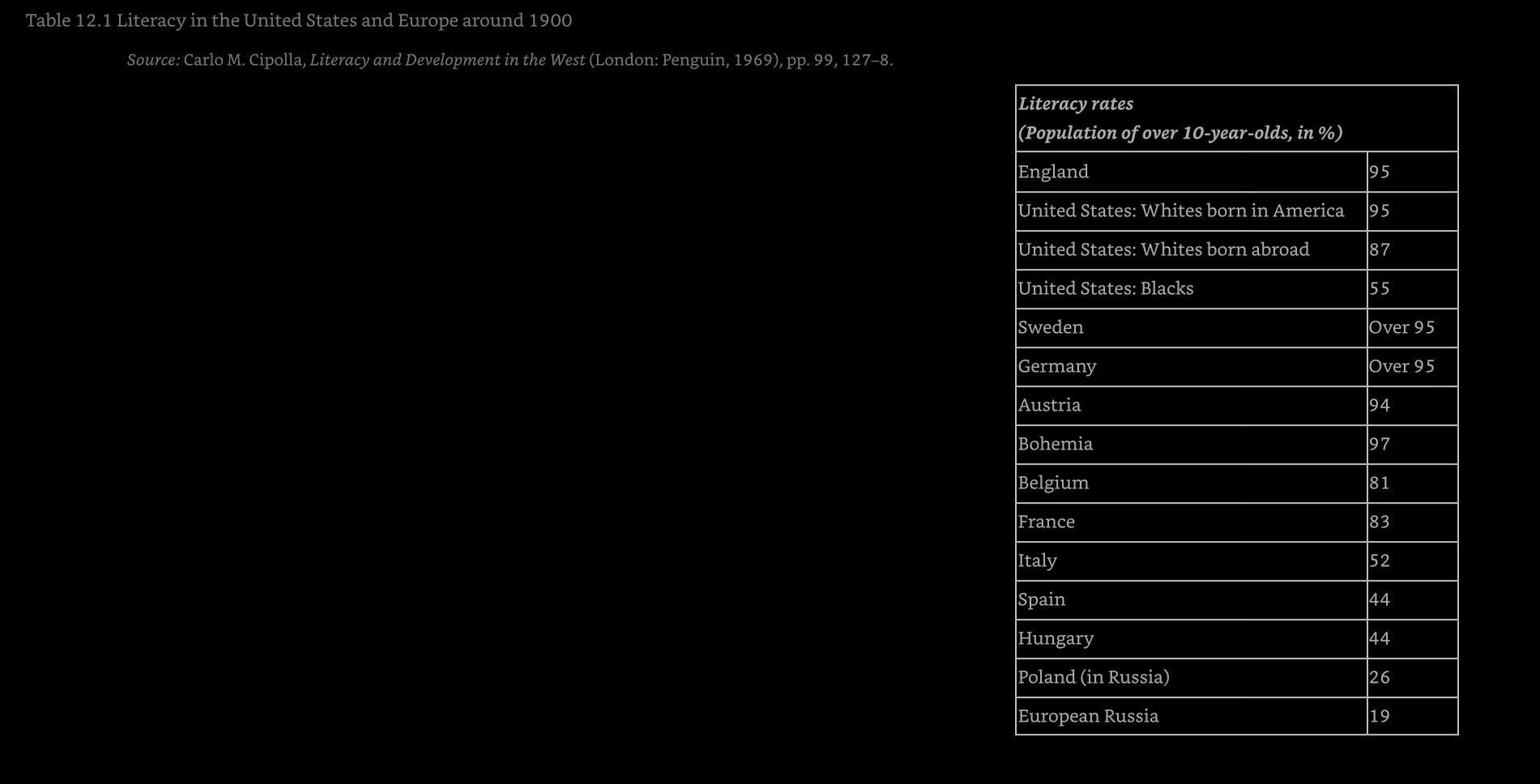
In 1900, over 90 percent of Britons, Dutch and Germans were literate; in Hungary the figure was 44 percent, in “Russian” Poland 26, in European Russia a mere 19. In the Czech lands it was likewise over 90 percent — which is to say that, educationally, Bohemia stood far closer to western Europe than to its eastern neighbors. The leap made under communism shows up in a generational comparison: set those schooled before it — Poles in their early seventies by 1990 — against those schooled under it — the cohort in their late thirties — and the share with secondary education jumps from 16 to 61 percent, university graduates from under 3 to over 10, a fivefold rise. Hungary tells the same story: secondary schooling went from 6 to 51 percent. Modest though some of these absolute figures remain, the progression under communist rule is unmistakable.
For its first two decades of communism, productivity growth was in fact pretty solid, because it rode the one-time windfall of millions migrating from the impoverished countryside into urban factories. It was in the 1970s and 1980s, once that initial modernization push was spent, that communism’s impotence at genuine innovation stood fully exposed — and in those two decades the gap between the Western and Eastern economies began to widen dramatically again. But for the initial industrializing push, communism more or less did the trick.
This idea — which I first encountered in Emmanuel Todd — was developed further by the Polish economist Marcin Piątkowski, in his book on Poland’s economic miracle. He argues that it was precisely the communists’ violently imposed transformation that laid the foundations for the region’s success in the post-communist capitalist era. Entering the 1990s, the region had largely urban, solidly educated populations — especially in technical fields — ready to move from the obsolete local heavy-industry plants to the brand-new German automotive factory springing up across the region. What survived communism and proved valuable was usually not the industry it built — much of which was scrapped, undone by obsolete technology, a neglect of consumer goods, and sheer inefficiency — but the people it had trained: both lower-skilled workers and engineers, well prepared to function in a modern industrial economy. This unintended effect was probably most striking in Poland, which after the Second World War also underwent the territorial shift Piątkowski calls “one of the best real estate deals in human history”: exchanging backward, sparsely populated eastern lands for formerly German territory in the west, with far better infrastructure and geographic position. A very similar idea was recently advanced by the economist David Oks in a Substack essay, “Why China Got Rich and India Didn’t.“ His central thesis is that China grew rich and India did not — not because of when each liberalized, but because between 1950 and 1980 China brutally modernized its society and built up its human capital (literacy, health, women in the workforce, the dismantling of traditional kinship and caste constraints), leaving it primed for explosive growth once it opened up, whereas democratic India never undertook that transformation and entered the market era with a workforce unready for industrial modernity. The essay has already drawn criticism for overlooking the IQ gap between India and China — but let us set that aside. The principle Oks presents is essentially the same as Todd’s or Piątkowski’s.
Piątkowski is no defender of communism — his book is a celebration of Poland’s recent success. He casts communism as a kind of external “big bang,” comparable perhaps to the Black Death in its medieval impact: a force violent enough to shatter the deeply entrenched social order that had been throttling further development. The takeaway, pushed to its logical end, is almost startling: the “ideal” scenario might have been for communism to do the bulk of its industrializing and educating work and then collapse not in 1990 but twenty years sooner — which would have let these countries profit from the foundations without enduring the long stagnation that followed. The ideology meant to destroy capitalism once and for all may have laid the conditions for capitalism’s greatest success. Let me be clear: this is, in the end, a love letter to capitalism — without doubt the most efficient way yet found to allocate resources, and one of the essential forces that lifted humanity from subsistence toward prosperity. But it is only fair to admit that capitalism needs a certain social fabric to function, and that vast swathes of the earth, throughout history, have been stuck in conditions where productive capitalism as we know it simply could not take root.
I remember talking with my wife’s Slovak grandmother about her life. She described living in her husband’s family home in a small village in central Slovakia — a wooden house with no running water, two small baby daughters, and the diapers she had to rinse in the stream outside, breaking a hole in the ice through the frozen winter months to do it. When the chance came to move to a brand-new “commie block” in the city — the very prefab housing now treated as a byword for the drabness of the communist legacy — then whatever one thinks of it aesthetically, the move to running water, central heating and electricity was clear and undisputed civilizational progress.
Visiting Czech and Slovak cities, I have always noticed that Slovak towns tend to be, on average, somewhat less pleasant and uglier — but for a very specific reason. Not because Slovaks are poorer today, or have worse taste, but simply because so many of their cities did most of their growing under communism, during the great wave of urbanization that came with industrialization. In most large Czech cities you find a historical core wrapped in a ring of, generally, handsome late-nineteenth- and early-twentieth-century development, before you proceed outward into the communist period — a kind of architectural voyage through time. In Slovakia you pass from the same lovely old core — the classic square with its church — far more quickly into districts plainly thrown up under communism. That, too, is a legacy of the Czech lands having gone through their great urban expansion earlier, before communism ever arrived.
Yet there is one last elephant in the room that any honest treatment of this idea has to face — the obvious objection: how do we know the same industrial and educational rise would not have happened in eastern Europe anyway? There is, after all, a cluster of European countries whose characteristics were broadly similar to eastern Europe’s — above all the southern ones: Spain, Portugal, Greece, southern Italy. At the start of the twentieth century, around 50 percent of Spaniards were literate, 30 to 40 percent of Greeks, only about 25 percent of Portuguese. These countries lagged far behind northwestern Europe as well. In 1938, Spain and Portugal were poorer than Poland in per capita terms. In 1950, 42 percent of Spaniards, 44 percent of Portuguese and 57 percent of Greeks still worked in agriculture — figures comparable to eastern Europe. And between 1950 and 1990 it was precisely Spain, Greece and Portugal that underwent explosive growth, averaging around 4 percent a year, not unlike what Poland or Romania saw after 1989. If the rise happened without communism there, why not in eastern Europe too?
Piątkowski devotes a chapter to exactly this counterfactual, and argues that several factors made the southern path significantly less likely in the east. The “reactionary” forces that would have taken power in a non-communist scenario carried a heavy landowner component, pushing hard for its own interests; and various forms of “agrarianism” were popular on the conservative right, which often saw industry itself as a gateway to communist influence, since it bred a proletariat. Disillusion with free markets after the crises of the 1930s and the war ran high across the board, so the prevailing current favored heavier state involvement in the economy in any case. Moreover — and here is the paradox — had these countries stayed democratic, they might actually have faced greater obstacles to industrialization, because the way communist governments financed it was by forcibly squeezing the peasantry, holding food prices very low. Under a democracy, in which farmers formed a powerful voting bloc, that would have been far harder to pull off; the interwar attempt at it under Piłsudski did not end well, and the large landowners would have fought it tooth and nail. It is quite possible that democracy in such fragile conditions would not have lasted, and that some form of right-wing authoritarian government would have taken hold across the region — which might, paradoxically, have proved an advantage in spurring industrialization. This echoes the essay on India and China mentioned earlier: democratic India had to defer far more to the wishes of its various voting blocs, which again and again blunted or blocked reform — exactly the constraint that authoritarian China was free to ignore.
Piątkowski also argues that the inflow of foreign investment — the kind that arrived after 1989, and especially after EU accession in 2004, which clearly ranks among the major accelerators of the region’s development — would have been far from guaranteed. Even outside the Eastern bloc, the region would have sat in a geopolitically tense position, squeezed against a Soviet Union that constituted a standing threat and dampened its appeal as an investment destination. Its very inclusion in the emerging project of European integration would likely have been unthinkable, given the Soviet rejection of that project and its insistence on neutrality — even Finland did not join the EU until 1995. Southern Europe, by contrast, enjoyed several major advantages. Its security situation was far more comfortable, lying as it did outside the grey zone between West and East. It drew enormous inflows of foreign currency from tourism, which could be ploughed into industrialization — in Spain, tourism receipts amounted to nearly 10 percent of GDP in the 1960s. Eastern Europe could expect no such windfall: lovely as Lake Balaton, the Polish Baltic or even the Romanian Black Sea coast may be, none of it is quite Málaga or Mallorca. And southern Europe, especially Spain but also Greece, simply had more developed “native” human capital. Spain, poor overall, still possessed genuine hubs of domestic industrial capitalism in Catalonia and the Basque Country. In much of eastern Europe, by contrast, entrepreneurial activity had been carried out by Jews and Germans — populations that would no longer be present in the postwar environment. One reason the interwar Polish state owned some 30 percent of the economy was precisely the absence of a domestic capitalist class.
Another case one might raise is Finland, which also grew wealthy while sitting in the neutral zone between West and East — but here the differences matter. Finland was almost 90 percent literate by 1900, very likely a legacy of Protestantism and its insistence on every individual reading scripture. It had also industrialized substantially before the Second World War: its GDP per capita relative to western Europe rose from 42 percent in 1860 to nearly 70 percent in 1938, and it kept growing through the interwar years, just as Poland, Romania and Hungary stagnated or slipped back. The analogy does not really hold, then, because Finland was already far wealthier and better educated to begin with.
Even with all this said, it is true that this is the weakest part of the whole thesis — simply because of its counterfactual nature. We cannot know what would have happened. But even granting the possibility that, in an alternative history, eastern Europe might have reached capitalist prosperity anyway — perhaps even greater prosperity, and without all the horrible oppression of communism — the reality, what actually happened, is that the communist period did lay much of the groundwork for the region’s present rise. And that success really is of historical proportions. Between 1995 and 2015, among middle- and high-income countries, GDP-per-capita growth in Lithuania, Latvia, Estonia, Poland and Slovakia was the highest in the world — higher than in South Korea or any of the Asian tigers — with Romania and Bulgaria only just behind Korea. Poland and Slovakia, trailing only Korea, made the leap from middle income (around $10,000 GDP per capita PPP) to high income (around $20,000) faster than almost anywhere on earth, in a mere fifteen years. Together with the East Asian cases — Japan, Korea, Taiwan, Singapore — the post-communist EU countries are among the very few that have genuinely crossed into the developed world.
In some respects it resembles China — which, though still classified as an upper-middle-income country, will likely join the high-income club before long. After liberalization, China achieved what was probably the largest lifting of people out of dire poverty in human history: as many as 900 million. As David Oks argues, the communist destruction of traditional Chinese social structures and the imposition of mass education — once again, horribly violent and criminal — may have been instrumental in making it possible. And of course the counterfactual never goes away: how do we know a non-communist China would not have been more peaceful, and more successful still, as Taiwan or Korea might suggest? Maybe it would. We will never know.
And in the same way, we can never know how the fate of eastern Europe would have looked. Suppose the belt of east-central European states really had kept the power to steer its own development, with no communism imposed from outside — and that the results were far from stellar. The reforms the region needs are blocked or left half-finished by the vested interests of the landowners. Relations with Germany, the most plausible large investor, sit on a knife’s edge after the war and the expulsions. Urbanization and industrialization crawl forward only slowly, and so does schooling, as fragile democracies lurch from one kind of populist to the next. Poland, Hungary and Romania remain what they had always been: a poor periphery on the wrong side of Metternich’s Landstrasse — and no one is surprised, because that is how it had always been. Millions leave for western Europe and America, the borders open, the West hungry for labor to rebuild itself after the war. And Lesek never works at a Škoda plant. He leaves for Chicago, one among hundreds of thousands of his countrymen in the great migration waves of those decades.
Yet what happened is what happened: post-communist Europe makes up a good part of the surprisingly small group of countries that have managed to join the high-income club since the Second World War. If communism played an instrumental role in making that happen, then it is simply a testament to the fact that history may have a strange sense of humour.
No posts
Comments
Nothing yet. Say the first thing.
Sign in to join the conversation.