
Stepping out of the rental car, I check my appearance in the rearview mirror. The black, sticky heat radiates from the newly laid cement. Despite the heat, I wear a button down shirt and jeans. I need to look the part of someone worth taking seriously. I am meeting with a professor from USC who had been the visiting fellow at Oxford the year I completed my masters. We had known each other for just a short time, debating in seminars and chatting about my PhD applications, he was the type of scholar I aspired to become: a shaper of intellectual discourse and historical research in the field of early America. We were meeting for the first time in over two years back in our home state, on unfamiliar territory. I had questions about how I might follow in his footsteps. How I too could become a career historian and shape the future of scholarship.
I had just completed my second year of my PhD in History & African American Studies at Yale and was preparing for a summer of archival work abroad in London. I had a list of conferences, an article I was polishing for peer review, and a variety of grants and fellowships I had drafted applications for. I knew that publication was paramount to scholarly success (at least that’s what my advisor told me) but I was also in the midst of the greatest period of growth for my businesses: Accepted Society and Accepted Consulting. I had a team of 9 to manage and was balancing my academic work with clients, marketing, and a growing team. I knew I would need to reduce the workload while preparing for comprehensive exams the following year but in that moment, I was the embodiment of the academic “girl boss”. It wouldn’t last.
I settled into my seat with my latte, sitting across from my idol: a charismatic, kind, and studied scholar whose research on indigenous history in North America prior to English colonial intervention brought together his decades long study of history, archeology and linguistics. We chatted nostalgically about our time at Oxford, my dissertation research and his forthcoming book with Oxford University Press. Inevitably we wind up on the topic of my career goals: do you intend to pursue a career in academia?
This was not the question I was asked when I started my PhD.
Acceptance letter in hand, a dissertation project in mind, and numerous conferences under my belt, I entered the PhD with the determination that I would build a career in academia. At the time it was assumed that an Ivy league education would be enough. When I asked my professors about the job market, placement prospects, and how to stand out, they simply replied “you’ll be graduating from Yale. Our students always find jobs.”
Turns out this assertion did not stand the test of time.
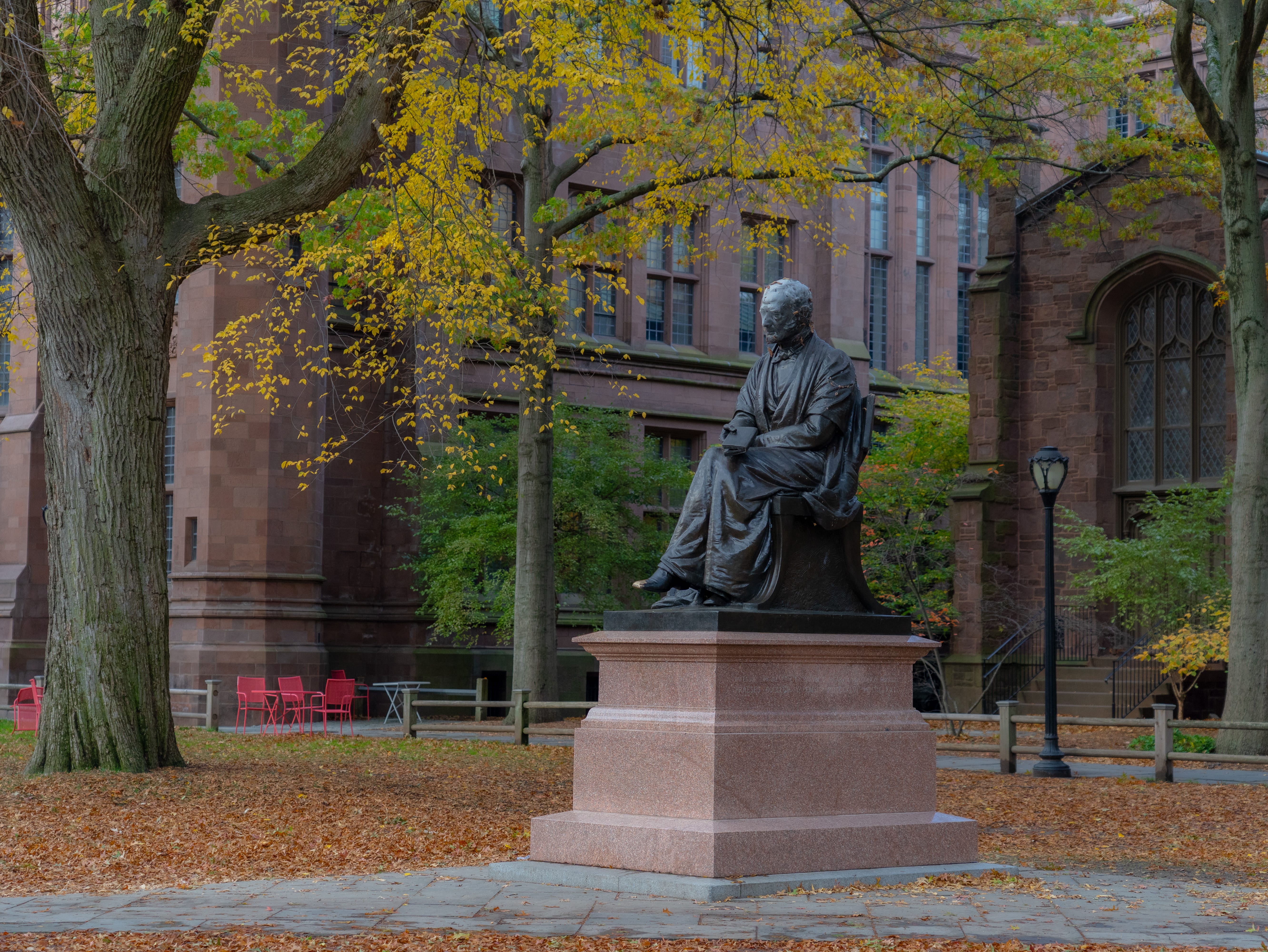
In 1979, there sparked a debate over the “professionalization” of the historian. Former editor of the American Historical Review and the sitting Director of the Department of Historical Research at the Carnegie Institution of Washington, J. Franklin Jameson envisioned a profession in which historical practice, the methods of research, and the monographs produced would effect popular history making and knowledge. He had written on numerous occasions in the early 20th century that the profession had emerged from the dark ages of historical craft in which economic elites penned the past. In the 20th century, he determined that historians would hold PhDs, dedicate their lives to rigorous research, and operate from the vanguard of the ivory tower. Joan Hoff, writing several decades later, argued that this approach to professionalization, the path which separated the historian and the public would result in its downfall.1
The debate continued. The 21st century promise persisted that a commitment to the enterprise and craft of intellectual rigor would be rewarded with security. The tenure model supported this. Complete a PhD, turn your dissertation into a university press monograph, teach for five years, and achieve tenure. After having crossed the tenure threshold, your continued loyalty, scholarship, and brilliance would be rewarded with a steady paycheck, a strong pension, and protection from students, economic recessions, etc.
Then came the economic crisis of 2008.
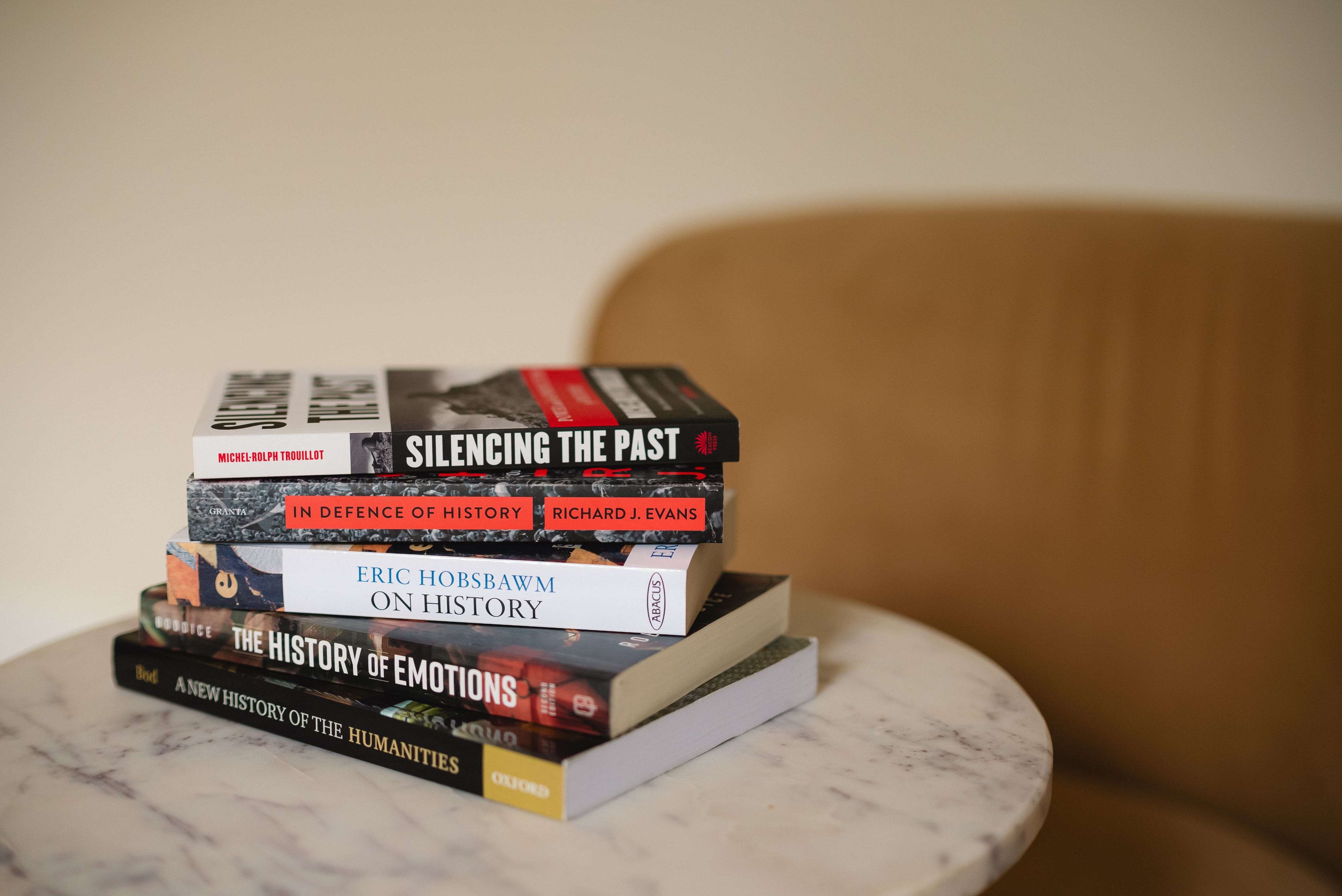
The sharp decline in tenure track positions is not conjecture. It is fact. A statistical conundrum which has left many qualified, passionate, and dedicated scholars without work in the fields to which we have dedicated nearly a decade in education and research. This decline can be mapped onto the economic and social conflicts of the 21st century. During the 2007-2008 academic year, the American Historical Association recorded 1057 academic posts. This number was a record high and was associated with a three year period in which the number of listings actually outnumbered that of qualified PhD graduates. Within a year, the number of jobs available dropped a dramatic 24%. This rate of decline has continued with one minor alteration in 2022 when DEI funding and a reinvestment in humanities subjects saw a short windfall of role openings (especially in cross-departmental roles such as a cross listed professorship in History & Gender Studies or History & American Studies).
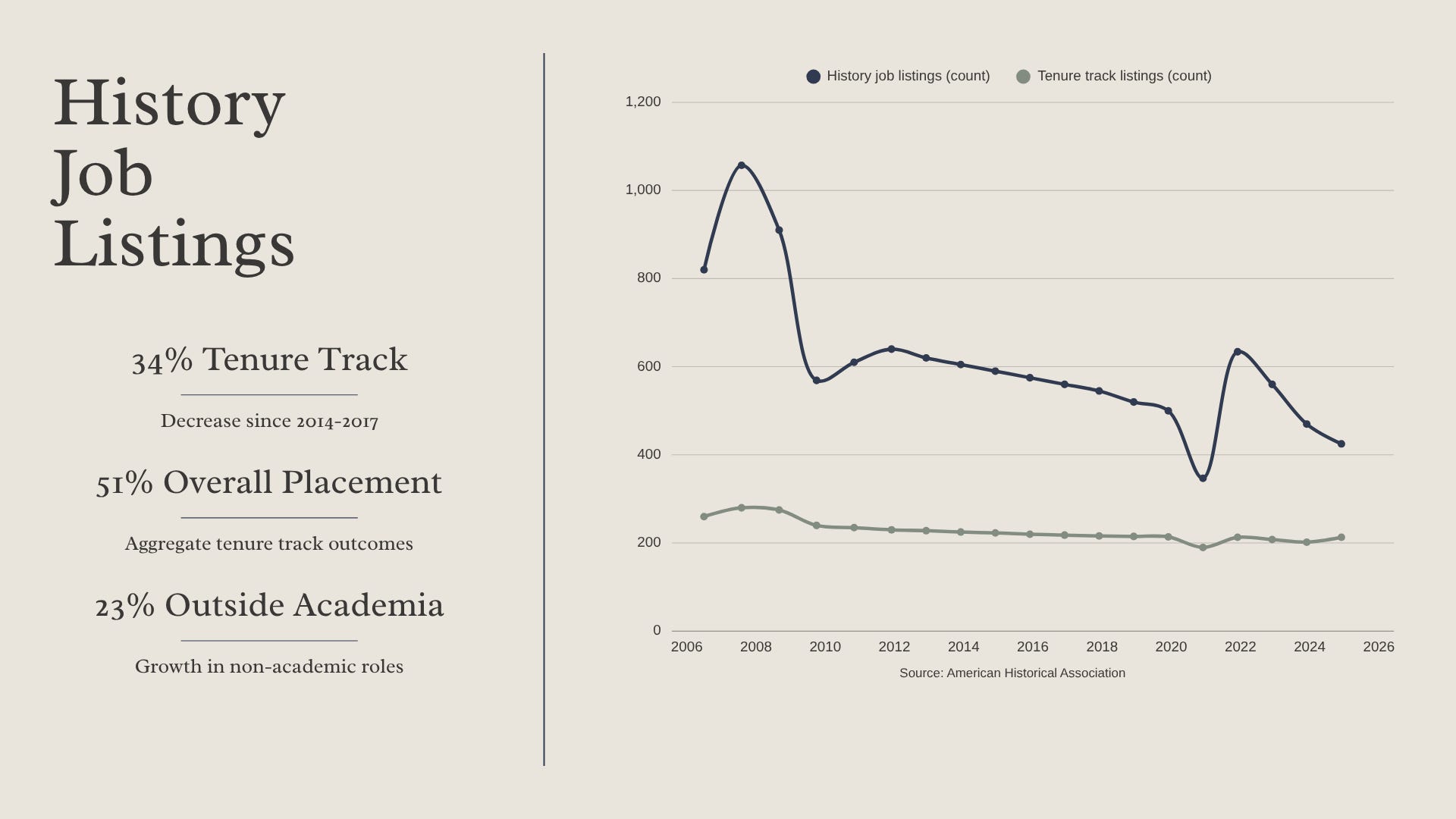
Despite the decreasing number of tenure track roles, universities continued to enroll and educated PhD Students. The solution? Adjunct contractural roles for fresh graduates. They would take on a teaching load which exceeded number required of permanent placements, thus reducing the labor and the cost on the university. For the lucky few that landed postdocs, it became increasingly common that they would jump from fellowship to fellowship before finally landing on their feet with a permanent contract. Along the way, it was expected that they might move several times, uprooting their lives, families, and license plates to register in a new state on the other side of America.
The system was fracturing. The fault lines became clear to spot. Yet, few at the university seemed to take the challenge seriously and even fewer offered solutions. Students would go on to fewer and fewer permanent posts and those who pivoted to “alt ac” were labelled “sell outs”, not “true scholars.” As if their decision was a personal failing rather than a structural issue which the academy had failed to address.
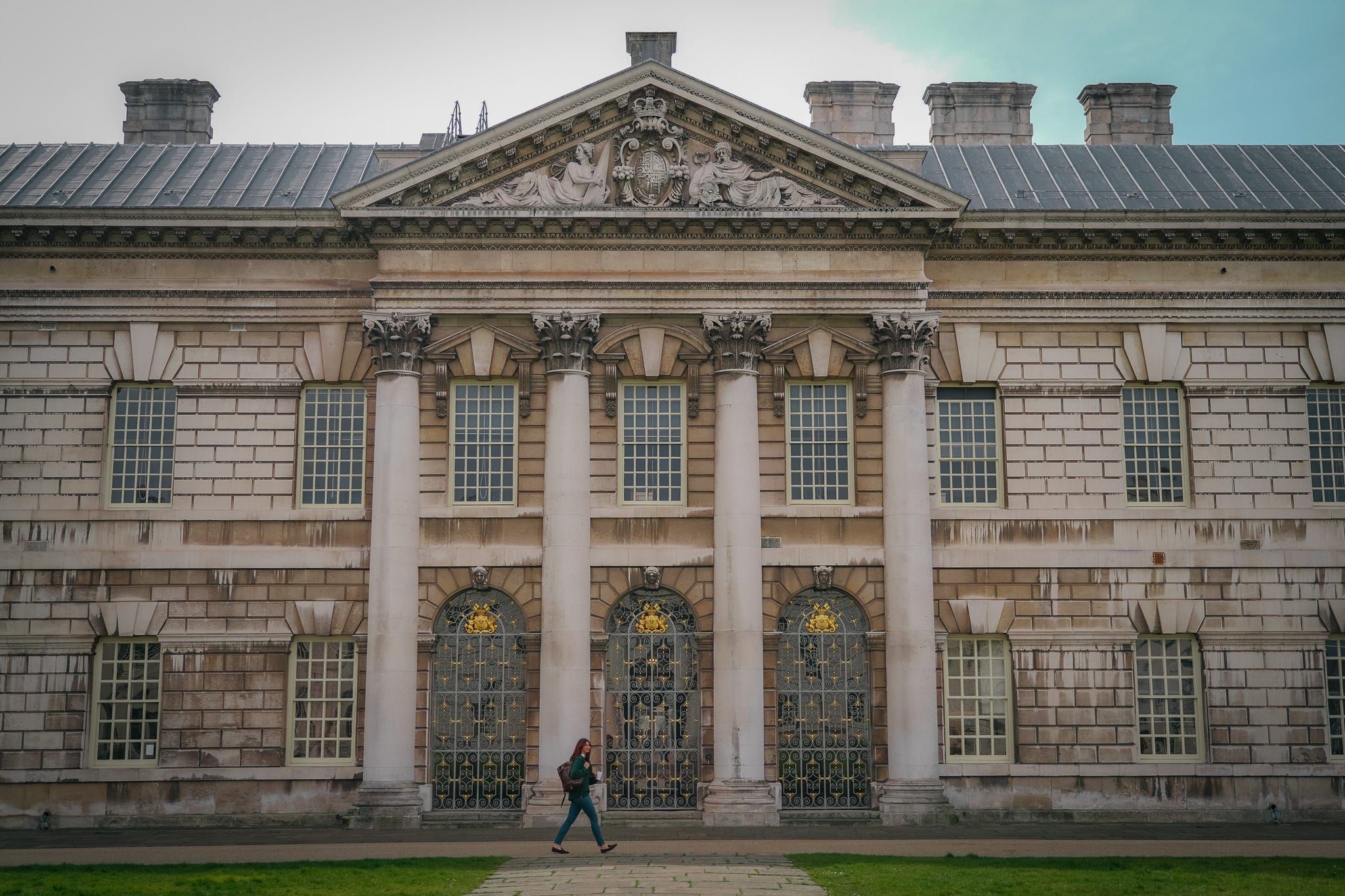
When I entered a PhD in 2020, at the height of the pandemic, I was already aware of the structural issues facing the humanities and the likelihood that the path to a career in academia was tenuous. I entered with a cohort of over 20 history PhD students and we questioned whether it was responsible of Yale to have accepted so many despite the lack of jobs available on the other side of our 5+ year journey. Students at the university were still landing jobs at this point but fewer and fewer landed on the tenure track straight out of the gate. We all hoped we would be one of the lucky ones. That reality was evidently shattered with the return of Trump’s administration, the dismantling of the Department of Education and the National Endowment for the Humanities, and the rising public resolve that the humanities is no longer valuable, fit for purpose, or credible.
Now, the very same students which entered into PhD programs in the past 10 years, who believed they might be one of the lucky ones, are struggling to find work in their fields. Those who have gone alt ac are increasingly finding roles which further them from their research, teaching, and the humanities all together.

The great resignation of scholars from the academy is often characterized as an individual choice. That “they chose a different path”. This discourse points the finger at the individual, one who has dedicated nearly a decade to the craft of learning and research and teach, and infers that they turned their back on the academy. They fail to consider what that scholar’s choice would have been in 2007 when tenure track roles were abundant. What they would choose if the options were not continuous instability, a lack of financial renumeration for their labor and expertise, and loyalty to an institution which appears to value profit over civil discourse and promoting intellectual inquiry.
The departure is a response, not a provocation. Scholars, like myself, love education. We love teaching. We would dedicate our entire lives to the pursuit of knowledge just so long as we were assured safety. But before we can fix the problem at hand, we must address the issue to begin with.
And it isn’t that scholars just want to be paid more and are therefore seeking alternatives. We deserve security. We also deserve to not bear the blame for an issue which goes beyond us.
We must acknowledge that the failure of humanities and higher education comes down to: (1) universities prioritized profit over education and (2) negative public sentiment towards the value of intellectual professions having reached a fever pitch alongside the rise of extremist political ideologies.
Universities once promoted civil debate and liberal discourse. They fostered debate and offered insights into issues of the day. Public Intellectuals stepped out of their offices and before cameras or their typewriters to weigh in on politics, economic policy, international conflicts, and more. They were the representatives of those in academia.2
But where are they now?
Where are the scholars who are speaking up for universities? For higher education? For the value of the humanities?
Who is our spokesperson?
Who can the public turn to instead of being barraged with misinformation and unsupported claims? What alternative do we offer?

In the Gilded Age (late 19th century) economic titans of industry and robber barons controlled markets and amassed ill conceived wealth. The economic chasm among socio-economic groups was stifling. Yet, these characters, including the likes of J.P.Morgan and Arthur Sackler, amassed wealth and built philanthropic organizations for the support of art, humanities, and science. They endowed chairs, sponsored new wings in the MET Museum, they engaged in galas and fundraisers. Their public image was dependent on their charity.
These were not moral men. But their actions teach us something about how economic and social elites respond to public perception. The Billionaires and Trillionaires of our day, when brought under a microscope for comparison, do not respond to the same pressures. They are not only unregulated. They lack moral dignity. The public no longer demands that they return their wealth to the community: at least in image.
We have relied on the “elite” to support and bolster the humanities, arts, and scientific research for too long and the relationship has soured. Universities relied on alumni donations, corporate sponsors, and stock market investments to become what we know them to be today. In doing so, they have signed a bad deal and have, in turn, become the private organizations which rely on profit and cooperation which has limited academic freedom and demanded that research have direct application to “innovation” in industry in order to be worth supporting.
But there is an alternative. A counter movement. A renaissance if you will.
Education is not limited to universities. We must return to our communities, take to the public, and reinvent the scholarly profession.

I was never meant to go to college. I wasn’t bright enough. Focused enough. I barely finished high school and lasted one semester at community college before dropping out.
I didn’t believe education was my ticket to prosperity and happiness. I didn’t fall for the belief that the degree would open the door. But I kept on learning. I read and wrote and listened. I watched online lectures, devoured podcasts, and became enamored by the work of historians.
I learned early on that a passion for knowledge is not only found in a lecture hall. It can be found in a YouTube video. A Podcast perhaps. Education is also not an individual act. It requires a community. It requires those willing to teach and those willing to listen, challenge, an disseminate.
That is why I have hope and I still have faith in universities.

Intellectual influencers, online courses, and even online intellectual communities are not the solution.
Yes, I said it.
I have built Accepted Society (an intellectual community for lifelong learners), post weekly videos on YouTube, write on Substack, teach courses on and offline. I have built the backbone of an entrepreneur in order to provide the safety net I need to survive. But if I had a choice, I would be teaching at a university. I would write books and attend conferences. I would manage departmental working groups and mentor students.
Social Media has granted many of us misplaced scholars the chance to make something of our work. To bring our scholarship and passion to a broader audience. In doing so, we have brought awareness. We have built communities and encouraged others to keep learning. This is crucial. But it is not the solution. It is a response. A band-aid. A pivot which rewards our thinking and our skills as educators.
We have created alternatives and developed a living for ourselves. But we shouldn’t give up on universities all together.
Universities need a rebrand. A complete restructure in its economic makeup and mission. And it starts with a PR campaign of sorts. We need to public to value education again. To do so, we need to start small.
Here is my proposal:
Grassroots organizing of in-person intellectual community events (book clubs, pub lectures, open seminars, read ins) and engaging in local politics to place local administrators who value education from grade school onwards.
Public Intellectuals on social media using their voices and platforms to promote higher education, intellectual inquiry, etc. by providing tools for how to study, read, research, etc.
Training undergraduate students to develop professional skills so they can go on to entry level positions, rather than going on to graduate school by default. This has three primary benefits: (1) more entry level workers who know how to talk about the value of their educations and how their humanities training makes them a better hire; (2) ensures students who do go into graduate school have the training and security to secure roles during and after their studies; and (3) less PhD graduates seeking roles without options.
University administrators refocus the intent of the university to promote critical thinking, leadership skills, and communal care over vocation.
All of these things are easier said than done. They are also not inclusive of all that can be done. I am one person but together, we have the potential to right the tide. To not “return the university to its former glory” but rather to think anew.
Universities are worth for.
To continue raising the torch for education is an act of bravery. Of resistance.
We aren’t alone and hope is not lost.
We just need to be willing to imagine.
This article was inspired by the work of four remarkable writers, thinkers, and public intellectuals who have made a name for themselves in academia and beyond its walls, leveraging social media in order to mull over just how we, as a community, can work together to promote and protect the humanities. We are optimists who know the power a humanities education holds and what would be lost in its disappearance. Our work goes beyond academia. It goes beyond social media. We all have a humanistic mission to fulfill: to spread our love, joy, and commitment to the arts, humanities and sciences. Because everyone’s education is worth the investment.
Adam Walker - A poetry scholar and intellectual creator whose critical discussions on humanities in the 21st century and video essays on YouTube inspire me to become a better writer, speaker, and educator.
Cait Murphy-Hurrell - My business partner in building Accepted Society, former Google compliance lawyer turned literary scholar, and a beautiful writer to boot.
Karina Anastasia - A recent discovery whose thoughtful deliberations on what is lost if we, the champions of higher education, leave academia, prompted this article.
Shae O. - A dear friend whose humanist approach to critical thinking in the age of AI has opened my eyes time and time again.
Please subscribe to them. Support their work. Their voices are so needed.
Robert B. Townsend, History’s Babel: Scholarship, Professionalization, and the Historical Enterprise in the United States, 1880-1940 (Chicago, IL: University of Chicago Press, 2013.; J. Franklin Jameson, John Bach McMaster, and Edward Channing, The Present State of Historical Writing (Worcester, MAL Davis Press, 1910); Joan Hoff Wilson, “Is the Historical Profession a ‘Endangered Species?”, Public Historian 2, no. 2 (Winter, 1980), 4-21.
Edward Saiid, Representations of the Intellectual
Comments
Nothing yet. Say the first thing.
Sign in to join the conversation.