
The most important marketing change right now isn’t a new ranking factor.
It is the decoupling of discovery from only the website visit.
A consumer can research a problem in an AI Overview, ask ChatGPT for providers, compare Yelp sentiment, see a Google Maps listing, encounter a Meta ad and finally call the business.
No single platform gets credit for that journey.
For local businesses, that makes three capabilities disproportionately valuable:
Being represented everywhere.
Tracking the source of qualified outcomes.
Building enough brand authority that AI systems repeatedly include the business in the consideration set.
That is where I would increasingly position local SEO, AI visibility, reviews, and paid ads as one integrated acquisition system rather than separate services.
👉 Book Your “Help Me Get More Leads” Call
Why ChatGPT ads are worth planning for now
Why AI Overview citations may not bring traffic
What to check in Google Ads before August 17
How AI reputation risk affects local businesses
Why local AI search needs cleaner proof across the web
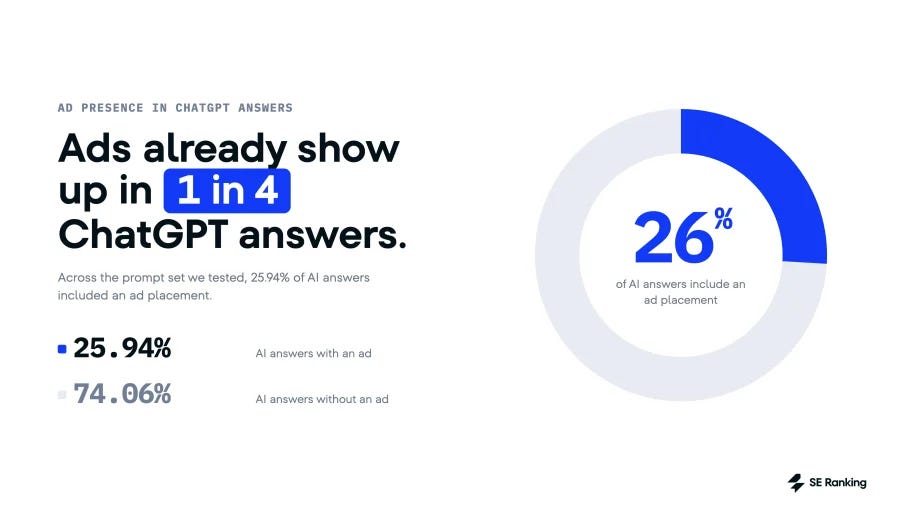
SE Ranking analyzed more than 100,000 prompts and found ads showing in roughly one in four commercial ChatGPT queries. They also found that ad visibility clustered heavily around buying-intent prompts, product comparisons, and transactional wording.
That does not mean every local business should panic-buy ChatGPT ads tomorrow. It does mean the shape of the paid search handoff is changing.
The prospect may ask an AI assistant for options, compare short recommendations, see a sponsored result, and then decide whether to visit your site, call, or keep chatting. In that environment, the old “keyword to ad to landing page” model is too narrow.
For local businesses and practices, the practical question is whether your service, offer, proof, and follow-up path are clear enough for an AI answer or ad unit to represent you correctly.
If your website, GBP, Yelp profile, reviews, and landing pages all tell different stories, AI-driven ads will expose the inconsistency faster.
The Real Reason This Matters:
ChatGPT ads are moving commercial research closer to the answer itself, not just the search results page.
Local businesses may have to manage paid visibility in spaces where the user expects a recommendation, not a list of blue links.
If the AI system cannot understand who you serve, what you offer, and why a prospect should trust you, a paid placement may send low-quality curiosity instead of booked demand.
Key Takeaway: AI ad inventory is becoming real enough to plan for, but it will reward businesses with clean offers, consistent proof, and strong follow-up data.
Action Step: Pick three high-value services and write the exact ChatGPT prompts a prospect would use before booking. Then compare your website, GBP, Yelp, reviews, and landing page to see whether the same answer would be obvious across every source.

Business Insider reported that small businesses are dealing with inaccurate or misleading Google AI Overviews, including business mix-ups, outdated information, and negative claims surfaced as confident summaries.
The Real Reason This Matters:
Reputation management is no longer limited to review counts and star ratings.
AI systems can synthesize reviews, directories, old articles, social comments, Reddit, and website copy into a narrative no customer wrote word for word.
Local healthcare, wellness, dental, chiropractic, and home-services searches often include trust-heavy questions where a bad AI summary can change the shortlist.
Key Takeaway: AI answers are now reputation surfaces.
Action Step: Run monthly prompts for each important client: “Is [business] reputable?”, “What are the complaints about [business]?”, and “Best [service] near [city].” Save the answer, cited sources, factual errors, and competitors mentioned.
Google’s target-based bidding change takes effect August 17 for budget-limited campaigns using tCPA, tROAS, or target CPC in Demand Gen. Google says campaigns currently beating their entered target may begin optimizing closer to that target unless advertisers adjust it.
The Real Reason This Matters:
A campaign producing $95 leads with a $150 target may start spending toward the $150 instruction.
Platform CPA is often cleaner than real qualified CPA because it can include spam, duplicate forms, bad-fit calls, no-shows, and wrong-service inquiries.
Local advertisers that optimize to weak conversion definitions are giving automation permission to scale the wrong leads.
Key Takeaway: The most urgent paid-search job this week is making sure targets reflect qualified business outcomes, not just form fills.
Action Step: Audit every limited-by-budget tCPA and tROAS campaign before August 17. Compare target CPA, platform CPA, qualified CPA, booked CPA, and customer CPA before changing bids or budget.
Semrush’s local AI search guide argues that local businesses need to optimize for how AI systems understand, summarize, and recommend them. The advice centers on complete business profiles, answer-ready service information, reviews, structured data, and third-party corroboration.
The Real Reason This Matters:
AI systems need a consistent entity to recommend, not just a page that happens to rank.
Reviews, directories, local mentions, service pages, and GBP details all help shape the answer.
Local businesses with vague service copy or scattered proof may appear less trustworthy than competitors with cleaner signals.
Key Takeaway: Local AI search work is becoming entity cleanup plus proof building.
Action Step: Pick one priority service and check whether your business name, category, location, service details, review themes, and proof points match across the website, GBP, Yelp, top directories, and major local mentions.
Search Engine Roundtable covered a Google Ads help update around new local customer optimization. It points toward a practical distinction many local accounts still blur: winning new customers versus getting cheaper repeat or low-value conversions.
The Real Reason This Matters:
Lead-gen campaigns can look efficient while recycling existing customers or low-value repeat inquiries.
Local practices and service businesses need to know whether spend is creating new demand or just capturing people who already intended to call.
As automation gets more control, audience and conversion definitions become more important.
Key Takeaway: Acquisition and repeat demand should not be treated as the same optimization goal.
Action Step: In CRM or call tracking, tag new customer, existing customer, wrong-fit lead, and booked outcome. Then review whether Google Ads is actually buying new qualified demand.
🌶️ Spicy Take
Your website is becoming one source, not the only destination
The uncomfortable shift is that discovery can now happen in an AI answer, Yelp-fed ChatGPT recommendation, Maps result, Reddit thread, ad unit, or GBP panel before the user ever reaches your site.
The spicy part is that many businesses still talk about the website as the destination. It is becoming one source in a larger recommendation system.
The offer, proof, reviews, categories, service area, and CRM feedback have to be strong enough to survive wherever the platform introduces the prospect.
Audit LSA history before migration. Export Local Services Ads reports now for affected home-services clients. After migration, historical campaign-level reporting will not move into Google Ads.
Build AI reputation prompts. Test brand, complaint, category, and competitor prompts in Google AI and ChatGPT so reputation issues are found before a prospect finds them.
Track social posts in Search Console. If a client has active Instagram, TikTok, YouTube, or X content, add eligible platform properties and watch which posts earn Google Search and Discover visibility.
Treat Yelp as AI search infrastructure. Compare Yelp rating, review themes, photos, and categories against GBP and website claims. ChatGPT can now use Yelp as part of local recommendations.
Fix GBP website links. Send GBP visitors to the most relevant service or location page instead of making every listing dump users onto the homepage.
Use GA4 to catch mismatched demand. Look for pages with traffic but weak qualified actions. The fix may be offer clarity, not more ad spend.
Watch Google Ads local update testing. If a local campaign suddenly shows format or interface changes, document the date before reading too much into a short-term performance swing.
Refresh entity proof for AI search. AI SEO still needs clean entity signals: clear services, locations, author credentials, reviews, citations, and third-party mentions.
Tighten Meta lead follow-up. Meta’s official lead guidance keeps pointing back to CRM feedback. Optimize for booked and qualified outcomes, not just cheap form fills.
Stop calling every AI mention a win. Separate AI visibility, traffic, and booked outcomes in reporting. AI can influence demand without sending a clean referral click.
Let me help you “Get More Leads”
If your ads, AI answers, GBP, reviews, Yelp profile, and landing pages are all telling slightly different stories, the platforms will expose that gap before your team catches it.
Whenever you’re ready, book a 15-minute Help Me Get More Leads call below. I will help you spot the biggest leak and the next practical fix.
Thanks for reading Local Marketing Minute! This post is public so feel free to share it.
Comments
Nothing yet. Say the first thing.
Sign in to join the conversation.