
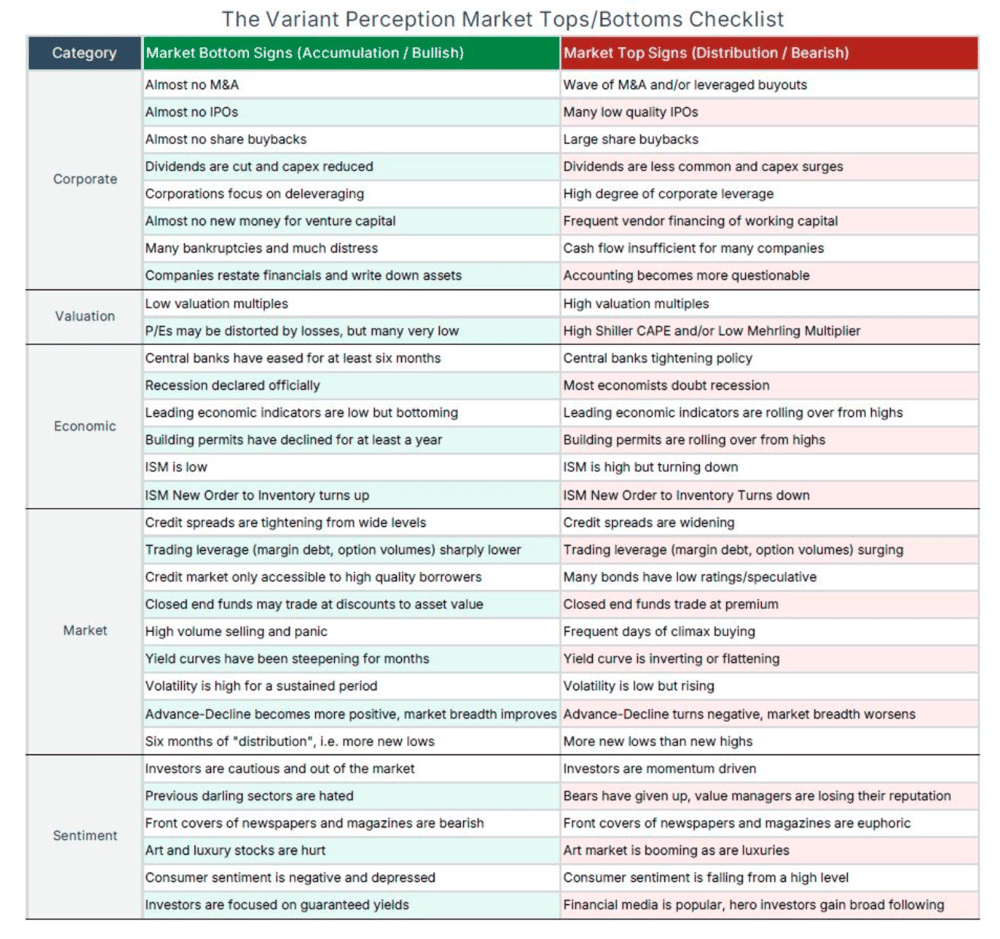
I am not here to say that SpaceX is Pets.com. It is far from it. This is more about what the company’s filing for an IPO this week reflects in terms of the state of the market. In the year 2000, Pets.com generated just $28.6 million of net sales while posting a $94.5 million net loss. The company spent more than 2x revenue on marketing and sales. And still it completed an IPO in February 2000, selling 7.5 million shares at $11 and raising $82.5 million, valuing the company at around $300 million. Pennies by comparison to today’s behemoths. By the fourth quarter of that same year, the stock had traded as low as $0.06, and the company had moved into liquidation accounting after approving a plan of complete liquidation in November 2000. It didn’t quite mark the top in the market, but it wasn’t far from it.
IPOs have a history of clustering around financial market tops because that is arguably when the gap between financial reality and the narratives we are fed is widest. Market participants are most willing to believe even the wildest prognostications. In normal markets, companies sell shares on evidence: revenue quality, margins, cash flow, and credible paths to profitability. In bubbles, they sell the possibility. Of anything really. Investors pay for narratives of total addressable markets, category domination, and network effects, typically before the company is anywhere close to profitability or before the underlying economics can justify the claims.
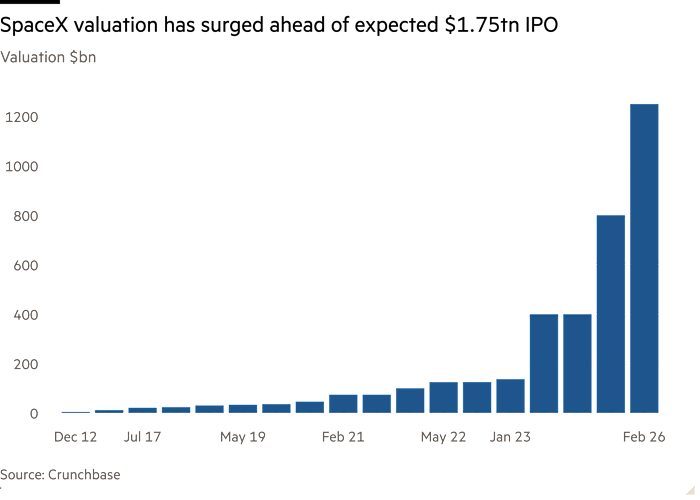
SpaceX filed for an initial public offering on Wednesday. Along with OpenAI and Anthropic, it could potentially be one of the most significant IPOs we have ever seen. This is partly because of the atmospheric (see what I did there) valuation being ascribed to it, and partly because of the timing. The topic has been covered at length this week, with the FT publishing one article titled “Six takeaways from Musk’s 200,000-word planetary vision” and the more interesting “How to make sense of SpaceX’s valuation.” The answer, apparently, is that you have to be wearing some heavily rose-tinted glasses. The piece finishes with the quote:
“Most attempts to value SpaceX will end up being both overly precise and incredibly vague. But the market has never before had to price a stock so speculative yet so large. With irrevocable control and every major Wall Street bank at his beck and call, for now, it’s worth whatever Musk says it is.”
I threw the 200,000-word prospectus into my LLM blender, and the models promptly freaked out at the file size. Eventually, I got around to asking it to pull out some of the more interesting details and tidbits.
First, on revenue: the prospectus provides audited 2025 and unaudited Q1 2026 figures to establish its current scale:
2025 consolidated revenue: $18.67 billion, up from $14.0 billion in 2024.
Q1 2026 consolidated revenue: $4.69 billion.
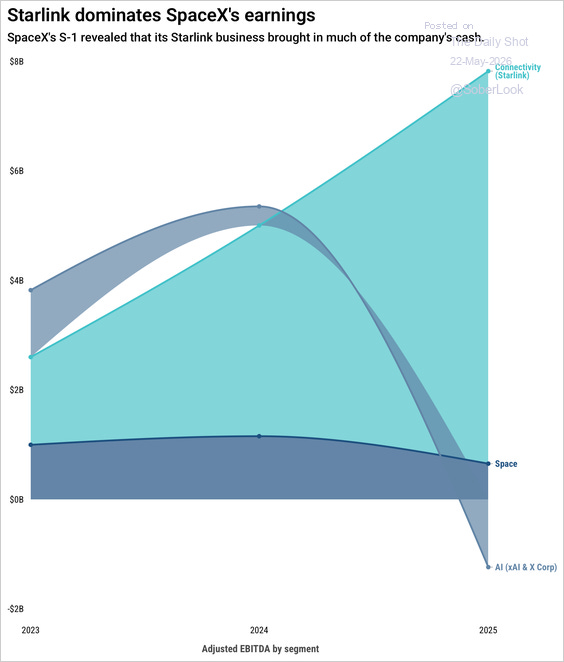
Connectivity, mostly Starlink, 2025 revenue: $11.39 billion, the largest segment.
AI segment 2025 revenue: $3.20 billion.
Space segment 2025 revenue: $4.09 billion.
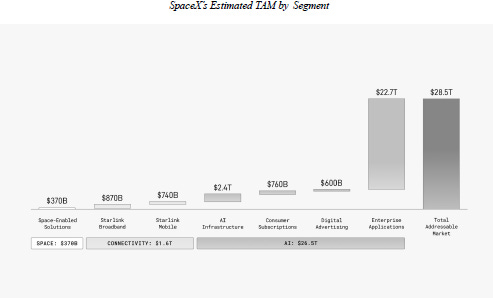
So, rounding up, call it roughly $20 billion of annual revenue, with an operating loss of $4.3 billion, being used to support a projected valuation of $1.75 trillion. This is “justified” by the total addressable market potential of space. Given that there is a lot of it (space, that is) it should not come as a surprise that the projection is for a $28.5 trillion opportunity. This is broken down into $26.5 trillion in AI applications and infrastructure and $1.6 trillion in connectivity. For reference, U.S. GDP is around $31 trillion, and global GDP is roughly $120 trillion.
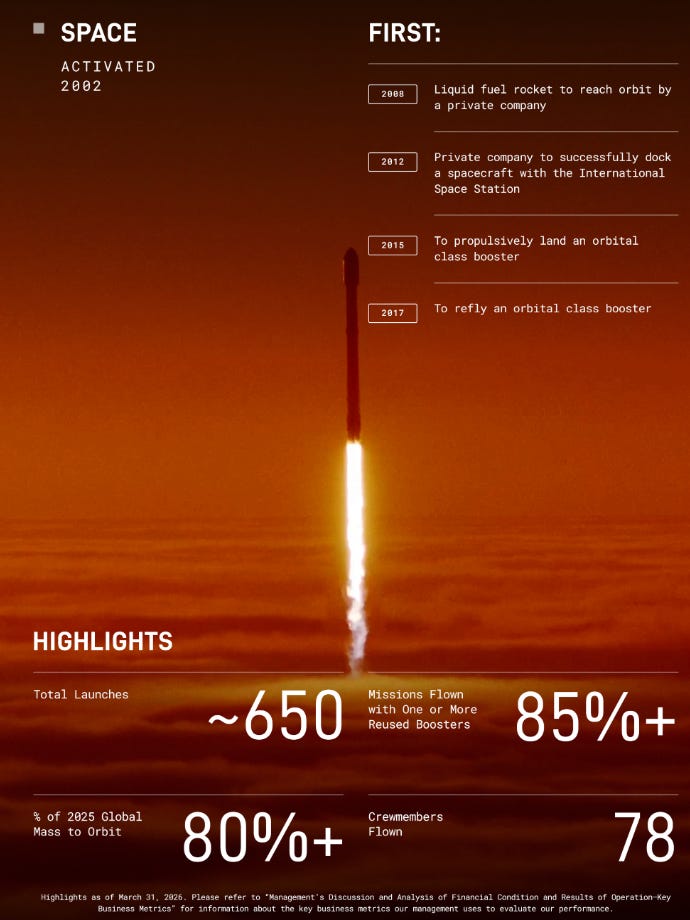
One particularly striking claim is this: “We expect these achievements will allow us to transport approximately one million metric tons to orbit annually, powering 100 gigawatts of AI compute.” In 2025, all launch providers on Earth combined delivered roughly 2,600 metric tons to orbit. SpaceX is therefore claiming it will achieve a roughly 385x increase over the entire global industry’s current output through “thousands of launches per year” of Starship, which has not yet completed a single commercial payload delivery. The proposed 100 GW of orbital AI compute is also staggering in scale, equivalent to a material fraction of total U.S. electricity generation capacity.
I read this article back in January about data centers in space, and it puts the concept, at least in its current form, into stark perspective. In the article, the authors go as far as to take SpaceX’s projections at face value and assume the company can pull off the requisite miracles. Quoting from said article:
“The [International Space Station] is powered by eight large solar array ‘wings’ that span over 110 feet in length and 30 feet in width. Fully deployed, this array is roughly half the size of an American football field… All told, the solar-plus-battery combination is capable of delivering an approximate average of 100 kilowatts (kW) of steady power. How much compute does half a football field of solar in space get you?... Basic arithmetic leads us to conclude the ISS array could power about 50 GPUs, and an array the size of a football field about 100… a single 500,000-GPU data center would require 5,000 football fields of solar to power it. One data center like this would hardly make a dent in global compute, but we suppose 100 might? That brings us to a cool 500,000 football fields orbiting the Earth. According to a recent analysis by the United Nations Office for Outer Space Affairs, there are a grand total of 15,000 human-launched satellites in space today, of which about 11,000 are still active.”

Kudos to Elon if he can pull off even half of what he has promised. There are certainly some snazzy pictures in the filing. SpaceX is espousing a mission “to extend the light of consciousness to the stars,” while also extending the scope of our gullibility along with it.
Keep the replies coming.
Donal
Ken Griffin did an interview at Stanford a couple weeks ago. The full interview is here.
All you really need to take from it is in this:
Comments
Nothing yet. Say the first thing.
Sign in to join the conversation.