
I am not sure whether the higher-than-usual number of replies to even a modestly bearish write-up is a contrarian sign for the market or something else. Typically, when we encounter this much groupthink, it is often time to go the other way. The fact that the consensus seemed so neatly aligned with my bearish shift is, if anything, mild cause for concern for the view.
The persistent market chatter about whether the A.I. trade resembles the dotcom bubble of 1999/2000 is strange, given how far the US market still is from the meteoric rise that preceded the Nasdaq collapse. If we want to look anywhere for something that better resembles the final stage of the dotcom bubble, then look no further than Korea’s Kospi index.
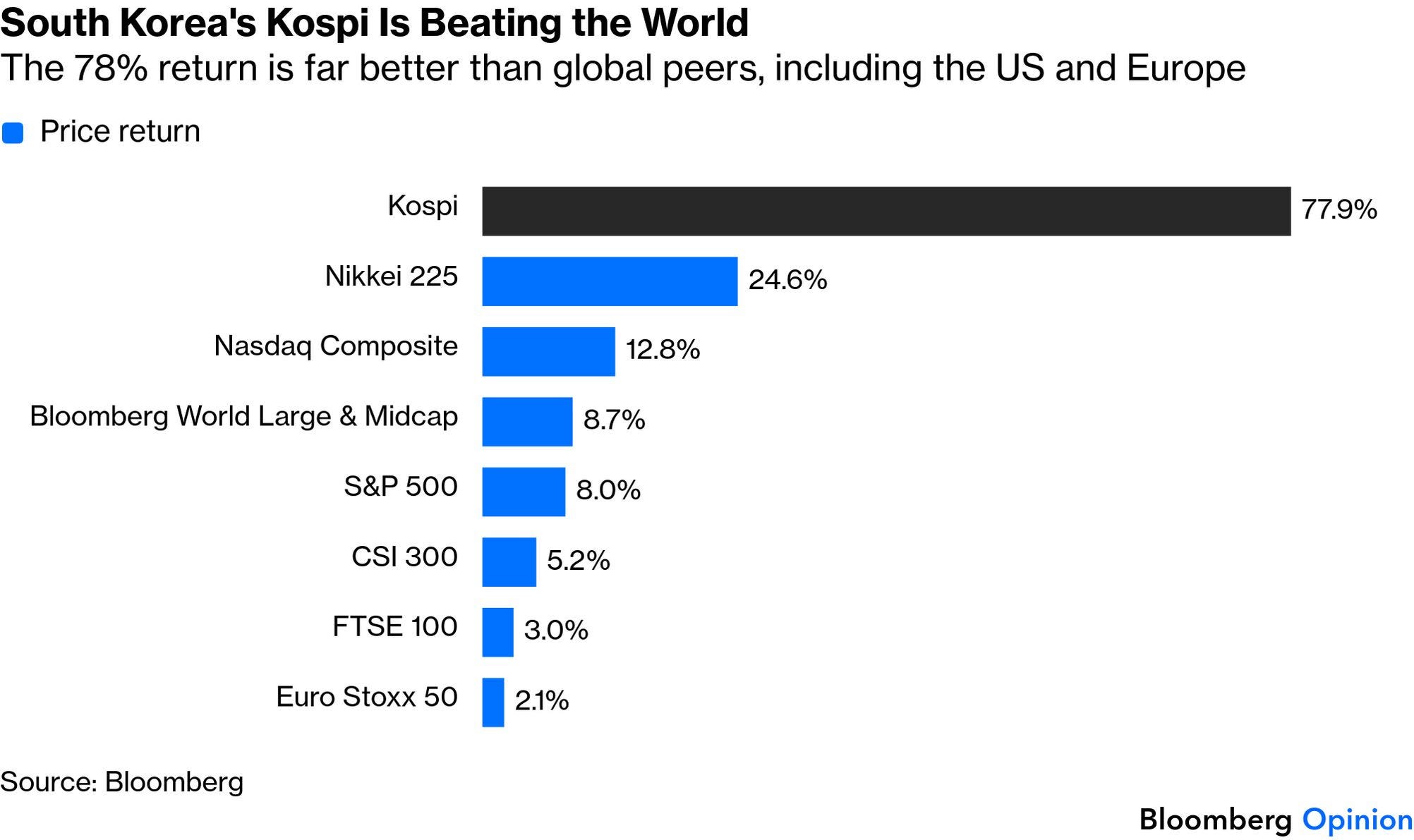
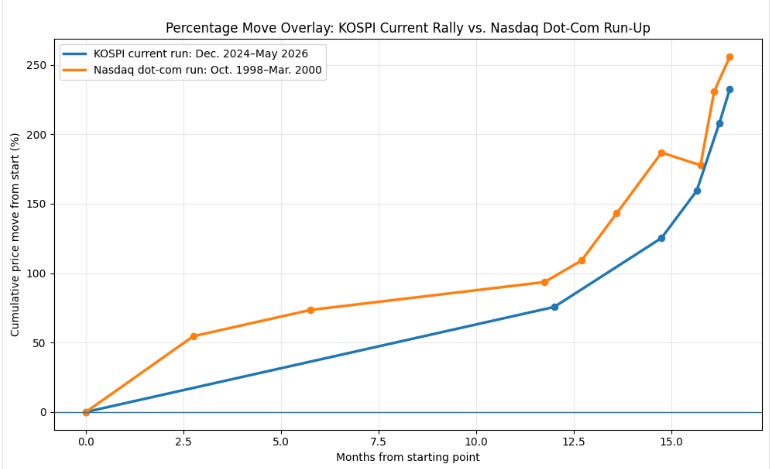
The index currently represents the cleanest manifestation of the A.I. bubble. That we are talking about this now likely tells you everything you need to know, read: it is about to collapse under its own weight. All we need is for the surge to be lauded on the cover of The Economist or Barron’s to put the final nail in the coffin. The Kospi is up roughly 200% over the past year, which is not something one ordinarily associates with a national benchmark index. To put it in perspective, the move broadly mirrors the Nasdaq’s rise from the post-LTCM lows in 1998 to its March 2000 peak. See below.
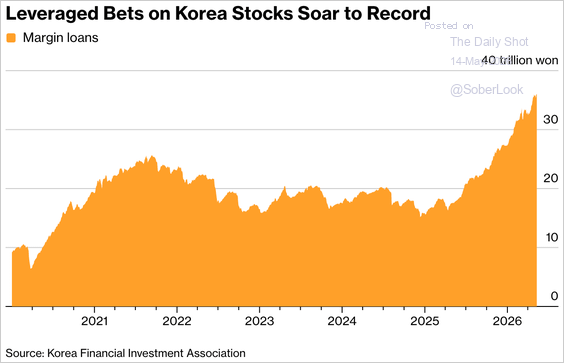
Bloomberg describes South Korea’s stock market as a $4.6 trillion affair in which “signs of euphoria are popping up everywhere,” including record margin borrowing, all-time-high trading volumes, and daily 5% moves frequent enough to make the Kospi the most volatile major stock gauge in the world. The retail enthusiasm is palpable, with a roughly 10x increase in new brokerage accounts opened for under-18s. Nothing says “long-term capital formation” quite like opening a trading account for your child because SK Hynix went vertical.
One could be forgiven for assuming this is only going to end one way. Margin balances hit a record 36.3 trillion won, roughly $24 billion, earlier in May, up 32% from the end of December, and even that may understate the amount of borrowed money chasing the rally. Retail investors have poured tens of trillions of won into local shares this year while foreigners have been net sellers.
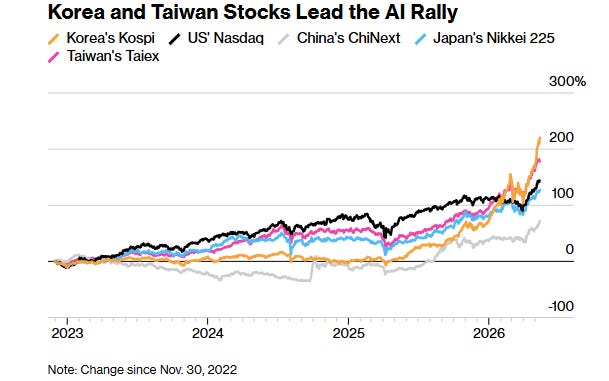
The argument, naturally, is that the rally is sustainable because of the A.I. spending requirements in the coming years. Samsung Electronics and SK Hynix sit near the center of the AI supply chain, making the memory chips required for the data centres that are supposed to power the next stage of machine intelligence. These companies are making cash hand over fist, with profits estimated to put them among the most profitable companies in the world this year.
At the same time, they account for the vast majority of the index’s performance. Strip them out and the roughly 80% increase in the index year-to-date (yes, +80% for an index) drops to closer to 30%. Electric and electronic equipment now represents more than half of the Kospi. So the national equity market of South Korea has essentially become a levered proxy for the memory-chip cycle, with an extremely concentrated bet on two stocks.
And yet, despite the surge, the index valuation still sits near the lower end of global rankings, at roughly 8x 12-month forward earnings and below its 10-year average. That is not to say this is a case of “it’s cheap, so keep calm and carry on.” It is simply to say that this is not a clean valuation bubble in the traditional sense. It is an earnings-revision bubble, which is more respectable, but only until the “E” in the P/E ratio starts behaving like a semiconductor cycle.
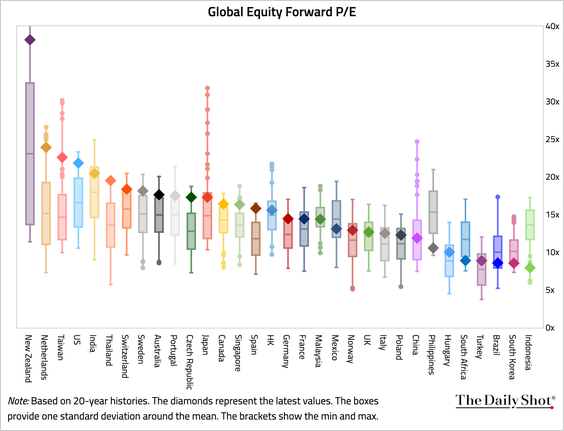
Rarely do parabolic moves like Korea’s simply fizzle out. When you get to the blow-off top after an exponential rise, it is often followed by a decline of equally dramatic magnitude. It does not look quite as though we have seen the blow-off top just yet - maybe we need to wait for the magazine cover to confirm it - but Friday’s move starts to smell a bit like it. The Kospi closed down a little over 6%, having been down even more intraday, after briefly trading higher above the psychologically crucial 8,000 level for the first time.
I would not be so bold as to say that where the Kospi goes, the rest of the A.I. trade must follow. Certainly not. But it bears watching as a cleaner expression of broader sentiment toward the space.
Keep the replies coming.
Donal
An update on the current state of affairs in the passive investing space:
Comments
Nothing yet. Say the first thing.
Sign in to join the conversation.