
"I know you believe you understand what you think I said, but I am not sure you realize that what you heard is not what I meant." - Alan Greenspan, former Federal Reserve Chair, who passed away this week.
Exams, moving apartments, and wedding travel all conspired to limit my ability to compile these ramblings over the past month. Last week, I had every intention of writing something, but I ended up playing padel and then drinking pints while watching the U.S. game instead. Look, you get what you pay for. Summer is now upon us, and I will endeavor to be more consistent, but with more travel/weddings, and Ibiza on the horizon, I cannot make any promises. That said, somewhat surprisingly, I gained more new subscribers during the weeks when nothing was published than I did over the previous couple of months. Maybe I should simply keep my mouth shut in perpetuity. But where is the fun in that?
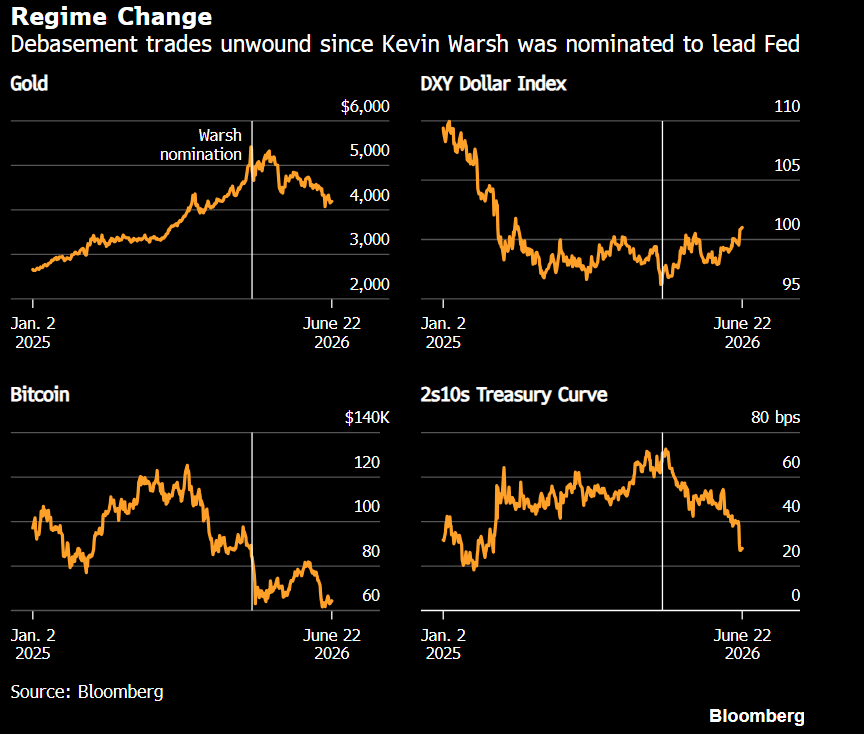
Much has happened in the intervening period: developments in the Middle East, a new Fed chair, the SpaceX IPO, and the announcement of several other potentially monumental initial public offerings in the pipeline. And yet, for all the noise, it does not feel as though much has really changed in financial markets. Stocks have essentially moved sideways for the past couple of months. The latest narrative doing the rounds is that Kevin Warsh, the new Fed chair, has put paid to the dollar-debasement trade I was so fond of earlier in the year. However, this was his first meeting, and anything other than a hawkish tone in the face of elevated inflation would have damaged what was left of the Fed’s credibility. In that sense, the outcome was largely unsurprising. Give it time. The likelihood that the president demands lower interest rates soon remains extremely high, and that will be the first real test of Warsh’s backbone.
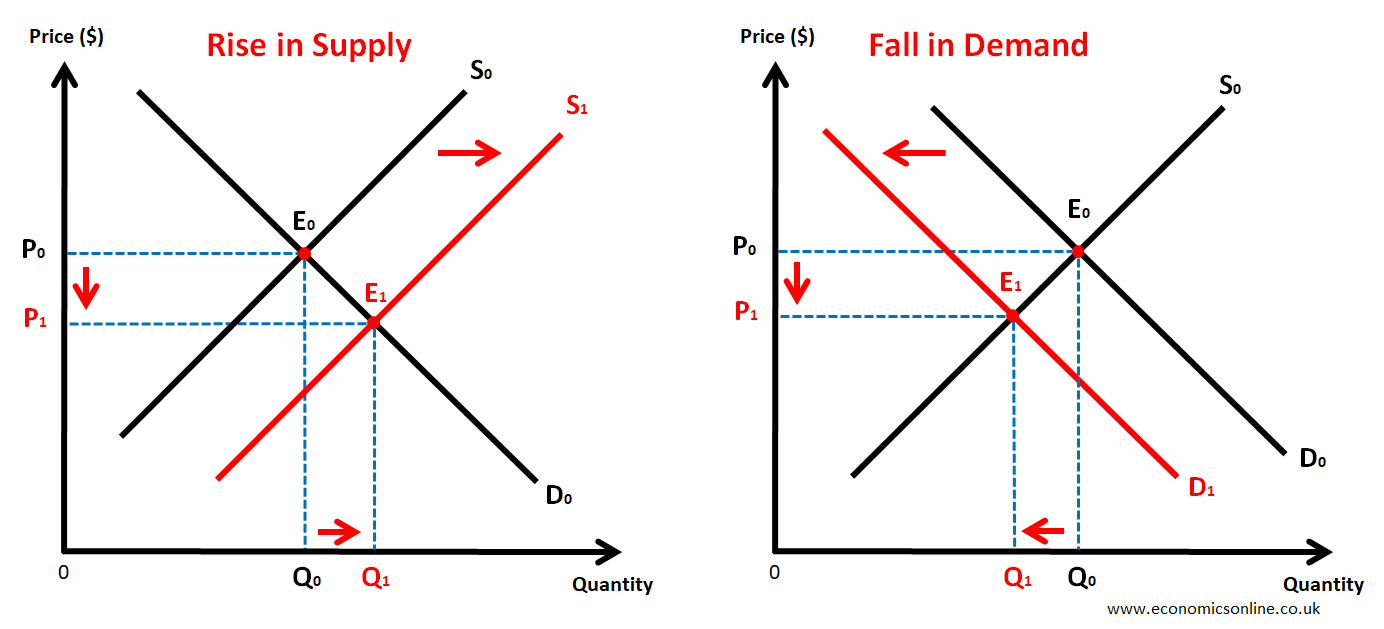
I am sure most of us have encountered something very similar to the supply-and-demand chart above at some point in our lives. I imagine some of my friends might even be “triggered” by memories of intermediate economics classes at university. There are a number of older academic studies that examine the impact of changes in equity supply on market returns. One paper by Baker and Wurgler, “The Equity Share in New Issues and Aggregate Stock Returns,” constructs an aggregate equity-issuance measure equal to equity issuance divided by total equity-plus-debt issuance. A high equity share indicates that corporations collectively favor selling stock rather than debt. The authors found that when equity issuance represents an unusually large share of external financing, future market returns tend to be lower. The interpretation centers on market timing in that managers may choose to issue equity when stock valuations are favorable and the perceived cost of equity is low.
Pontiff and Woodgate’s “Share Issuance and Cross-Sectional Returns” moves from the market level to individual firms. They measure changes in shares outstanding over the previous year and find that companies with greater share issuance subsequently earn significantly lower returns, while firms that reduce shares outstanding tend to earn higher returns. Taken together, these studies suggest that increases in equity supply can predict lower future returns both across firms and over time.
Maybe, sometimes, it really is as simple as a supply-and-demand story.
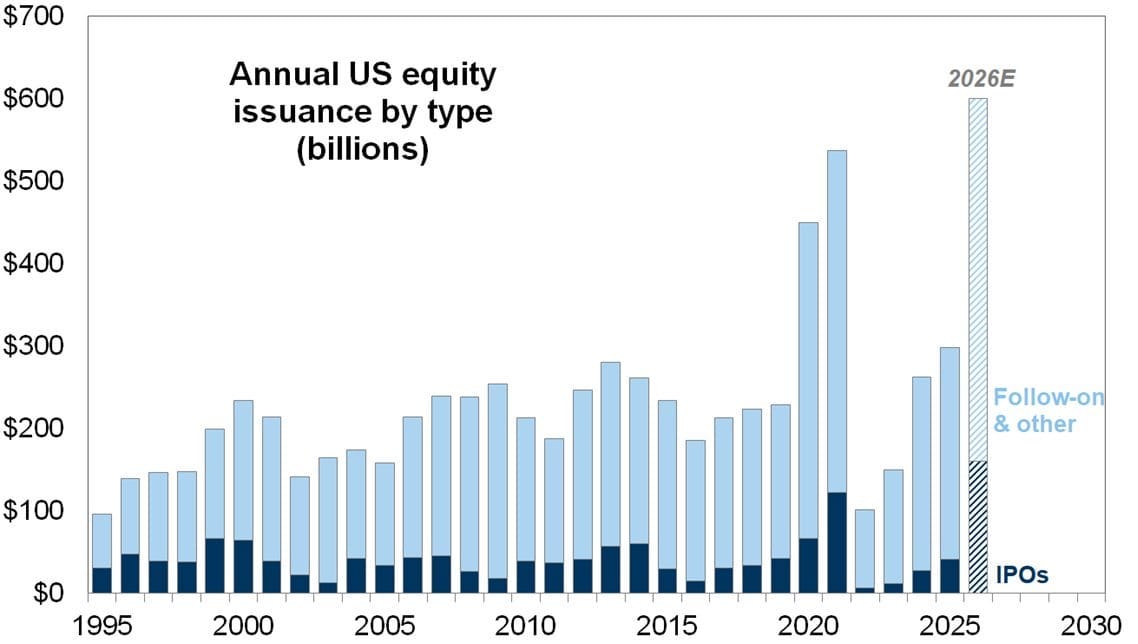
Much has been made of the 2026 IPO wave and the sheer magnitude of equity supply expected to hit the market this year. Current estimates suggest more than $260 billion of equity issuance may arrive in 2026. In nominal terms, that is a large number. But relative to a market with a total capitalization of more than $60 trillion, it is peanuts. The more interesting question is what happens once the corresponding lockup periods expire for the companies completing these IPOs. A lockup is typically a 90-to-180-day window during which insiders, founders, employees, and early venture investors are restricted from selling their shares. Rough estimates suggest potentially upwards of an additional $500 billion in shares could become eligible for sale once these lockups expire.
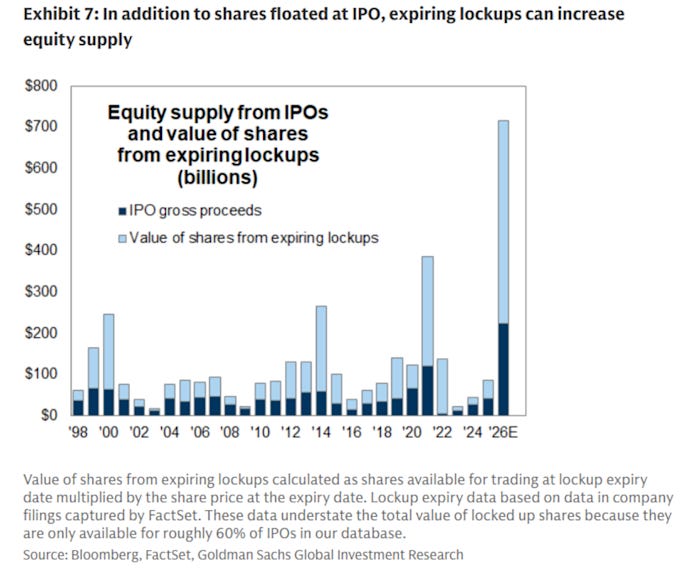
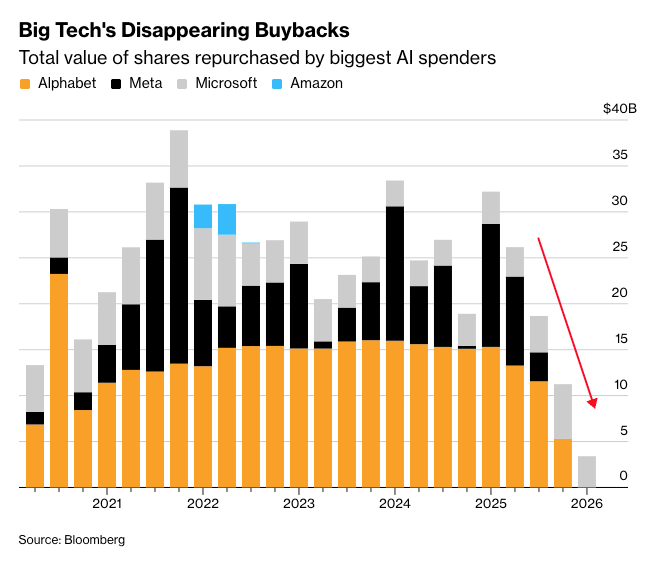
These numbers do not include follow-on equity offerings or debt issuance. The hyperscalers, as they are now called, are expected to spend staggering sums on capital expenditure to support the AI build-out. To fund this, some have curtailed buybacks, tapped debt markets, or considered new equity. Alphabet has gone further than most, raising roughly $85 billion in equity, while Meta has reportedly considered following suit. All of which is to say, there is plenty of supply hitting the market this year, and likely more to come next year.
This has a historical analogue in what is sometimes called the John Templeton short strategy. During the dot-com bubble, Templeton systematically shorted highly valued technology IPOs shortly before their lockup periods expired, anticipating that insider selling would pressure the shares. The strategy worked because many of those companies had extreme valuations, limited earnings support, and a sudden wall of new supply coming to market…
The setup today is not identical, but if it quacks like a duck…
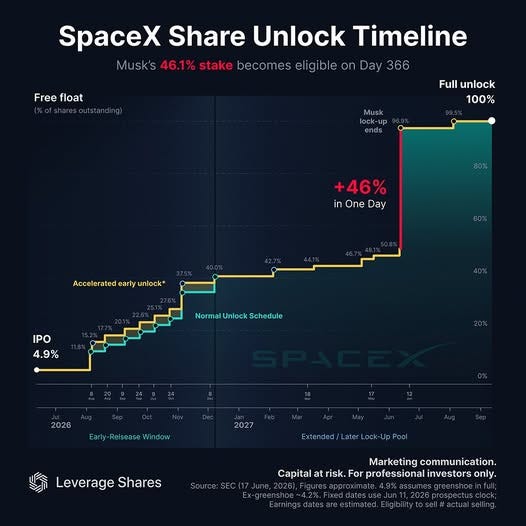
In 2021, lockup expirations were often more staggered, with early-release clauses designed to avoid a hard 180-day cliff. SpaceX’s lockup schedule is even more unusual. The initial public float was extremely low, likely helping support the IPO price, while additional shares become eligible for sale gradually over time. The major dates around the lockup expirations for companies such as SpaceX, Anthropic, and OpenAI will be worth watching closely. Plenty of traders will be looking for a Templeton-style setup ahead of the supply wave, and it seems like any excuse at the moment to construct a bearish narrative will be heartily embraced in this market.
Keep the replies coming.
Donal
Good chat.
Comments
Nothing yet. Say the first thing.
Sign in to join the conversation.