
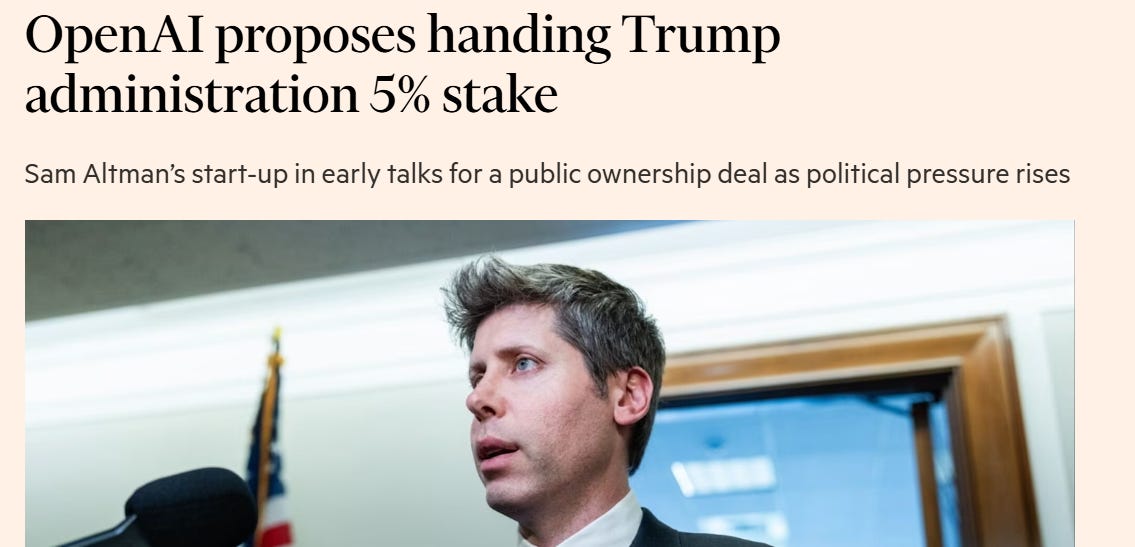
What more sycophantic way better birthday gift could Sam Altman give the United States on its Semiquincentennial, its 250th birthday, than a 5% stake in OpenAI. That this follows the decision to punt the proposed IPO into 2027 should surely raise some eyebrows. As reported by the FT, it could conveniently help in clearing political and potential competitive obstacles coming down the track if the government had an interest in ensuring the company’s success. Altman very kindly proposed including the other leading A.I. behemoths in the deal, none of whom have indicated a willingness to participate.
I wrote the following back in February: “What moat does ChatGPT have when it is just a matter of time before we can ask it, or one of its competitors, to build a better version of itself? Compute and capital are the limiting factors, but costs are falling precipitously. So, given the concern now rampant across software, why wouldn’t the LLMs eventually come for the LLMs themselves?”
It turns out this is happening in spades. Cheap Chinese models are flooding the market, and they are increasingly likely to pose a problem for Altman and company as they seek to justify lofty private-market valuations with increasingly ambitious revenue projections.
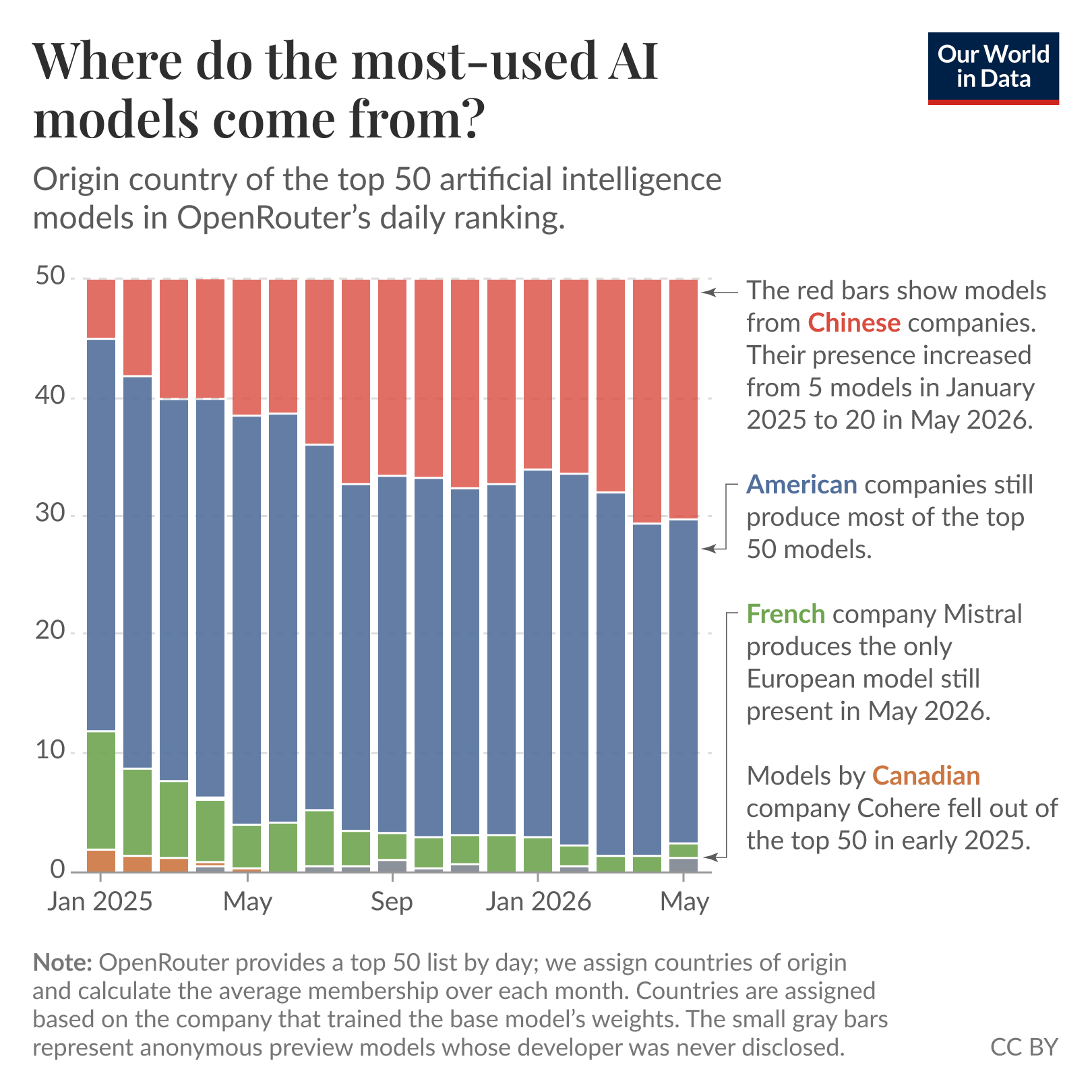
OpenRouter is a platform that lets developers access hundreds of AI models through a single API key. It reduces the need to juggle multiple subscriptions and codebases, making it easier to switch between models and find the most cost-efficient option. The company also provides usage rankings across the models on its platform. As is becoming increasingly evident, China-based models have rapidly gained share: they went from 5 models in OpenRouter’s daily top 50 at the beginning of 2025 to 20 by May 2026. Reuters, reporting on a U.S.-China Economic and Security Review Commission warning, also noted that some estimates suggest around 80% of U.S. AI startups now use Chinese open-source AI models. If switching from ChatGPT to DeepSeek gives a startup meaningfully more runway, the decision becomes a no-brainer.
The huge difference in capex spending is driving pricing differentials that are unlikely to be sustainable forever. Estimates for U.S. hyperscaler AI capex in 2027 are now slightly above $1 trillion, compared with a little over $100 billion for major Chinese hyperscalers. The prices charged by the major U.S. labs are therefore encouraging a shift toward significantly cheaper Chinese models that may not be quite as good, but are ultimately good enough for most everyday use cases.
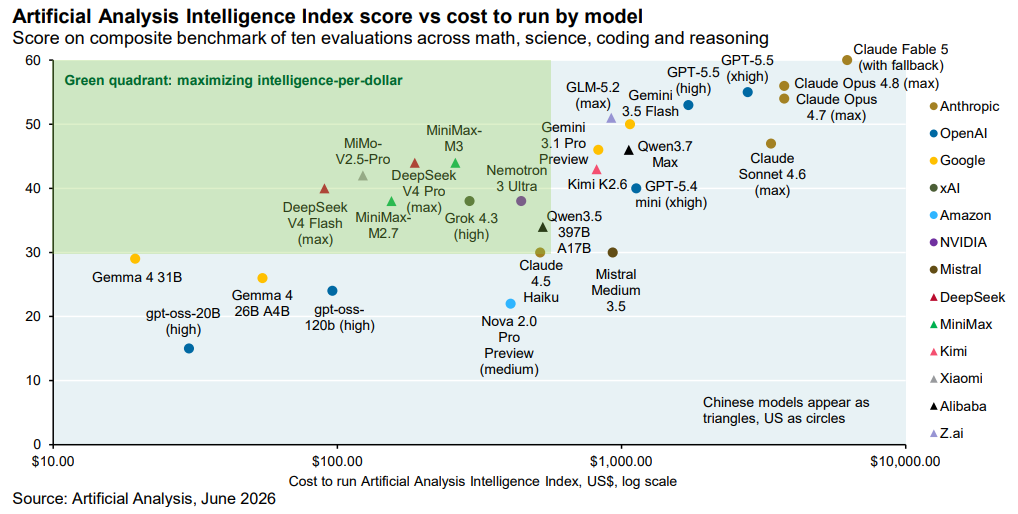
“While OpenAI and Anthropic compete with their own smaller models (e.g., Claude Haiku and GPT-5.4-mini), these models aren’t competitive vs the efficient frontier right now. That frontier shown as the green zone below is dominated by China (DeepSeek, MiniMax, Xiaomi, Alibaba) and only includes a modest presence from US models including one from xAI (Grok) and one from NVIDIA (Nemotron). Consider the following: Claude Opus 4.8 costs $3,700 to run the Artificial Analysis Intelligence Index task set for a score of 56, while DeepSeek V4 Pro (Max) scores at 44 for just $186, which is ~20x cheaper. TLDR; you don’t need frontier level intelligence for everything” – Michael Cemblast, J.P. Morgan.
If I can buy a plain black Uniqlo T-shirt for $12, what is the point of spending $50-plus on something fancier?
![r/dataisbeautiful - [OC] The AI CapEx: U.S. hyperscalers vs China’s big four](https://substackcdn.com/image/fetch/$s_!WB8_!,f_auto,q_auto:good,fl_progressive:steep/https%3A%2F%2Fsubstack-post-media.s3.amazonaws.com%2Fpublic%2Fimages%2F036c24cc-42f7-458a-bc9d-5eb6f589ce8d_5556x4628.png "r/dataisbeautiful - [OC] The AI CapEx: U.S. hyperscalers vs China’s big four")
U.S. A.I. companies are retreating behind protectionist and anti-competitive measures. A formal regulatory framework is now being called for by the A.I. giants, despite having previously been strong supporters of the Trump administration’s initial hands-off, deregulatory platform to avoid European-style red tape. More importantly though, audits that are pitched as a way to avoid sudden government-mandated bans, create a formal regulatory framework that naturally favors heavily capitalized incumbents. Requiring expensive twice-yearly independent audits and strict data-vetting pipelines creates a massive compliance moat. This strategy directly protects proprietary U.S. firms from being undercut by highly agile, open-weight Chinese alternatives that do not have to answer to Washington.
As per my (U.S.) LLM: “Historically, the Chinese manufacturing playbook relies on hyper-efficient process engineering, massive volume, government-backed runway, and aggressive price undercutting to turn high-margin premium technologies into low-cost global commodities. In 2026, Chinese AI labs (such as DeepSeek, Alibaba, Zhipu AI, and Moonshot) are using this exact playbook to disrupt the business models of Silicon Valley giants like OpenAI and Anthropic.”
Ever been in a BYD car? As it is to a Tesla, so is DeepSeek to ChatGPT.
Keep the replies coming.
Donal
Interesting listen.
Comments
Nothing yet. Say the first thing.
Sign in to join the conversation.