
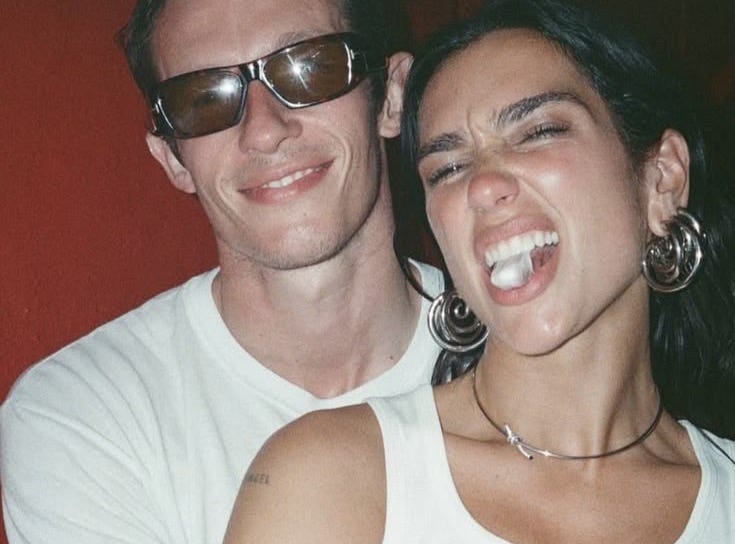
If your algorithm leans towards celebrity decadence or discourse, you’ve likely scrolled upon photos of Dua Lipa and Callum Turner on their honeymoon. The pictures I’m referring to capture the couple emerging from the turquoise Mediterranean, clad, naturally, in swimwear. Lipa, as ever, appears sculpted by the gods: her body honed by an undoubtably gruelling workout routine as well as live performance, her raven hair secured in a bandana. Turner, behind her, is strong and tall, an undeniable hunk, yet is neither overly ripped nor particularly lean.
Regardless, women on the internet have crowned his physique “the ideal male body.” “For all the jokes on here about chubby Dad bods, this is actually the exact physique most women are attracted to. Tall, broad, well built, clearly trains his ass off but also looks like he has no problem smashing a burger and fries and would throw you over his shoulder afterwards,” read a post that went viral on X.
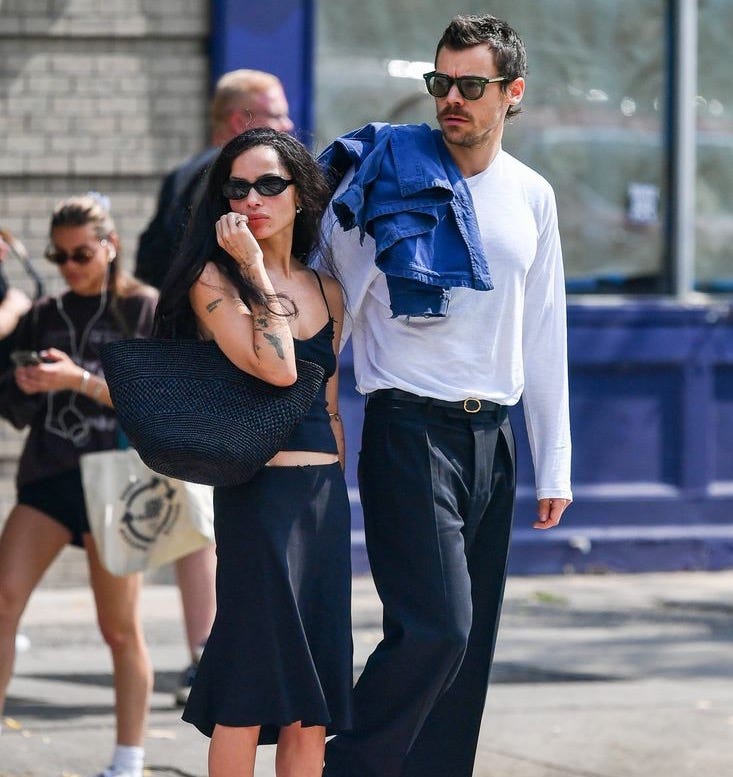
But although I wholeheartedly agree with its sentiment, let’s be real: if one of the most beloved, lusted-after male pop stars on god’s green earth was photographed with a paramour who was anything other than an embodiment of our stringent Western beauty paradigm, she would be at the receiving end of a deluge of trolling comments about her unfortunate DNA arrangement. Just think about the public’s abhorrent remarks about Pierce Brosnan’s wife of 25 years, Keely Shaye Smith, and the misogynoir Zoe Kravitz has faced in the wake of her Vogue cover and engagement to Harry Styles.
But Turner? Turner can be lionised for his “dad bod” (emphasis on the quotes) because women assess men’s attractiveness based on more than how close they come to western standards of perfection. From the supposition that men look better with age, to receding hairlines becoming hot at the hands of The White Lotus’s Walton Goggins, to the “silver fox,” the list of negative traits flipped into positives for men’s benefit is longer than the menu at Kris Jenner’s aesthetics clinic.
Women’s idiosyncrasies, meanwhile, are not framed as charm in disguise. Dua Lipa is often subject to incel-coded “mid” allegations. In 2010, South Park aired a warped, close-eyed depiction of Sarah Jessica Parker and referred to her as a “transvestite donkey witch.” Then there’s the spate of female celebrities who’ve been driven to eating disorders at the hands the press (see Ariana Grande leaning on her microphone for stability and support); the mocking of former child stars when they gain weight post-puberty; the sea of online trends conjuring up new flaws like being a “bottom tooth talker,” and the tendency to equate women’s looks with morality (someone took to X to write, “God made your hair thin as a punishment for your greed,” aimed at Taylor Swift.) I’m not going to go into specific comments because I’m not comfortable disseminating racial hatred, but when it comes to famous women of colour, it’s worse. They’re at the receiving end of the same aesthetic sadism, this time driven by blatant racism.
So, what bore this glaring double standard? Why are men’s imperfections romanticised, while women’s are seen as flaws to be needled, starved, or built anew?
Both traditional and social media are behind the majority of the aforementioned abuses. Social media accounts critique women’s appearances in a reliable exchange for clicks, because in a society that pits us against each other, we’re conditioned to find catharsis in other women’s flaws. Meanwhile, magazines enjoyed half a century of telling us what men supposedly want and don’t want from us, to the benefit of the beauty industry. Men’s magazines, meanwhile, taught them to see women not as coarse and real humans, but as a sum of hot parts. But anyone who’s ever been close to a man knows that they, too, possess the ability to see women’s idiosyncrasies as beauty. But the media doesn’t, and there’s a knock-on effect for all.
There’s also a greater societal onus on women’s beauty than men’s. Historically, a man’s value came from their success and ability to provide, while a woman’s came from her looks, as that’s what enabled her to find a man who could grant her that security. It goes without saying that if your value, stability, and place in life rest on your appearance, there’s little room for flaws.
This laid an ideal bedrock for the wellness, beauty, fashion, and fitness industries, which ensured that even when the expectation for men to serve as providers began to wane, aesthetic pressure on women stuck. In her book Trick Mirror, Jia Tolentino described today’s ideal woman as “an ordinary woman reproducing the lessons of the marketplace.” In other words, the $677 billion beauty industry rests on convincing us to reproduce those lessons and hold women celebrities to their standards.
There’s also the age-old theory that when it comes to choosing a partner, women aren’t as aesthetically driven as men. Scientists often posit that this is down to the evolutionary theory that it’s more important for us to tie ourselves to a kind man who won’t abandon our children and us than a man with a jawline that could cut glass. In The Beauty Myth, however, Naomi Wolf counters that this difference in approach is learned: a result of women not being as bombarded as heavily by images of conventionally attractive men from childhood, and thus not holding them to such a high standard.
Entitlement also plays a role. Straight, white, cis men were promised the world. Many feel that this promise includes some iteration of the ideal woman (even as this ideal gets narrower and narrower at the hands of the internet), a fact that inceldom has mercilessly proven. Although women are not immune to hot men, they seem to feel less entitled to partners and celebrity heartthrobs who meet standards of perfection, as proven by our lust for Turner’s ever-so-slight adipose tissue. Many of us have a soft spot for rat boys and short kings, and seek out “medium-ugly” men in the hopes that they’ll treat us better, a trend Internet neologists have coined “shrekking.”
Still, women are calling Turner’s physique a “dad bod,” because we, too, are capable of criticizing men’s appearance. We do, however, seem better primed to unearth charm in less conventional traits, or at least to more readily overlook them in search of something deeper. As observed by Wolf, “women are able to view men just as men view women, as objects for sexual and aesthetic evaluation; we too are effortlessly able to choose the male ‘ideal’ from a lineup…Given all that, women make the choice, by and large, to take men as human beings first.”
*When I refer to “flaws” in this essay, I’m referring to traits generally considered so by conventional (often problematic) beauty standards, not personal opinion.
Comments
Nothing yet. Say the first thing.
Sign in to join the conversation.