

When I posted an Instagram carousel on the positive impact of reading, it reached 1.2 million people so far. That’s not a niche interest, and it seems I have touched a nerve many of us feel, not just among the fervent readers of BookTok.
In a world where an increasing number of people are beholden to their thumbs and screens, an equal or even greater number of us are concerned about this society’s ability to think critically, empathize, and find joy in another world afforded by a book.
Share this with friends you want to make a book club with!
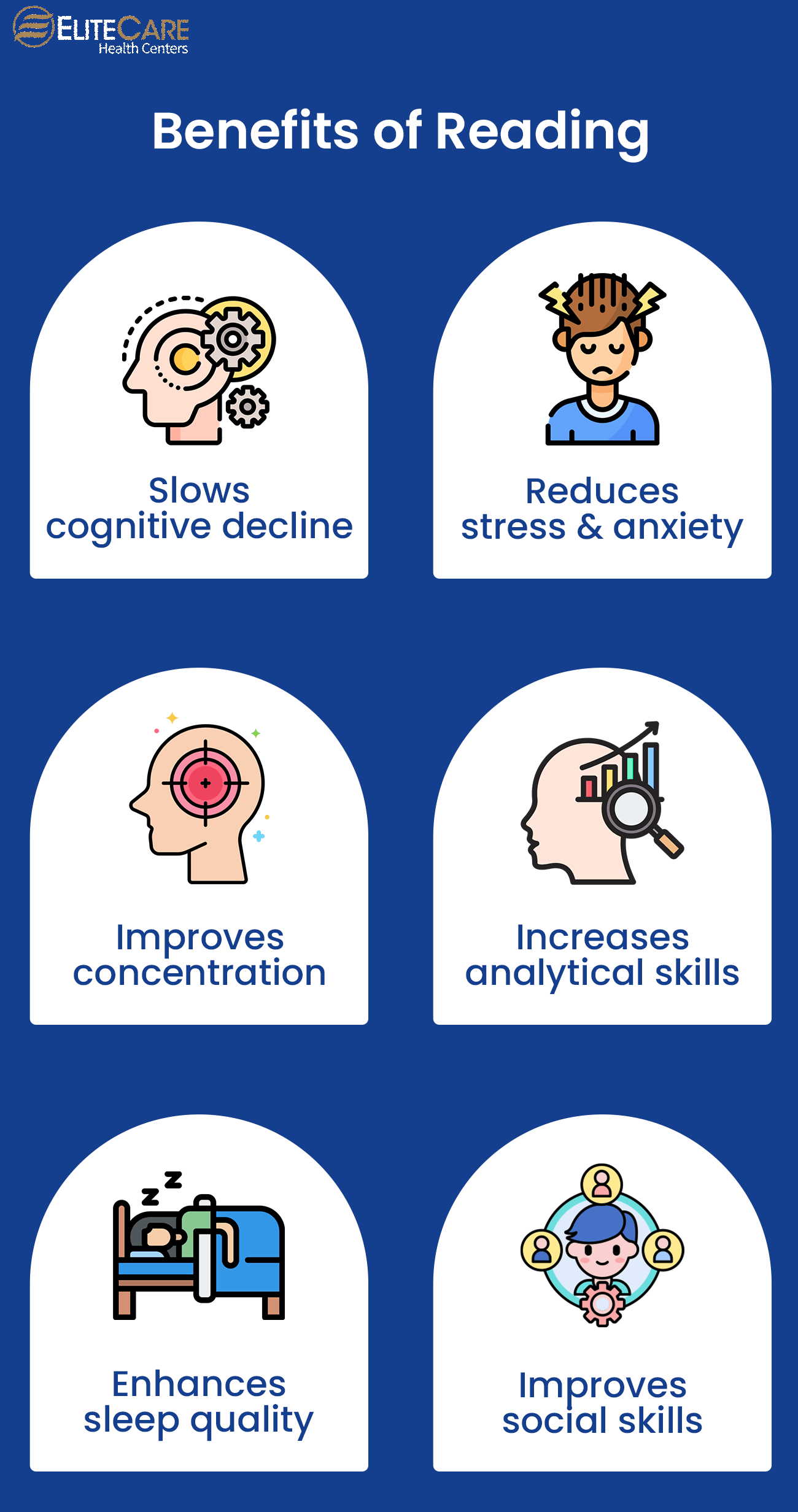
Plus, in a world currently obsessed with wellness, reading represents one of the most powerful cognitive interventions available across the human lifespan. Reading induces substantial structural and functional brain changes, particularly in language networks, attention systems, and social cognition areas. Approximately 12 hours per week of reading appears cognitively optimal for children, while even 30 minutes daily confers benefits in adults (The benefits of reading for children have their own slew of research not covered here).
I may do an update post on the benefits of reading, but assuming you are convinced, allow me to answer a few frequently asked questions arising from my post, drawing on the latest scientific studies. But before we get into it…
Almost everything below is observational, not experimental. Researchers compared people who already read to people who didn’t; nobody randomly assigned thousands of people to a decade of reading or not reading, because that trial isn’t something you can ethically run.
Regardless, observational data this consistent and replicated across independent labs, countries, and decades are still meaningful. It’s evidence of association, not proof that reading alone causes every outcome listed. None of it is a prescription for exactly how many books, which genre, or how many minutes a day.
My own read (yes, pun intended!): stop optimizing and just read more. The findings above don’t converge on one right answer: they point to different answers depending on which benefit you’re chasing. Literary fiction does something for empathy a business book won’t. Book-length engagement does something for longevity a magazine won’t.
Chasing the exact genre, the exact page count, or the ideal number of minutes a day treats reading like a supplement dose, and it misses the real message: more reading, more consistently, moves the needle on nearly every outcome here, whichever one matters most to you. That holds individually, and I think it holds for a society too. A more-read population is, on this evidence, a more attentive, more empathetic, less lonely one. I’m not waiting on a precise prescription.
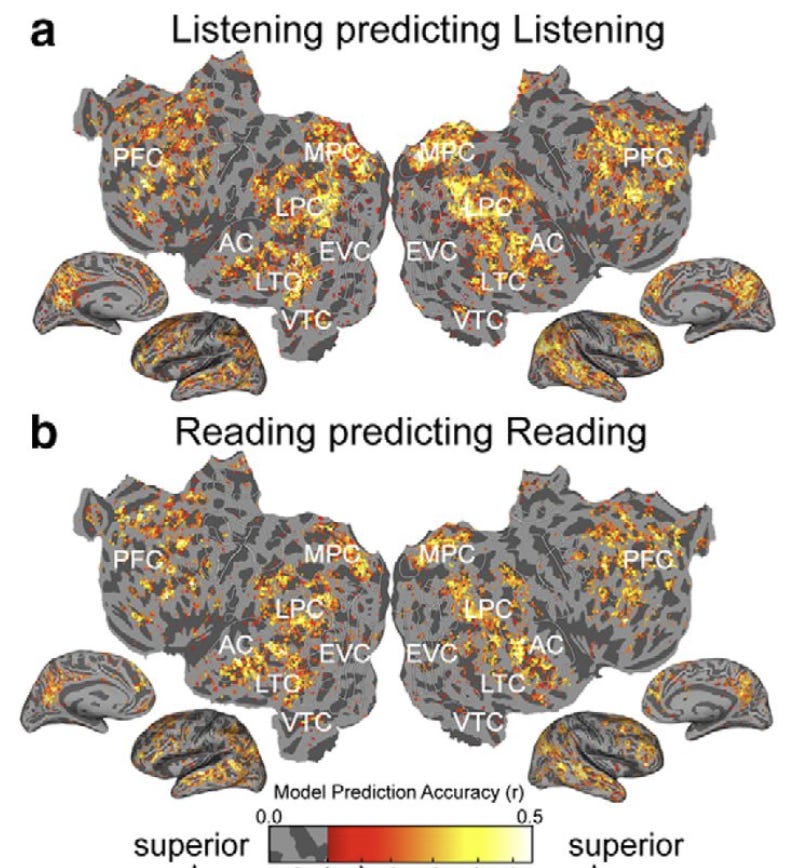
Findings: Closer than most people assume. Researchers had people either read or listen to the same hours of narrative content and mapped the semantic information represented across their cortex in both conditions; the resulting maps were nearly identical, meaning the brain organizes meaning almost the same way whether words arrive through the eyes or the ears. Deniz et al., 2019, Journal of Neuroscience.
A controlled study of 91 adults found no significant difference in immediate or two-week comprehension between people who listened to an audiobook, read the same text, or did both at once. Rogowsky, Calhoun & Tallal, 2016, SAGE Open
A six-week randomized trial of older adults given fiction or nonfiction audiobooks found no overall difference in well-being between the two genres. However, people who reported feeling more absorbed in what they listened to showed greater benefit. Poerio & Totterdell, 2020, Psychosocial Intervention: Reading keeps a real edge in self-paced, inferential comprehension, the kind that benefits from pausing and rereading a sentence, which is harder to replicate at a narrator’s pace.
Verdict: Choose whichever format gets you to finish books consistently. Personally, audiobooks sometimes lead my thoughts to wander on their own because my visual system gets distracted easily. Plus, I think the reader’s voice predetermines my emotional response and takes away from my imaginative process.
Findings: For narrative fiction, not much. For dense, informational nonfiction, yes. A meta-analysis of 54 studies and more than 171,000 participants found a small but consistent comprehension advantage for print over digital, concentrated in expository, informational text and situations with limited reading time, not in narrative fiction read at a comfortable pace. Delgado, Vargas, Ackerman & Salmerón, 2018, Educational Research Review.
At night, the picture shifts for a different reason: a study of twelve adults found that reading on a backlit iPad before bed suppressed melatonin, delayed the body’s internal clock, and reduced next-morning alertness compared with reading a printed book. Chang, Aeschbach, Duffy & Czeisler, 2015, PNAS. That study tested a backlit tablet specifically, not a non-backlit e-ink reader, so a Kindle Paperwhite with the light off is a different proposition from a phone or tablet at 11 pm. If you’re reading in the hour before bed, print or non-backlit e-ink is the better call.
Verdict: Aside from sleep disturbance (which is more a function of phone screens than reading itself), the differences between print and digital are minuscule enough that I am inclined to recommend whatever works best for you.
Findings: Length and depth appear to matter independently of the fact that words are being read when it comes to longevity benefits. In a 12-year Yale study of 3,635 adults, book readers showed a meaningfully larger survival advantage than people who read only newspapers or magazines, even though all three groups were reading regularly. Bavishi, Slade & Levy, 2016, Social Science & Medicine
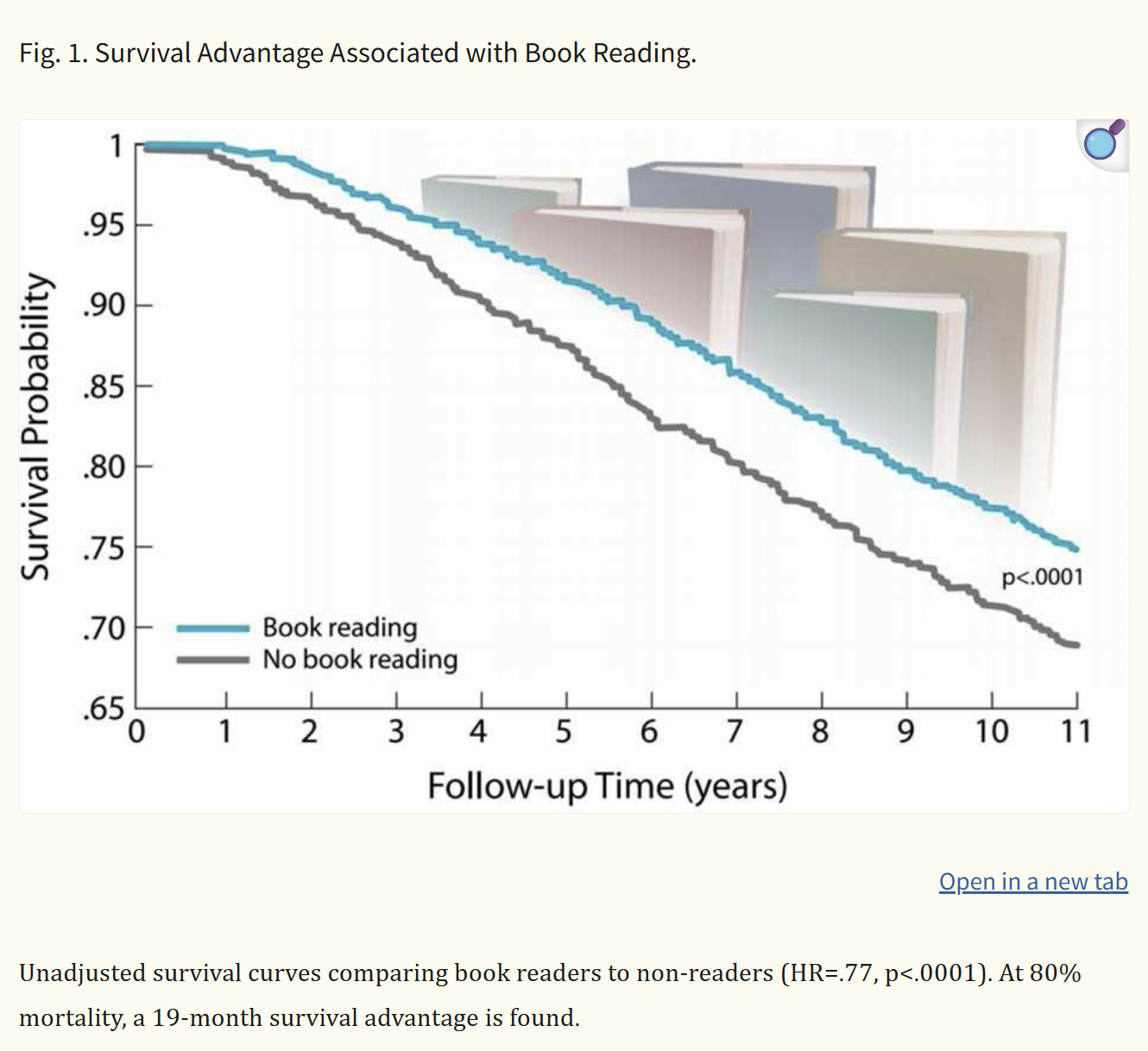
This is observational data, not a controlled experiment, so it shows association rather than proof that length alone drives the effect. Still, it points to something specific about sustained engagement that a five-minute article doesn’t ask of you. Shorter reading isn’t worthless. It’s a different, smaller rep than a book is.
Verdict: While observational, I agree with the researchers’ hypothesis that the longevity benefits of reading a book require sustained attention and deep engagement, which probably does not come from reading periodicals. This effort builds cognitive reserve, protecting against aging. Reading novels with character development and social themes likely enhances empathy and emotional intelligence, fostering stronger social bonds.
Findings: Depends which benefit you’re after. For perspective-taking and worldview complexity, genre matters a lot: a study of 5,176 people found literary fiction read earlier in life predicted a more complex adult worldview. In contrast, formulaic genre fiction like romance novels predicted the opposite. Buttrick, Westgate & Oishi, 2023, Personality and Social Psychology Bulletin.
The original theory-of-mind study behind this idea drew a similar literary-versus-popular-versus-nonfiction distinction. Still, it has a rocky record of replication: a 792-participant, three-lab attempt failed to reproduce it. I don’t think this means the findings are untrue; rather, this study is complex with many confounding variables and not possible to run controlled experiments. Kidd & Castano, 2013, Science.
For cognitive-reserve and longevity findings, genre barely enters into it. Rush University’s cognitive-activity research (Wilson et al., 2013, Neurology) and the Yale longevity study (Bavishi, Slade & Levy, 2016, Social Science & Medicine) didn’t require any particular kind of book, only sustained engagement with one. If the goal is empathy and social reasoning, current evidence favors literary, character-driven fiction. If the goal is long-term cognitive protection, almost any book you’ll actually finish clears the bar.
Verdict: Incorporate both if you can. I think reading both genres is the best for maximal diversification of benefits. I tend to gravitate towards nonfiction but am working towards reading more fiction, not just for neurological benefits but as a form of escapism.
Findings: In the moment, yes, a genuinely absorbing long-form piece delivers focused, immersive reading. What it doesn’t replicate is the cumulative effect. The Yale longevity study mentioned in Q3 found book readers outperformed periodical readers specifically, which suggests length is doing independent work, not just standing in for total reading volume. Bavishi, Slade & Levy, 2016, Social Science & Medicine. And the Rush University cognitive-reserve findings were built from sustained activity over years, not single reading sessions Wilson et al., 2013, Neurology. Treat a long article as a single rep and a book as a training block: both belong in the program, but they’re not interchangeable.
Verdict: Long-form articles might never fully replace reading a book, but they definitely have their own special spot in your reading collection. Some topics, like investigative pieces, are really well-crafted, thoroughly researched, and quite thought-provoking; so much so that I can imagine they do good things for your brain. That said, just like going to the gym, I think of these kinds of articles as trying out new exercises to keep things fun and interesting, rather than a steady weight-training routine that gradually improves over time.
Comment below on what I should read next!
No posts
Comments
Nothing yet. Say the first thing.
Sign in to join the conversation.