
When I criticized Hades Calculus for not understanding vore, I had to explain the interaction (especially when it comes to kink) as being literally prey/predator, dominant and submissive all the way back to tigers and elk. Now that I’ve finished Devourers, I might have to go back and revise that section because apparently, I missed quite a few metaphors.
This is going to be a short little review, because I have a lot of positive things to say but all of them have to exist without spoilers, as this is a very easy book to spoil. Even if you know the point is the journey, not the destination, the journey itself is incredibly intimate and personal, and all the way to the final pages, Devourers finds new ways to recontextualize what’s happened.
I suggest you go in unspoiled and baby deer level new, so go get it now. It’s fantastic. Yes, the story is romantic and queer, but trust me when I say not just in the way you think.
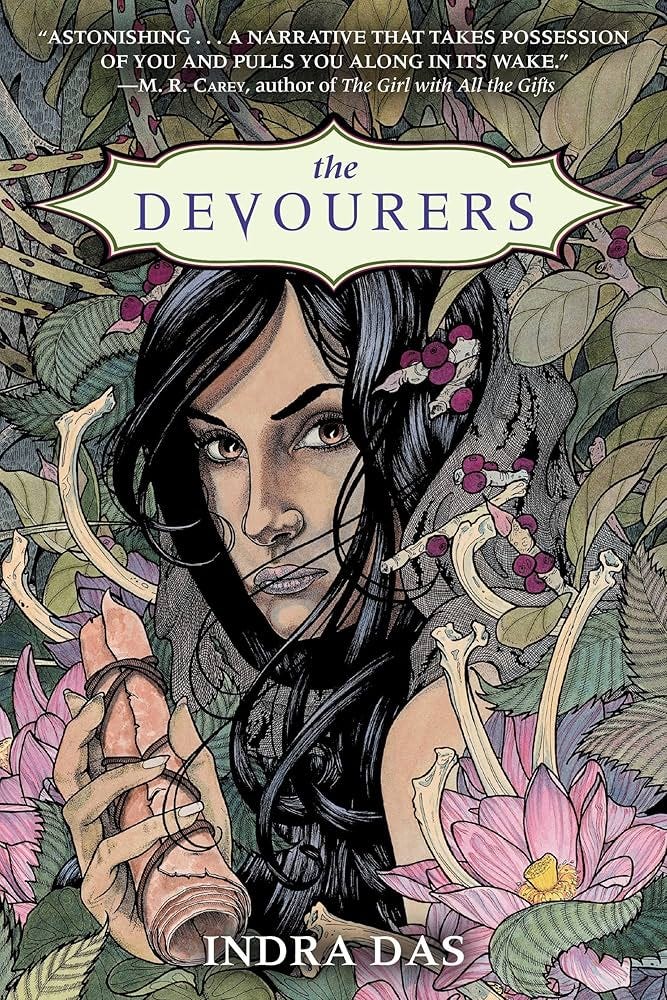
Devourers is a story-within-a-story, where a college teacher in India named Alok meets a handsome stranger at a party, who introduces himself as a “half-werewolf.” He doesn’t seem to be messing around, and yet the story is too absurd to believe, so Alok follows him to learn more. The stranger does not identify himself, but instead requests his services — translation. He hands him a tome of a book, in a language Alok can read, and asks him to transcribe it.
Thus begins the narrative, as Alok cracks open the tale to delve into the mystery of the book and the handsome man who gave it to him. And, hold onto your chair a moment, he is not lying about the whole “werewolf” thing.
I don’t think it can be said enough just how beautiful this book is just to read. Gorgeous, delicate prose weaved into a tale of immortal lycanthropes hunting and eating people and marking their territory with urine, framed around a suburban meeting between two young men in modern India.
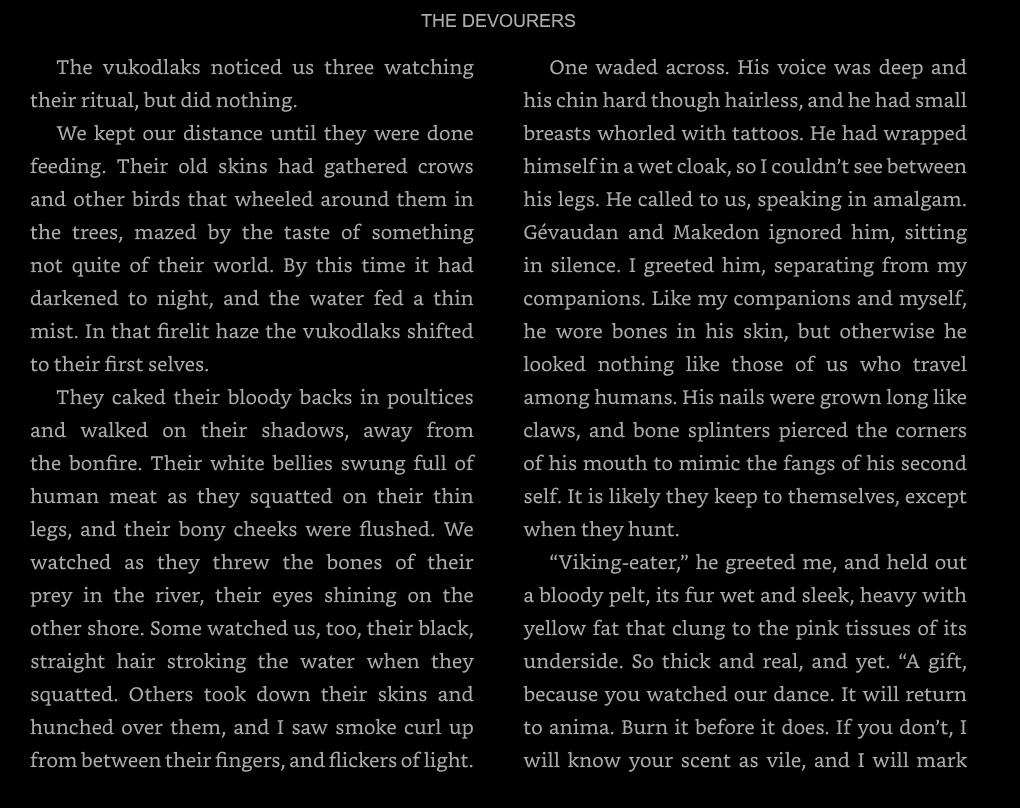
This kind of graphic subject matter spoken so beautifully makes the book feel mature. It will tell you the werewolves in human form taste urine to follow scents better, and it doesn’t feel juvenile. It feels like you’re watching some terrifying predator about to do something incredible.
And it’s so tightly edited. We spend just enough time learning about the werewolves to give us a sense of mystery and excitement as we learn more. Not once does Devourers flash back to some progenitor race, or a curse of darkness, or a god struck down to earth just to tell us where the werewolves came from. Like any good supernatural story, you get at best about a quarter of the answers you want. You see bits of werewolf society through the actions of the characters, the isms and rituals and customs of their people, but not once does the book drop you in Wereburg to learn about primary imports and average growth domestic product. That’s not where the story is, it’s in the messy interpersonal lives of the characters. Bless Das for understanding that.
Cannibalism is at the forefront of the narrative, literally as soon as you read the title, but it’s not just about that. Devouring another is a metaphor, and the novel gets every drop of meaning out of it. There’s tension in the framing device of the stranger and Alok, and if the dangerous predator is interested in him as a friend, a historian, a lover, or prey, and it’s a recurring theme through the whole book — the stranger on the street you just made eye contact with, who they are to you, and the fear and apprehension of ‘do I trust them with my vulnerabilities.’
This extends to all of the relationships of the book. The story-within-the-story is a love triangle, but it’s layered with danger as the werewolf characters make it clear humans are their cattle. It’s blunt and direct about how these creatures think of humans, as nothing more than cattle to feed on.
A lesser writer would have made them all vampires — instead, Indra Das keeps underlining the concept of ‘consuming’ another human with gory, gristly depictions of cannibalism. It feels fitting for interpersonal drama this messy and wet and grotesque between monsters and humans.
Devourers starts to circle back on the themes by the conclusion, and it’s a wonderful way to conclude the novel. The book keeps calling the werewolf forms the ‘second self,’ and they are closely guarded and protected from the eyes of mortals. Maybe I’m just watching too many Elephant Graveyard videos, but the parallel to the Jungian ‘shadow self’ seems too obvious — a self that is hidden, quietly protected, and dangerous to reveal.
And yet, as the werewolves interact, you get the feeling they too have ‘second selves’ they do not reveal to each other. They can speak about their not being human, and yet their social dynamics look all too familiar to ours. Jealousy, bitterness, insecurities… all the stuff that makes humans humans.
When you devour someone, as the film Ravenous quote says, “you inherit their strength.” Devourers, by contrast, extends the metaphor further. Werewolves in this world retain pieces of their consumed prey, sometimes as mere dreams or visions or images, other times significantly more. Consuming this many beings complicates the psyche, but it also becomes something more, with each of the people you’ve devoured adding to the greater whole of what makes up the ‘you.’
Sex is a perfect parallel to this; the carnal act is a mortal’s form of devouring, consuming the person tangled up in your body into yourself. The lovers of the past hurt us by biting off pieces of who we are, but we take pieces of them too, and from it we grow and evolve and add more views to our psyches. Humans might not be immortal cannibal werewolves, but consume each other in our own ways. And we transform, into a new person, bit by bit.
Each little fragment of other people evolves us, and as the reader consumes the characters in the story, we too become something greater. And our inner selves become less secret, less hidden, like the characters are to each other, and us.
Beautiful little queer book.
No posts
Comments
Nothing yet. Say the first thing.
Sign in to join the conversation.