
When I was first recommended the writing of Mur Lafferty, I got about ten percent into the first Midsolar Murders book before realizing, oh dear, this is cozy, silly, camera winky lighthearted fluff. And if there’s one thing that repulses me like a vampire before the True Cross, it’s all the words I just told you, back to back.
I was instead recommended Six Wakes, and it’s actually provided a really interesting contrast. Lafferty pretty clearly always wanted to write cozy, lighthearted murder mysteries, which is super irritating because as a speculative scifi writer with horror themes, she’s got a ton of great ideas.
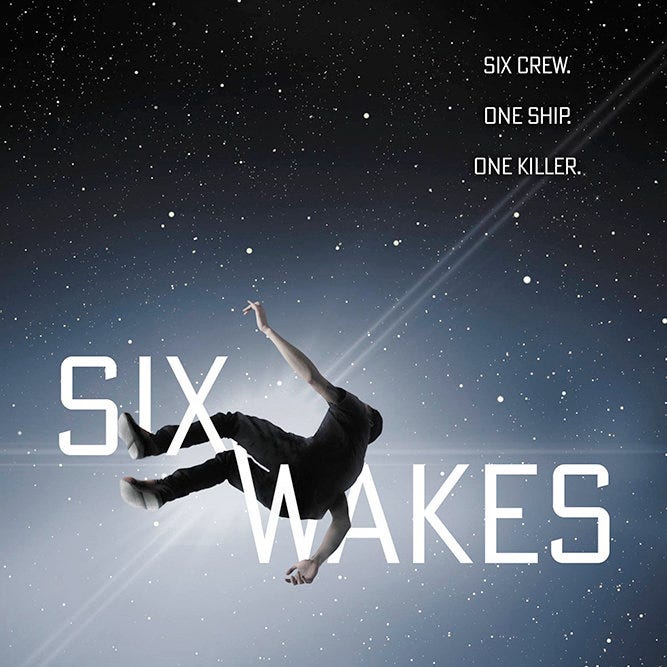
The premise is quick and punchy and grabs your attention — six clones awaken on a ship, stumbling out of their clone pods and looking up at their floating dead bodies above them, aged twenty five years and extremely dead. Hiro, Maria, Wolfgang, Katrina, Paul, Joanna, and IAN the ship AI all now have to piece together the empty decades that led to their deaths. There’s no records, no footage, and no witnesses. Just Hiro’s body hanging from a noose, a knife in Katrina’s chest, vomit surrounding Maria, and a malfunctioning food generator. And worse yet, their brain scans are blank and they can’t make new ones. Which means these are their only bodies. If the killer strikes again, that’s it.
Since they’re clones without updated memories of the last decades, the murky suspicion is on all their minds. It’s not even who did the murders — technically, none of them did — but it’s more about asking who is capable of it.
This is a good premise, but unfortunately Six Wakes kinda bungles it. We’re told about plenty of tension and anxiety, but none of it really has any chance to settle. Hiro discovers a horrible secret that implicates him, and he hides it from Maria, who he seems to be developing a light romantic tension with. We’re given no time to absorb this before we jump into resolving this in the next chapter.
Ordinarily, this would be where I throw a fit about lost opportunity and an extremely boring book. But I actually commend Lafferty here for being smarter than that — these revelations stick around just long enough, then we’re jumping back to earth to tell you more about the character who discovered it. This happens repeatedly, at a steady rhythm, through the whole book. We learn about our characters, then learn about their pasts, and we’re jumping to a new character.
The more we spend time on Earth before the ship left, the more you start to realize the book isn’t actually a murder mystery. How could it be? The murderer is as dead as their victims. Instead, it is closer to a classic speculative scifi horror, in the vein of The Dead Past or Black Mirror, using a single piece of technology to prod questions about humanity and the self.
Cloning starts off as merely a framing device for the murder plot, but the book starts to show you who the cast is and why they’re on the ship, and soon the murder mystery kind of stops mattering because the political and philosophical questions of cloning take center stage. There isn’t even really talking out much in the way of clues until the very end.
After Hiro realizes a terrible secret about himself, he’s acting shady and strange. Trusting only Maria, he brings her into a secluded place and speaks to her about a secret message written to himself that he located. Who wrote the message?
Well, we dig into Hiro’s history. And it turns out Hiro did.
It was mentioned in brief in the opening that early cloning was messy and horrifying and badly done, and I assumed at the time that was their way of getting away from questions the book didn’t want to answer. But we’re getting into it now.
This is a great little turn, reframing the question of cloning and “Who is the murderer” away from something as petty and juvenile as personal grievances or passions.
But it’s worse than that. It’s not that a different Hiro sent a message to Hiro on the ship. There’s multiple Hiros inside of our Hiro, due to a process called “mind hacking”, where the brain scan of a person to be cloned is altered. After all, if we’re moving your mind from one body to another, then it’s just data. And if it’s just data, then why not alter the data?
It was around here that I started to get actually excited about this book. This isn’t just about a murder mystery, that’s just the excuse to examine what “cloning” means to the people being cloned.
And man, she’s got some flaws, but damn if Lafferty doesn’t actually get into some cool ideas.
Anti-cloning priest, all rooted in belief in the soul and of God’s light, forcibly abducted and forcibly cloned to ‘convert’ him to their side? Waking up in a body that you simply know is wrong, and knowing you’re never leaving it? Complete with the murky parallels about religious organizations trying to “cure” the queer of their “affliction”? Oh man, you’re speaking my language here Lafferty.
Another topic in these flashback sequences; the social aspects of cloning, what it does to society. My favorite of this is Katrina’s origin story as a corporate assassin in a world with cloning — since death is pre-empted every time, being stabbed at high society dinners and board rooms essentially becomes a fun show and gossip for the wealthiest on earth.
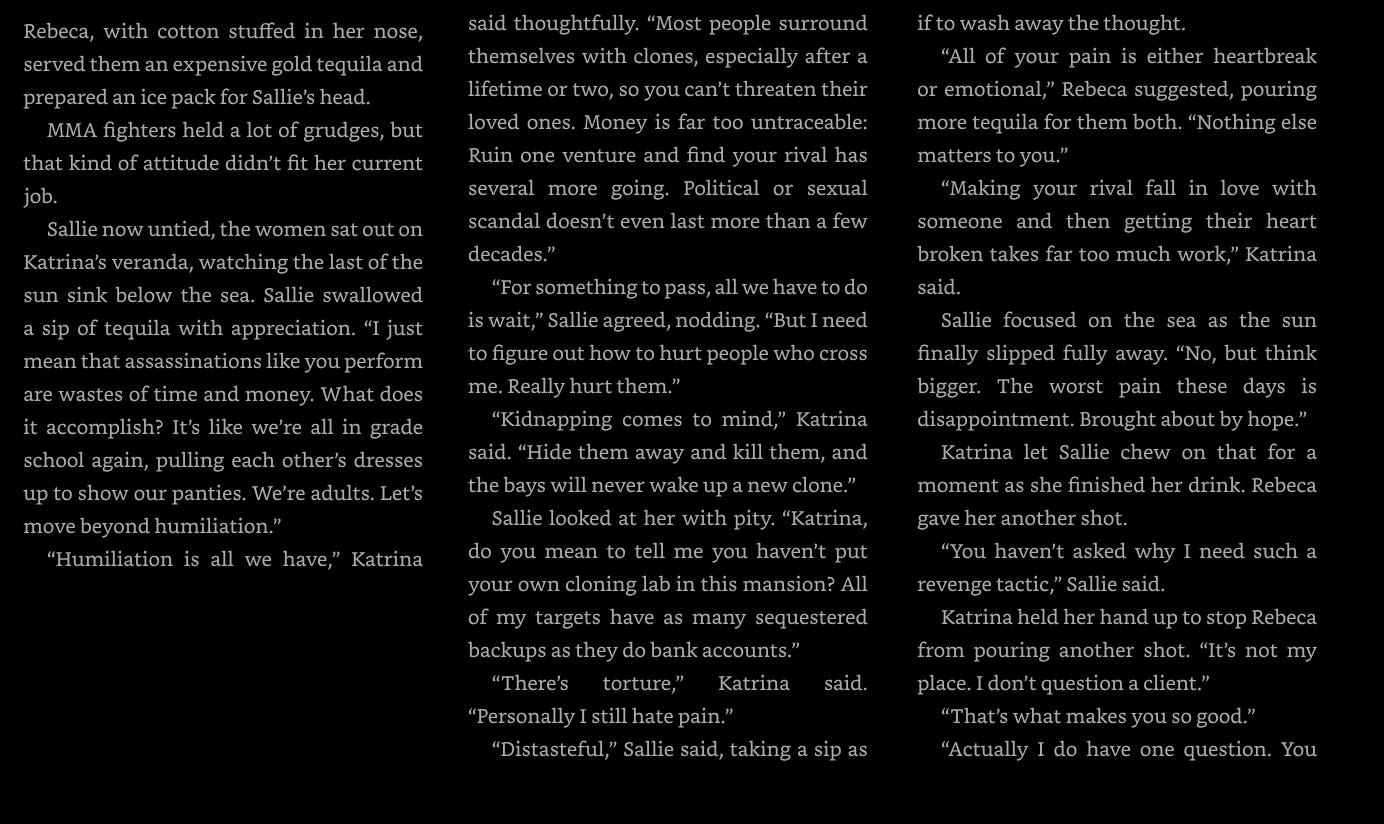
Perfect! What does dying matter for the 1%ers of the globe? If someone stabs a coworker at a fancy dinner, or poisons their chablis, that’s not scary — it’s exciting! It might happen to you! And it’s not like there’s repercussions for slumping over at the Met Gala, cause you have ten more bodies in a lab under your estate, and fresh mind maps in databases.
I started off irritated by all the cutaways to life on Earth pre-departure, but by the third one I was delighted by them. It’s paced expertly, giving the characters something to reveal while setting up the next character backstory to delve into the ethics of cloning, and when we finish prodding some interesting ideas, it’s back to the ship to apply what we know about her to the plot.
Pacing is the special sauce that makes a mediocre story engaging, and it can make an excellent one transcendent. I was pretty high on the story about halfway through, but unfortunately a lot of issues kept popping up. Though we get a lot of really juicy factoids about the world the crew left behind, none of them are delved into too deeply.
The unpleasant concept of your mind being ‘hatcheted’ into a killer to cause trouble is implemented then discarded, as is hacking someone’s brain to remove things like belief or ideology. Nothing as wonderfully scary as the first guy you run into in SOMA, telling you, “no you idiot, I’m a human, look,” and twisting a metal claw attached to a mechanical arm, tapping his CRT TV head with a metallic ‘donk.’
It gives the whole story a kind of deflating lack of stakes to present something this dark then buff the sheen out until it’s less upsetting. And I can’t explain it better than with just telling you about how it ends.
The vibes of the book never really managed to get close to Alien, which is deeply unfortunate since it’s a great premise for it. Remember how I said I started off reading Misolar Murders first, then jumped to this? It was actually very informative for me to start there and work backwards, because I really feel like Lafferty is uncomfortable making characters who are disposable and ready to die. Not even the truly reprehensible ones.
Maybe a bit ironic cause they are literally disposable — they’re clones — but it’s the other way around, I believe. Lafferty would rather not murder characters she likes, so cloning does exist in this world, even if it’s offline for right now, allowing a hole to slip into where nothing bad has to happen. Misolar Murders, to me, feels like a response to the discomfort she found in Six Wakes.
They have a food fabricator that weaves all-purpose primordial soup stored on the ship into organic material they can eat. Maria nicknames it ‘Bebe,’ and it becomes a bit of a side focal point through the story, since the original one was altered to only produce poison leaves. Around the time all the mysteries get solved, things are looking pretty dire as yet again the crew start dying off, and there’s no clone vats to bring them back to life.
We’ve spent a long tine in this book asking the question about the nature of the ‘self,’ especially in a world where the ‘self’ can be digitized, moved, altered, and destroyed. Now a rogue AI is having a tantrum as the crew starts killing each other off, the mystery solved but the myriad of problems reaching a climax.
In this time, I was giddy, hoping for a conclusion where problems are solved, but the consequences are dire. I’ve spent years thinking about the way that the video game SOMA ends, the distress of Simon’s voice as the lights start to shut down and everything goes quiet. I was fully ready for something equally bleak — clones awakening to start the mystery anew, the whole crew being digitized into AIs, or Maria getting comeuppance for her crimes to live as something still alive, but less than human.
Or hell, Maria is where the story started, why not end it with her? Maria has been shown over and over to be morally compromised, even despite all her assertions that she isn’t. Akin to the way someone like Charles Xavier “only uses his powers when he absolutely has to,” which keeps being all the time, Maria has limits on what she will do to a human mind. That is, until she doesn’t.
So then do we get an ending where Maria’s morality is eroded by her circumstance, using her skills to hack her colleagues minds into being better so the ship can survive? Nope! That would be too mean. And I just don’t think Lafferty wants to be mean.
So here’s what actually happens.
As Hiro bleeds out and the rest of the crew die, the sole survivor Maria realizes the off-the-cuff comment she made in the beginning of the book — the food fabricators like Bebe read their saliva and memorize their preferences — is actually the key to it. If the machine can read their tastes, that’s the same thing as taking a mindmap. And if he can fabricate a whole pig to eat…why not just turn the food processor into a clone bay? Since it’s all the same technology, right?
This actually works. She fabricates new bodies for them all to inhabit, using the taste-reader power to copy their most recent selves via their saliva. The day is saved.
This is kinda clever, sure, but it’s in sharp contrast to everything else in the book. Again, drawing parallels to SOMA — cloning and the advancement of technology is a messy, murky, complex thing. The further you dig into what is a person and what is merely 1s and 0s, the more fungible the self becomes. The whole book is not subtle about the theme, telling you nothing is ever simple and if you don’t think about the ramifications, you’re going to discover how ugly it is.
And then the book casts that off. Nevermind! You just need the right people and the right tech and you can do anything. Spin everyone up some new bodies, point the ship forward into a brighter future, and take the happy ending.
I am not exactly over the moon over this decision, as you can see.
All the same though, it’s hard for me to feel super negative on the book overall. It’s disappointing that it doesn’t end stronger, it’s a bit too blunt about its morals, and none of the characters are especially interesting, but all the same, I enjoyed it, if only for brevity and a breezy pace.
There’s something to a book spending some time on the philosophical and metaphorical to buoy subpar characters and tension. It could be much better, of course, but it could also be so much worse. Or maybe I’m just a huge slut for pacing and am willing to forgive not wasting my time. Dunno!
What I do know is that sometimes good enough still makes for a fun read, even if only once.
No posts
Comments
Nothing yet. Say the first thing.
Sign in to join the conversation.