
Holy shit what an absolute grand slam of a novel. If you trust my instincts at all on this blog, just get it. No questions, just pick it up right now.

Let me get through the pitch as fast as possible so I can just start gushing like crazy; it’s a dark academia novel. Behind the world we know there’s a darker, magical universe we only ever get peeks at from our mortal eyes. Eight houses control and study different schools of magic, and the ninth house Lethe exists as watchers over them all. And all magic — or at least, all the powerful stuff we the reader see — seems to come from the realm of the dead. Ghosts, the afterlife, and mortality are center to the studies going on in this fucked up version of Hogwarts.
Galaxy Stern, who goes by “Alex” for fairly obvious reasons, is a new inductee to the school. An impoverished drug addict, she’s got the natural-born gift of seeing ghosts, which is rare and valuable, circumventing the need for a dangerous and often lethal potion. She’s brought in quickly and given the position of Dante, companion to the role of Virgil (who is her mentor, Daniel “Darlington” Arlington), as a duo to monitor and report any misadventure done by the eight different fraternities on behalf of the ninth house, Lethe. To cover for her weirdly rushed induction, they sign her up for Yale under an art program. Alex is struggling to keep up, but it’s going reasonably well, that is until a woman winds up murdered, and Alex — feeling a pang of sympathy that the body full of drugs cooling in the morgue that reminds her of her long dead best friend Hellie — starts to chase the trail down.
Already you can feel some of what Leigh is putting down just from the premise — a mirror universe Yale, guarding schools of magical study and education, hidden just off another street corner? Magic that involves cutting open the innards of schizophrenics to get predictions on stocks? It’s the kind of blunt, obvious metaphor for institutional academic power and how it runs the globe — right down to addressing the Yale fraternity Skull and Bones by name, the same that brought us George Bush. It would be goofy if Ninth House wasn’t utterly dripping with complexity and meaning every chapter.
Take for example, a major plot element for the whole book — supernatural drugs. The Manuscript chapter of Lethe, who specialize in illusions, compulsion magic, and chicanery, are producers of said mystical drugs. Darlington is on assignment with her at a Manuscript party, and he gets dosed with a face full of a lust concoction and makes an utter ass of himself. Manuscript, for their part, find this kind of hilarious, since he’s such a stick in the mud and more than a little pompous, and hey why not fuck with the guy assigned to monitor your activities? And this is only one of many that the school produces, such as merity, which renders the subject a willing and eager acolyte, or star powder, which makes the user’s voice turn all who hear it into willing servants.
Sounds like a pretty powerful tool, and it is — you see its effects firsthand repeatedly, and though it’s never fully questioned you wonder to yourself, ‘damn, this is pretty scary sorcery, what if someone abuses it?’ Enter its use as the ultimate date rape drug. Suddenly, a woman who’s just here at a party needs only a little dumped into her drink and she’s utterly entranced by you, and all too eager to wave off friends who think she’s not in her right mind.
This thread of drugs starts to unravel a complex web of power, money, and influence at Lethe that winds Alex nearly killed multiple times, and it’s made all the worse by people stonewalling her because they have incentives not to push anyone’s buttons. Despite her position as the school’s Dante, she’s very much on her own here.
Alex comes from an addict’s background, and the parallels between drug dens and Lethe are dripping through the whole story. Take away the pretentious concept of higher learning and education and being the shepherds for the magical world, and all you really have is people with power and money doing useful crimes just enough to not get noticed. Swap out guns with funding grants and cocaine for merity and it’s all the same thing; money and power in people’s hands, and bodies to be buried for putting that at risk.
This is already a thrilling premise for a novel set in a bad world full of utterly grotesque magic — I was not joking when I said they read an insane man’s entrails to get stock tips, that is an opening scene in the book — but this kind of careful, beautiful duality radiates from the whole novel, start to finish. And nowhere moreso than the primary characters, Alex and Darlington.
Alex is a great protagonist even if she was written badly. She’s complex, determined, tragic, riddled with mistrust and neuroses, a heart of gold and more guts than sense. When she nearly gets killed by a murderous ghost sent to stop her investigation, she barely escapes with her life and is healed by her friend Dawes. And she starts laughing — because until now, she just thought she was overthinking things, doubting herself. But someone trying to kill her just to shut her up means she’s on the right track. She’s striking out trying to right a wrong because it’s the right thing to do, and danger doesn’t even bother her. Why would it? She was hiding drugs and fucking dealer boyfriends and running from cops since her sophomore year of high school, this is exactly her element.
A great character beat. But the book rolls on, exposing Alex’s extremely fucked up past, and your heart hurts for her. Sure, she’s got this Chosen One special power of seeing ghosts, but the more you unravel what ‘can see ghosts’ means the more terrifying it becomes. Ghosts are everywhere, they can follow you, they can watch you, and you always know they’re there. In that circumstance, why wouldn’t you turn to drugs? There’s a line or two about how downers makes the ‘greys’ go away, but there’s no reason to assume it’s not the same way other addicts get into substance abuse — anything, anything just to make my insurmountable problems quiet, just for a second.
One of the moments that really just crushed me was when Alex meets up with a friend of hers from her addict years. They bump into each other in public, and the friend, visibly pained by what they went through, apologizes for getting her addicted to drugs. Alex, surprised, looks at him and says, “Why? You saved my life.” The friend, disgusted with himself, flees.
In a different book — a worse book — this would be the moment where Alex truly starts to doubt herself, question her life choices, and wonder about her substance addiction. Instead, nothing like that happens. She just brushes the incident off as yet again, people just don’t understand her. How could they? The way everyone talks, she’s one of the only people like her in the magical world. No one really understands what she’s gone through. Why would he be any different?
Again, that totally relatable feeling from the view of a victim — you are the only one on earth to undergo trauma and suffering. No one would truly understand what you went through. And yet, at the same point, the reader can’t help but go, yeah. I mean, fair. I don’t know what I would do either if ghostly faces stared at me when I walked to grade school, and when I pointed them out to the teacher they reprimanded me for making things up.
Bardugo has admirable restraint to leave this kind of murky, messy ambiguity exactly where it is. I want to just fucking hug this book for understanding I don’t need characters to explore, introspect, and question every lingering feeling and interesting hook the second it comes up. My favorite example is her relationship to Hellie, Alex’s best friend during her time in the drug den. She’s spoken of often but never shown, having died some time ago, and later in the book we finally get to see what their relationship was like.
It is fascinatingly gay. Despite that both have boyfriends, they seem tightly connected only to one another. They spend an afternoon puttering around town, scrounging up money and enjoying each other’s company while avoiding a sketchy party Alex’s boyfriend is throwing.
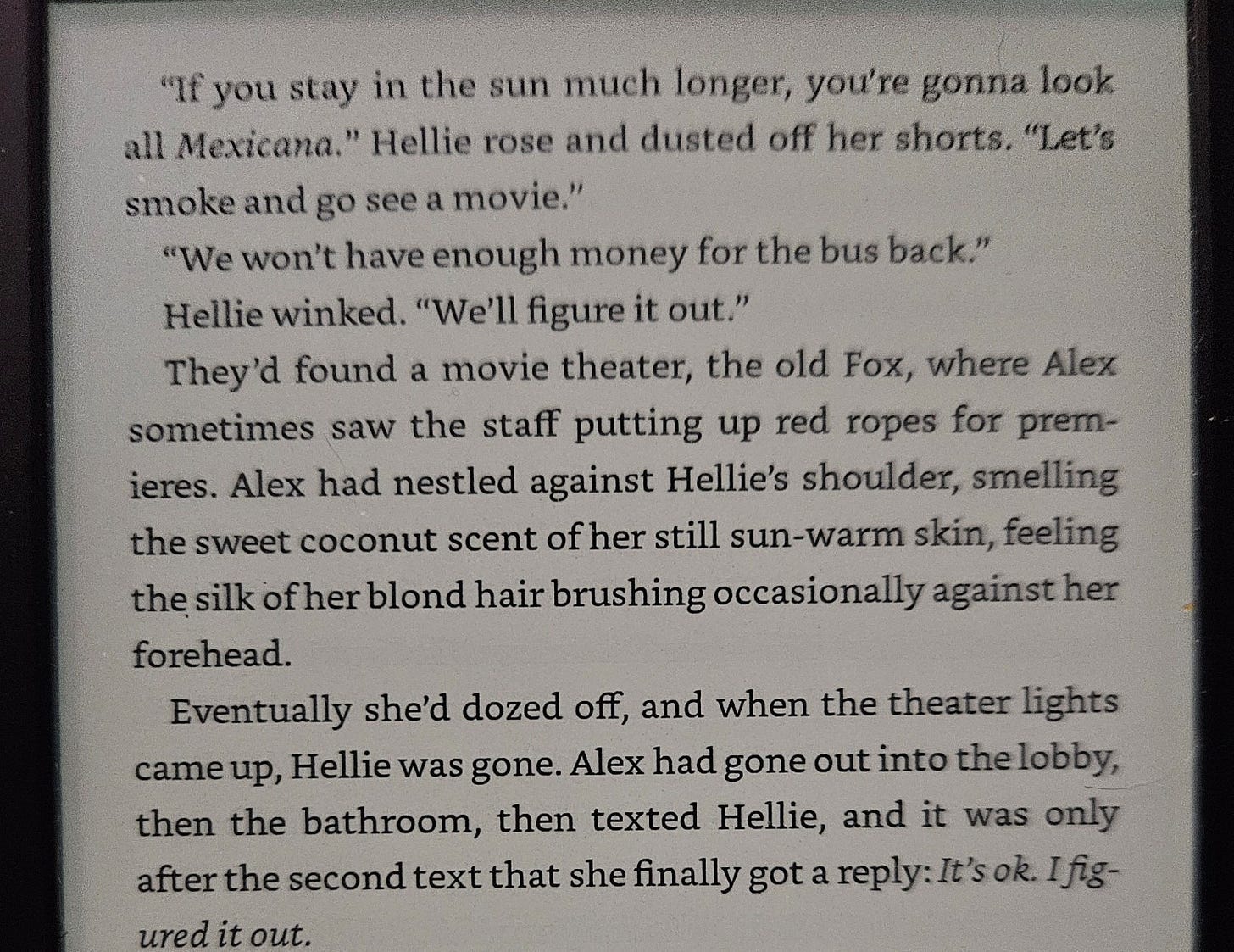
They even have a plan to run away together, one they keep bringing up when things are bleak and difficult.
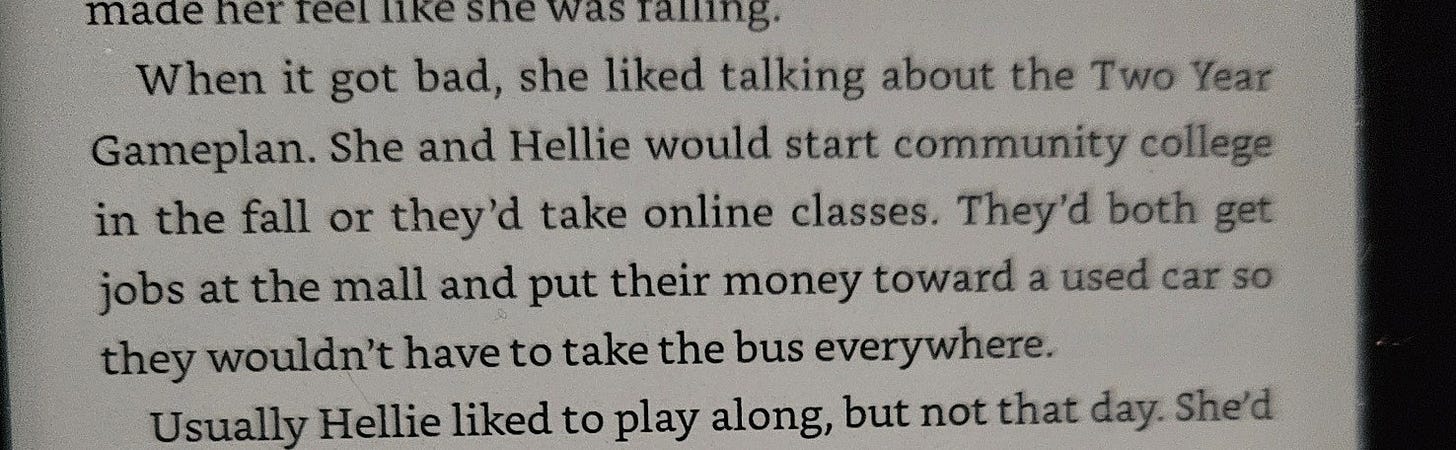
This is the sort of thing that would become a fixation of a lesser book, this sudden burst of queer love in the middle of a largely heterosexual book about upper academia. A worse writer would have spent hours pouring over Alex’s lingering gay feelings, wondering if she was a friend or a lover, and how much of their love for their boyfriends was compelled just by “it’s what you do.”
Leigh, wisely, simply moves on from this question. Why would Alex think about that? Hellie’s death weighs on her, and she’s already got budding feelings towards Darlington that she’s refusing to admit to herself. If someone asked her, “Did you love Hellie?” she would go, of course. No one is there to ask if it was more than friendship, and driven by shame and loss, Alex wants to bury that chapter of her life. So we move on, leaving her complex sexuality unexamined, maybe to explore in another book — or maybe not.
More delicious, granular little details that makes Alex fascinatingly complex, in the way a twenty year old woman with a troubled past and a rare gift would be.
Standing opposite to her is Darlington, who the book presents as everything she isn’t. Alex is a grubby, drug addicted street urchin with track marks, arm tattoos, and a smart mouth, thrust into this world she resents but can’t walk away from. Darlington, meanwhile, is refined, handsome, cultured, and seems to come from money. The magical world comes naturally to him, and he’s a little too eager to flex his knowledge, always with the right answer, and more than a little smug about it.
And yet, as they spend time together, it starts to become clear Darlington isn’t what he seems. He has some authority and insight and experience on the campus, but the faculty don’t seem to respect him or even like him that much. Who would like the campus police for an ivy league college, especially when it’s undoubtedly full of arrogant rich kids? If he had some authority or respect, why all the hazing rituals he doesn’t even seem to see are being mean to him? For all his fine grooming and intelligence, he doesn’t seem to have any friends either. Just Alex.
Alex and Darlington don’t get to see each other’s backstories to the fullest, just the details they tell one another when they absolutely have to, but we the audience get it. And there’s more of that wonderful duality coming to the forefront — Darlington does come from money, but his parents abandoned him with his grandfather for much of his life. When he died, Danny had nothing other than his estate they wanted. Fixating on protecting his grandfather’s legacy, Darlington clung to it like a life raft, even after he couldn’t pay its bills and had to sleep in the cold. If not for his intuition noticing the supernatural world and getting the attention of Lethe, Darlington would’ve probably died of exposure and poverty, stalling his parents acquiring his home for only a short time.
Sleeping in the cold, fighting off hunger, and getting whisked away to the magic college only a short time ago? The two protagonists are more alike than they seem, and again, Bardugo is smart enough to have them never talk to each other about it. They see only peeks at each other’s true selves, behind the facades they wear when working. Darlington puts on an expensive suit in the same way that Alex acts like a prickly smart ass — a protective layer, hiding the vulnerable part they don’t want to reveal. Young people, forced to grow up too quickly, struggling to identify what they want out of life other than, “keep my opportunity from collapsing underneath me.”
At one point, after an especially traumatizing event where ghosts started laying their hands on her — something Darlington literally didn’t know was possible — Alex finally explodes at him, smashing a piece of expensive glassware in his home and demanding to know why Lethe didn’t help her even once when she was a child. Despite knowing she could see ghosts for so long, despite monitoring her for years, no one at Lethe came to her and to help her deal with her supernatural senses. The same ones that ruined her life.
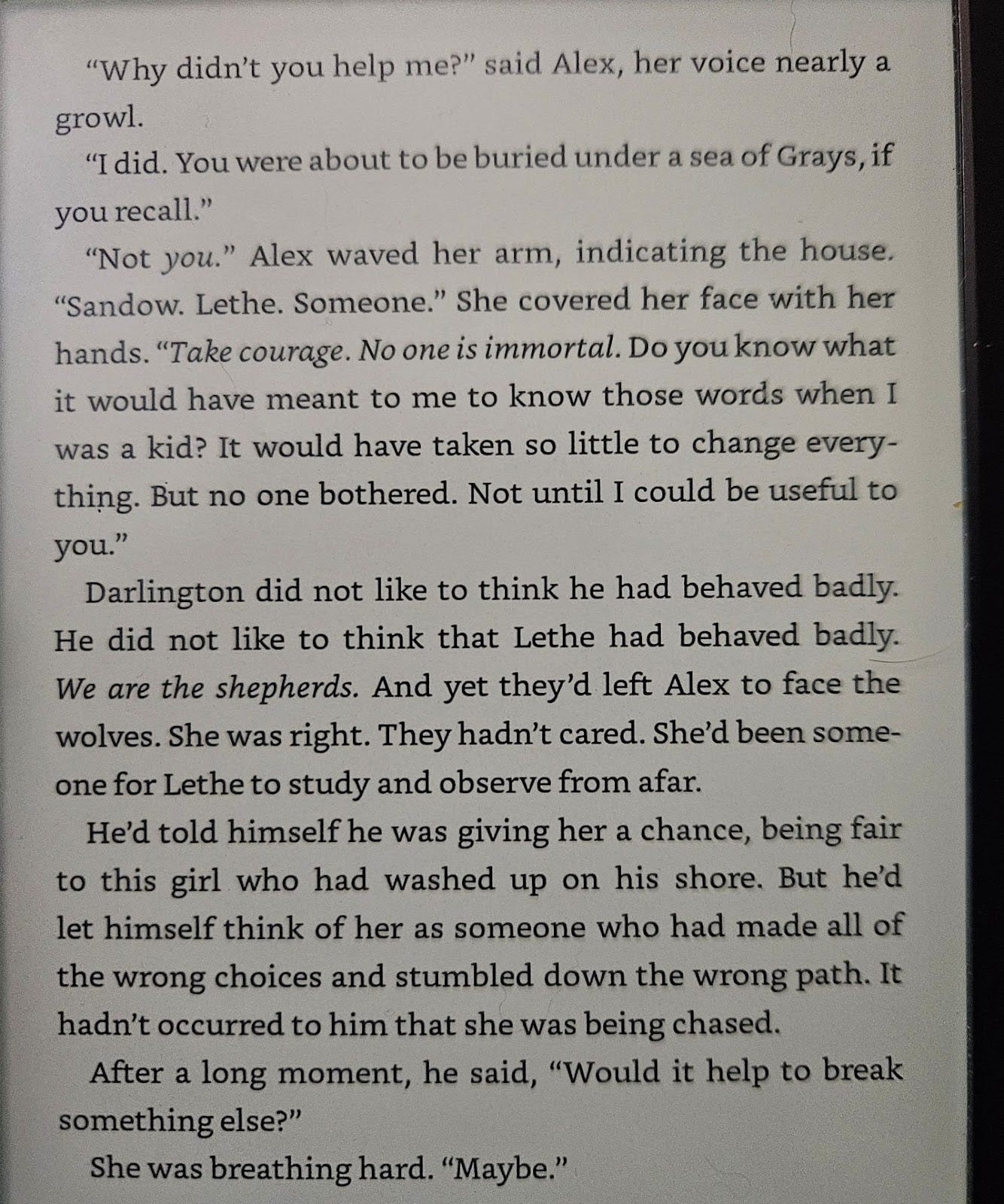
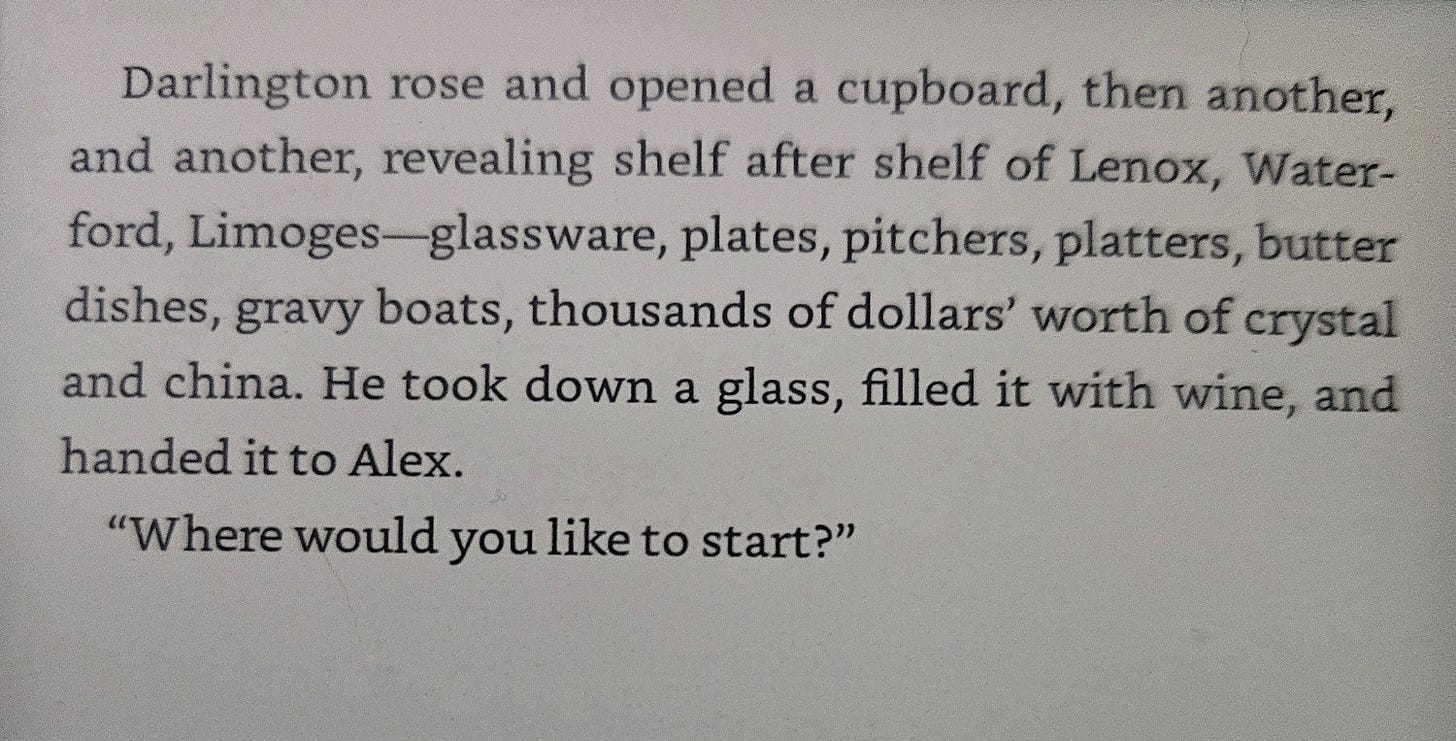
Darlington loves Lethe, at least at this point in the story. But he’s aware the school neglected him too, until he was useful to them. And it gets him thinking about how the school seems to only select who is useful, not who is truly alone and suffering. The school saved him, yes, but also, for their benefit. So Darlington offers her something she wants — to destroy something of Lethe’s, in a petty act of revenge against people who neglected her until she was useful. Much like how the world and Lethe neglected him.
This duality just keeps coming up through the whole story. Poverty and wealth. The powerful and the disposable. Magic and mundane. Solidarity and selfishness. Consumption and collaboration. Community and the individual. All handled with a deft, gentle touch that doesn’t make the core theme too blunt. There’s even a careerist girlboss character, and rather than really layer home how her interest in Alex is purely selfish, it’s merely hung over the scenes she appears in. Alex doesn’t even seem to parse how self-involved her would-be mentor is, other than how she acts just like the rest of the school. I could kiss this book for having the bravery to not tell me the meaning in words — implying it from the events is enough.
Their interest in each other — the slow, circling curiosity, admiration, and respect they grow over the story — feels so grown up and mature. As I said earlier, Darlington is a perfect example of everything Alex ostensibly would have no reason to trust or want; a rich, pretty man with power over her.
Sex and love for Alex for most of her life was a way people got what they wanted, right down to a scene of teenage Alex being told by her boyfriend to “keep our rich guest happy” and deciding without emotion to give him a blowjob. When her boyfriend is mad, Alex is legitimately confused. You didn’t…want me to do that? What’s the big deal? I just sucked his dick. It doesn’t, you know, mean anything.
And likewise, Darlington wouldn’t take a second look at Alex normally. Not only is he a stand up gentleman who would never abuse his position, a fact he takes pride in, she’s also just not his type. Too rough, too brittle, too different. She’s a coworker and a friend, and his understanding of romance is all old fashioned courtship rituals, likely learned from his blueblood grandfather. Gentle compliments, flirtations, slowly working your way up to offering to go on a date together.
But the characters are too fucked up from their damage to know what they truly want, how to get it, or what to do with it if they had it. They are, after all, college kids hoping to lock in a meal ticket for the rest of their lives. So the mutual attraction — not merely sexual, but based on genuine affection and admiration — starts to manifest itself in small ways they dismiss and rationalize.
Darlington vanishes from the story for the second half, and Alex suddenly feels isolated and lost without him. She sneered at him when he was alive and babysitting her around campus, but it’s a scary world, and his competence was a wonderful aid. While working on the murder case, she stays at his place — petting his cat, sleeping in his bed, dreaming about him laying next to her, speaking of their relationship.
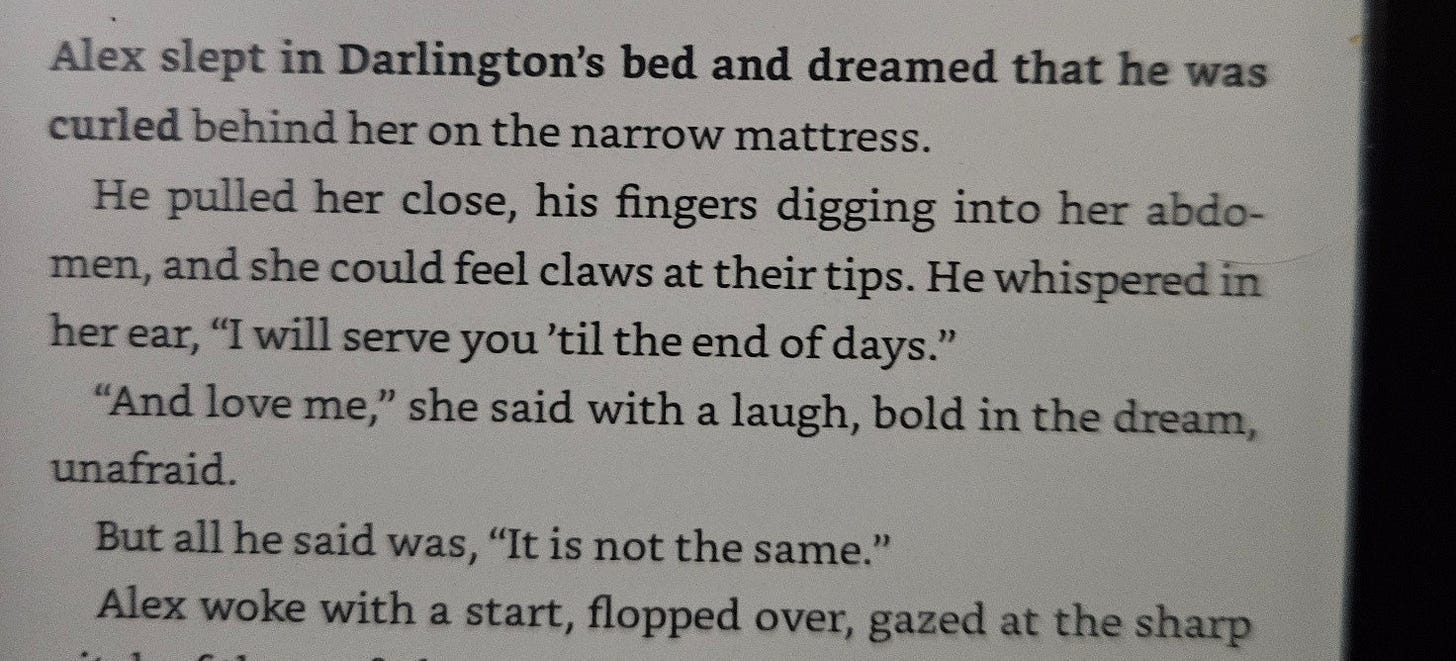
Deep in her id somewhere, Alex knows she likes him. She knows deep down that his kindness, gentleness, and respect for her belies his nature as a good guy who will do right by her. But she’s pushed away everyone in her life, even her mother, due to her wholly unique second sight, and now it’s reflexive. Alex is fiercely loyal, but she’s never actually trusted before. You get the feeling — backed up by the second book, apparently — that even if she did admit her feelings to herself, she wouldn’t know what to do with it. What does a boyfriend look like to you, when you’ve only understood it to be sex and drugs and fatalism?
Likewise, Darlington is also too much himself to ever admit his attraction to Alex. From the outside, Darlington looks like a buttoned up, controlled, authoritative figure, stuck with this drowned rat fished out of the sewer because of happenstance. And yet, he keeps being surprised at how socially capable she is, in this nest of vipers they call a school, like when they attend a party hosted by Manuscript, the illusion magic house.
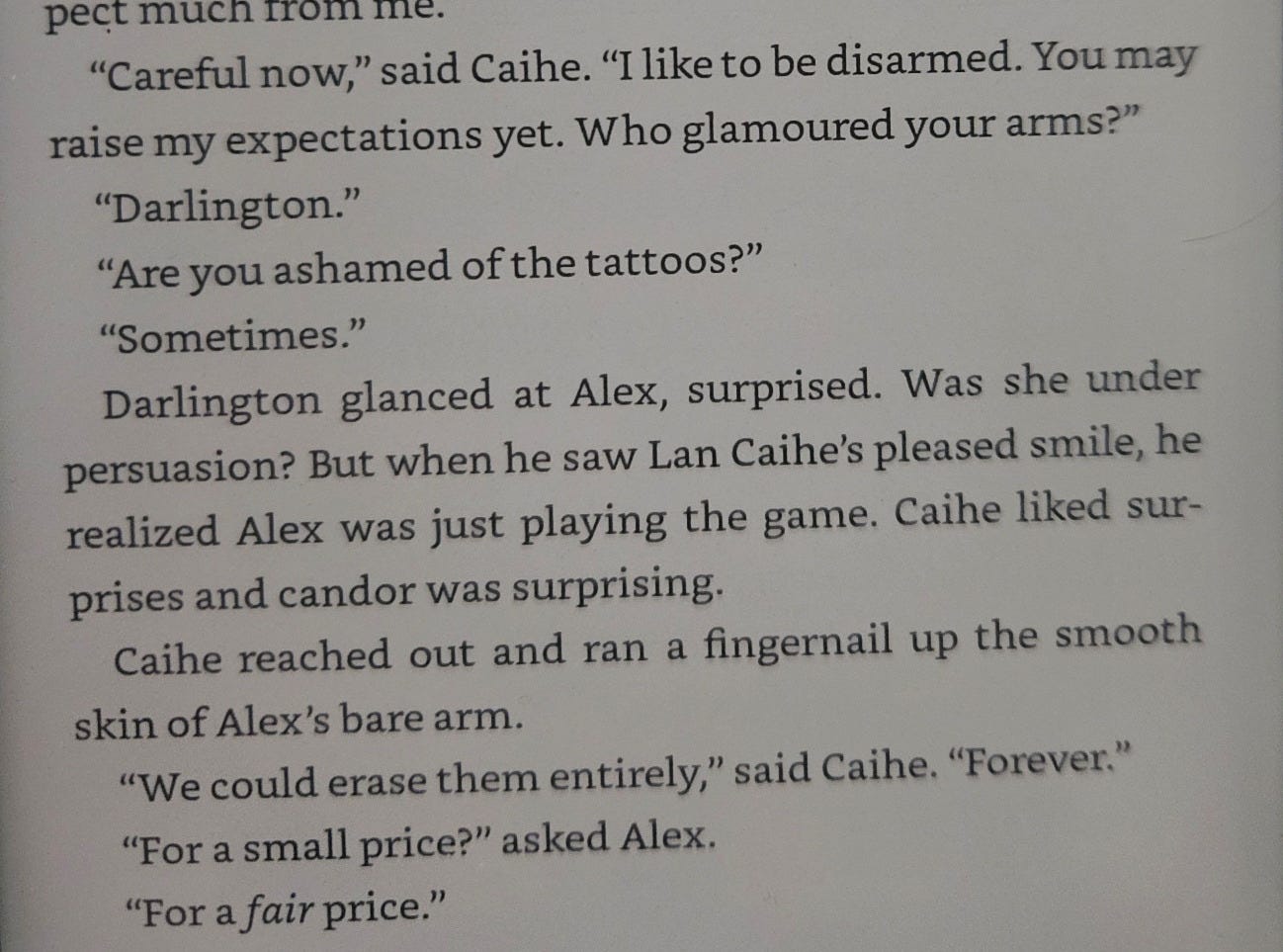
Expertly engaging, entertaining, and keeping distance from an authority figure who is openly looking for an angle to work. Darlington does not know her as well as he thinks he does. Nor does she know him.
And when Danny gets drugged, making him lustful and without restraint, what does he act like? Does he become a horny fool for the beautiful people of the Manuscript costume party? Does he embarrass himself burying his face in a faculty member’s tits?
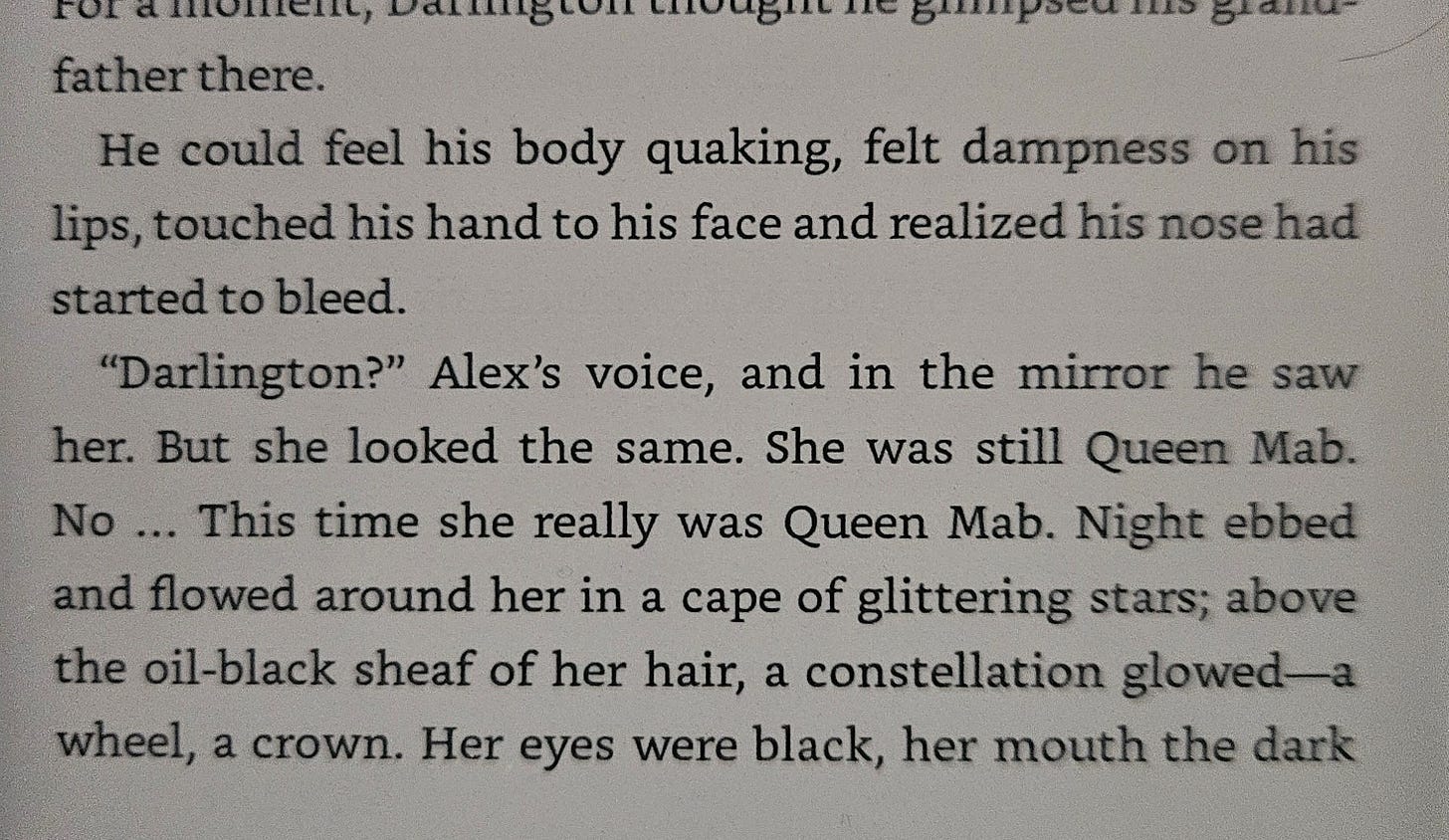
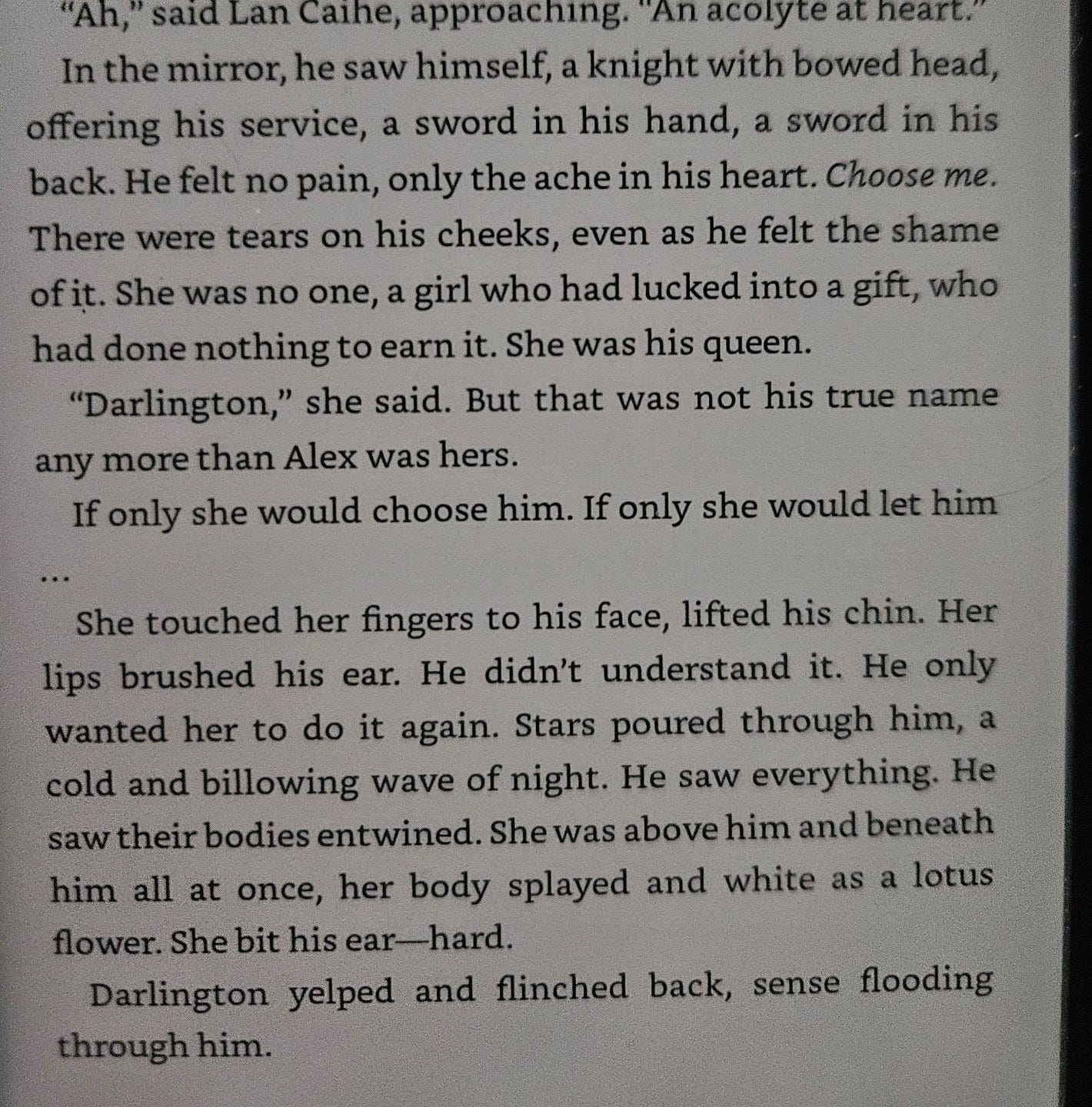
Darlington sees himself as a knight in service, out to make the world a just place. And in Alex, he sees not just a like minded champion, but someone who is better than him. Someone he can respect, someone he wants — needs — the approval of. Someone, for the first time in his life, he could swear his loyalty to and have it be placed somewhere good and righteous. Lethe does not have his loyalty, nor does it deserve it. But Darlington feels in his gut that Alex would, even when he doesn’t know it himself.
When Darlington kneels before her, mouth inching over Alex’s pubic mound, it’s because he (quite literally) looks up to her. The parallel to Alex sucking a rich guy’s dick because it seemed like her boyfriend asked her to impress him can’t not pop up in my mind.
And is Alex furious at him for this behavior? Not even slightly. She instantly figures out he’s drugged, helps him leave, dismisses his actions, patches up his wounded pride, and agrees to file a report about what happened. Mortified, Darlington allows her to take charge — the thing his id told him he craved when he was drugged.
I’ve read explicit fuck scenes, graphic and wet and messy, and this proud, handsome boy dropping to his knees under a lust drug and practically begging to do oral on his queen of the night, who immediately brushes it off with a tsundere persona, is one of the hottest things I’ve read in a long time.
Darlington almost certainly expected she would be a nervous wreck around all these high society socialites throwing a party, trying to finagle some business, and fucking with each other with drugs. But there’s that duality again – her youth was spent in drug dens and sleazy parties, who else would you want by your side?
Loyalty, service, and fealty keeps being a recurring thing in the novel, largely pointed at the direction of their roles as Dante and Virgil of the school. But for all the talk of the roles they serve being noble service in a just cause, what both of these kids want is someone they can trust, someone they can believe in, because they’ve lived a long life without that and suffered. And no one, not even Lethe, would care if they weren’t useful.
Rules made to prevent cheating, exploitation, and criminal activity are often turned by powerful institutions into something resembling balance sheets. How many deaths can you get away with, and what angles can you work to make it benefit you when one happens?
Alex and Darlington might be campus cops for the school, but they’re still just students, and upper management has no loyalty to them if one of them suddenly goes missing. Cover your tracks, fill out a report, explain it as an unfortunate tragedy, and move on with your busy lives. Alex, who has a fierce sense of right and wrong, who has watched her drug dealer friends rush to hide a body, who does not care about consequences when injustice must be solved, is the perfect thorn in their paw.
No posts
Comments
Nothing yet. Say the first thing.
Sign in to join the conversation.