
Micron Technology is up over 330% in the past twelve months. It just reported fiscal Q2 2026 results that nearly tripled year over year revenue to $23.9 billion, with gross margins of 75% and earnings per share of $12.20 that obliterated a $9.00 consensus. It guided Q3 to $33.5 billion in revenue at 81% gross margins, a single quarter that exceeds every full year revenue total in the company’s history through fiscal 2024.
By almost any traditional measure, this looks like a stock that has already had its run.
I don’t think it has.
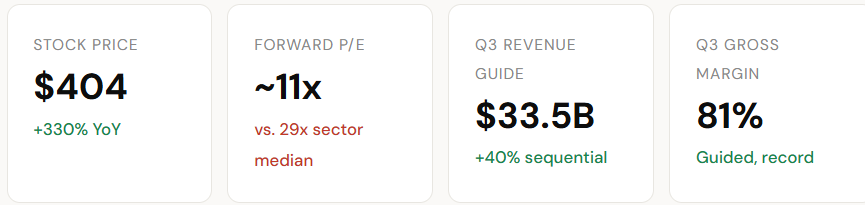
Even after a 330% surge, Micron trades at a forward P/E of roughly 10 to 12x. That is below the S&P 500, below NVIDIA at 36x, below the semiconductor sector median of 29x. The stock price has moved enormously. The multiple has not. The market has acknowledged Micron’s current earnings power. It has not accepted that this earnings power is anything more than a cyclical peak to be faded.
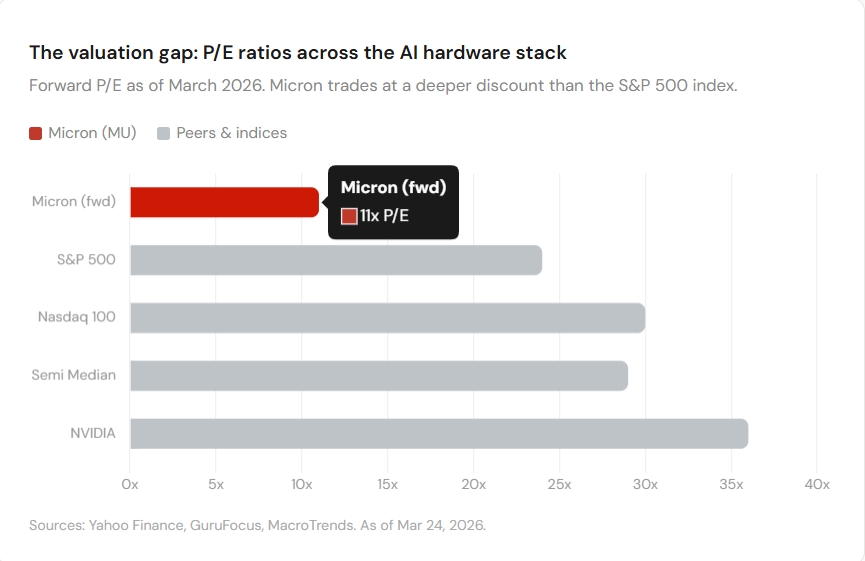
That gap between price performance and valuation multiple is the entire thesis. Micron’s revenue has been repriced. Micron’s identity has not.
I want to make the strongest case I can that Micron is being miscategorized, and then I want to honestly lay out the strongest case against my own argument, because the piece becomes more useful when you can see both sides clearly and decide for yourself where the weight of evidence falls.
The foundational claim is simple: AI has shifted the primary bottleneck in computing systems from raw compute to memory bandwidth. If that claim is true, everything else in this piece follows. If it is false, nothing else matters.
It is true, and it is no longer controversial among people who actually build these systems.
The performance gap between processor speed and memory bandwidth, what the industry calls the “memory wall,” has become the dominant constraint in AI inference. Leading systems researchers have demonstrated that primary performance challenges in modern AI workloads are memory throughput rather than compute. New architectures show 10 to 40x gains when optimizing for memory bandwidth. At the Morgan Stanley conference in March 2026, NVIDIA’s Jensen Huang said that however much high bandwidth memory the world’s factories can produce, NVIDIA is ready and willing to absorb every unit.
The key word is inference.
Training large models is capital intensive but episodic. Inference is persistent, ubiquitous, and scales with deployment. Every token a model generates requires accessing billions of parameters stored in memory. Every step of reasoning requires holding and retrieving prior context. The speed at which memory can feed data to the processor determines the speed at which the system can think.
Three converging demand drivers are about to multiply memory requirements in ways that are not yet reflected in most forecasts.
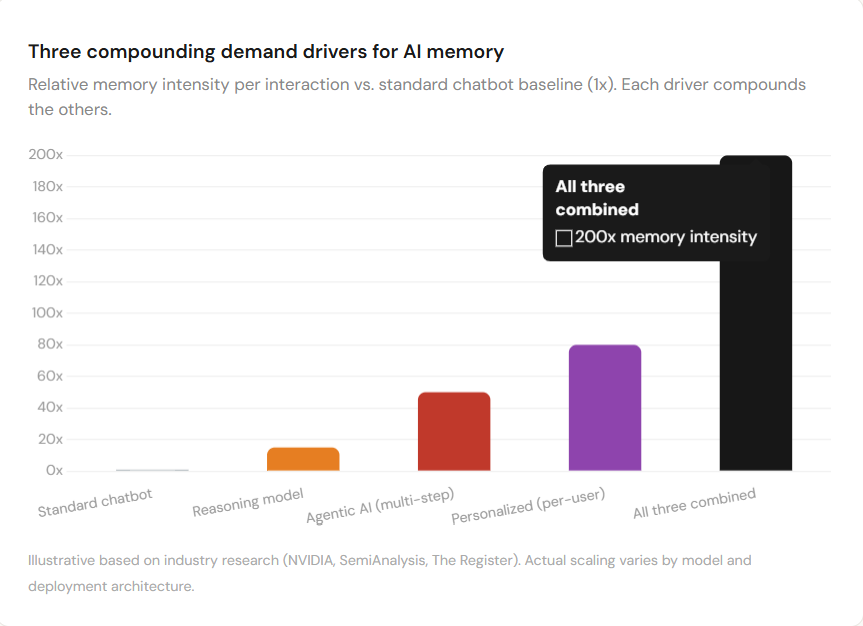
Agentic AI is the most important of the three. This is the shift from one-shot chatbot interactions to autonomous AI agents that reason across multiple steps, use tools, maintain persistent context, and complete extended workflows. From a memory perspective, this is transformational. An agent accumulates context. It holds intermediate reasoning states in a key-value cache that grows linearly with sequence length and must remain in high-speed memory. NVIDIA launched its Inference Context Memory Storage platform at CES 2026 specifically to address this constraint.
Why does this matter for the investment case? Because agentic AI is what turns AI from an impressive technology into an economic engine. A chatbot is a productivity tool. An agent is a worker. When AI can autonomously execute multi-step tasks, the willingness to pay scales from “nice to have” to “core operational expense.” That is the transition from capex running ahead of revenue to revenue catching up to capex.
Reasoning models dramatically increase tokens generated per query, consuming 10 to 100x more memory bandwidth per interaction than standard completion models.
AI personalization scales memory requirements with concurrent personalized contexts across hundreds of millions of users, creating demand that is essentially unbounded at current infrastructure levels.
Each of these trends compounds the others. And they are all accelerating simultaneously.
The most intuitive bear case against sustained memory demand is that software will get more efficient. Model compression, quantization, mixture-of-experts architectures all reduce memory required per inference operation.
That is true at the unit level. It is almost certainly bullish at the aggregate level.
Make inference 10x cheaper and you don’t get 10x less inference. You get 100x more, because every efficiency gain unlocks applications, users, and deployment scenarios that were previously uneconomical.
This is Jevons’ paradox applied to compute, and it is the single most misunderstood variable in the entire memory investment thesis.
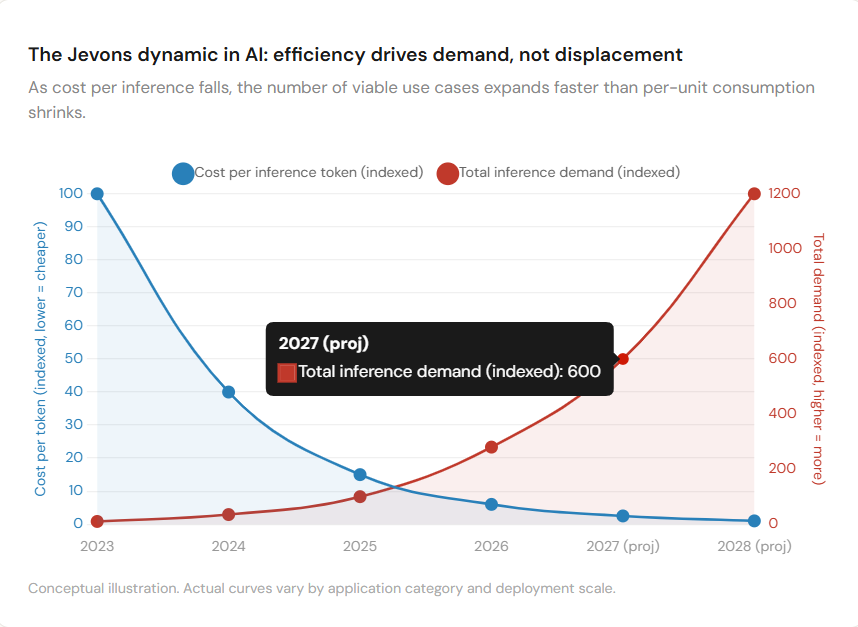
The evidence already confirms this pattern. Despite massive improvements in inference efficiency over the past two years, total demand for inference compute and memory has increased, not decreased. Micron’s management noted that demand exceeds available supply across every market segment.
But there is a deeper point. Efficiency gains do not just increase memory demand. They accelerate AI’s economic viability. Every reduction in cost-per-token brings AI closer to positive unit economics in more use cases, which drives deployment, which generates revenue, which justifies continued infrastructure investment. This is the virtuous cycle that makes the hyperscaler capex story more sustainable than skeptics assume: efficiency improvements make the bet more rational, not less
The strongest evidence that something structural has changed is not the revenue. It is the margin structure.
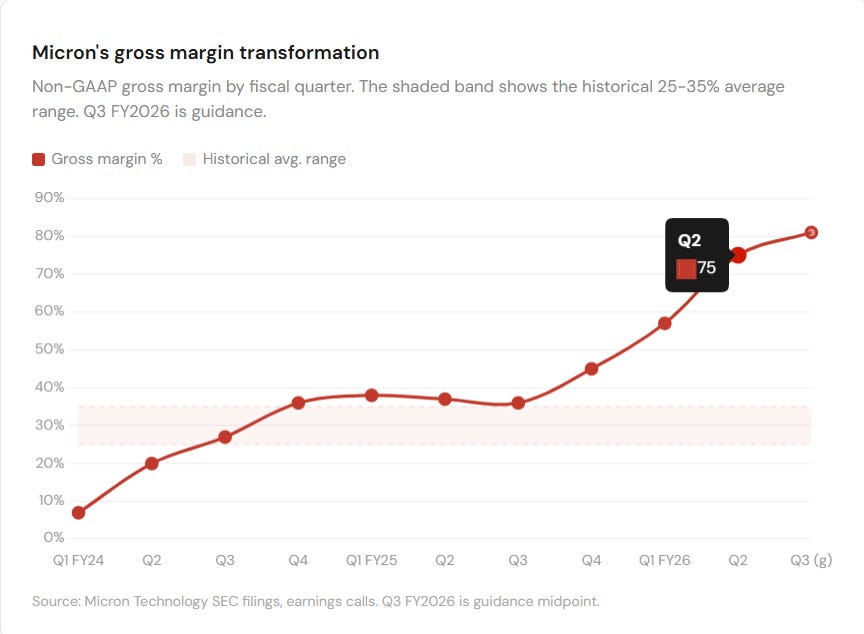
Micron’s gross margins averaged 25 to 35% for most of the past decade. Last quarter they hit 75%. Next quarter guidance is 81%. These are margins historically associated with monopolist software companies, not commodity chipmakers.
Understanding which forces are durable and which are transient is critical.
What is durable: HBM commands dramatically higher ASPs due to advanced packaging, vertical die stacking, and customer-specific customization. HBM is increasingly designed into specific platforms, creating qualification cycles and switching costs. This is a genuine structural change that will not revert.
What is also durable but less appreciated: The reallocation of capacity toward HBM is tightening supply of standard DRAM, driving conventional prices up over 100%. IDC described this as “a potentially permanent strategic reallocation of the world’s silicon wafer capacity,” a zero-sum game where every wafer allocated to HBM is denied to consumer devices.
What will moderate: Current margins of 75-81% reflect extreme imbalance. Even if the structural thesis is correct, margins this high attract investment that will eventually add supply. The question is not whether margins come down from 80%. They will. The question is whether they settle at 50-60% (transformative for valuation) or revert to 25-35% (the old commodity world).
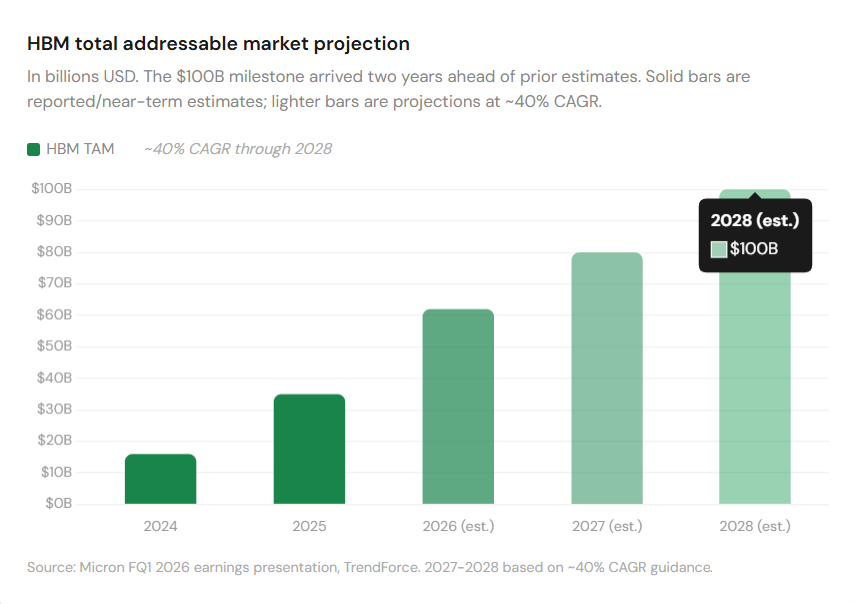
Micron’s entire HBM production for calendar 2026 is 100% sold out. SK Hynix expects shortages to persist until approximately 2030. AI is projected to consume nearly 20% of global DRAM wafer capacity in 2026. New fabs take 4 to 5 years to build. Advanced packaging, the actual bottleneck on HBM assembly, is even tighter.
I want to be precise here, because the competitive landscape is the area where bulls are most prone to wishful thinking.
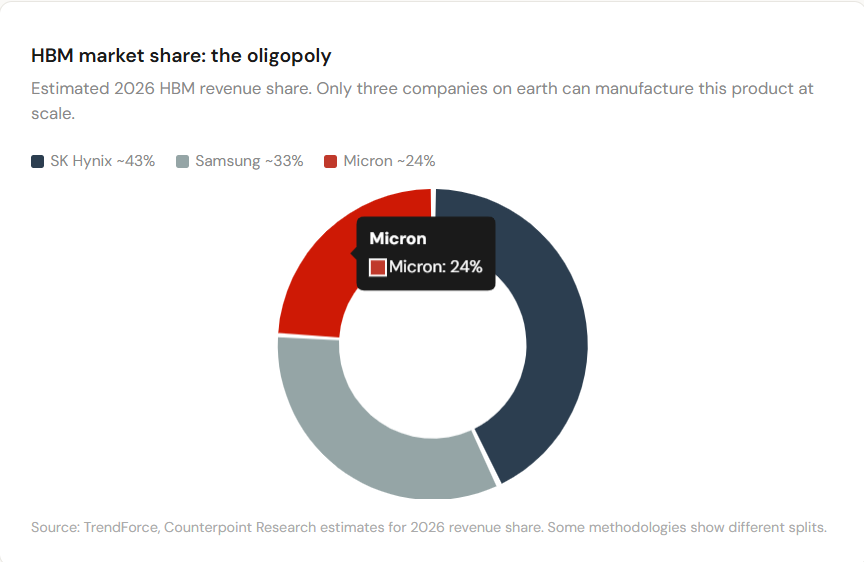
SK Hynix is the dominant leader with 50 to 62% of HBM shipments and reportedly secured over two-thirds of supply orders for NVIDIA’s Vera Rubin. Samsung is staging a comeback with a $73 billion capex commitment. Micron holds approximately 21 to 24% share, though some revenue-weighted estimates put it lower. A March 2026 TrendForce report suggested Micron’s HBM4 may be positioned for mid-tier inference accelerators rather than the flagship Vera Rubin.
That is the honest picture. Here is why it still supports a bullish thesis.
In a market tripling in three years, you do not need to lead to win. Even if Micron’s share stays at 24% of a $100 billion HBM TAM in 2028, that is $24 billion in HBM revenue alone, up from roughly $8 billion today. The asymmetry comes from participating in explosive market growth.
Micron is executing above its ranking. Revenue tripled. It was the first supplier to bring HBM4, Gen6 SSDs, and SOCAMM2 to volume production simultaneously for Vera Rubin. Its 1-gamma DRAM node delivers 30% better power efficiency than the nearest competitor. Q2 FY2026 revenue beat guidance by 27%.
Micron is the only American company in the trio. CHIPS Act funding, reshoring dynamics, and supply chain diversification create structural tailwinds. This advantage will compound as U.S. fabs reach production in 2027-2029.
Energy efficiency is becoming a gating factor. In power-constrained data centers, Micron’s 20% HBM4 power efficiency advantage is a deployment multiplier, not a secondary spec.
Every memory investor who has ever said “this time is different” has eventually been wrong. That history deserves respect.
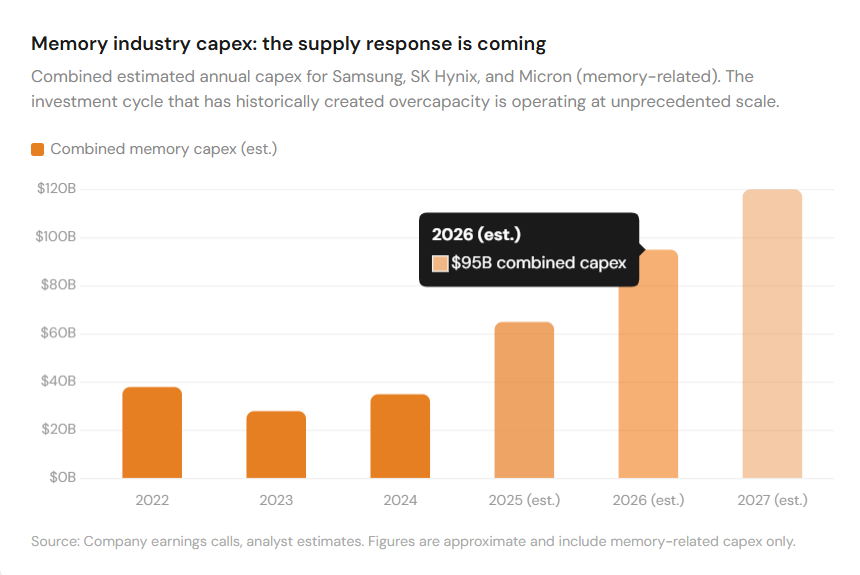
The supply response is massive. Micron is spending over $25 billion in FY2026 with a meaningful step-up in FY2027. Samsung committed $73 billion. SK Hynix is building mega-fabs. Multiple analysts flag that “an oversupply scenario in 2028-2029 remains a realistic possibility.”
Hyperscaler capex may be unsustainable at current growth rates. The top five hyperscalers are projected to spend $602 billion in 2026, with capital intensity approaching 30% of sales. They have issued over $100 billion in bonds to fund this spending, with investors demanding record CDS protection. Man Group argues the capex is partly a recursive loop where companies invest because competitors are investing, not purely because revenue justifies it.
Micron’s stock has historically peaked before earnings peak. In the 2017-2018 cycle, the stock peaked at a trailing P/E of roughly 3 because the market priced the coming downturn. The stock declined while earnings were still growing. If that pattern repeats, current prices could be a local top.
Current margins are almost certainly not sustainable at these levels. 75-81% reflects extreme imbalance. Some compression is inevitable.
These are real risks. I do not dismiss them.
Here is where I push back on my own bear case.
The standard cyclical argument assumes that demand is roughly static while supply catches up. That assumption held in every previous memory cycle because the demand drivers (PC refresh cycles, smartphone upgrades) were stable and predictable.
This cycle is different in one critical respect: the demand target is moving, and it is moving faster than supply can chase it.
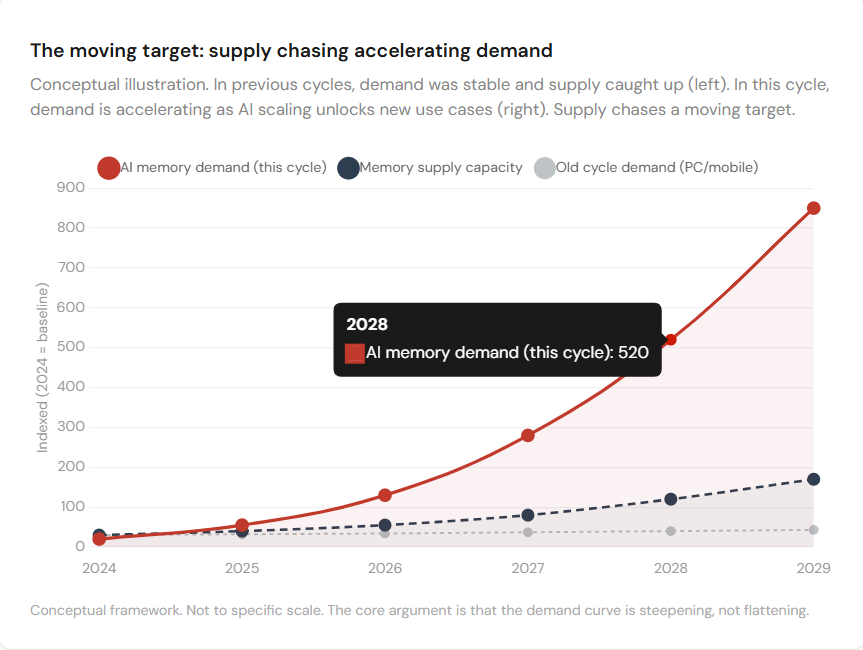
AI scaling laws are not a theory. They are an empirically validated relationship in which model capability improves predictably with compute, data, and parameters, and each improvement in capability unlocks new commercially viable applications.
Consider the trajectory. In 2024, AI was primarily chatbots and image generators. In 2025, coding assistants and search integration. In 2026, autonomous agents, reasoning systems, and AI-native enterprise workflows. Each stage increases both the memory intensity per workload and the total number of workloads deployed.
By 2028, when new fabs come online and the bear case expects supply to catch up, the demand landscape will likely look nothing like today. If agentic AI is widely deployed at enterprise scale, if reasoning models are standard in consumer products, if personalized AI assistants are running continuously for hundreds of millions of users, then 2028 demand will be multiples of 2026 demand, not roughly equal to it.
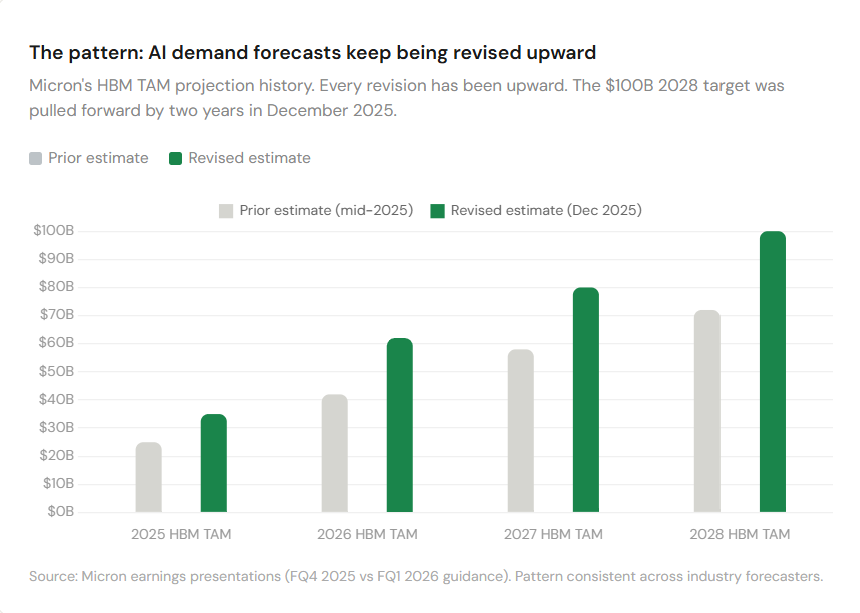
When the bears say “supply will catch up by 2028,” they are assuming the demand side holds still. There is no evidence it will. Every major demand forecast over the past three years has been revised upward, often dramatically.
This does not mean margins stay at 81%. They won’t. But it does mean the downcycle, when it comes, may be shallower and shorter than historical patterns suggest, with margins settling in the 50-60% range rather than reverting to the 25-35% commodity baseline.
The hyperscaler capex concern is the more serious risk. But here too, the demand side matters. Agentic AI is creating genuinely new categories of economic value. Unlike the dot-com era, where infrastructure was built speculatively ahead of revenue, this cycle is seeing revenue ramp alongside infrastructure, even if it lags. Each quarter the gap narrows. If agentic AI delivers on even a fraction of its commercial promise, the capex becomes self-sustaining, not speculative.
That is a bet on the technology being real. I believe it is.
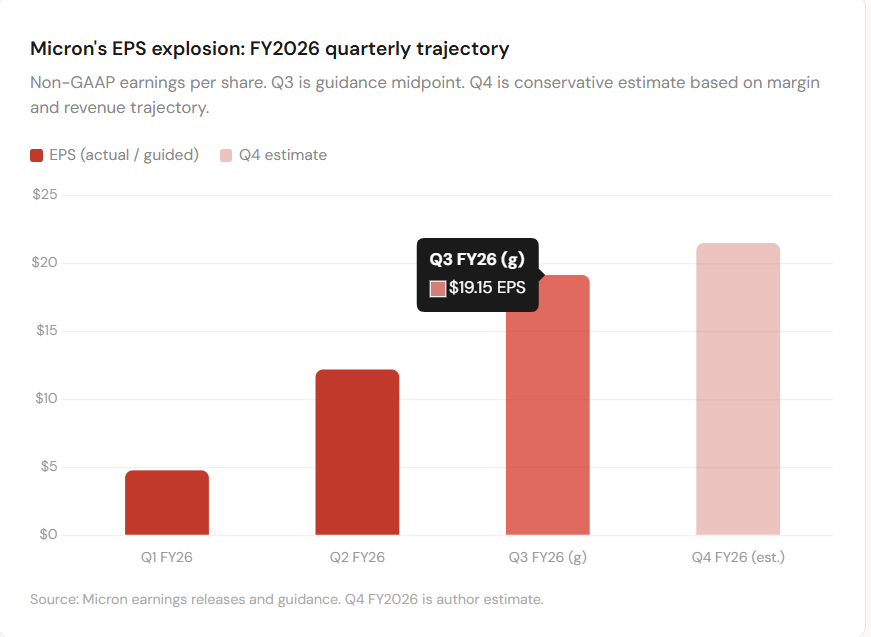
Q1 FY2026 EPS: $4.78. Q2: $12.20. Q3 guidance: $19.15. Full year FY2026 EPS likely lands at $56 to $59. Management expects records across every metric for Q3 and the full fiscal year, with market conditions remaining tight beyond 2026.
There are too many variables to give a single price target with false precision. Instead, here are scenarios with honest probability weights. Assign your own if you disagree.
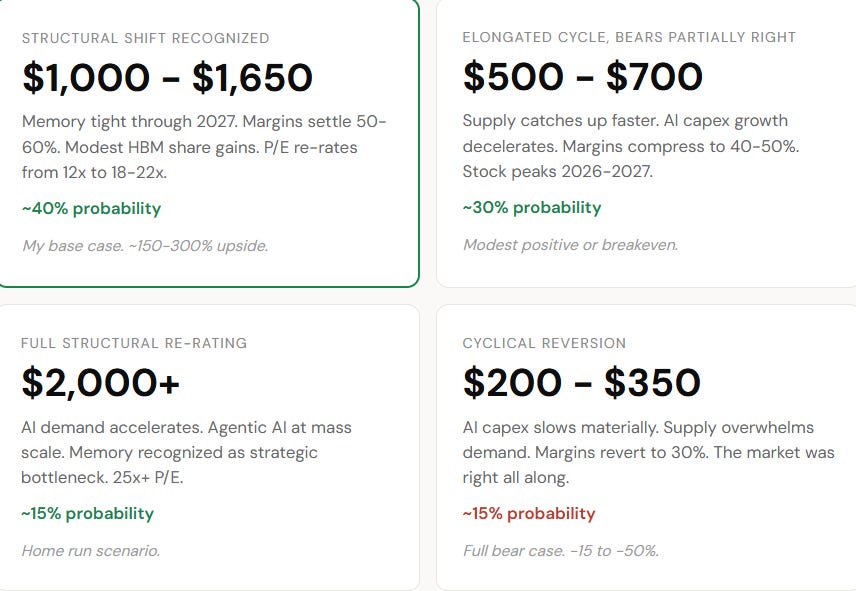
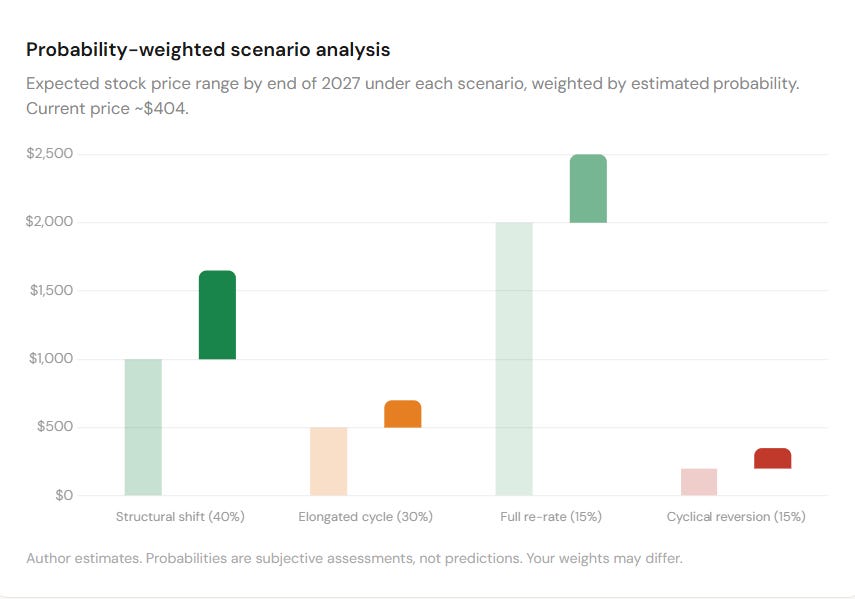
Two sources of upside the market is not pricing:
1. Earnings growth alone. If FY2026 EPS comes in at $57 and FY2027 grows even modestly to $65, at a depressed 15x P/E that implies $975. That is 140% upside with no re-rating at all.
2. Multiple expansion. The distance between 12x (where Micron trades today) and 20x (still below semiconductor median) is enormous. That re-rating alone doubles the stock on top of earnings growth. It does not require Micron to be treated like NVIDIA. It only requires the market to stop treating Micron like a commodity cyclical.
AI scaling laws are shifting the semiconductor bottleneck from compute to memory bandwidth. This is creating a structural increase in demand for high-performance memory that will persist for years, not quarters. The supply response will eventually come, but it is chasing a demand curve that is steepening faster than new capacity can be built. That is the fundamental asymmetry.
Micron sits at the center of this shift, executing at record levels, participating in a market that is tripling in three years, and trading at a valuation that assumes all of this is temporary.
It might be temporary. Memory has always been cyclical, and humility about one’s own thesis is a prerequisite for surviving in markets.
But if the structural case is even partially correct, if margins settle at 50%+ instead of reverting to 25-35%, if AI demand in 2028 is multiples of 2026, if the market slowly begins re-rating memory as strategic infrastructure rather than commodity inventory, then Micron at a 10-12x forward P/E is not just cheap. It is mispriced at a categorical level.
The market will reconcile this eventually. The question is whether it takes two quarters or two years. I am willing to wait.
Disclaimer: The author holds a concentrated position in Micron Technology (MU). This is analysis, not financial advice. The scenarios described involve genuine uncertainty, and the author could be wrong. Position sizing should reflect that uncertainty. Do your own due diligence.
No posts
Comments
Nothing yet. Say the first thing.
Sign in to join the conversation.