
On 26 February, Iranian and American negotiators met in Geneva and reopened a diplomatic channel that had stalled for months. Oman, acting as intermediary, projected optimism and reported “significant progress.” Tehran indicated readiness to transfer 400 kilograms of highly enriched uranium, and both sides scheduled a fourth round in Vienna for the following week. The process moved forward on a limited and fragile track.
Forty-eight hours later, Trump, in coordination with Prime Minister Netanyahu, ordered a strike that decapitated Iran’s senior leadership and terminated the talks.
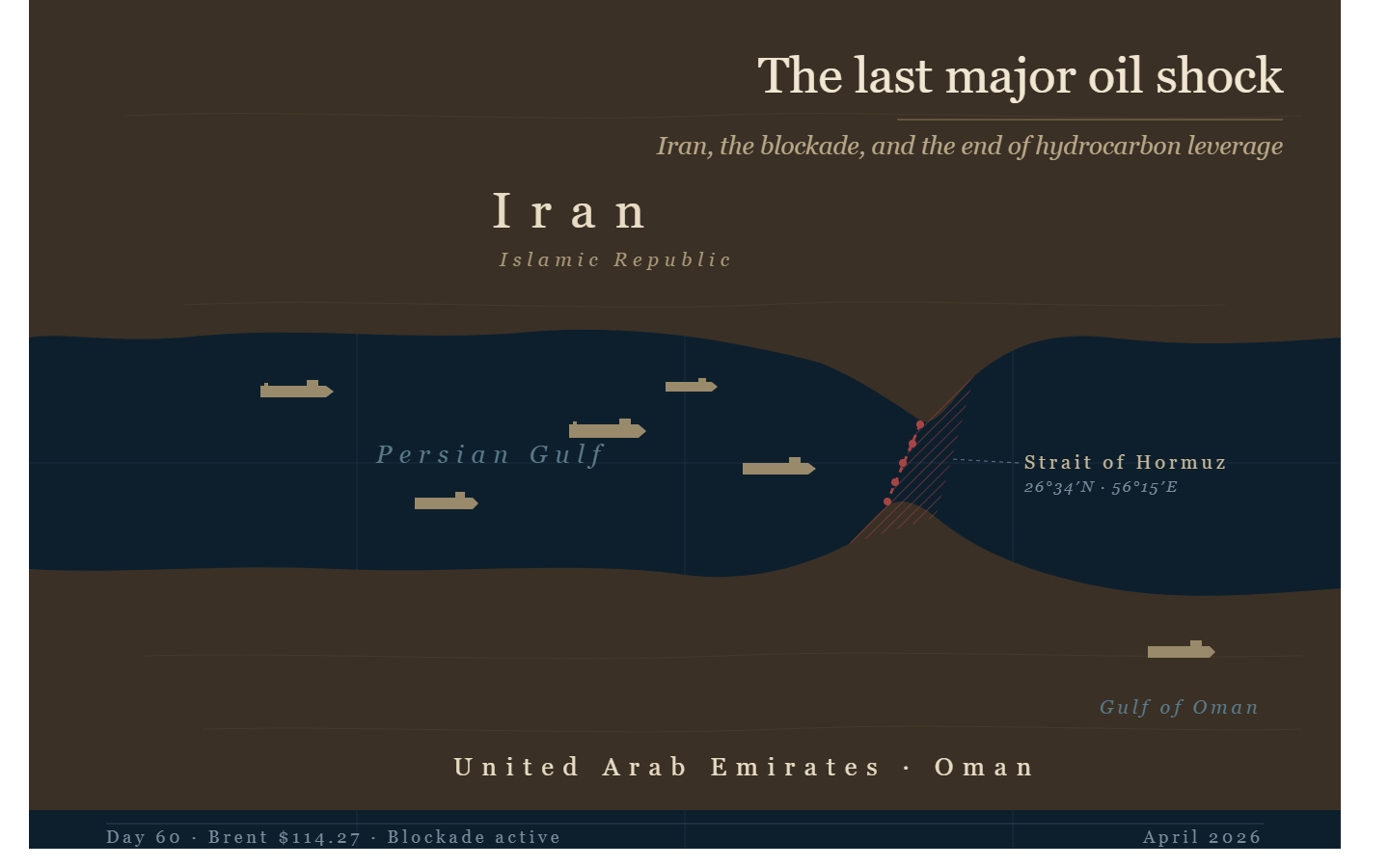
Sixty days later, the consequences of that decision have hardened into a new operating environment. The Strait of Hormuz sits under a double blockade. Brent crude closed above $114 on 29 April, its highest level since June 2022. Trump has instructed aides to prepare for an extended blockade after rejecting Iran’s latest three-phase proposal as bad faith, while senior officials warn privately of a toxic, Cold War-style stalemate. He has weighed the alternatives, renewed bombing or withdrawal, and selected the blockade as the more palatable option.
The scale of the disruption is already clear. The IEA has described this as the largest energy supply shock on record. Markets, however, continue to blissfully price the disruption as temporary. The spread between current prices and those implied by a sustained constraint on Gulf energy flows has become the central variable in global markets, and that gap is set to widen as conditions persist.
Maintaining the blockade commits the United States to the most damaging trajectory available. A prolonged confrontation that constricts the Strait of Hormuz places sustained pressure on global energy supply, drives price volatility, and transmits shocks across the international economy. It also entrenches a political deadlock with no clear resolution or exit, forcing a continuous allocation of attention and resources without producing a decisive outcome.
Diplomacy continues, but it functions primarily as signaling rather than negotiation. Trump’s position requires any agreement to impose strict limits on Iran’s enrichment, extend timelines beyond the JCPOA, and address regional activity at the outset. Iranian proposals reverse that sequence, seeking early sanctions relief and de-escalation while deferring binding nuclear constraints. One side treats these elements as preconditions: the other treats them as the end state. The terms do not align, as each side seeks to preserve leverage while extracting concessions from the other.
To gain negotiating leverage, both sides have moved to apply pressure through opposing chokepoints. Washington has enforced a naval blockade of Iranian ports and expanded interdictions of tankers across the Gulf and Indian Ocean to constrain Iran’s seaborne trade and oil exports. Tehran has tightened control over transit through the Strait of Hormuz, disrupting a central artery for global flows of oil, gas, and key commodities. Each side attacks the other’s economic weak points while pushing the costs onto others.
This strategy rests on a shared assumption. Each side is betting that the other’s political tolerance for economic pain breaks first. Both assume time shifts the balance in their favor, which removes any incentive to compromise and converts delay into strategy rather than cost.
That logic points toward escalation rather than resolution. Even if direct fighting subsides for periods, constrained shipping and reduced oil flows persist, keeping energy markets tight and volatile. Those pressures prevent any stable equilibrium and increase the incentive to use force to break the stalemate. The result is a cycle of renewed hostilities at higher levels of intensity, while disruption to the Strait of Hormuz continues regardless of the tempo of combat.
Over the past several years, the Iranian regime has entered a period of sustained decline at home and abroad. Its deterrence weakened under continuous Israeli and American pressure, while the proxy network that had long served as its forward defense unraveled in sequence. Israeli operations degraded Hezbollah’s missile stockpiles, command structure, and infrastructure, and dismantled Hamas as an organized military force in Gaza. U.S. and allied strikes targeted the Houthis for disrupting Red Sea shipping, degrading their launch capabilities. Assad’s fall in Syria broke the land route linking these groups, fragmenting what had been a coherent strategic system into disconnected parts. While Iran’s proxies were battered, Tehran avoided meaningful intervention, knowing it could not compete conventionally. Its missile exchanges yielded limited results as interception systems blunted their impact, and Israeli operations penetrated Iranian territory with increasing frequency, striking air defenses, military infrastructure, and senior personnel. The balance shifted steadily against Tehran.
This external deterioration translated into mounting internal strain. Economic pressure intensified as oil exports held at roughly 1.5 to 1.8 million barrels per day, well below previous levels, and sold at steep discounts to Chinese buyers. Inflation ran between 40 and 50 percent annually, the currency lost most of its value over the years, and the Iranian people’s purchasing power deteriorated sharply. Chronic electricity blackouts and worsening water shortages reflected persistent governance failures. As conditions worsened, unrest followed. Movements such as Women, Life, Freedom signaled deepening discontent and culminated in the January 2026 uprising. That uprising represented a broad rejection of regime legitimacy, and the state responded with heavy weaponry and militia deployments, killing possibly tens of thousands over what became known as Black Weekend.
By late February 2026, pressure had converged across external, economic, and domestic fronts. The U.S.-Israeli decapitation strike landed two days after Iranian negotiators reported progress in Geneva, killing the Supreme Leader and much of the senior military and security leadership. With that strike, a managed decline transformed into a fight for survival. The strike consolidated hardline control and eliminated any remaining pathway to compromise. In Tehran’s reading, the timing carried a clear message. American diplomacy appeared not as a parallel track to coercion, but as part of it. The strike reinforced the view that engagement functions to weaken Iran ahead of regime change, with nonproliferation as the stated objective and force as the underlying instrument.
Subsequent events reinforced that interpretation. The American bombing campaign decapitated IRGC leadership and struck military targets across the country, yet the regime remained intact. It continued to impose costs on U.S. forces and Gulf partners, and the domestic unrest Trump publicly encouraged did not materialize. From Tehran’s perspective, this endurance under sustained pressure confirmed a central lesson: a regime that negotiates without credible deterrence invites attack, regardless of the concessions it offers. Negotiations without binding security guarantees do not reduce risk. Instead, they increase vulnerability by forcing Iran to trade its primary deterrent for assurances from an adversary that has already shown it is willing to strike during active talks.
That logic shaped Iran’s next move. The Strait of Hormuz became an instrument of pressure, a lever through which Tehran could impose systemic costs on the United States and its partners and force a renegotiation of the regional balance. The demands that followed reflected that strategy: continued enrichment, an end to IAEA oversight, binding non-aggression guarantees, protection for proxy forces, Hormuz tolling rights, large-scale asset releases, full sanctions removal, and U.S. military withdrawal from the region. What appears maximalist in Washington reflects, in Tehran’s view, the minimum conditions required for regime survival.
The U.S. response to the closure of the Strait revealed its own constraints, reinforcing Tehran’s confidence. Trump oscillated between threats of overwhelming force and public downplaying of the Strait’s importance, at times claiming it would reopen soon and at others insisting it was already open and the conflict effectively over. He also signaled a preference for diplomacy, pursuing negotiations in Islamabad and agreeing to a ceasefire with repeatedly delayed deadlines. As prices climbed above $110 per barrel, public pressure intensified, tying the conflict directly to domestic economic strain and electoral risk. On the diplomatic front, the United States struggled to assemble a broad international coalition and allies remained hesitant to commit militarily. Markets interpreted this all as evidence that the conflict would be short-lived, expecting the administration to ultimately back away from escalation.
From Tehran’s perspective, these signals converged into a single conclusion: Washington faces tighter political limits than it projects, and those limits constrain its willingness to escalate decisively. Iran’s leadership, meanwhile, had been shaped by the bloody Iran-Iraq War and had absorbed far higher levels of economic and human cost while maintaining regime cohesion. American political pressure operates on electoral timelines, where economic indicators shift quickly and energy prices translate directly into political risk.
Iran’s strategy follows from that contrast. It assumes that Washington’s tolerance for economic disruption will break first, and that escalation through Hormuz will generate concessions before Iran reaches its own limits.
Fragmented Power: Why Pressure Fails and Iran Cannot Deliver a Deal
For 36 years, Ayatollah Ali Khamenei served as the ultimate arbiter among Iran’s competing regime factions. Khamenei’s death on February 28 removed that mechanism. His son Mojtaba, now Supreme Leader, assumed the title in early March but operates through IRGC intermediaries following injuries he sustained in the U.S. and Israeli strikes that killed his father. Mojtaba’s assumption of the title without clerical consensus reflects a structural realignment, effectively transferring enduring authority to the IRGC. Access to him is mediated by a military council that filters both information and influence, distorting inputs and fostering competition over what reaches the nominal leadership.
In this environment, Ahmad Vahidi, a senior IRGC commander and former defense minister, and a wartime inner circle consolidated control, anchoring decision making within security institutions rather than clerical or civilian channels. Following the assassination of Ali Larijani, a pivotal regime insider who long mediated between competing factions and bridged civilian and security institutions, Mohammad Bagher Zolghadr, an IRGC-aligned figure, assumed the role of Secretary of the Supreme National Security Council through a process shaped by IRGC influence. Within this framework, President Masoud Pezeshkian’s role in senior appointments has narrowed sharply, with candidate selection and final approval concentrated in IRGC-aligned channels. The presidency thus functions largely as a formalizing institution, while effective authority resides within overlapping security networks.
Authority has devolved to autonomous regional military commands that exercise independent discretion over escalation, fragmenting the chain of command and entrenching the shift away from centralized control. In parallel, this dispersion of power has elevated competing centers of political influence, most notably Mohammad Bagher Ghalibaf, the parliamentary speaker who treats calibrated disruption as negotiating leverage, and Saeed Jalili, the former nuclear negotiator who rejects phased agreements in favor of maximalist positions. Their rivalry permeates every diplomatic channel, underscoring a system in which authority is diffuse, contested, and lacks any single, coherent representative.
The regime’s economic architecture helps explain both the difficulty of centralizing control and the limits of coherent negotiation, fusing politics, security, religion, and economic power into a single, interlocking system. A narrow set of institutions controls the commanding heights of the economy, anchored by the IRGC, which oversees networks spanning construction, energy, logistics, telecommunications, and finance. Its primary engineering arm, Khatam al Anbiya, holds contracts worth roughly $50 billion, close to 14 percent of GDP, while IRGC linked entities manage a substantial share of oil exports, shipping, and sanctions evasion networks. Alongside it, clerical foundations such as Setad and the Mostazafan Foundation control large portfolios across real estate, manufacturing, agriculture, and finance, with a combined footprint of roughly 15 to 20 percent of the economy, while state owned and quasi state firms dominate banking, heavy industry, and energy.
Each of these actors derives power from control over revenue streams, patronage networks, and coercive capacity, giving them strong material incentives to preserve their position. These competing stakes raise the costs of coordination and heighten the risks of concession, as any negotiated outcome reallocates power and resources across the system, leaving no single actor able to credibly commit on behalf of the whole.
Sanctions and isolation leave this arrangement largely intact because the institutions that hold power remain insulated from their effects. The IRGC generates revenue through construction contracts, domestic energy concessions, and shadow trade networks that operate within a controlled internal economy, independent of full access to global markets. Clerical foundations draw steady income from real estate, agriculture, and manufacturing. By contrast, the costs fall most heavily on urban consumers, the professional middle class, and private sector firms, which carry little institutional weight.
The regime prioritizes the deterrence architecture that underpins its survival: proxy networks, missile forces, and the nuclear program. The ideological language of resistance, sovereignty, and distrust of external guarantees aligns closely with the material interests tied to these assets, reinforcing rather than constraining the system’s strategic orientation.
Any agreement capable of delivering meaningful sanctions relief from the U.S. would require limits on enrichment, constraints on regional force projection, or reductions in proxy capacity. From the regime’s perspective, those concessions strike at the instruments that sustain its power, while the economic gains accrue primarily to actors outside the dominant coalition. The absence of a credible external security guarantee sharpens that calculation, since concessions on deterrence assets appear as unilateral exposure. War conditions intensify the same logic. Conflict stabilizes the regime in the short-term by centralizing legitimacy around resistance, expanding IRGC authority, and suppressing internal challenges to the existing distribution of power. Peace would reverse these short-term effects and bring economic weakness and internal division back to the forefront. For the actors who hold power, conflict is politically preferable than major diplomatic concessions.
Even when elements of the regime align on objectives, generating meaningful consensus remains difficult. This structure shapes how policy operates in practice. On April 17, Foreign Minister Abbas Araghchi announced the reopening of the Strait of Hormuz; within 24 hours, the IRGC reversed the decision and maintained closure. Civilian negotiators articulate positions, while actors who control force determine outcomes.
The same structure that fragments negotiation around concessions enables coherence in coercion. Escalation requires a single decision and operational autonomy, both of which the IRGC possesses. By contrast, implementing an agreement demands sustained coordination and restraint across regional commands, civilian negotiators, and military leadership, a level of alignment this system does not generate. The result is a widening gap between Iranian signaling and Iranian capacity: public messaging projects unity, while internal decision making remains divided and filtered through competing channels. External actors who treat Iranian statements as expressions of a unified state risk misjudging what the regime can credibly deliver.
Vahidi’s camp treats the Strait as the central instrument of leverage and favors sustained escalation, including pressure on Gulf shipping and energy infrastructure. Figures aligned with Ghalibaf adopt a more calibrated approach, using disruption to generate bargaining power while preserving space for negotiation. These divisions extend across the Gulf, where factions diverge over widening the conflict or containing it, and persist within the IRGC itself, where regional commanders split between expanding pressure and limiting escalation to maintain operational control. Coordination between the IRGC and the regular army has also shown strain, leaving fragmentation as the defining feature of the command structure.
The political track mirrors these divisions. Ghalibaf led Iran’s delegation at the April 11 Islamabad talks, advocating a sequenced approach closer to the JCPOA model, while Jalili represents the opposing pole, rejecting phased agreements and treating sanctions relief and security guarantees as preconditions. On April 24, Ghalibaf lost his role as lead negotiator after attempting to broaden the scope of the talks, and on April 25, officials recalled a delegation preparing to depart for further discussions following intervention from Mojtaba Khamenei’s inner circle. Policy positions therefore function as markers of loyalty, with advocacy for compromise carrying reputational and political costs. Jalili’s rise reflects these incentives: his previous tenure expanded enrichment while diplomacy stalled, and the system continues to elevate figures whose positions align with its preference for restriction over pragmatism.
That structure sets clear limits on external engagement. Diplomatic channels reach Foreign Minister Abbas Araghchi, but he does not control implementation. Strategic decisions sit with IRGC leadership under Ahmad Vahidi, which does not participate in formal negotiations. Economic inducements tied to sanctions relief target sectors already controlled by the regime’s dominant networks, reinforcing rather than reshaping their incentives. Security assurances directed at Mojtaba Khamenei pass through the same military council that filters his information and access, leaving interpretation with actors who prioritize deterrence over accommodation.
Each instrument engages a different node of the system, but none aligns authority, incentives, and execution within a single set of actors. External counterparts negotiate with officials who can signal agreement but cannot implement it, while those who can implement outcomes face little incentive to accept them. Engagement falters not for lack of channels, but because no channel connects decision making, commitment, and enforcement in the same hands.
Trump chose this war. He chose it because the Venezuela campaign had worked, because Maduro’s regime folded under pressure faster than most had expected, and because the lesson he drew from that success was that American military and economic pressure, applied decisively and without hesitation, breaks adversaries. Trump believed Iran would break the same way. He believed a short, sharp campaign would do what Obama could not do through engagement and Biden could not do through containment: end four and a half decades of Iranian humiliation of American power, dismantle the Islamic Republic’s regional position, and cement his legacy as the president who finally reordered the Middle East alongside his ally Netanyahu. He entered this war confident that Tehran would buckle within weeks. He miscalculated.
Now Trump wants out. The political incentives point in that direction. His political base that was initially divided on the opening strikes, now shows little enthusiasm for a prolonged Middle Eastern conflict, which he specifically had ran against. President Trump’s approval rating has fallen into the low thirties, with economic approval lower still. Republicans outside his core coalition are drifting, Democrats lead across competitive House districts and Senate races ahead of the midterms. Congress is also resisting additional funding without a defined end state, with Democrats against and Republicans wary of carrying all the political risk. Energy prices have surged, with U.S. gasoline averaging above $4 per gallon, having risen more than 25 percent since February. Every signal point screams toward de-escalation.
Unfortunately for Trump, although he would like to leave with his political perception intact, Iran has closed off any viable exit, and Israel has made it unenforceable. Tehran uses its leverage to impose terms Washington will not accept. Its position demands cessation of U.S. operations, sanctions relief before concessions, and binding guarantees against future strikes, including Israeli ones. These terms hand Tehran a visible outcome while offering no enforceable return. The Trump administration calls them bad faith. Tehran treats American conditions the same way. A U.S. guarantee against future strikes, moreover, would also depend on Israel, which Washington does not fully control and who views the Iranian regime in existential terms. Negotiations are harder still when there is no mutual trust. U.S. strikes amidst two prior active negotiations have further eroded all U.S. credibility from Tehran’s point of view. Tehran treats American assurances as worthless. While the Trump administration maintains that a deal remains possible, the context and content of the conflict suggest otherwise.
A further challenge for Trump and the United States is that only modest conventional capabilities are needed to effectively disrupt shipping through the Strait of Hormuz. Iran has seeded key approaches with naval mines and backs them with anti-ship missiles, drones, and fast attack craft that raise the risk of transit beyond what insurers and shipowners will accept. War risk insurance has surged from near zero to several multiples of prewar levels, adding hundreds of thousands or even millions per voyage and rendering many routes uneconomic, while Iran’s tolls of up to $2 million per ship further raise costs and reinforce its control over maritime traffic. Reopening the Strait requires clearing mines from narrow shipping lanes only a few miles wide, followed by sustained safe passage long enough for insurers to lower premiums and for shipping to normalize. Gulf export infrastructure and production flows then take additional months to recover. Even if a deal were reached today, these timelines would keep prices elevated through the midterms and likely beyond. The costs are already embedded. Each additional week extends the timeline for prices to normalize and raises the threshold any settlement must meet to be presented as anything other than defeat. For Trump, leaving the Strait of Hormuz under Iranian control locks in severe political, economic, and strategic costs without offsetting gains, while continuing the effort preserves at least the possibility of an outcome that can be framed as success.
At this point, the desire to exit and the ability to do so have fully diverged. Trump is not escalating to achieve the outcome he originally promised; he is escalating because stopping now would produce a clear and irreversible defeat. He entered the war expecting a decisive outcome and now faces a system that offers no acceptable terms, no rapid recovery, and no politically survivable exit. As the conflict persists, these constraints reinforce one another, making disengagement increasingly difficult.
Trump cannot exit, so the war continues through the strategy he believes can force a political break in Tehran: a naval blockade. This choice guarantees the conflict will not end anytime soon. Blockades are inherently prolonged contests of will, operating on timelines measured in months rather than days. They rely on cumulative pressure and economic attrition rather than decisive battlefield victories. By committing to this path, the United States signals its readiness to sustain current hostilities, shifting the theater of conflict away from volatile proxy skirmishes and onto the structural vulnerabilities of the Iranian state. The administration’s public messaging may shift day to day, but its force posture remains constant. Watch what it deploys, not what it says.
The logic of the blockade pits overwhelming U.S. conventional naval strengths against acute Iranian conventional vulnerabilities. Unlike earlier maximum pressure campaigns that relied on financial sanctions, this phase imposes the physical control of trade. Iran’s economy is tethered to the sea, relying on maritime routes for the vast majority of its oil exports, particularly from Kharg Island, and for critical imports into hubs such as Bandar Abbas. By layering naval assets across the Strait of Hormuz, the Gulf of Oman, and the Arabian Sea, the United States strips away Iran’s ability to obscure or reroute trade. The blockade denies Tehran roughly $450 to $500 million in revenue each day, turning geographic dependence into sustained economic destruction.
To sustain that pressure, the United States continues to rotate and reinforce major assets into the region, positioning itself for a more robust return to high intensity operations if required. As the USS Gerald R. Ford redeploys, the Boxer Amphibious Ready Group and the 11th Marine Expeditionary Unit move in to maintain and expand operational capacity. Additional destroyers, logistics vessels, and unmanned maritime systems broaden interdiction coverage, strengthen maritime domain awareness, and sustain operational tempo across key transit routes. The resulting force posture emphasizes prolonged enforcement, with layered capabilities that support both sustained pressure and rapid escalation.
The problem lies in what this pressure produces. A blockade rarely creates a clear decision point at which a regime chooses to concede. It more often generates a deteriorating equilibrium that incentivizes escalation. As the daily economic burden compounds, the cost of compliance rises alongside it. Tehran therefore gains from resisting by raising the stakes. It can intensify attacks on commercial shipping, deploy additional mines, or target Gulf energy infrastructure to amplify global costs and redirect pressure onto Washington. It does not need to break the blockade outright. It needs to make it more costly to sustain than to settle.
The United States faces a parallel dynamic. When a blockade fails to produce immediate political results, pressure shifts from restricting maritime flows to degrading production capacity. Trump has already signaled a willingness to target Iranian oil infrastructure directly. Such a shift would move the conflict from control to destruction, expanding the target set to refineries, export terminals, and storage facilities. The immediate effect would be a deeper supply shock. The secondary effect would be retaliation against U.S. forces and regional partners, widening the conflict.
The result is a feedback loop. The United States maintains the blockade to leverage its conventional advantages and sustain pressure at relatively lower risk. Iran escalates in response, relying on asymmetric disruption as its most effective tool. Each side acts rationally within its own framework, yet each move intensifies the conflict. The blockade thus sustains the war, locking both sides into a prolonged contest in which pressure accumulates and drives escalation toward a broader and more violent confrontation.
Escalation becomes the most likely outcome as the economic effects of the siege take hold. A narrow window between late May and early July concentrates these pressures, as U.S. Strategic Petroleum Reserve buffers thin while Iran draws down its estimated $12 billion in readily usable foreign exchange. This convergence forces a strategic shift. For Tehran, sustaining a prolonged blockade without retaliation means absorbing rising internal costs without generating additional leverage, making expansion of the battlespace the most effective way to raise the external price of the siege. Likely targets include the Saudi East West pipeline, Emirati production centers, and Houthi pressure points at the Bab el Mandeb. Washington faces a similar logic. As global economic costs mount without producing decisive political results, incentives move from containment toward coercion. Direct strikes on Iranian industrial infrastructure offer a way to shorten the timeline and compel an outcome.
As the conflict moves from blockade enforcement to broader escalation, the scale and scope of hostilities will expand sharply. The conventional balance favors the United States and its partners, particularly in airpower, surveillance, and precision strike, but Iran relies on cost exchange asymmetry. By using inexpensive drones and ballistic missiles to deplete a finite supply of costly interceptors, Tehran can impose sustained disruption at relatively low cost. These dynamic favors endurance over decisive outcomes, as each round of escalation shifts the burden of attrition onto the adversary.
At a certain point, the logic of limited targeting gives way to systematic escalation. What begin as threats to strike export terminals and industrial infrastructure become operational policy. The United States and Israel would move to degrade the physical foundations of the Iranian economy, marking a qualitatively different phase of the conflict. The objective shifts from constraining Iran’s participation in global trade to eliminating that capacity altogether. Likely targets include Kharg Island, the Bandar Abbas refinery, the Mahshahr petrochemical complexes, and the Mobarakeh Steel Plant, with the aim of not only reducing revenue but rendering key sectors of the economy inoperable.
The immediate economic effects inside Iran would be severe and cumulative. Destruction of export capacity would eliminate an estimated $15 to $20 billion in annual non-oil and illicit trade revenue, while simultaneous damage to refining and distribution networks would disrupt domestic fuel availability. Power grid instability across industrial hubs such as Karaj and Isfahan would constrain output, water desalination, and basic services at the same time. The currency would enter rapid devaluation as the Central Bank expands the money supply to sustain internal security spending, driving inflation into a self-reinforcing cycle. Purchasing power would erode quickly, weakening what remains of centralized macroeconomic management.
Social consequences follow rapidly from these economic conditions. With the Shahid Rajaee port complex neutralized, national supply chains fragment, cutting off essential imports such as livestock feed, industrial components, and specialized medicine. Urban areas that rely on complex subsidized distribution systems face acute disruption, while rural regions confront parallel strain due to dependence on fuel, agricultural inputs, and transport networks. The state’s capacity to offset these pressures through clerical foundation redistribution erodes alongside fiscal collapse. In its place emerges an uneven landscape in which access to basic resources increasingly depends on localized power structures and coercive control.
Political fragmentation accelerates in this environment. As central revenues collapse, national authority becomes largely nominal. Institutions that depend on federal coordination break down, including fiscal transfers and regular military pay. Networks tied to the Islamic Revolutionary Guard Corps hold an initial advantage through their control of security forces, logistics, and shadow economies. Yet the same fiscal collapse strains internal cohesion, as the Guard’s engineering and financial arms rely on large state funded contracts that no longer function.
This breakdown does not produce a unified alternative authority. Instead, military commands and affiliated militias consolidate control over specific provinces, surviving subterranean missile infrastructure, and key smuggling routes, particularly in border regions such as Sistan and Baluchestan and Kurdistan.
The result is a fragmented system of governance defined by warlordization and uneven capacity. Some areas remain relatively stable under organized military factions with access to stockpiled resources, while others experience severe breakdowns in basic order and service provision. Economic activity shifts into informal and illicit channels, reinforcing the autonomy of local power centers and severing national integration. Formal institutions of the Islamic Republic may persist in Tehran, but they function as symbolic shells rather than effective instruments of governance.
From a broader perspective, this outcome reflects the convergence of sustained external pressure and internal economic breakdown. The naval siege initiates contraction, while systematic strikes on industrial infrastructure remove the physical and institutional basis for recovery. Neither side secures a decisive victory. The conflict instead yields prolonged regional instability and a severely disrupted global energy market, with any stabilization driven primarily by collapsing demand. Iran evolves into a fragmented, postindustrial landscape in which centralized authority effectively disappears.
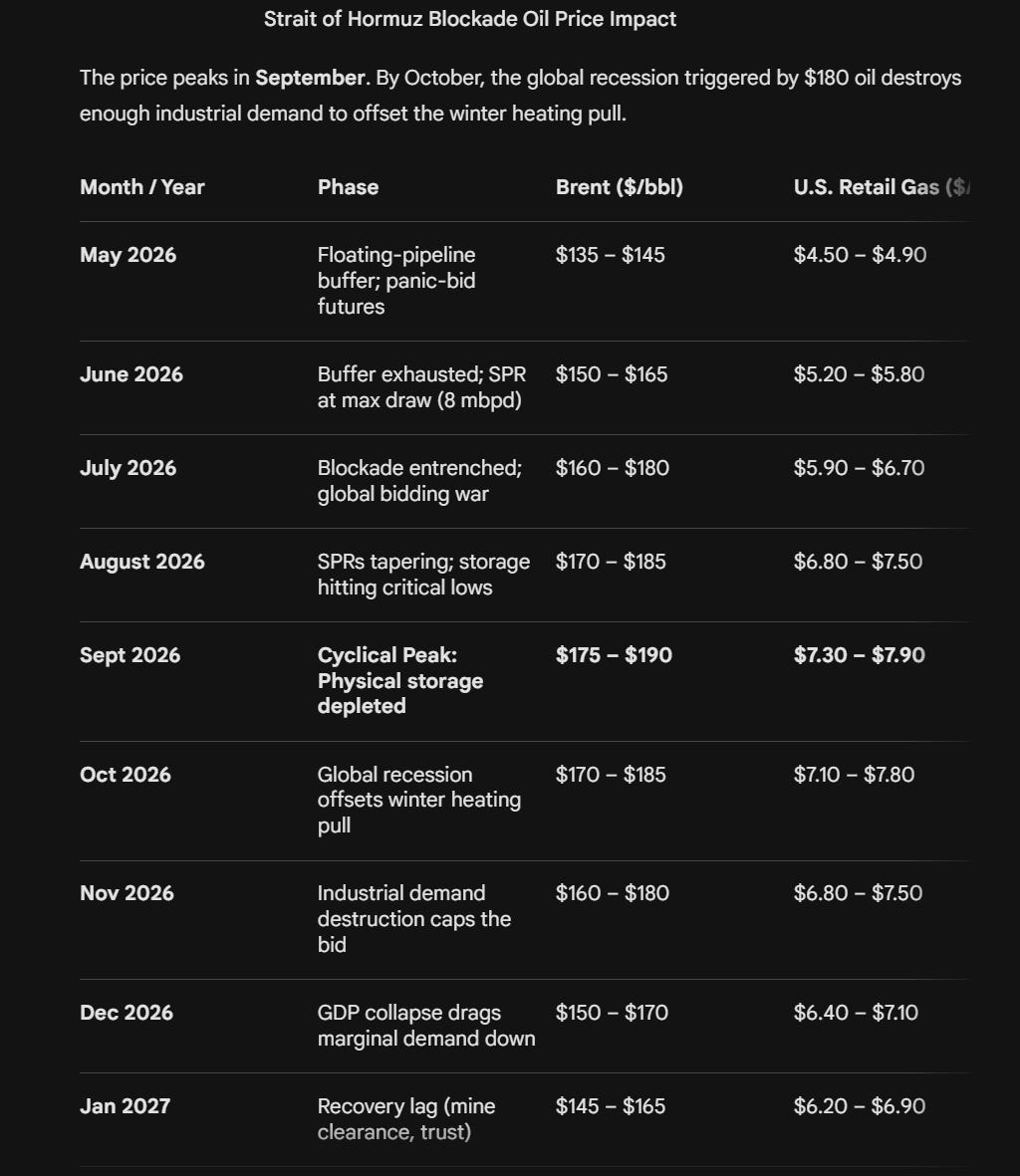
Global Oil Markets — Model I: Hormuz Strait Remains Blocked
This model estimates monthly oil prices per barrel and U.S. gasoline prices per gallon under a continued closure of the Strait of Hormuz from April 30, 2026, through January 2027. It assumes the current blockade conditions persist unchanged, removing roughly 20 percent of global supply while regional production infrastructure remains intact. The model excludes escalation into broader regional conflict.
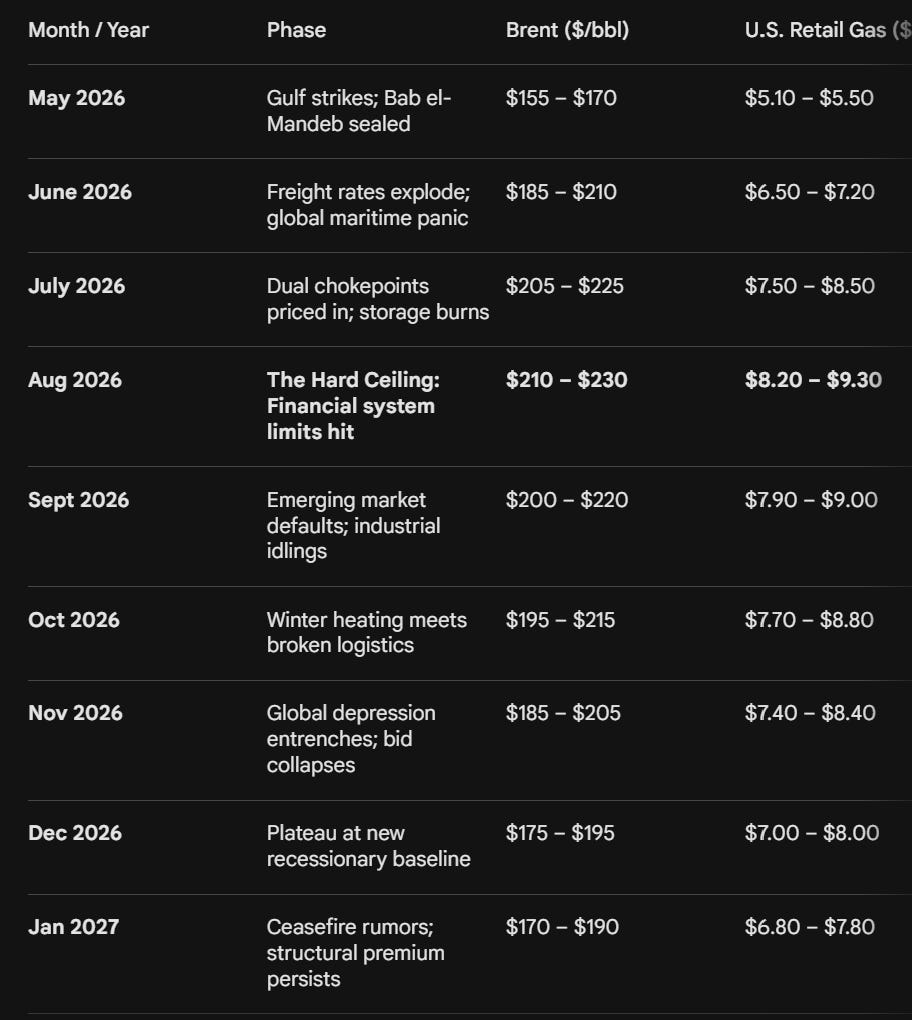
Global Oil Markets — Model II: Renewed and Intensified Military Escalation
This model estimates monthly oil prices per barrel and U.S. gasoline prices per gallon under a scenario in which the conflict expands beyond the blockade into sustained strikes on Gulf and Iranian energy systems from May 2026 through January 2027. It assumes disruption to production, storage, refining, export terminals, and diversion pipelines across the Gulf, alongside damage to Iran’s own energy infrastructure. The scenario also includes renewed Houthi attacks on Red Sea shipping, further constraining flows and disrupting oil diverted toward the Red Sea and Indian Ocean. The model incorporates Iran’s remaining capabilities and constraints, assuming it sustains disruption through mines, drones, and proxy networks like the Houthis while operating under limits imposed by degraded infrastructure and finite resources, resulting in persistent but uneven pressure on regional energy flows.
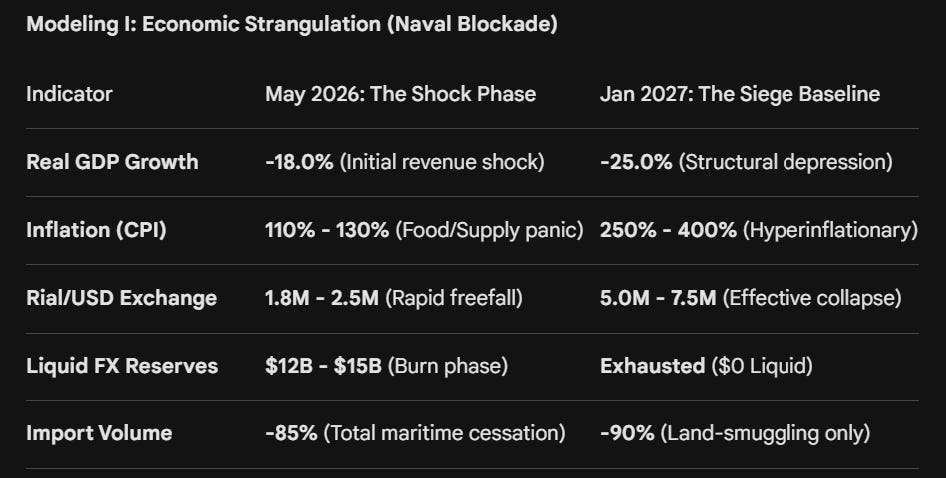
Iranian Economy — Model 1: Hormuz Strait Remains Blocked
This model examines the economic effects of a sustained “siege” in which the Strait of Hormuz remains closed, cutting Iran off from key sources of hard currency and industrial inputs without a direct inland military campaign. Roughly 90 percent of Iran’s oil exports and a majority of its total trade flows transit the Strait, with oil exports accounting for an estimated 10 to 15 percent of GDP and a far larger share of government revenue and foreign exchange earnings. The scenario assumes that state stability depends on the pace at which foreign exchange reserves are depleted and the limited capacity to reroute trade through inefficient land corridors. Under these conditions, the economy shifts from market-based activity toward centralized allocation, with the state prioritizing the distribution of scarce resources to sustain internal security.
Iranian Economy — Model II: Renewed and Intensified Military Escalation
This model traces the economic effects of a shift from blockade pressure to sustained, renewed, and intensified strikes on Iran’s industrial and logistical core. Conflict expands beyond the maritime domain to target energy, telecommunications, manufacturing, and strategic infrastructure, including bridges, military facilities, and key industrial plants. The focus moves from fiscal constraint to the degradation of production and connectivity, disrupting the systems that sustain an integrated economy. Widespread damage erodes energy networks, manufacturing, transport, ports, and logistics infrastructure, cutting off fuel, food, and industrial inputs. As the currency collapses, Iran becomes increasingly dependent on imports it cannot finance. Shortages intensify, utilities break down, and central authority fragments into localized zones of control, leaving economic activity to operate through fragmented survival systems rather than a coherent national structure.
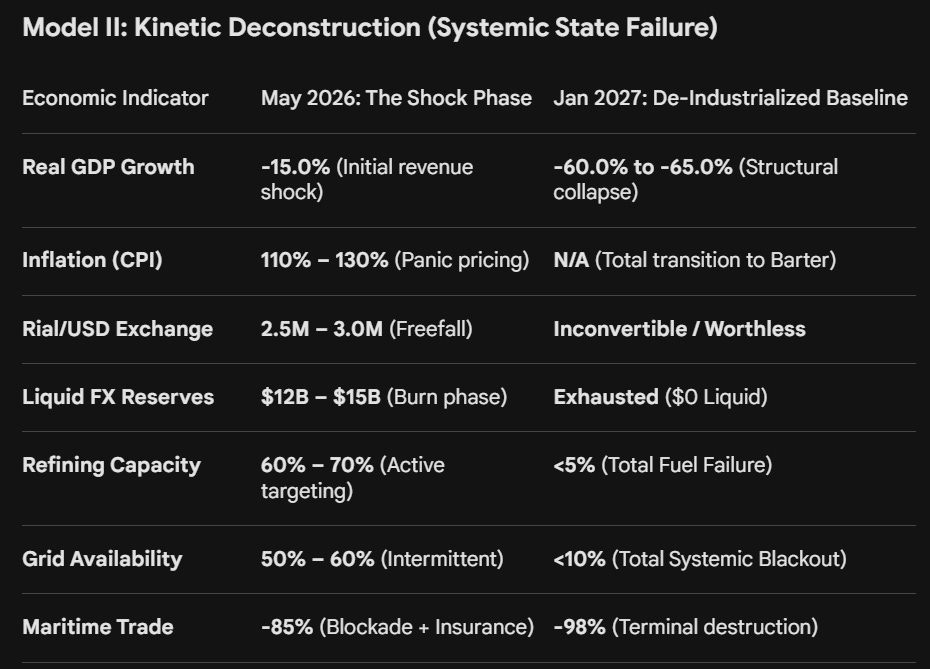
The war does not end at a negotiating table. It ends when the Iranian state ceases to function as a coherent actor. Sustained naval interdiction combined with kinetic deindustrialization strips the regime of its revenue base, its enforcement capacity, and its central command in sequence. The end state resembles Libya or Assad era Syria at a far larger scale, but the path is neither clean nor rapid. The Islamic Revolutionary Guard Corps does not collapse under a single blow. Its decentralized structure, which has sustained the regime through decades of sanctions, uprisings, and war, becomes a driver of fragmentation once the economic networks that fund elite loyalty break down. As the IRGC loses the ability to pay and provision its own forces, the internal cohesion that external pressure once reinforced begins to erode.
Fragmentation follows existing fault lines. Peripheral regions such as Sistan, Baluchistan, and Kurdistan assert autonomy from a center that can no longer pay, provision, or police them, while divisions widen between Tehran's commercial and clerical elites and the hardline core as survival displaces ideology. The regime does not fall in a single moment. It disaggregates. That process triggers a humanitarian crisis on a scale the postwar international system cannot readily absorb. Millions of refugees move simultaneously into Turkey, Iraq, Pakistan, and the Caucasus, destabilizing neighboring states and arriving before the conflict itself has concluded.
The costs of the war fall hardest on the very people in whose name it is waged. The Iranians who filled the streets during Women, Life, Freedom, who rose again in January 2026 only to be cut down in the tens of thousands during Black Weekend, now bear the weight of a war waged ostensibly on their behalf. The regime that turned heavy weaponry on its own citizens months earlier now postures as their defender, converting their suffering into political capital abroad and a pretext to suppress dissent at home. The blockade and the bombing campaign aim to bankrupt the Iranian state and force it to the table on American and Israeli terms, but the only mechanism for accomplishing that runs through the Iranian economy. The Iranian people grow poorer and more desperate by the day, caught between a brutal regime fighting for its own survival and foreign powers determined to destroy that regime regardless of the cost to those living under it. When Iranians cry out for women, life, freedom, they are demanding a state accountable to them, not the destruction of the state itself. That distinction is lost. A movement for dignity has been answered with deindustrialization, a demand for political voice with the dismantling of the political community itself. The slogan is women, life, freedom. The outcome is warlords, scarcity, and exodus.
The oil supply void created by disruption in the Middle East will redraw the global oil map in ways that persist beyond the crisis. Production from international oil companies across North America, South America, and frontier Africa will scale to capture elevated prices, make new investments, and increase output, with the Permian Basin and Canadian oil sands leading the near-term response due to shorter investment cycles. New supply from Guyana, Suriname, Brazil’s pre salt fields, Argentina’s Vaca Muerta, and deepwater projects off Namibia and Senegal will attract substantial capital, though their longer development timelines mean they will shape the post-crisis market rather than alleviate the immediate shock.
Russia will seek to capitalize on higher prices to support state revenues, but its capacity to expand output remains constrained. Sustained Ukrainian strikes on refining infrastructure and export terminals, along with sanctions on shipping and technology access, restrict its ability to increase production. As a result, Russia captures higher revenue per barrel without offsetting lost Persian Gulf supply, reinforcing a tighter global market even as new investment accelerates elsewhere.
The immediate macroeconomic legacy of the conflict is a multi-year period of global stagflation. Sustained high energy costs strain supply chains, with uneven effects across economies. In the United States, the outcome is sharply bifurcated: domestic producers capture windfall profits while consumers face persistently elevated fuel prices that compress real disposable income, particularly for households most exposed to energy and food costs. The Federal Reserve confronts a policy dilemma with no clear resolution. Easing rates to cushion the downturn risks reigniting inflation, while tightening to contain prices deepens contraction and financial stress. The credibility rebuilt during the 2022 to 2024 tightening cycle comes under its most severe pressure since the 1970s.
The political consequences for the administration that launched the campaign are severe. The promise of a rapid, decisive victory collides with an extended energy crisis, a fractured Iranian state that yields limited strategic return, and domestic stagflation that weighs most heavily on the working class that formed its electoral base. The November 2026 midterms reflect this convergence. A historic electoral repudiation paralyzes the legislative agenda and leaves the administration managing an ongoing crisis with minimal political capital and lame duck energy.
The destruction of functional Iranian statehood reshapes the physical geography of Gulf energy. With the Strait of Hormuz carrying a persistent war risk premium, Arab Gulf states accelerate overland diversion routes to the Indian Ocean and the Red Sea. Saudi Arabia expands the East West Petroline to Yanbu, while the UAE scales the Habshan Fujairah pipeline to bypass the Strait into the Gulf of Oman. Despite setbacks to diversification agendas, both states absorb the shock through financial reserves, expand air defenses, and invest heavily in alternative export infrastructure, while elevated prices sustain strong revenues for available volumes. This realignment underpins a new regional power structure in which Qatar, Bahrain, Kuwait, and Iraq become increasingly dependent on Saudi and Emirati support for financial stability, security, and access to bypass routes. Turkey’s role rises in parallel as both a security actor and a transit hub for Iraqi exports. The dominant Gulf producers turn shared vulnerability into a durable advantage, as a lasting risk premium on Hormuz transit entrenches alternative corridors under their control and, alongside Iran’s degradation, elevates Saudi Arabia, the UAE, Israel, and Turkey into a more competitive and fragmented regional order.
What most likely restores viable transit through Hormuz is less a diplomatic settlement than a technological shift. Iran’s ability to close the Strait rests on a cost advantage in drones and anti-ship missiles against defenses built for a different threat and price point. That imbalance becomes a central procurement priority for the United States, Gulf states, Israel, and other major powers, driving large scale investment in layered counter drone systems, directed energy, distributed sensors, AI enabled targeting, and low-cost interceptors designed to reverse the cost equation. Once inexpensive drones can be defeated reliably at equal or lower cost, the economic logic of asymmetric disruption breaks down. Iran’s early mover advantage in low-cost drone warfare has been its greatest asset, but the scale and sophistication of U.S. and allied investment point to a widening gap that Iran is unlikely to match going forward.
Yet the more historically significant legacy of this crisis lies less in the destruction it inflicts than in the transformation it compels. The energy transition, which had advanced unevenly through climate policy, falling technology costs, and contested industrial subsidy, accelerates on a more powerful and politically durable foundation: national security, energy independence, and economic competitiveness. These drivers align constituencies that climate policy alone never could, bringing the European right, the American center, the Chinese Communist Party, the Indian developmental state, and working-class voters facing high energy costs to the same outcome through different motivations. As a result, global oil demand by 2030 falls well below what mainstream forecasts in 2025 would have projected based on pre crisis trends. Electrification reduces the share of energy demand moving through vulnerable maritime chokepoints, while domestically generated electricity displaces oil across transport, heating, and industry on a compressed timeline, eroding the geopolitical leverage long derived from hydrocarbons and weakening the pricing power of OPEC, the influence of Russian gas, and the strategic importance of chokepoints from Hormuz to Bab el Mandeb to Malacca.
That shift manifests across very different political systems. The European Union treats energy autonomy as the organizing principle of the post crisis order, combining expanded renewable deployment, accelerated nuclear restarts and new builds across France, Poland, the Netherlands, Sweden, and Czechia, large scale grid interconnection, and electric vehicle policies that close the cost gap for mass consumers, while fiscal resistance gives way to the imperative of energy security. China follows with greater industrial capacity, scaling domestic electrification while leveraging its dominance in batteries, solar, electric vehicles, and grid systems to expand exports and reduce strategic exposure to imported oil. India accelerates electrification and domestic manufacturing under similar pressure, while other major emerging economies, including Indonesia, Vietnam, Brazil, South Africa, and Turkey, alongside the Gulf states themselves, move more decisively to diversify as the long-term trajectory of hydrocarbon demand becomes less certain. In the United States, state governments, consumers, and businesses accelerate investment in renewables, electrification, and grid modernization, generating a political economy that builds toward federal action even in the face of current administrative resistance.
The world that emerges from this shock is more stable, cheaper, cleaner, and more secure than the one that entered it, which is the deeper irony of the conflict. Iran’s peak exercise of energy leverage triggers the conditions that dismantle that leverage permanently, along with the broader model it represents. This becomes, in a literal sense, the last major oil shock, not because crises disappear, but because the global economy restructures itself so that no single chokepoint, authoritarian regime collapse, or supply disruption can again exert comparable control. The energy system that replaces it becomes one of the defining infrastructure achievements of the twenty first century.
No posts
Comments
Nothing yet. Say the first thing.
Sign in to join the conversation.