
Happy October! I’ve been on a bit of a novel kick of late, so this month I have four to recommend that vary quite widely in style—two more recent releases and two older books—and the best I can come up with for a theme is that…there is no theme. Just that, as my college cross-country coach used to say, variety is the spice of life!
I started humming the part about taking my rocking chair down by the river and rocking my blues away. What she said about the voice being better because it tells what you’ve been through. Consequences. It seems as if you’re not singing the past, you’re humming it. Consequences of what? Shit, we’re all consequences of something. Stained with another’s past as well as our own.
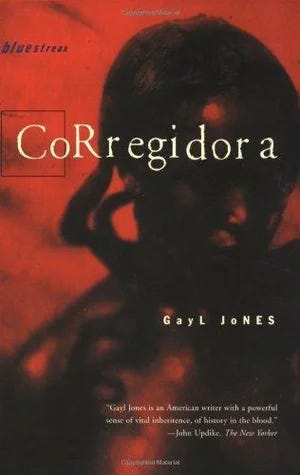
The first is Gayl Jones’ Corregidora, which I first heard about through this short Lit Hub interview with Jamel Brinkley, in which he describes it as the book that has had the strongest emotional impact on him. The book was acquired and edited by Toni Morrison during her tenure as a senior editor at Random House and is increasingly gaining the status of a classic (it was published in 1975). Set in the late 1940s, it’s narrated by Ursa Corregidora, a blues singer who learns she can no longer conceive children after an assault by her husband and is trying to sort out what this means for her, especially in the context of her female forebears’ admonitions to “make generations” to preserve the stories of their own traumas, most significantly those perpetrated by Corregidora, the white Portuguese slaveholder who is also her ancestor through rape and incest.
The novel is told in a spare and direct narrative voice that perhaps more than any book set in the past I’ve ever read felt like it collapses time and distance—it feels that immediate and intimate. It’s like being inside a movie and experiencing it in three dimensions with unfiltered interiority, rather than merely watching and listening to the events being depicted. Or maybe like listening to a blues song.
If you’re interested, there is this in-depth interview with Jones in The Massachusetts Review, available to be read with a free JSTOR account, from shortly after the book came out. The interview sheds light on her inspirations and intentions for the book, particularly regarding how her approach to this narrative voice was shaped by oral storytelling traditions and her affinity for ambiguity and contradiction. The story also takes some surprising turns, which I won’t discuss to avoid spoilers, but I was fascinated to learn from this interview that these were surprises for Jones as well.
I felt weirdly detached, engrossed by pain and also by a strange relief, the relief of being a patient, of being passive; I had made my decision to come and now, for a while, there weren’t any decisions, other people would decide, and so long as they hadn’t decided I could relax in their not-yet-deciding. What I mean is that I was scared of what they would say, it was my own irrationality, as if so long as they had spoken whatever was happening wasn’t real, as if there could be no catastrophe so long as the catastrophe wasn’t named.
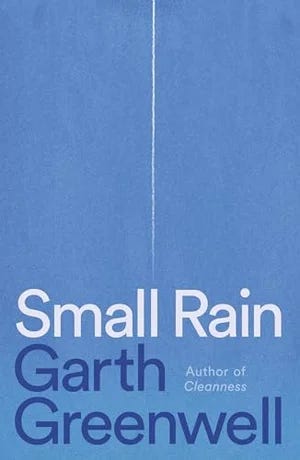
I avoided reading this book for about a year after it came out last September because it got so much buzz, but when a hardback copy recently came across my path at a tiny used bookstore on the Oregon coast, I decided the universe was telling me the time had come to give it a chance. The premise is that this narrator develops an acute health issue that upends his life one day in his early forties and entraps him in the vagaries of the American healthcare system. Honestly, as much as I have enjoyed Greenwell’s work in the past, the jacket copy made this one sound a bit tedious (not to mention one negative reviewer’s diatribe against a passage in which Greenwell’s narrator waxes poetic about a bag of chips). To my delight, however, I was entirely absorbed and deeply moved by this novel. Yes, it’s slow, but a very good kind of slow, as long as you are reading it more in a spirit of contemplation. In true Garth Greenwell form, the narrative style is very granular and carefully observed, physically as well as metaphysically. It’s a book about reckoning with one’s mortality, vulnerability, and ultimate dependence on others, including strangers.
That said, I do suspect this is one of those books that probably means a lot more to people who are at least in their mid-thirties and older and/or who have had some kind of wake-up call regarding the fragility of their bodies. I don’t think it would have resonated with me nearly as much if I’d read it in my twenties. It’s also a book best absorbed slowly but in large doses—the narrator’s health crisis is an experience of being taken out of time and into what Susan Sontag terms “the kingdom of the sick.” In a similar way, I think this is a novel that rewards immersion. If a copy floats across your path in the coming months, take it as a sign.
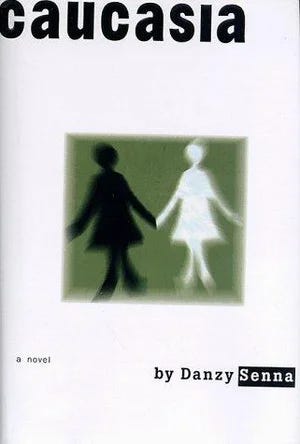
Caucasia: A Novel by Danzy Senna
I liked to play a game with myself. I would try to imagine the days before I was born—what my parents were wearing, what the weather was like, what the smells in the air were. Sometimes I saw that first meeting, as if I were there with them, floating over them, waiting with bated breath for them to bring me to life. But most of the time the image disintegrated into the people they had become, no matter how hard I tried to see something different.
In contrast to the Greenwell and Jones novels, this 1998 debut by Danzy Senna is a much more conventional novel—a 400+ page, first-person coming-of-age story with a propulsive plot and a well-developed cast of characters. It’s a book to take on a trip when you want a literary page-turner that will last you a while, not just for sheer page count but also for the thought-provoking psychological and sociological layers that accompany its exciting plot.
It’s the story of a mixed race family in 1970s Boston, told from the perspective of Birdie, the younger of two sisters. I don’t want to bring in too many spoilers, but there’s a kind of thriller plotline involving their parents’—particularly their white mother’s—political activism, and how this breaks up not only the parents’ marriage but also the family, separating the sisters and forcing Birdie and her mother into hiding. The book especially centers on Birdie navigating her racial identity in a world that tends to read her as white and her sister as Black, despite them having the same parents. There’s also an exploration of Birdie’s relationship with her mother and her mother’s possible mental illness that, for me, was among the most powerful and poignant elements of the book. I loved what Senna does with Birdie’s limitations as a first-person narrator, trying to make sense of her own childhood and family, but not having access to all the information she needs to do so.

The Buffalo Hunter Hunter by Stephen Graham Jones
But I didn’t know to turn my horse to the side and watch for as long as I could, I thought it would never end, would always be the same, so all I have instead are hundreds of other days I have to steal that day rider from, and that woman carrying water, and those children, the dogs…Those are what I carry on the cards I keep inside, that I lay out before me every night and study like I can go back if I look hard enough, if I remember it down to each flake of snow, each curl of smoke, each black hair lifting from each cheek in the wind.
I was tempted to save this last one for next month’s post, but considering it’s the best novel I’ve read so far of those published this year, I’m eager to tell you about it sooner rather than later. This is a multi-POV historical horror novel set primarily on Pikuni (Blackfoot) land in Montana, with the primary events taking place in 1870, 1912, and 2012-2013. If you enjoyed Victor LaValle’s Lone Women, which I recommended in my September 2023 post, you will definitely want to check this one out.
Stephen Graham Jones incorporates a lot more bloodshed and dead bodies than I can usually tolerate, but here the gore is very much in service to a brilliant and profound reckoning with the story of America. The book is anchored primarily in the point of view of a thirty-seven-year-old Pikuni man—known by many names in the book, but most often as Good Stab. Good Stab is trying to deal with his own moral failures while avenging a massacre in which white settlers killed many of his loved ones; he is also the narrator of the passage excerpted above. The book’s other narrators are an old white Lutheran minister of the same generation as Good Stab, and his great-great-great granddaughter Etsy, who comes into the possession of a journal he kept during the spring Good Stab visited him for confession in 1912. This multi-POV frame seemed clunky to me at first, but by the end of the book, I was completely won over. I won’t tell you anymore. Just go read it (and if you don’t vibe with the first two chapters, hang in there until you get to the third).
Before I sign off, I should probably share a bit more good news: my short story, “Harbinger,” just came out in the Autumn issue of The Southern Review. Very grateful and honored to have found such a great home for it. :)
And…that’s a wrap for October! Thanks as always for reading!
Jules
No posts
Comments
Nothing yet. Say the first thing.
Sign in to join the conversation.