
Happy September! I hope you’ve gotten some refreshment these past few months, however you most needed it. And a very warm welcome to those who’ve subscribed over the summer! 👋🏻 I’m grateful you’re here.
At the start of each new academic year, I have a teacher’s inclination to think of ways I might reboot and refresh this newsletter, yet after the usual thrashing and gnashing of teeth, I keep returning to my original intention: to share a few books with you that I’ve read recently—whether there’s any thematic link among them or not—that I was glad to have encountered and spent the time reading.
This month, there’s definitely a strong element of the speculative running through these recommendations, which reflects my growing interest in fiction that opens up a space between the real and the slightly surreal or unreal. Often there’s a time element at work in these kinds of stories as well: forays into the near future or reimagining the past, and/or explorations of slightly altered versions of the present.
What I love most about speculative fiction is, perhaps ironically, the fresh light it tends to shed on reality. These stories take us places we can’t go in real life, and in so doing, give us a vantage point from which to look back at our own lives that we otherwise couldn’t achieve. They’re also inherently gutty—like, hey, here’s a ghost, or a near-future reality, or a talking horse, and we both know that the laws of the known universe are heavily weighted against me, but I’m going to make you believe in this ghost/near-future reality/talking horse—or at least make you want to believe in it.
All of that said, even if you don’t typically think of yourself as a reader of more speculative genres like fantasy and science fiction (and I am with you on this), you might be pleasantly surprised by how well some of these more grounded and literary approaches to incorporating speculative elements might fit into your reading tastes.
Before we dive in, I feel I should acknowledge that it has been a momentous summer for me in terms of my writing life: I queried my first book manuscript and am thrilled to share that I’m now represented by Rayhané Sanders at Massie McQuilkin & Altman. The first two recommendations below are connected to this good news, as I sought them out to read during the query process because they’re by writers she represents—Te-Ping Chen and Lidia Yuknavitch. I’m incredibly honored to join them and the other writers on her list.
Land of Big Numbers by Te-Ping Chen
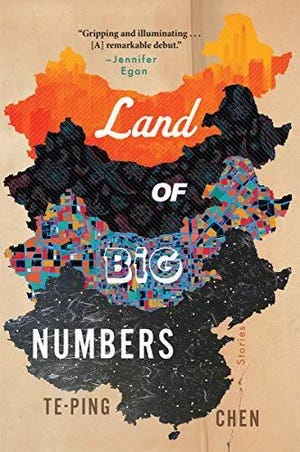
“He was standing with his back to the screen above the square, which was lit with a swirling orange spiral, as though the sun were rising out of his head. Doesn’t it matter that you are one of a billion plus? an announcer was saying, an advertisement of some kind. It doesn’t matter—you are one of us.” — from “Hotline Girl”
For me, the first sign of a great collection is that, after I finish each story, I feel compelled to pause, to wait a day before reading the next story, because the story I just read so thoroughly filled my brain that I want to savor and digest it before moving onto the next one. Land of Big Numbers was like this for me.
Set mainly in contemporary China, these stories focus especially on how individuals and communities accommodate to deeply painful or difficult realities—in terms of the world in which they live, their own choices, and/or the actions of people they love. In short, their primary subject is the human heart and conscience. And as understated and restrained as many of Chen’s stories are at first glance, they are also quite capacious and consistently rife with high stakes. They regularly snuck up on me with unexpected emotional force.
This collection is a bit unusual in that some of the stories tilt more purely realist while others are decidedly speculative. It’s a potent juxtaposition, wherein the more speculative stories highlight the unreality of some of the situations in which characters in the more strictly realist stories find themselves, while the realist stories make the more speculative-leaning pieces feel somehow closer to reality. My favorites were “New Fruit,” “Fields Notes on a Marriage,” “Hotline Girl,” “Shanghai Murmur,” “Gubeikou Spirit,” and “Lulu.” This interview with Te-Ping Chen from the Otherppl podcast with Brad Listi is a great companion to the book and gives a lot of insight into Chen’s background as a Wall Street Journal reporter who lived and worked in Beijing and Hong Kong for many years and how these experiences inspired and informed her approach to writing fiction.
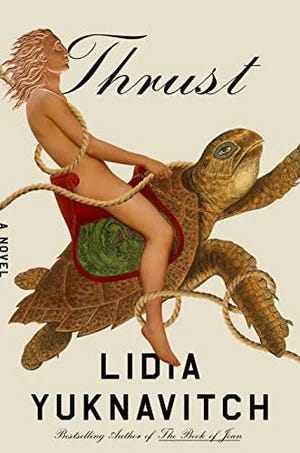
Her choice was not difficult. With one hand, she snatched the locket’s chain from the dead woman’s grasp; with the other, she picked up the turtle. “I can take you to the old Narrows.” She began a brisk walk across the street toward the waterway, bypassing the Awn Shop, which made her heart beat fast enough that she could feel it in her neck. “But you have to show me which current path to take.” - from Thrust
I love a novel that makes me think differently about what’s possible for the form, that expands my sense of what a novel might be, do, or include. This book, quite simply, blew my mind. It’s big-hearted and ambitious and defies simple explanation, though if I must attempt one, I will say it’s about the stories we tell ourselves about stories, both individually and collectively, and it centers around the Statue of Liberty, the people who designed it and built it, and the stories America tells itself about itself and its complicated relationship to actually living out the ideals of liberty and justice for all. It’s braided and polyphonic; it time travels between the future and past. There’s a talking turtle. The only other book that I can think of that’s a pretty good analogue is Daniel Mason’s polyphonic historical novel North Woods, though Thrust makes the structure of that novel feel pretty tame and straightforward by comparison.
And yet, for as much ground as this book covers and for all the ways it consciously resists narrative conventions, it does a masterful job of teaching the reader how to read it and carrying you along on its journey without letting you get lost. I really enjoyed gradually coming to see the book’s larger logic. (On the topic of less conventional structures, I strongly recommend this Between the Covers conversation Yuknavitch did with David Naimon, which explores how Ursula K. LeGuin’s “carrier bag theory of fiction” influenced Yuknavitch’s thinking about how to tell stories that move beyond Hero’s Journey archetypes and conventional single-protagonist plot arcs.)
If you, like me, love a big swing and are up for a book that will open more doors and windows in your mind than it closes, check this one out when you need to read something completely different.
The last two books I’d like to include in this post are ones for which I did author interviews that were published online this past summer, so I’ll keep my descriptions a little more concise and link to the full interviews (both freely available to read without paywalls) in case you want to read more!
The Volcano Daughters by Gina María Balibrera
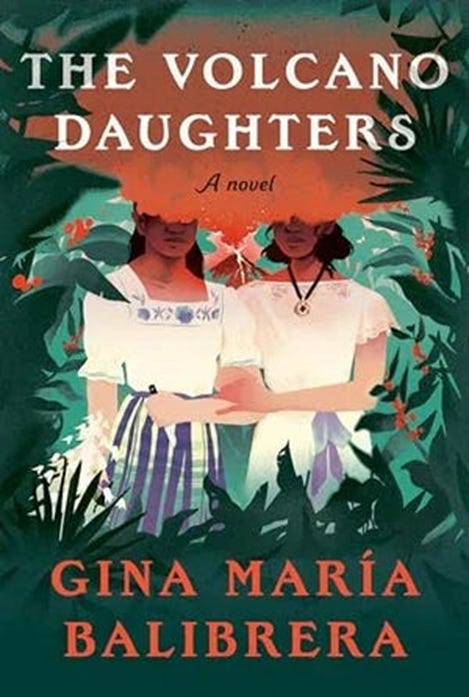
The first is with Gina María Balibrera about her debut historical novel, The Volcano Daughters, which is narrated by four ghosts—young girls who were murdered in a massacre in El Salvador in 1932. These imagined girls, in real life, were denied the opportunity not only to tell their stories, but to live them to their fullest, and now, they spectate and narrate the stories of their surviving friends from the afterlife, stories which a writer named La Yinita hears and feels compelled to try to record and transmit to readers to the best of her ability. A big part of what is so powerful about this book is the way it uses the speculative element to recuperate—in a conscientious and deeply respectful way—the voices of people whose stories were quite literally erased by political violence. It feels like an example of one of fiction’s highest possible uses, and I find Balibrera’s meta way of framing the story extremely compelling.
Here’s the full interview over at Aster(ix)!
There Are Reasons for This by Nini Berndt
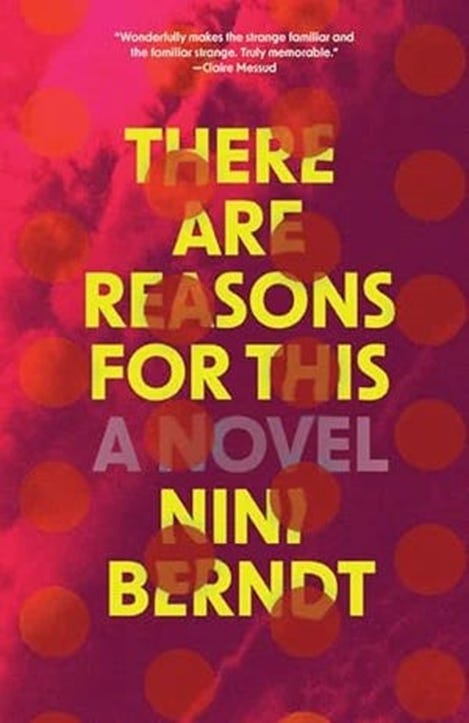
The second is with Nini Berndt about her debut novel, There Are Reasons for This. Here, too, the distance between our reality and the book’s reality is quite narrow but strategic, and all the more moving and thought-provoking as a result. Set in 2028 Denver, the book’s speculative elements show up primarily in how climate change impacts everyday life and how increased automation impacts the nature of human work—but not in the way you might assume. Rather than focusing on the jobs lost, Berndt explores what forms of human labor might actually increase in value as a result: those that involve physical and emotional intimacy. It’s a refreshing angle that balances the doom-and-gloom of climate change and robot apocalypse with a heightened and (to me) very realistic focus on ordinary moments of connection and intimacy between neighbors, siblings, lovers, and friends.
If you’re curious to read more, please check out our conversation at Foglifter. :)
Thanks for reading! If you know someone else who might enjoy this post, feel free to use the link below to share!
Until next time,
Jules
No posts
Comments
Nothing yet. Say the first thing.
Sign in to join the conversation.