
To close out these last short days of 2025 in the northern hemisphere, I bring you two very different short story collections—one from the early 1990s, one just published in the U.S. this fall—and two novellas—likewise one contemporary and one classic—and all four of them under 200 pages. While they may be short in page-count, they are rich and rewarding reads.
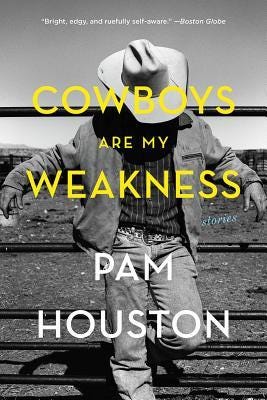
Cowboys Are My Weakness by Pam Houston
The west isn’t a place that gives itself up easily. Newcomers have to sink into it slowly, to descend through its layers, and I’m still descending…I’ve always had this thing about cowboys, maybe because I was born in New Jersey. But a real cowboy is hard to find these days, even in the west. I thought I’d found one on several occasions, I even at one time thought Homer was a cowboy, and though I loved him like crazy for a while and in some ways always will, somewhere along the line I had to face the fact that even though Homer looked like a cowboy, he was just a capitalist with a Texas accent who owned a horse.
This is a delightful story collection, despite the patronizing blurbs on my circa 1992 used copy (e.g. “These are the stories that might have emerged had an intelligent woman followed Hemingway around,” and “Exhilarating, like a swift ride through river rapids with a spunky, sexy gal handling the oars”). These stories are not so much Hemingway-esque in their style (which to me would not be much of a selling point) so much as they focus on women protagonists in the American mountain west who tend to chase relationships with Hemingway-like men. To me, this is a book about the limits of self-awareness. The stories are very sharply written, full of wry humor, and set in the rural mountain West: Utah, Montana, Alaska, etc. They feel lived and lived in, like Houston really knows these places and characters.
The most likely critique of the book is that the protagonists feel like they’re all versions of the same woman in slightly different situations, but this didn’t bother me much because I found Houston’s protagonists’ quite endearing. In other story collections, I’ve found that kind of quality more frustrating (leading to the question, why not make this one protagonist and turn it into a novel proper?), but here the shifting settings and different shadings and variations on type were enough to add interest and depth. One, for example, involves a whitewater rafting expedition, while another is about being a sheep hunting guide.
Right about the time I was starting to weary of the predominant themes (though that was not until the second to last story), Houston switches it up with a poignant banger of a final story, which I appreciated on many levels, but particularly for the way it moves the book beyond its obsession with heterosexual relationships into the gray area between friendship and romance between two women (who are also in heterosexual relationships with men). My favorites were “Selway,” “What Shock Heard,” “Dall,” “Cowboys Are My Weakness,” and “In My Next Life.”
“the man without the whip lies down on his back and spreads his legs and lifts his feet up to the sky and shouts okay do it just flick ‘em just lightly flick my nuts
the man with the whip snaps his arm back and forward and the whip hits the dirt in front of the lying down man and the lying down man says yes yes
the woman presses her phone and says be careful those are my boys
I try to understand people but they make it hard”
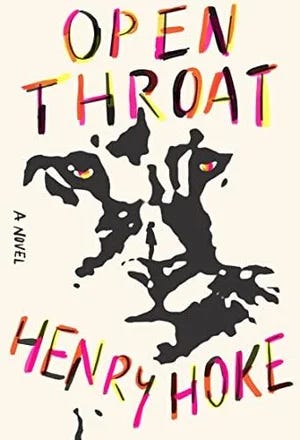
I heard a fellow writer recommend this book with a phrase like, “This was the book about a gay mountain lion that I didn’t know I needed,” and I must concur. It’s a very short, engaging read that I devoured in less than an hour. (The book is marketed as a novella, but I’d be very curious to know the word count. With all the white space and short chapters, it feels like it might be in the neighborhood of 15,000 words.)
It’s told from the point of view of a mountain lion in the hills above Los Angeles (or “ellay,” as the mountain lion transliterates from the conversations of the hikers he overhears) whose habitat is increasingly at risk and being encroached upon by humans. The real pleasure of the book is in how Hoke sheds light on a certain swath of contemporary life from the perspective of a outsider character (quite literally of a different species) for whom these behaviors are strange and often inscrutable.
To try to capture the sense of a mountain lion narrating, Hoke doesn’t use punctuation; sentencing is accomplished instead through line breaks, which is part of why the book reads so fast. The only capitalization, I think, is the pronoun “I.” Sometimes the logic of these choices eluded me—why the mountain lion spells many words in accordance with standard English but occasionally uses phonetic spellings instead, like “diznee” for “Disney”—but for the most part, I think these choices work to create just enough acknowledgment that this is a non-human narrator while providing minimal alienation for the human reader. It does feel a little uneven in the second half (I found the mountain lion’s trip to “diznee” to be a bit far-fetched), and the plot felt a little clunky at times, but it was still a very thought-provoking and memorable read.
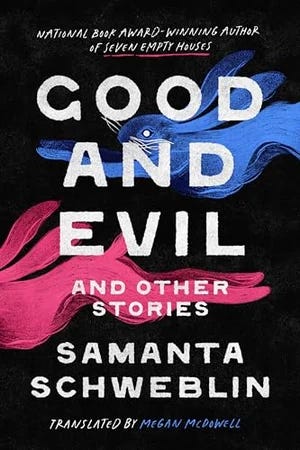
Good and Evil and Other Stories by Samanta Schweblin, translated by Megan McDowell
I am aware that I have hardly spoken for a few days now, but what do I know about what is normal and what is not? Yesterday, there was a boy on TV who said that there are false teeth that have to fall out so the real ones can come in; maybe you also stop talking before the first truly adult words come in. Maybe every child my age passes or has passed through a similar hallway, and maybe the long, high tube of light is performing a specific function on my body. Maybe, as the doctors say, we just have to wait.
I’m already a fan of Schweblin’s work, having especially loved Little Eyes and also enjoyed her earlier story collection, Seven Empty Houses. If you are new to her work, a good introduction/trial run would be to read either the first story in this collection, “Welcome to the Club,” which is available online at The Yale Review, or to check out this New Yorker Fiction podcast episode, in which Souvankham Thammavongsa reads and discusses Schweblin’s 2017 story “The Size of Things” with Deborah Treisman.
This collection feels very much in keeping with Schweblin’s other work—eerie and unsettling but not actually that overtly speculative. Stephen King makes an oft-quoted distinction between gore (that which grosses one out), horror (a fear based on something that has actually happened), and terror (a fear based on something that may or may not have actually happened or only might yet happen), and Schweblin’s work is very squarely in the terror mode, much more an exploration of psychological terrain in realist settings—people haunted especially by their failures and limitations, and most of all the ones they’ve carried privately. I especially the enjoyed the short notes at the end in which Schweblin sheds a little light on the inspirations for each piece. My favorites were “Welcome to the Club,” “A Fabulous Animal,” and “An Eye in the Throat.”
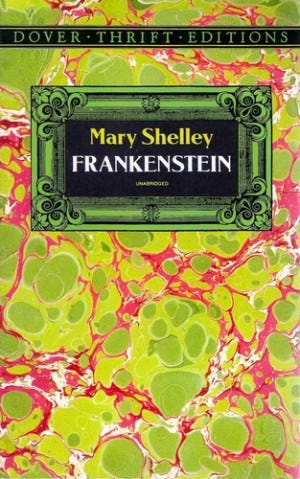
I cannot describe to you my sensations on the near prospect of my undertaking. It is impossible to communicate to you a conception of the trembling sensation, half pleasurable and half fearful, with which I am preparing to depart. I am going to unexplored regions to “the land of mist and snow"'; but I shall kill no albatross, therefore do not be alarmed for my safety, or if I should come back to you as worn and woeful as the “Ancient Mariner.” You will smile at my allusion; but I will disclose a secret. I have often attributed my attachment to, my passionate enthusiasm for, the dangerous mysteries of the ocean, to that production of the most imaginative of poets.
I don’t know if this one actually qualifies as a quick read—it’s short, but it was slow going for me due to the dense, nineteenth-century prose style—but if you are feeling like you need a little break from the limited interiority and stripped down prose style of most contemporary fiction, Shelley’s classic horror novella might be just the antidote. I had read the story once before for a class and had struggled through it; this time, reading for pleasure, I really admired and enjoyed its nested frame structure (it’s really a story inside of a story, with multiple narrators). The exterior frame story, which I had long forgotten about, and involves a guy writing letters to his sister while he’s on a journey to try to find magnetic north—and does not at first appear to have anything to do with Victor Frankenstein and his monster—is the book’s real genius. It’s also just such a great monster story, where the most monstrous character is indeed Frankenstein the human.
Thanks as always for reading. :) Here’s wishing you peace and joy (and the company of some good books) for the start of 2026!
Jules
No posts
Comments
Nothing yet. Say the first thing.
Sign in to join the conversation.