
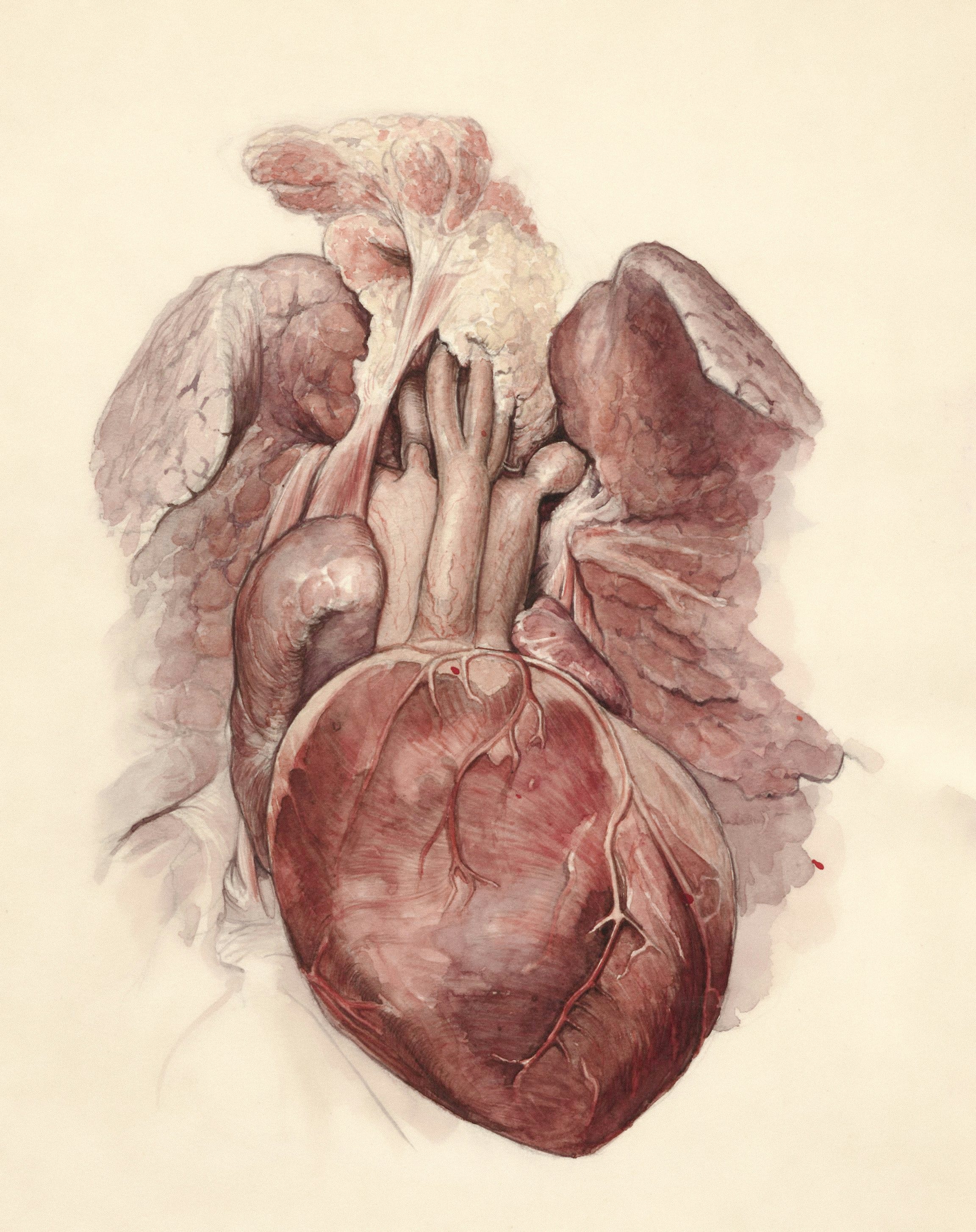
We’re kicking off the new year here with a special post, as these are three novels for which I have an unusually high level of enthusiasm and admiration. (Though I’ll continue to refrain from actually assigning star ratings, let’s just say my average star rating for these three runs exceptionally high.) However, I realize I’m a bit late to the party on them, as they were published in the U.S. in 2019, 2020, and 2017, respectively, and each garnered some well-deserved attention—so perhaps you’ve already encountered them. But if, like me, you missed out when they were first released, I’m honored to introduce them to you now!
While they tilt heavier and darker than what I usually recommend (the human heart, sadly, can be a very dark place), I hope you find them as compelling as I do.
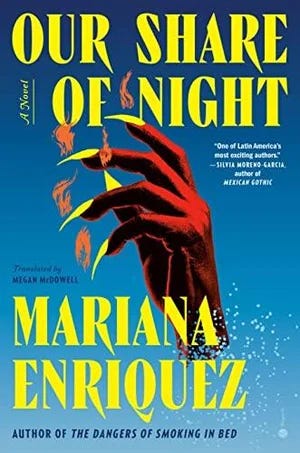
Our Share of Night by Mariana Enríquez (translated by Megan McDowell)
My father always says that everyone in the Order goes crazy in the end; that day, I understood what he meant. Once, the day after a Ceremonial, Dad came in with his whiskey to see me and I asked him: how can we go on after this, how do you all do it, the world is stupid, the people who know nothing are contemptible. And he gave an answer that was so true I sometimes repeat it out loud. The thing is, nothing happens after this, dear. The next day, we get hungry and we eat, we want to feel the sun and we go swimming, we have to shave, we need to meet with the accountants and visit the fields because we want to keep having money. What happens is real, but so is life.
A friend emphatically recommended Our Share of Night to me maybe two years ago, and the novel is every bit as incredible as she promised. It’s a doorstopper, close to 600 pages, comprised of six nonchronological sections written from multiple points of view. Though the vibes are quite different, the unusual structure reminds me of William Faulkner’s Absalom, Absalom! in that there is no obvious pattern to it (like a book that rotates narrators, or follows an overtly logical sequence), yet the sequence is perfectly fitted to the story itself. It’s also wholly unexplainable without describing the entirety of the book. For me, one of the pleasures of reading it was in periodically flipping back to the table of contents and trying to guess how the titles and time periods overlap and converge (not a spoiler: they do).
As suggested by the title, Nuestra parte de noche in Spanish (literally, “Our part of night”), this is a book about characters negotiating their relationships with evil, about reckoning with an inheritance of a legacy of evil and feeling trapped within it while wanting to free one’s children from becoming trapped in it as well. I especially love how Enríquez uses the supernatural to embody evil, how it manifests in the physical environment as well as its impact on people’s bodies. In an interview with David Naimon on Between the Covers (I know, I recommend this podcast so often and will recommend again later in this post, but I love its longform nature and find it a great reading companion), she talks about how she’s drawn to the horror genre because of its ability to make real the horrors of life in a way that is more difficult to do with straight realism because of our tendency to go numb when we hear repeated stories of real-life atrocity. In her hands, the supernatural elements do not turn us away from reality, but rather enable us to confront aspects of it that are the most difficult to face; in Our Share of Night, this means focusing on life under dictatorship in Argentina and its aftermath—particularly with regard to the many people who were tortured and disappeared, to their families, and to those who were complicit in the violence.
I also thought the ending was incredible—the closer I got, the more I was in disbelief that Enríquez could find a way out of the giant trap of the book, and once the ending became clear, it was stunning to me how well it fit. There were several moments as I read when I would be triggered to recall some earlier plotline or character and start wondering when that was going to be picked up again, just in time for the story to return to it. The pacing wandered just a touch in some of the longer sections, but the underlying tensions were always lurking, creating the sense of an undertow even when there was a seeming lull in the dramatic action. That said, this book is very disturbing (I’m not going to attempt a full list of content warnings, but I will at least note that there is considerable gore and graphically described child abuse—though the latter doesn’t take up many actual pages of the book, it’s still…a lot), so those lulls were also in some ways a relief and permitted time to process and absorb the implications of the more difficult passages. All of that to say, if you can tolerate those aspects, it is a powerful, thought-provoking, and unforgettable novel.
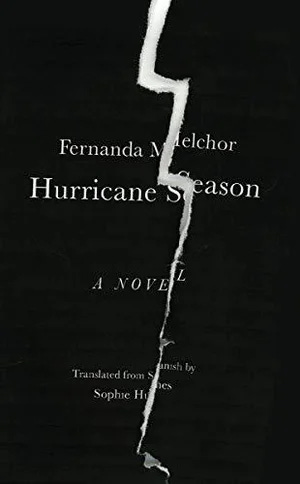
Hurricane Season by Fernanda Melchor, translated by Sophie Hughes
They say that’s why the women are on edge, especially in La Matosa. They say that, come evening, they gather on their porches to smoke filterless cigarettes and cradle their youngest babies in their arms, blowing their peppery breath over those tender crowns to shoo away the mosquitos, basking in what little breeze reaches them from the river, when at last the town settles into silence and you can just about make out the music coming from the highway brothels in the distance, the rumble of the trucks as they make their way to the oilfields, the baying of dogs calling each other like wolves from one side of the plain to the other…
I sought out this book after hearing Mariana Enríquez and David Naimon discuss it briefly in that the interview I mentioned above. Like Our Share of Night, Hurricane Season (in Spanish, Temporada de huracanes) is also an exploration of evil, but in a more strictly realist vein (even though the person at the center of the book is known in her village as a witch). Faulkner seems like an influence here as well (the dust jacket copy mentions him) but more at the level of syntax and style: each chapter is one giant block paragraph full of incredibly long and sinewy sentences, and there’s a spiraling, layered nature to the storytelling that deepens with each return to a given character or incident. The book also calls to mind for me Toni Morrison’s Song of Solomon—it’s very lyrical, dense, and highly controlled, and ultimately tells the story of a whole community even as the narrative ostensibly centers around one character. Like Song of Solomon, I really needed to read it in longer sittings, to allow myself to get immersed. Melchor is a master of voice, and there’s a strong sense of rhythm in her prose, but it’s necessary to acclimate to it, to slow down and focus.
The novel’s structure is a chorus of sorts filtered through a roving omniscient narrator who regularly slips into a close third person with a lot of free indirect narration. In other words, the narrator is outside the characters and therefore can describe them more objectively, yet the narrator can also slide into an individual character’s way of thinking and speaking, almost like a first person narrator. Each chapter focuses on a different character and peels away more layers of the story of the murder, though all are incomplete and at some level unreliable. Intriguingly, the two characters most at the heart of the crime are only seen from the perspectives of those around them.
I naturally sought out the Between the Covers interview of Melchor as well and learned that she was originally inspired to write the book about a real-life murder, in the tradition of Truman Capote’s In Cold Blood, but she recognized that it was both extremely dangerous and likely impossible to really find out the truth of the crime. So, she wrote it as a fiction instead. I read Hurricane Season primarily as a meditation on misogyny; the violence in this book is not just directed at women but also at anyone who demonstrates so-called feminine qualities. There is abundant homophobia and transphobia, too, but misogyny remains the force undergirding all the violence and hate. The story is set in a small town outside of the port of Veracruz, which has in recent years experienced a tremendous amount of femicide related to cartel violence. Interestingly, Melchor doesn’t focus on the cartel violence itself but rather on ordinary working-class people who live in its shadow.
This novel is similar to Our Share of Night in terms of its emotional intensity and need for content warnings; there are some incredibly difficult sections to read, particularly involving one character’s sexual grooming by a stepfather and another character’s affinity for pornography involving bestiality. As with Enríquez’s work, there is nothing about it that feels gratuitous to me, but it will not be for everyone by a long shot. Despite the emotional weight, I found it very much worth reading for the way Melchor captures something profound about the banality of evil in general and about the many facets of misogyny in particular. I also admire her absolute fearlessness in taking on such difficult subject matter and her willingness to venture into the very darkest corners of her characters’ hearts and minds.
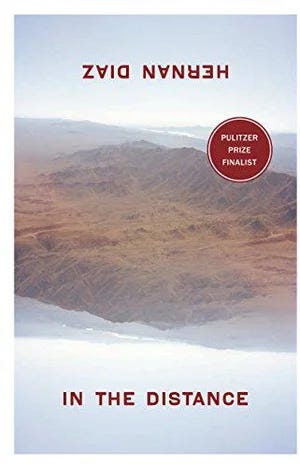
In the Distance by Hernán Díaz
And yet, despite its unbending sameness, the desert was now entirely different in Håkan’s eyes. From the compass warming in his pocket, invisible beams radiated in every cardinal direction. The plants were no longer blank but traversed by lines of certainty, as solid and unquestionable as avenues and thoroughfares. Knowing where he was going, having the assurance of finding the line of emigrants beyond the ring of the horizon, being able to build a fire and cook proper food on it, hearing the water lap in the vats with each of the burro’s steps, sensing the weight of his full purse in his pocket, feeling the desert was not such a foreign place anymore—all these things and impressions turned the plains into an actual territory that could be traversed and exited instead of a suffocating void from which everything, including space itself, had been drained.
I debated opening this post with this book because in some ways, I think it’s a fascinating retelling of Frankenstein, which I recommended at the end of December’s post. It’s also a very literary take on the American Western, but inverted in some intriguing ways. I think it’s part of this genre that I’ve just learned about called the “anti-Western,” which probably includes Stephen Graham Jones’ The Buffalo Hunter Hunter, Victor LaValle’s Long Women and C. Pam Zhang’s How Much of These Hills is Gold, each of which I’ve covered here on this Substack—and, as I understand it, is basically a contemporary approach to writing a story set in the historical American West that in some way interrogates or complicates the standard-issue racist and romanticized mythologies of the traditional “Western” genre.
In this case, the protagonist is a Swedish immigrant headed the against the usual grain of travel during this mid-nineteenth century time period: east from California to try to find his brother in New York, rather than west to seek fortune. Díaz, whose family emigrated to Sweden from Argentina and then back again and who has now lived in the U.S. for over twenty years, is interested in the idea of foreignness, of traveling through a country as a foreigner, and his style is quite lyrical but in a somewhat toned down way. Also, if the intensity of the previous two novels doesn’t appeal to you, rest assured that the intensity in this one is much more PG-13 (and not in a bad way), and more balanced by moments of tenderness. Some brutal and awful things happen but are less graphically described, and the story doesn’t linger overlong in such moments. There’s also a lovely little queer love story embedded in the book that is beautifully rendered.
I hadn’t actually made the Frankenstein connection until I read a review in Chicago Review of Books1 that noted how the ending feels like a nod to Mary Shelley’s Frankenstein, but then all the connections between the two books suddenly seemed glaringly obvious and fascinating. Like Frankenstein’s monster, Håkan is distinguished by his unusual height—this makes him so easily recognized even in the wide expanse of the plains that anonymity is impossible for him (this is key to the plot as well). He is likewise profoundly lonely, and what isolates him is of human construction: his perceived foreignness and stories of his supposedly monstrous deeds. Lastly, the book takes the form of a frame story, wherein the frame itself has some obvious Frankenstein echoes: an Arctic setting, an icebound ship, and an old, world-weary man on a likely futile quest. That said, I don’t think you need to read Frankenstein to enjoy this book; it’s just that if you have, you might enjoy that extra layer of confluence. It inspired me to think more about the book as a commentary on how people are made into (fictional) monsters, as Håkan really isn’t a monster by my definition, but his life ends up being radically shaped by other people’s perceptions of him as such.
If you’ve read Díaz’s Pulitzer Prize-winning second novel, Trust, know that this one is very different in style and tone. Personally, I found his debut to be more emotionally engaging and transporting. I would recommend Trust too, but for different reasons: it’s an especially valuable novel to read if you are interested in thinking about unconventional forms and want to read a frame story that manages to do away with the frame (an astounding feat, if you ask me, and a good reason he won the Pulitzer for it). For my fellow lit nerds out there, I’ll also plug Díaz’s 2021 lecture on the relationship between fiction and referential reality, which unpacks Henry James’ concept of the House of Fiction and just generally blew my mind.
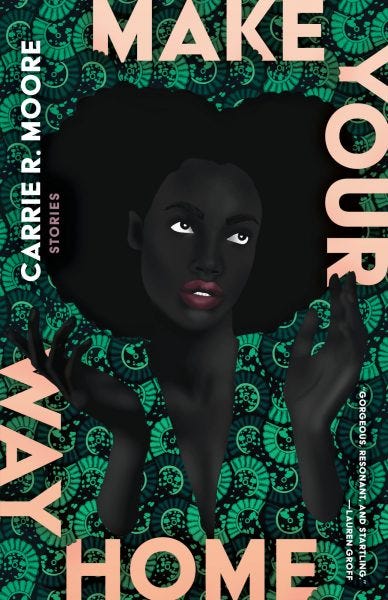
Before I sign off, I just got word yesterday that my review of Carrie R. Moore’s stellar story collection, Make Your Way Home, is now live at Colorado Review! I hope you’ll take a moment and check it out and see if this book might be for you. I feel like story collections never get enough love, and this one is really good:
All right, friends. Thanks as always for reading, and know I wish you well wherever you are (and those of you in the path of the giant winter storm in the eastern U.S., please stay warm and safe)!
Jules
I take issue with several aspects of this review’s critique of Díaz’s debut (for one, the review’s subtitle is a bizarrely gendered dig at the novel’s perceived lack of scope: “Big Man, Little Novel”), but I do want to give credit to the reviewer, Kazuo Robinson, for drawing my attention to the echoes of Frankenstein.
No posts
Comments
Nothing yet. Say the first thing.
Sign in to join the conversation.