
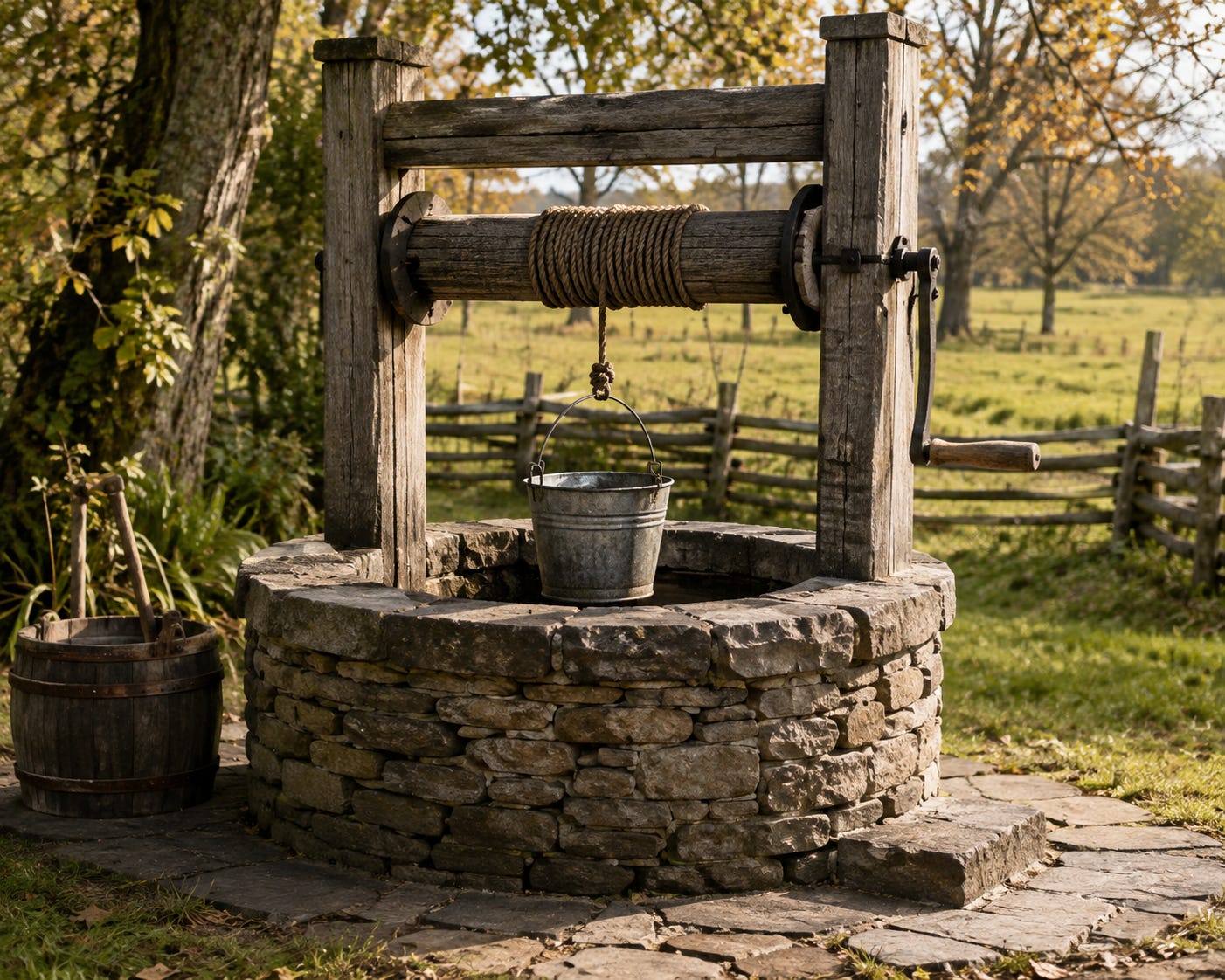
I got hung up almost immediately on the phrase “old-fashioned well.”
Old-fashioned to whom?
Elsie Wheeler said it in 1925, which means my own mental furniture is already suspect. So I went looking at older wells and ran into the word windlass.
For reasons known only to my brain, I briefly imagined something involving sails. A yacht. Rigging. Some magnificent bit of wind-powered engineering.
No.
A windlass is basically a horizontal wooden drum with a crank. You turn the handle, the rope winds around it, and the bucket comes up.
I was honestly a little disappointed.
But it did make me stop and think about how easy it is to hear “old-fashioned” through modern ears and immediately start furnishing the scene ourselves.
And that is probably where we should begin with Gemini 7.
The well is already there.
That seems almost stupidly obvious, but I think I kept wanting to drag the reader backward into the drama of finding the water, and Elsie doesn’t give us that. She gives us the thing after all that has happened. Somebody found the spot, somebody believed in it enough to start digging, somebody did the filthy work, somebody rigged up whatever old contraption belonged to the place, and now there is a well sitting there like, yes, obviously, this is where the water is.
A well is a funny object because most of what matters is missing from view. The water is underground. The useful bit is the bit you can’t see. What you can see is the evidence that somebody got the relationship right.
And yes, I did go skittering off into dowsing, because apparently “old-fashioned well” was not enough entertainment for one morning. People really did walk land with a forked willow, peach, or witch-hazel branch, one fork in each hand, looking for the place where the branch would dip or twist. Whether the branch itself is doing something peculiar with underground water is a separate argument, and I managed to have that argument too, because I have hobbies.
But it did make one thing vivid for me. Before the well existed, somebody had to say: here.
Maybe it was a dowser. Maybe it was somebody who knew the land so well he could practically hear the damp. Maybe it was vegetation, slope, soil, memory, luck, an irritating neighbour with a good track record. Whatever. The point is, by the time Elsie shows up, the uncertainty has become a structure.
There is a well there because enough things went right.
And then people use it. That is the other part I was flattening before.
You do not build a well, admire it for three days, and then retire it as a family monument. You go back to it. Again and again. Bucket down, bucket up. Pump. Carry. Fill. Spill some on your shoe. Swear. Come back tomorrow.
So the well is not only the aftermath of one successful act of finding. It is a habit. It is a route people keep using.
That is where the field becomes interesting to me. The water is still hidden. The people are still above ground. The well keeps those two things in contact. It is not doing anything mystical. It is just sitting there holding open a route that somebody figured out how to make.
And it can go wrong. Wells dry up. Pumps freeze. Water gets foul. Things collapse. Somebody has to notice. Somebody has to fix it. You are closer to the source in an old setup like this. You know when the handle feels wrong. You know when the bucket comes up light. You know when the water tastes funny. The relationship is not abstract. It is in your hands.
That feels very different from turning on a tap and trusting a municipal system three neighbourhoods away to sort out whatever fresh nonsense has happened underground.
And there is another thing I like about the old well: it probably belongs to more than one person’s life. Family, animals, garden, maybe neighbours, maybe half the yard. One source, lots of dependence around it. You can picture people coming and going, carrying water, noticing things, muttering about the pump, arguing about whose turn it is.
Then Elsie says old-fashioned.
That is the word that keeps snagging me.
She does not say useless, broken, or adorable little heritage feature with begonias around it.
She says old-fashioned.
So this is an older way of doing something people still need done.
The method may look clunky beside the newer one. Fine. Maybe it is clunky. Maybe you have to work the handle and get your boots muddy and haul the damned bucket yourself. But if the water still comes up, the thing has not lost the plot.
The well is the evidence of a relationship that already worked well enough to build around.
The water stayed hidden. The people built access. And then they kept coming back.
Jones comes first and does what Jones reliably does: he looks at a perfectly ordinary object and starts dressing it for church.
The well becomes an “unimpeachable source of life,” then we are off into self-renewal, organic integrity, human exchange and RECOMPENSE, which is such a Jones word that I can practically hear him clearing his throat before saying it.
Still, I can forgive him quite a lot here because he hasn’t actually tampered with Elsie’s picture. He is standing beside the same well she gave him, talking himself into a philosophy.
Dane, on the other hand, cannot resist home improvement.
Elsie: An old-fashioned well.
Dane: A well with bucket and rope under the shade of majestic trees.
Oh, come on.
The bucket and rope are cheeky enough. Historically plausible? Sure. Elsie’s words? Nope.
But the trees.
The bloody majestic trees.
Not two scruffy poplars. Not a willow with one bad side. MAJESTIC TREES.
And then he actually points to them.
The trees, Dane informs us, attest to the presence of the life-giving fluid.
Of course they do. You put them there.
This is my favourite Rudhyar manoeuvre because it is so brazen. Add something to Elsie’s image, wait half a sentence, then use the added thing to prove your interpretation. By that method I can add a Holstein cow, notice that she looks thirsty, and conclude that Gemini 7 concerns the sacred bovine longing for cosmic replenishment.
Nobody stop me.
From his freshly planted grove Dane proceeds into “primordial man,” earth and sky, biological roots, modern technology, mastery over matter, the usual struggle between some supposedly natural human condition and the terrible cleverness of civilization.
At this point the old-fashioned well has been asked to carry an unreasonable amount of luggage.
Jones does something different. He enlarges the meaning, certainly, and some of it gets very Jonesian, but he does not need to change what Elsie saw in order to get there. His interpretation may be pompous in places, but the crime scene remains undisturbed.
Dane has moved the furniture, planted an arboretum and is now giving us a guided tour.
That difference matters.
If Elsie’s image is the raw material, then the first obligation is surely to notice when an interpreter stops working with the raw material and starts manufacturing additional evidence. The problem with Rudhyar is not simply that I dislike his philosophy. The problem is that he keeps slipping his philosophy into the picture before interpreting it.
And once you notice him doing it, you cannot unsee it.
The well wasn’t enough. It needed a bucket. It needed a rope. Apparently it needed forestry.
And, naturally, it needed a lecture.
If Gemini 7 is prominent in your chart, people may have a habit of showing up with buckets.
They arrive with some horrible tangle they have been chewing on for three days, or a story that has become so complicated it now requires diagrams, or a question everybody else has turned into a doctoral thesis, and you have this peculiar way of getting to the useful bit. You find the opening. You get down to what is actually there. You bring it back up where it can be used.
You may do this with information, language, care, humour, ideas, people, practical knowledge, emotional material, whatever the rest of your chart gives you to work with. The specific content can vary wildly. The pattern is the same: something that was hard to reach becomes reachable around you.
And you may be so used to doing this that you hardly notice.
Other people are standing around looking deeply concerned, wearing the psychic equivalent of hard hats, and you are already halfway back with the bucket wondering what all the fuss was about.
That is one of the delights of this degree. You may have very little interest in making difficulty look impressive. If there is something worth getting at, you would rather get at it than perform the magnificence of the descent.
You may also be especially good at hearing what is underneath what somebody is saying. Someone gives you twenty minutes of explanation and one sentence catches your ear. There. That one. That is the live bit. Somebody hands you a mess of facts and you notice the odd little connection holding the whole thing together. Somebody brings a room to the brink of solemn death and you say one perfectly timed ridiculous thing and the oxygen comes back.
You are not necessarily the source of what becomes available. That may be the part people misunderstand about you. You are often the route.
A well does not sit there claiming authorship of groundwater. It simply gives access.
You may have that kind of usefulness.
People remember where they got water.
They may come back because something tends to become clearer, more usable, more speakable, more human, or simply less bloody complicated in your company. They may not even know exactly what you did. They just know they arrived with a dry bucket and left carrying something.
And then there are the things that keep giving you water.
You may have subjects, practices, questions, crafts, bodies of knowledge, or peculiar little obsessions that you return to for years because every time you go back, there is still more there. Other people may get bored and wander off toward something newer and noisier. You keep pulling up another bucket because the damned thing is still full.
That does not make you stodgy. It makes you attentive to what actually yields.
If this degree is strong in your chart, I would look for the places where you make access possible without needing to make yourself the star of the operation. You may be at your best when you are helping something useful come through cleanly, quickly, and with enough ordinary humanity that nobody has to put on a special hat first.
That is a lovely thing to carry.
If Gemini 7 is prominent in your chart, one of your more entertaining mistakes may be assuming that because your well reaches water, everybody else should stop wandering around with their ridiculous little methods and come use yours.
Careful.
Your access point is not the aquifer.
You may know a route that works brilliantly. You may have used it for years. You may be able to drop the bucket blindfolded and have water in your hand before everybody else has finished discussing methodology. Lovely. But that does not mean yours is the only opening in the ground.
Somebody else may have a spring. Somebody else may drill. Somebody else may know a completely different route into the same territory. If you get too attached to your own access point, you can become weirdly bossy about things you are actually very good at.
There is also the possibility of working one source to death.
You find something that gives. A subject, a practice, a person, a method, a body of knowledge, some particular route into whatever you need. Great. Then you keep going back. And back. And back. And eventually the poor thing is sitting there with its tongue hanging out while you are still lowering the bucket.
A source can be real and still be overdrawn.
Then there is the old favourite: we have always used this well.
That sentence has probably poisoned more things than anyone wants to admit.
An old well can be beloved, useful, familiar, woven into everybody’s habits, and still need checking. Water changes. Structures fail. Things get into places they should not be. The fact that something has served you faithfully for years does not mean you get to stop paying attention.
This is where “old-fashioned” can become genuinely funny. You may have a very high tolerance for methods everybody else thinks belong in a museum, and sometimes you will be absolutely right. Sometimes the old thing still works beautifully.
Sometimes you are drinking pond scum out of a heritage vessel.
Discernment, darling.
And because you can be so good at getting at things, there is another trap waiting for you: retrieval is not the same as understanding.
You can bring something up from below the surface and still have no idea what the larger system is doing. You found the fact. You found the story. You found the buried emotional piece. You found the obscure document. Excellent.
That does not automatically mean you understand the whole damned aquifer.
This may be where you occasionally get overconfident. You are so used to being able to reach the thing that you assume access equals mastery.
It does not.
Sometimes you have a bucket of water.
That is already plenty.
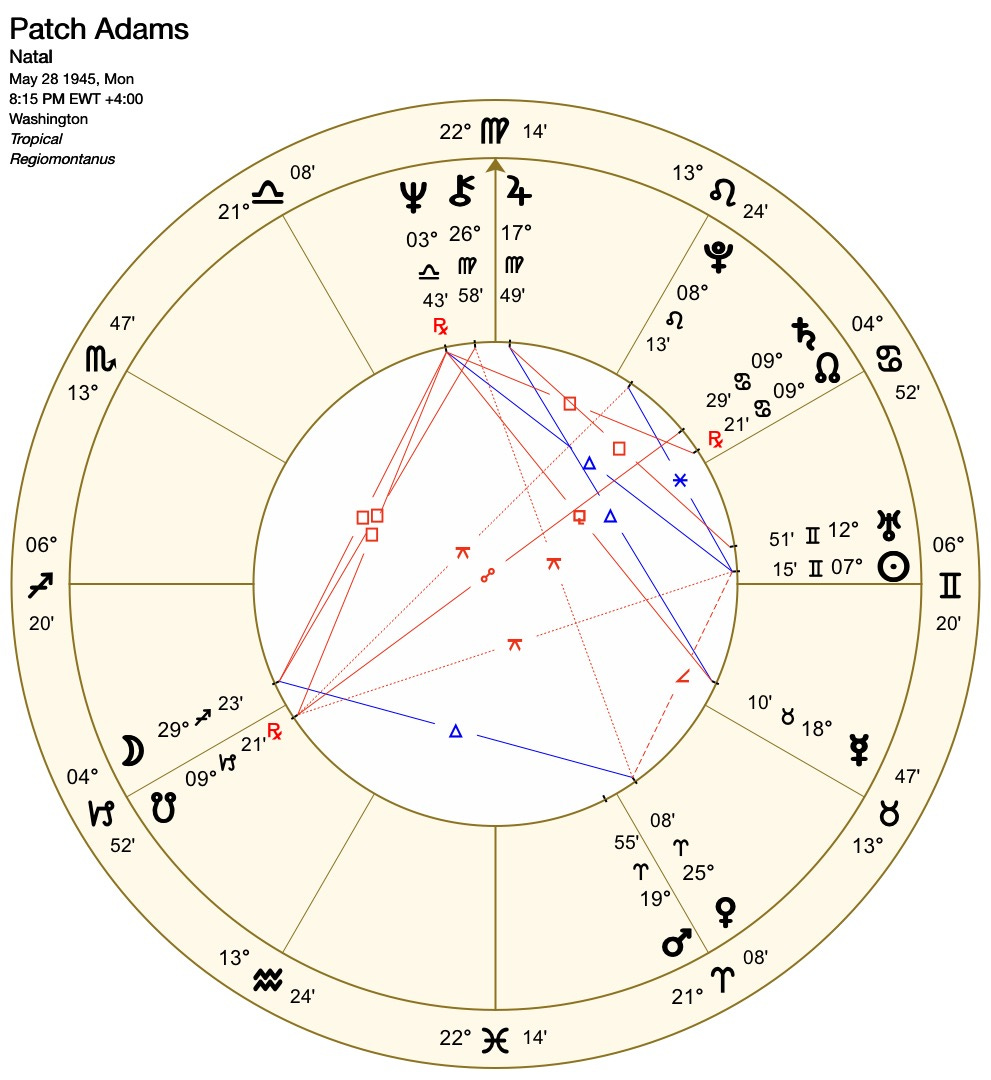
Patch Adams has his Sun at 7°15 Gemini, right on Gemini 7 and almost sitting on the Descendant. That got my attention immediately, but the chart only became useful once I stopped thinking about the Robin Williams movie.
The movie makes him look like somebody who might leap out of a cupboard and insist that joy is medicine.
The real Patch Adams is a much better specimen.
He is angry.
He is funny, certainly, but underneath the clown clothes is a man who has spent most of his adult life being profoundly pissed off about what happens when medicine forgets there is a person attached to the illness. He objected to short appointments, hierarchy, money determining who gets treated, professional distance being mistaken for competence, and the whole peculiar arrangement in which a frightened human being can be surrounded by highly trained people and still feel utterly alone.
That is much more interesting than “doctor uses laughter.”
Patch’s answer was not to become the world’s most exhausting cheerful person. He built his work around contact. He refused to treat care as something delivered from Important Doctor to Grateful Patient. He spent ridiculous amounts of time with people. He touched them. He listened to them. He dressed like an escaped circus employee when that helped. He went into hospitals, prisons, war zones and other places where nobody was exactly begging for a balloon animal.
The clowning was never the source.
That is what makes him such a good Gemini 7.
He found ways in.
A hospital can accumulate layer after layer of procedure, rank, language, fear and professional behaviour until everybody is technically doing medicine and nobody can get near one another. Patch seems constitutionally unable to tolerate that for long. He goes looking for the opening and then, with very little respect for decorum, uses it.
That may be humour. It may be affection. It may be listening for hours. It may be behaving so strangely that the usual social machinery gives up and the actual person underneath gets a chance to appear.
His Sun right on the Descendant makes perfect sense of that. This degree comes alive for him across from somebody else. The useful thing happens in contact.
And Uranus nearby in Gemini gives him the manners of a man who has never once looked at an accepted social convention and thought, well, we had better keep that because everyone seems comfortable.
If the room has become stupid, he interferes with the room.
If medicine has become cold, he does something warm enough to embarrass it.
If suffering has made everyone terribly proper, he may arrive dressed like a lunatic.
There is nothing delicate about him. He has described himself as an instrument for peace, justice and care, and “instrument” is probably the word I like best. He does not have to be the source of whatever restores the person in front of him. He makes himself useful to the contact.
That is the well.
Not a saintly man dispensing healing waters while violins play in the background.
A rather unruly human opening through which something badly needed can get through.
Theme Song: “Bring a Little Water, Sylvie” — Eric Bibb & Jean-Jacques Milteau
This is exactly why I like the song for Gemini 7.
It is an old song, but in the hands of Eric Bibb and Jean-Jacques Milteau it does not feel preserved under glass. They take something simple, old, practical and familiar, and make it feel warm and alive again.
There is no frantic need to modernize it beyond recognition. No one has decided the original idea was embarrassing and required twelve synthesizers and a concept album.
They just understand what is good in it.
Bibb gives it that beautiful, lived-in ease, and Milteau’s harmonica comes slipping through like it has always belonged there. The whole thing feels refreshed without being scrubbed of its age.
That is very close to what I think old-fashioned is doing in this degree.
The old thing is not being mocked, worshipped, or dragged around like a museum piece. It is simply being used well by people who know what they are doing.
Modern men, old song, still plenty of water in the well.
And unlike Dane, they managed the whole renovation without planting a single majestic tree.
When a transiting planet hits Gemini 7, something that was already there may suddenly become accessible.
This is not usually a trumpet-blast revelation from nowhere. It is more like finding the opening after spending half the morning stomping around on the surface being annoyed.
The right question appears. The right person answers the phone. An old note coughs up the missing fact. Somebody says, “Why don’t you just call her?” and six hours of unnecessary complexity fall dead on the floor.
There can be a very satisfying oh for Christ’s sake, it was right there quality to these days.
The old-fashioned part may show up too. The unfashionable solution works. Pen and paper beats the app. The battered book on the shelf contains the answer the internet has been hiding from you for forty-five minutes. A method you thought had gone out with rotary phones suddenly proves itself perfectly serviceable.
And you probably do not need the whole aquifer.
You need a bucketful.
That may be the best advice for this degree when it is activated. Get what is useful now. You do not have to understand the entire underground system before lunch.
Mercury may bring the missing phrase, fact, name, or connection. Venus may reopen an easy route between people or make something familiar pleasurable again. Mars may make you quit circling and go straight after the thing. Jupiter can make the source unexpectedly generous. Saturn may show you what still works because it has been maintained properly. Uranus may reveal an opening nobody had thought to use. Neptune can make it harder to tell whether the water is clean or whether you have been drinking your own imagination. Pluto may haul something up with half the bottom of the well still attached to it.
The mood of the day is simple enough: stop wearing a path into the grass.
There is an opening here.
Use it.
I began this degree wondering what Elsie Wheeler meant by old-fashioned in 1925, and I think I like the phrase more now than I did when I started.
Not because old things are automatically wise. Some old things are terrible. Some old things leak. Some old things should have been hauled behind the barn and shot years ago.
But sometimes an old arrangement survives because it still does the job.
That is the charm of the well.
It does not need a rebrand. It does not need an app. It does not need a subscription tier, a wellness consultant, or a tiny blue light telling you the bucket is connected to Bluetooth.
It needs water underneath it and a way to get the water up.
That is refreshingly hard to improve upon.
Modern life is very good at replacing the handle, redesigning the rope, launching Well 2.0, adding seventeen features nobody asked for, and then standing around looking surprised because nobody checked whether the damned thing still reaches water.
Elsie’s image is much less impressed with novelty than that.
The well is old-fashioned.
Fine.
Does it still reach the source?
If the water still comes up, I’m not terribly interested in how fashionable the bucket is.
No posts
Comments
Nothing yet. Say the first thing.
Sign in to join the conversation.