
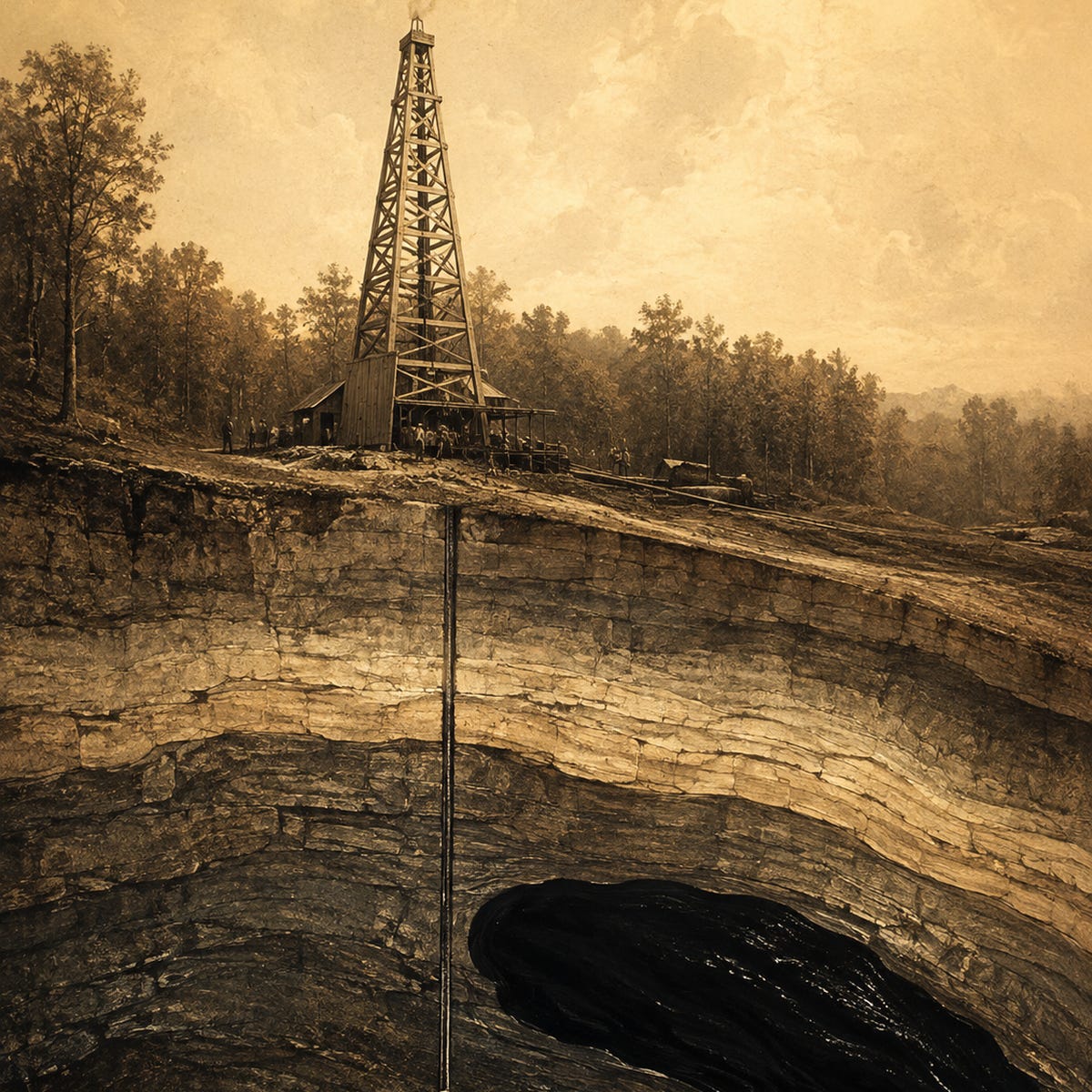
Before I became an astrologer, I spent two years working as an administrative assistant to Doug Lailey, vice-president of Shaw Pipe Protection Limited in Calgary.
This was 1990, when office technology apparently consisted of beige machinery, carbon copies and making women do things a chimpanzee could have automated. The place was spectacularly male. The men ran the show; the women orbited them with coffee, correspondence and increasingly homicidal levels of boredom.
Two years of this.
By the end, I was ready to claw my own eyes out.
Doug, who has since died, was another matter. He was charming, funny and intractable all in one fell swoop. You could enjoy him immensely while also recognizing that once the man had decided something, geological forces were probably going to have to get involved.
As it happens, geological forces did get involved.
Doug and the Shaw brothers would sometimes drill for oil.
I cannot adequately convey how much money this cost. Even in 1990 dollars, the numbers made my little administrative-assistant brain leave its body and hover near the ceiling. You did not wander into a field with a shovel and optimism. There were geologists, surveys, crews, equipment, casing, machinery, logistics and an enormous amount of money disappearing straight down a hole in the ground.
I think the Shaw brothers may have struck oil somewhere along the way.
Doug, as far as I knew, never did.
That fascinated me even then. You could have expertise. You could have geological evidence. You could have experienced people making the call. You could have enough money to make the attempt properly.
And after all that, there remained one brutally simple fact:
You still had to drill the hole to find out.
That came roaring back into my head when I reached Gemini 6.
Elsie Wheeler gave us:
Drilling for oil.
Well.
I know this one.
Drilling is not finding. Drilling is what you do when you think something valuable may be there and the surface cannot tell you for certain. You gather the evidence, pick your spot, commit the resources and bore straight through what you can see in order to test your idea about what you cannot.
Sometimes you hit oil.
Sometimes you spend a bloody fortune discovering that you were wrong.
And apparently Dane Rudhyar looked at all of this and thought:
Atlantis.
I have been calling this section Drill-Down all this time, and Elsie has finally decided to make the joke literal.
Fine. Hand me the hard hat.
The essential fact about drilling for oil is that you do it because the answer is unavailable from where you are standing. Something has made one particular patch of ground interesting. The geology looks promising. The seismic data gives you reason to pay attention. Enough has shown itself for a possibility to become figure.
But possibility is still possibility.
At some point, all the maps, models, expertise and educated guessing run up against the same problem: you cannot settle the question from the surface.
So you make a hole.
That is such a lovely Gestalt experiment. You have a working idea about the situation, but instead of mistaking the idea for reality, you arrange contact with something that can answer you.
And the ground may tell you that your excellent idea was horseshit.
There may be oil, gas, or water. There may be a little petroleum that costs far more to extract than anybody could ever make selling it. There may be a heroic quantity of rock.
The point is that reality gets a vote.
And that makes a dry hole more interesting than simple failure. You have spent a fortune and not received what you wanted, certainly, but you now know something you did not know before. The experiment has changed the situation. Perhaps the geological model needs revising. Perhaps another location looks more promising now. Perhaps the evidence says keep going. Perhaps it says stop throwing money into Alberta.
That last one is part of the image too.
Drilling requires commitment because you cannot keep changing your mind every six feet. But commitment can turn into stubbornness with breathtaking speed when the hoped-for thing remains underground. At what point are you still following evidence, and at what point are you drilling because you have already spent too much to bear stopping?
Elsie doesn’t tell us.
She gives us the drill.
A borehole is tiny compared with the landscape being investigated. You do not excavate the entire province to find out what lies beneath it. You choose a point of entry and learn what you can from contact made there. A very narrow encounter may alter your understanding of a much larger situation.
That is recognizably how we investigate all sorts of things. We seldom have access to the whole field at once. We sample. We test. We poke something and see what happens.
Sometimes what comes back confirms the hunch. Sometimes it wrecks it. And if you actually strike oil, congratulations: you now have another problem.
Finding something valuable does not end the field situation. It changes it. Suddenly extraction, pressure, transportation, ownership, cost, environmental consequences and market conditions come roaring into view. Even a genuine discovery may not be commercially useful. Oil can be there and still not be worth getting out of the ground.
Which is why I don’t want to turn this into the usual symbolic shortcut where anything hidden automatically becomes the unconscious.
Something can be unseen without being psychic. Sometimes the situation simply contains more than we can presently know.
And drilling is one of the things human beings do when there is enough evidence to justify looking, but not enough evidence to know.
That, I think, is the heart of Gemini 6. The surface gives you a clue, the drill asks the question, and the earth supplies the correction.
Marc Edmund Jones
Marc Edmund Jones is almost suspiciously well behaved here.
He calls the degree SPECULATION, which is hard to argue with. Then, being Marc, he cannot resist inflating the oil rig into “man’s indomitable efforts to discover every last resource of the world in which he finds himself.” Every last one, Marc? Leave something for the grandchildren.
Still, he keeps his boots more or less on the lease. He gives us risk, uncertain objectives, concentration, specialization and the possibility of foolish gambling. All recognizably present.
I particularly enjoy “ill-considered self-exploitation.” That is a tremendous phrase for spending an obscene amount of your own money proving there is no oil under your pasture.
His formula is wonderfully Jonesian:
manipulating-practical-ingenious-specializing-social-experimental
Apparently the derrick has six gears.
A few wisps of Marc incense hover around “opening new dimensions of being,” but by his standards he has shown remarkable restraint.
SPECULATION stays.
Now Dane arrives with a shovel and immediately begins digging somewhere else entirely. Dane Rudhyar does something much worse than merely overinterpret the image. He guts it.
Elsie gives us:
Drilling for oil.
Dane gives us:
WORKMEN DRILLING FOR OIL.
That looks like a tiny change. It isn’t.
The workmen are only one small part of the operation, and probably the least useful part if you are about to start talking about ambition, wealth and power. They did not necessarily choose the site, finance the well, study the geology or decide that drilling was worth the risk. They are the guys on the rig taking orders from somebody else.
So Dane narrows the whole image onto the labourers and then immediately hangs this keynote around their necks:
“The audacity for that knowledge which ensures wealth and power.”
Whose audacity?
Whose knowledge?
Whose wealth?
Whose power?
The fellow handling the drill pipe may simply be trying to get through his shift without losing a finger.
Elsie’s image leaves the entire operation intact. Dane points the camera at a handful of workers and then makes them carry motives that may belong to investors, executives, geologists, speculators, or nobody in particular.
And then the wheels come off entirely.
Oil is the product of decayed living material, so drilling for oil becomes an attempt to penetrate the collective unconscious and reawaken the powers of the archaic psyche.
From there we get ceremonial magic, tribal cultures, shamans, witch doctors and — naturally — Atlantis.
Atlantis.
At this point I’m beginning to suspect Dane may be doing a little shadow work of his own. Just saying.
Elsie gave him drilling for oil and he somehow managed to excavate Atlantis from underneath it.
Then crude oil gets “refined,” so the archaic psyche can apparently be refined too. Petroleum pollution becomes pollution of consciousness. Gemini itself gets dragged in to explain the symbol. One Twin looks backward for ancient power and knowledge; the other looks toward a spiritual source supplied by the next symbol.
And there, for me, the whole operation gives itself away. He is no longer staying with Elsie’s image. He is making it serve his system.
The degree has to fit Gemini. It has to fit his five-fold sequence. It has to connect to the next degree. It has to accommodate his ideas about human evolution, spirituality, ancient psychic powers and the corruption of modern consciousness.
The original image has been stripped for parts. And after this enormous metaphysical detour, Dane finally tells us the degree is about:
AMBITION.
Maybe ambition is present somewhere in an oil-drilling operation. It might belong to the investor. It might belong to the company. It might belong to nobody at all.
But Dane has rewritten the degree so that the workmen are suddenly standing there holding the bag.
Elsie did not give us their motive. She did not even give us the men. She gave us the act. Drilling for oil. That is what I am keeping.
The workmen can go back to taking orders, and Atlantis can remain wherever Dane found it.
If Gemini 6 is prominent in your chart, you may have a peculiar response to uncertainty.
Other people hear we don’t know and stop.
You hear it and start looking for somewhere to put the drill.
You may be very good at noticing that a situation contains more than it is showing on the surface. Not because you are wandering around sensing Mysteries of the Deep, but because one little thing catches your attention. A discrepancy. A clue. An overlooked possibility. Something everybody else has walked past without realizing it might lead somewhere.
You have resource radar.
That resource might be money. It might be information, talent, an opportunity, an unused idea, a neglected bit of research, a person nobody has taken seriously yet. You may look at perfectly ordinary ground and think, Hang on. There’s something here.
Then comes the useful Gemini 6 question:
How do I find out?
That is where you can be bloody good.
You don’t necessarily need the whole picture before you begin. You need a decent point of entry. One precise question. One experiment. One phone call to the person who actually knows. One obscure document. One test that will tell you whether the entire theory is worth another afternoon.
A borehole is tiny compared with an oil field. Your investigations may work the same way. You can sometimes learn an astonishing amount from one carefully chosen point of contact.
This makes you useful when everybody else is milling around inside a big problem.
You may be the one who says, Try here.
And you can tolerate a certain amount of failure because you understand that an unsuccessful attempt may still tell you where the oil isn’t. You test something, learn from it, move over twenty feet and try again. From the outside this may occasionally look inefficient. Then one of your pokes produces something enormously useful and suddenly everybody understands why you were poking.
You may also be willing to put a surprising amount behind a possibility once you think the evidence warrants it. Time. Work. Study. Money. Reputation. Attention. You can commit before certainty arrives, which is sometimes exactly what discovery requires.
And one good strike can change the arithmetic of a whole period of your life.
Years of apparently disconnected interests may suddenly produce the expertise you need. A research trail that seemed to be going nowhere coughs up the missing piece. One person you decided was worth taking seriously opens an entirely new avenue. One question produces an answer large enough to reorganize everything around it.
You are not necessarily a “deep” person.
You may simply be very good at finding the seam.
That is different.
The planet sitting here tells us what part of you does the drilling. The house tells us where you are most likely to set up the rig. But the degree itself seems to carry this readiness to investigate what cannot yet be known from the surface.
And when Gemini 6 is working beautifully, you don’t demand certainty before you move.
You look at the evidence, choose your spot and find a way to ask reality a better question.
Your first problem is falling in love with the hunch.
You begin with there may be oil here, which is perfectly reasonable. Then, somewhere along the way, it becomes there has to be oil here, and now you are in trouble.
Once you need reality to prove you right, you are no longer investigating. You are drilling for vindication.
You can also get caught by everything you have already put into the hole. Time. Money. Work. Reputation. Hope. At some point, I’ve come this far starts sounding like a reason to keep going.
It isn’t.
What you have already spent is gone. The only useful question is whether the evidence in front of you still supports another foot of drilling.
You also need to watch your appetite for unanswered questions. Not every mystery requires your rig. Not every odd detail needs following. Not every person needs excavating.
This matters particularly with people.
You may be very good at sensing that there is more going on than you are being told. Fine. Sometimes there is.
But sometimes somebody has already given you the answer and you simply don’t like it.
And sometimes I don’t want to talk about that is the property line.
Do not bring in heavy equipment.
You can also mistake difficulty for value. The harder something is to uncover, the more important it can begin to look. That is a dangerous equation. Something buried under six months of research, three spreadsheets and fourteen phone calls may turn out to be absolutely fascinating.
It may also be crap.
Then there is the temptation to confuse activity with progress. You can research, search, test, probe, investigate and make one more call until the cows come home. If none of it is changing what you know, you are not making progress.
You are making a deeper hole.
And if you ever do hit a spectacular gusher, be careful what lesson you take from it.
Persistence paid off that time.
That does not mean persistence always pays off. One glorious strike can make the next doomed venture look much more promising than it really is.
Your best navigation here depends on keeping the drill in its proper place.
It is a tool.
You use it when the evidence gives you reason to look. You pay attention to what comes back. You revise the theory when reality disagrees. You move the rig when the ground tells you to.
And sometimes the smartest thing you can do is stop drilling.
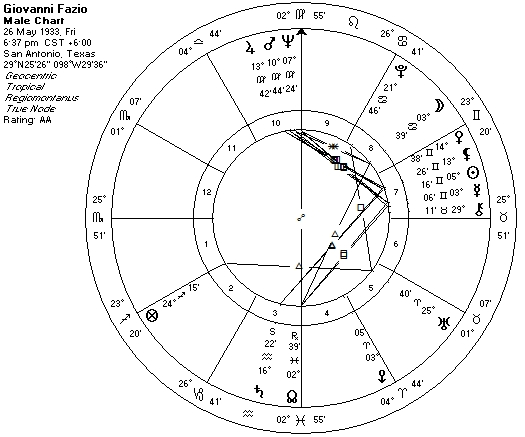
And then there is astrophysicist Giovanni Fazio, with his Sun at 5°16′ Gemini, bang inside Gemini 6.
Sometimes Elsie makes this ridiculously easy.
Fazio pioneered gamma-ray astronomy using balloon-borne telescopes, then moved into far-infrared astronomy, eventually becoming principal investigator for the Infrared Array Camera (IRAC) on the Spitzer Space Telescope. His career has involved building increasingly sophisticated ways of detecting parts of the universe that ordinary human vision simply cannot see.
That is drilling for oil with the ground removed.
Something is there. You have good reason to think it is there. You cannot perceive it directly. So build something that can get at it.
And his chart piles on.
His Gemini 6 Sun is conjunct Mercury within 2°10′, with the two also parallel within nine minutes of declination. Mercury itself squares the MC by only 0°10′. The investigative mind is practically bolted onto the career angle.
Then look at the other end of the square. His Sun squares Neptune, while Mars and Neptune are conjunct in Virgo up in the tenth house.
I mean, come on. Mars: tools, machinery, getting in there and doing something. Neptune: what cannot readily be seen. Virgo: precision. And he spends his professional life building exquisitely precise instruments that let us detect an invisible universe.
Fazio didn’t decide invisible meant unknowable. He treated it as an instrumentation problem.
Gamma rays? Build a detector.
Far-infrared radiation blocked by the atmosphere? Put the telescope on a balloon and get above much of the atmosphere.
Want to see the infrared universe properly? Spend twenty years helping develop a camera and put the damned thing in space. IRAC eventually flew aboard Spitzer and produced observations of star formation, distant galaxies, brown dwarfs, black holes and other objects that could be studied through infrared light. (Center for Astrophysics)
There is our Gemini 6 behaviour in the wild. The answer is unavailable from where you are standing. Fine. Build a way to reach it.
“Looking Too Closely” — Fink (2014)
Well, this is almost indecently perfect.
Gemini 6 has a gift for spotting the detail everybody else missed and then following it until something useful turns up.
Fink supplies the warning label.
There is a point where close attention becomes too close. Where the investigation stops opening the world and starts narrowing it. Where curiosity turns into fixation and the drill keeps going because stopping now would feel unbearable.
That is this degree in one gorgeous, brooding song.
And musically, it sounds right too. Low-slung, patient, slightly obsessive, as though somebody has been staring at the same patch of ground for three days and has just decided to bring in machinery.
Perfect.
When a transiting planet hits Gemini 6, you may get an urge to put time, money or attention behind something that is still only a maybe.
Good.
Just don’t confuse interesting with promising. Some holes deserve drilling. Some deserve a lawn chair and a beer while somebody else loses the money.
Gemini 6 people are a bit wonderful.
You are the ones who notice the funny little wobble in the story, the odd patch of ground, the tiny clue we don’t see. Then you cock your head, wander off in that direction, and a while later the rest of us hear machinery starting up.
There is something deeply endearing about that.
You are curious without being flimsy, persistent without needing a parade, and perfectly capable of becoming fascinated by something the rest of us have not yet realized is fascinating. Sometimes you come back with oil. Sometimes you come back with a very expensive hole and an absolutely cracking story about what happened down there.
Either way, you have usually learned something.
And frankly, the world would be a duller place without you lot in it. We need people who are willing to say, “Hang on, what’s under there?” and then actually go find out.
So yes, Gemini 6, we see you.
You’re peculiar.
You’re useful.
You’re fun to have around.
And we are very lucky you wandered into our orbit with a drill.
No posts
Comments
Nothing yet. Say the first thing.
Sign in to join the conversation.