
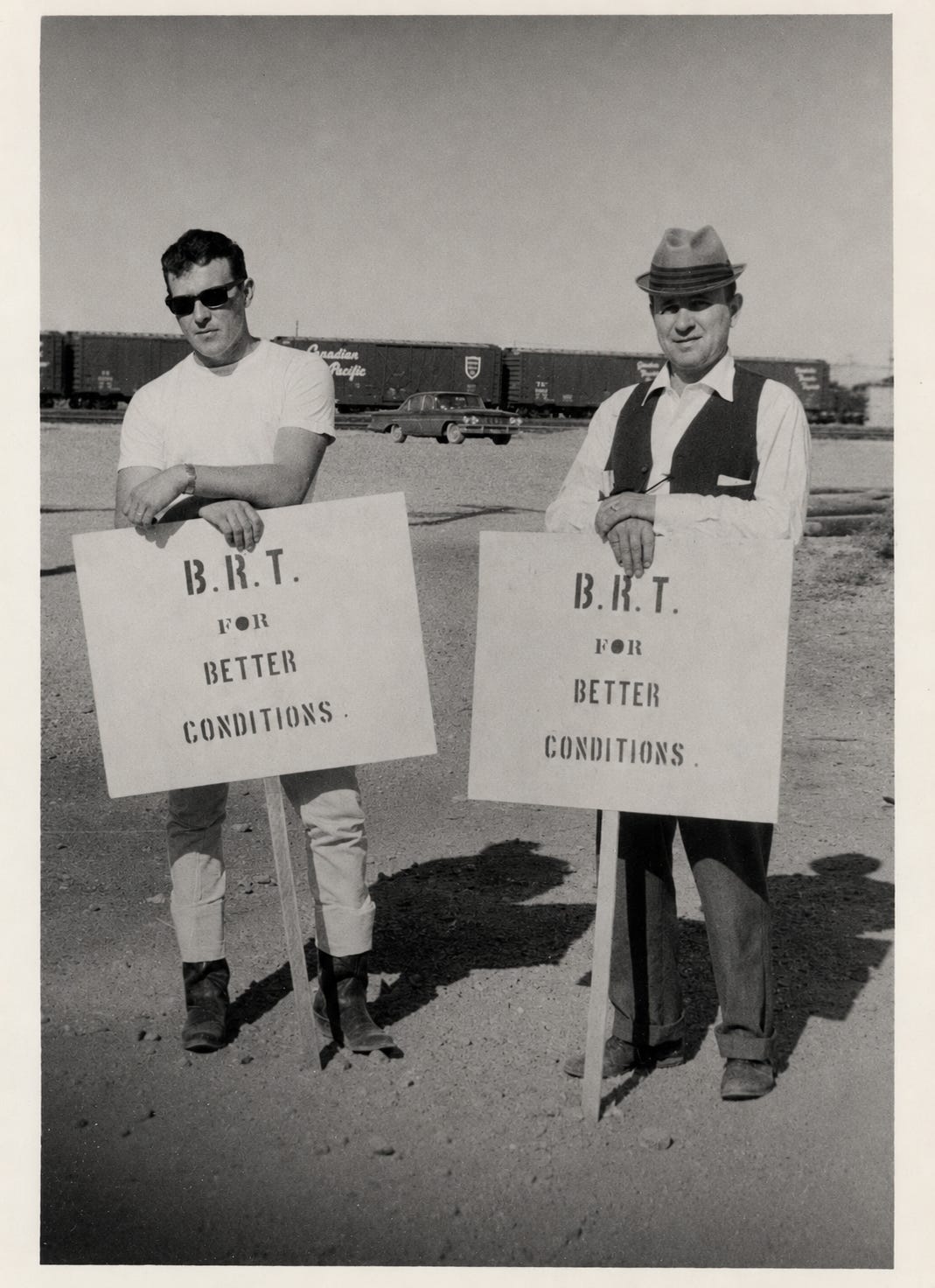
One of these men is my father.
Go on. Guess.
Yes. Obviously it’s the handsome bastard in the sunglasses.
That’s Leonard de Haan, standing in a Canadian Pacific rail yard in Winnipeg during the national railway strike of 1966, leaning on a Brotherhood of Railroad Trainmen picket sign that says, with admirable lack of poetry:
B.R.T. FOR BETTER CONDITIONS
The strike began at noon on August 26, 1966 and shut down Canadian National, Canadian Pacific and several smaller railways across the country. It ran until September 2, when Parliament forced the men back to work.
I have known this photograph all my life, but I had never thought of it as anything more than Dad being young, good-looking and mildly insolent in a white T-shirt.
Then I got to Gemini 8.
Elsie Wheeler’s image is:
AN INDUSTRIAL STRIKE
Well.
There he bloody is.
No factory surrounded by “aroused strikers.” No grand theory of civilization. No rape of the earth. No egocentric hoarding, spoliation, ambitious mind or collapse of human relationship.
Just two railwaymen in the sun, freight cars behind them, holding signs asking for better conditions.
Which is where I think we should begin.
Elsie gives us almost bugger-all here, which is useful.
The work has stopped.
A strike means a group of people have decided they are not carrying on under the present arrangement. Whatever was supposed to happen that day — trains moving, machines running, freight getting where it was going — is now sitting there with its pants around its ankles because the people who actually do the work have gone, Nope.
And that is where the power is.
The workers may not own the railway, the factory, the mine, the whatever-it-is, but they do own their labour. They can keep handing it over, or they can stop.
Once they stop, everybody gets a rather brisk education in who was keeping the whole contraption moving.
That’s what I like about Elsie’s wording. She doesn’t tart it up. She doesn’t tell us what kind of strike, whether the workers are furious, whether management are bastards, whether somebody is waving a brick, or whether there’s a brass band playing in the parking lot.
The arrangement has broken down because the people inside it have withdrawn their cooperation.
And a strike has a funny way of exposing what everybody had been taking for granted. When the work is happening, labour can become nearly invisible. Once it stops, suddenly the absence is enormous.
That’s plenty.
We can leave the scenery department to Dane.
MARC EDMUND JONES
Jones looks at AN INDUSTRIAL STRIKE and, mercifully, does not immediately drag in the fall of Rome.
His keyword is PROTEST.
That’ll do.
He sees the strike as the point where people stop putting up with conditions that no longer suit them. There’s some Jonesian varnish about “effective self-interest” and refusing “a lesser in lieu of a greater,” but you can still see the original animal under the fur.
People are fed up and stop working.
Management discovers, perhaps with some surprise, that the railway does not in fact run on executive confidence.
Jones also catches something useful about self-assertion. A strike is not vague dissatisfaction. It is dissatisfaction that has put on boots and gone outside.
So far, so good.
Then Dane arrives carrying lumber.
Elsie said:
AN INDUSTRIAL STRIKE.
Dane says:
AROUSED STRIKERS SURROUND A FACTORY.
Oh for Christ’s sake. Where did the factory come from? Where did the surrounding come from? And who decided everybody was aroused?
That is not a tiny embellishment. He has changed the picture before he has even started interpreting it.
Now we have a mob, a building, and, apparently emotional heat.
And once he has done that, he can start hauling in all his usual furniture: the disruptive ambitious mind, industrial unrest, violence, exploitation of planetary energy, egocentric hoarding, privilege, spoliation, man raping the earth.
By the time he reaches REVOLT AGAINST PRIVILEGES, Elsie’s poor strikers have been made responsible for half the sins of modern civilization.
All she gave us was a strike. And this is where Dane’s method gets slippery. He adds ingredients to the image, then interprets the ingredients he added.
Of course “aroused strikers surrounding a factory” suggests confrontation. He put the confrontation there. Of course it suggests siege and hostility. He put those there too.
Elsie gave him a bare patch of ground and he built a whole bloody union hall on it.
My father’s photograph is actually a lovely corrective.
Two men. A rail yard. Picket signs.
FOR BETTER CONDITIONS.
That’s it. No planetary rape or collapse of human relationship. No revolutionary opera swelling in the background.
Just working men saying the deal is lousy and they’re not doing another shift until somebody improves it.
Jones at least stayed close enough to the ditch that we can still see where Elsie started.
Dane is halfway to Saskatchewan.
If you have Gemini 8 prominent, I suspect you have a pretty good nose for a shitty deal.
Not necessarily at work, either. You could be eighteen and suddenly realize that the family has been running on an arrangement nobody bothered to renegotiate after you stopped being twelve. You could be sixty and discover that you’ve somehow become the person who organizes every Christmas, remembers everybody’s birthday, looks after Mother, feeds the cat, brings the potato salad and gets called difficult the first time you say you’re not doing it. You could be ninety and have your children discussing where you’re going to live as though you’ve already left the room.
There are picket lines everywhere once you know what one is.
That’s where I’m going with this degree. I don’t think Elsie was handing us a symbol exclusively for working adults with lunch buckets. The industrial strike gives us the shape of something much more ordinary: an arrangement has been operating for a while, one side has decided the conditions stink, and cooperation is withdrawn until there is something worth agreeing to again.
Sometimes Gemini 8 may recognize this earlier than everybody else. They can see who is carrying the thing, who has got comfortable being carried, and exactly what would happen if the person doing all the carrying sat down.
They may also have a useful talent for finding the actual bargaining chip. Not the dramatic one. The real one. What do I contribute here that you have assumed will continue indefinitely? What happens if I stop?
That can be labour, certainly. It can also be availability, money, caretaking, enthusiasm, expertise, sex, hosting Christmas, driving everybody to the airport or being the only bugger on the committee who knows where the keys are.
And because this is a strike rather than simply quitting, I think there can be a wish to preserve the arrangement. The message may be less I’m gone than I’ll come back when we fix this.
There’s solidarity in the picture too. One railwayman refusing to work has a problem. Ten thousand railwaymen refusing to work have negotiations. Gemini 8 may have a sharp eye for the point where a supposedly personal grievance turns out to be everybody’s grievance. That can make these people formidable when they decide to stand beside somebody else and stay there.
Of course, they can also become a monumental pain in the arse.
A person can discover the power of withholding and start using it every time the peas touch the mashed potatoes. They can refuse before they negotiate, dig in because they enjoy having everybody scrambling, or stay furious long after somebody has offered perfectly decent new terms.
But the good version of this degree has something I rather like.
It knows cooperation is an agreement.
Even if the agreement is old. Even if nobody remembers making it. Even if the whole family, company, marriage, school, club or village has been merrily proceeding on the assumption that you will keep doing your bit forever.
Every now and then somebody puts down the shovel.
Then we find out what the arrangement was really made of.
This degree can get into trouble when it forgets that a strike is supposed to change the terms, not become a permanent hobby.
You can be twelve and decide nobody is getting another word out of you until the family acknowledges some gross injustice involving chores, privacy or your sister wearing your hoodie. You can be forty-eight and stop carrying half the office on your back. You can be eighty-seven and tell your children that if they want to rearrange your life, they can bloody well include you in the meeting. Same animal. Different paddock.
One error is withdrawing before anybody knows what the grievance is. If you stop speaking, helping, showing up or participating and everybody else has to hire a psychic to figure out why, that is not especially useful leverage.
Another is turning withdrawal into punishment. Silence can be a boundary. It can also be a little homemade dungeon. Same with affection, money, rides, help, attention, sex, access, enthusiasm, Christmas dinner. If the purpose is to make everybody suffer until they surrender, we have wandered away from better conditions and into bog warfare.
There is also going on strike when you actually want to leave. If there is no possible version of the arrangement you would return to, you may be done. No need to spend six months picketing a relationship you secretly hope burns to the ground.
Then there is the opposite problem: staying long after you know the conditions are rotten. Children do this. Teenagers do it. Old people do it. People in families, schools, marriages, clubs, churches, care homes and friendships do it. They keep cooperating because everybody will be upset if they stop. Well. Sometimes everybody being upset is how you discover who was benefiting from your cooperation.
Gemini 8 can also overestimate its leverage. You may indeed be the only person who knows where the passwords are. You may also discover Brenda has a notebook.
There is breaking ranks, too. If everybody has the same problem and you cut yourself a private little deal, congratulations, you may have improved Tuesday and made Wednesday worse for everyone else.
The reverse is joining the mob without checking the complaint. Twelve-year-olds can do this with friends. Seventy-year-olds can do it on condo boards. Humanity remains remarkably consistent.
Another trap is getting attached to the fight. Sometimes the conditions improve and the person is still out there emotionally waving the sign because being aggrieved has become the most interesting thing happening all month.
And one I particularly like for this degree: mistaking being needed for being cherished.
If everything falls apart when you stop doing it, that certainly tells you something.
It may tell you everyone loves and appreciates you.
It may also tell you they got very comfortable while you did all the work.
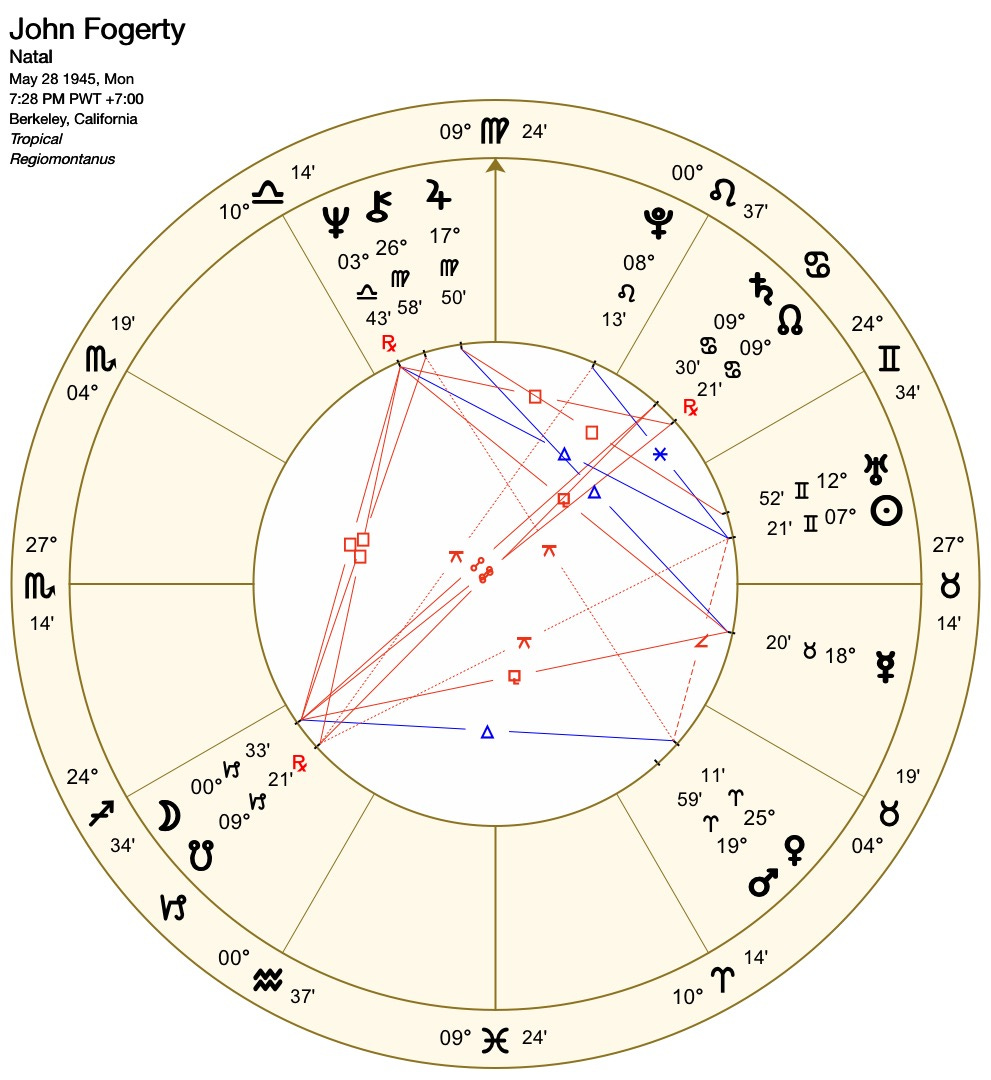
John Fogerty may be one of the cleanest Gemini 8 examples in the pile.
After Creedence Clearwater Revival broke up, Fogerty was still tied to Fantasy Records under a contract he had come to hate. The terms were lousy, the relationship had gone sour, and he still owed the label more records.
So he stopped making them.
He withheld the thing they needed from him: John Fogerty making records.
For years, he simply would not keep handing his labour over under conditions he found unacceptable. The dispute got so bad that David Geffen eventually bought him out of the Fantasy contract so Fogerty could record elsewhere.
And then the chart gets almost rude about it.
His Gemini 8 Sun sits in the seventh house, the house of contracts, agreements and the people on the other side of the table. His great Gemini 8 story is quite literally a war over the terms of an agreement with somebody else.
The Sun is also conjunct Uranus.
There’s your refusal.
You don’t own me. I’m not doing this anymore. Figure it out.
And the Sun is tightly sextile Pluto, which fits the part of the story that became a fight over ownership, control, money and who got to decide what happened to the work he had created.
Apparently the chart thought we might otherwise miss the point.
The story gets even sillier.
Years later, Fantasy sued Fogerty over “The Old Man Down the Road,” claiming it sounded too much like “Run Through the Jungle.”
Which Fogerty had also written.
So John Fogerty ended up in court having to demonstrate that a John Fogerty song sounded like another John Fogerty song because both had, inconveniently, been written by John Fogerty.
You couldn’t make this shit up.
His Mercury, ruler of that Gemini Sun, is in Taurus and almost exactly trine Jupiter in Virgo, which also suits the sheer nuts-and-bolts nature of the grievance. This wasn’t a vague artistic sulk. Contracts, royalties, ownership, obligations, who gets paid, who controls what. The complaint had paperwork.
There’s a darker side to it too. The fight with Fantasy went on for years and ate up an enormous amount of his attention. He became estranged from his own Creedence catalogue and from the pleasure of playing some of those songs. The strike had done its job, but the picket line stayed up in his head long after the original dispute had changed shape.
That’s useful for us because Gemini 8 isn’t only about knowing when to stop cooperating. It also has to know when the terms have changed enough to come back in.
Fogerty gives us the whole damned thing: bad conditions, refusal, leverage, a long fight over the ownership of his own work, and the danger of letting the grievance become a second career.
Some people go on strike outside a railway yard.
John Fogerty did it with a guitar.
John Fogerty wrote “Fortunate Son” in 1969, and it comes roaring out of exactly the territory Gemini 8 knows so well: lousy arrangements, unequal burdens, privilege, and the point where somebody finally says, I am not swallowing this deal just because you handed it to me.
It is not a song about a strike. It has the same snarl.
Some people get the flag, the money, the protection, the family name and the useful connections. Other people get told to be patriotic and go take the risk.
Fogerty looked at that arrangement and called bullshit.
Which is funny as hell in this essay because Dane eventually drags our poor little industrial strike all the way over to REVOLT AGAINST PRIVILEGES.
Fine, Dane.
Have John Fogerty.
The song has exactly the right amount of insolence for Gemini 8. It does not ask politely whether the terms might perhaps be reconsidered. It points at the whole rotten setup and refuses to pretend everybody got the same deal.
And given Fogerty’s own history with Fantasy Records, there is something particularly satisfying about using a song written by a man who later spent years saying, in effect, you do not get my work under these conditions.
Turn it up.
A transiting planet through Gemini 8 can make the day unexpectedly hinge on terms and conditions.
Read the fine print. Ask what’s actually being agreed to. Notice where the price has changed, the promise has shifted, or somebody has quietly assumed your consent.
This can be the day to renegotiate the deal, cancel the subscription, hand back the keys, or discover that the “small favour” has somehow acquired a pension plan.
Keep your boots dry and your wits about you.
I keep coming back to Dad in that photograph, mostly because he looks like he should be selling Brylcreem rather than withholding labour.
There he is in his sunglasses, leaning on the sign as though striking the CPR is simply what one does before lunch.
And maybe that’s the useful little joke in this symbol.
Big historical language tends to make protest look enormous and theatrical. Banners. Speeches. Revolution. Dane has already ordered the scenery.
Meanwhile, actual people are usually standing around in work boots wondering who brought coffee.
That’s probably why Elsie’s version survives all the embellishment so well.
She left the human beings in it.
No posts
Comments
Nothing yet. Say the first thing.
Sign in to join the conversation.