
Happy Equinox, friends! Summer is somehow behind us here in Oregon, and lately, although I’ve been beginning my days as I usually do—sitting in my backyard trying to soak up as much sunshine and birdsong as I can while glued to a computer for work—I’ve been doing so bundled up in a sweater and puffy vest, a beanie tamping down my bedhead. Every day in the early afternoon, I’m surprised to find that I’m roasting and need to run inside to ditch the layers, lose the wooly cap in favor of a tee shirt.
That’s what this time of year is like—full of dramatic shifts, sometimes in the ambient temperature and sometimes in my inner weather. I often feel like a scale weighted in one direction, then another, never balanced. I’m hustling and bustling with nonstop activity, or I’m sprawled all day on the couch. I’m longing to flit about and meet all sorts of people, visit new places, try challenging things, or I’m craving acres of solitude and stillness and nothing more challenging than guessing which bird that is calling from the neighbor’s pine.
On this day when light and darkness are equal, I’m reminded that perfect equanimity is rare, that our whole little world has its own pendulum swings, rocking between a triumphant abundance of daylight and a long cloak of secluded darkness. As we arc from one season into another, may your own shifts and swings be easy, may there be solace in both the hum of the light and the quiet of the dark.
xo
JP
When I started sending out my most recent book to publishers, I knew it wasn’t done. In the past, with every book I’ve written, I’ve spent weeks or months or years noodling with the order of the poems, swapping some out, writing new ones to fill in gaps, revising and revising and revising until, at last, something snapped into place. It’s akin to the feeling I get when I finish a poem—that feeling is, in fact, how I know a poem is finished, that sense that something has clicked closed, a door securely latched, a puzzle piece pressed firmly into the last remaining spot. But with this last book, although I swapped and wrote and revised for years, that feeling never arrived, and so I sent the manuscript out anyway, knowing that even if it wasn’t quite finished, it was close enough, and that if it got picked up, I could sort things out later.
But later is now—or actually, later was last month, when I had to send the final edits on the manuscript to my publisher. As I reentered the book, I could still feel the problem clearly, but not the way through it. The problem was the ending, where I’d placed all the poems that offered some relief from the heft of the first two-thirds of the book, which focuses on racism, gun culture, grieving my mother’s death, and the painful end of a relationship. (You know, just some light reading.) I wasn’t trying to slap a happy ending on, but I wanted to gesture toward a way forward through all that despair. So I’d ended the book with a dozen or so odes to queer communities where I’ve found hope, even when it’s been fraught or tempered by fear. When my editor shared notes, they confirmed that this sequence of poems, often set among the revelry of nightclubs, seemed like an abrupt shift from the themes and settings of the rest of the book.
This summer, I tried to build a bridge to those poems, adding in detours and side trails that might connect one landscape to another. It felt odd, and sometimes annoying, to have to build that bridge for readers. After all, my own experiences of queer joy and hope live right alongside my grief and pain and rage, so couldn’t I trust a reader to make the leap to understand that, too? But I knew that, without some signposts, some wayfinding, a reader might not know how a body can cross those territories, how readily someone can step from one to another.
So, I set out to build some placards, to lay some branches across the path in the shape of an arrow, to leave some breadcrumbs to say, This way! Follow me! After months of not writing—and of wondering, as I always do, will I ever write again?—the pressure of a deadline worked its potent magic, and I wrote a handful of new poems that I thought might serve as those pointers. I tested out the signs, the bridges, the side trails. Those new poems grieving my sister’s death, my regrets about our relationship? Too bleak, a route covered in slippery rock that could make a reader plunge into a canyon instead of rising toward the viewpoint I wanted them to see. But those other poems, the ones where I returned to using the “acrostic-telestic double whammy karaoke remix” form that I wrote about in ? Those were a more promising track, a scenic route that might lead to a different vista than the one I’d originally set out for, but one that might prove satisfying nonetheless. (Can you tell how much hiking I did this summer? So much.)
There was something to these poems, which riffed on problematic but popular songs from my childhood. One in particular—a poem that borrowed from Aerosmith’s magnum opus, “Dude Looks Like a Lady”—pointed me back to my own body, a body that has aged and ailed and otherwise transformed, that has confused other people—that has confused me—with its flouting of racial categorization, with its alternating and overlapping demonstrations of ladylike and dudely demeanors. My body—site of grief and pain and disappointment, site of delight and wonder and humor—gave me a new focus for the ending of the book. I pulled together poems about my body in its sickness and sweetness, in its gore and glory, in its mess and magnificence, and these became the gesture toward hope, toward survival, that I wanted to end the book with.
I sent off that new version of the book to the publisher a few weeks ago, and I’m still waiting to hear back from the editors, so maybe this isn’t where the book will end after all, but for now it feels fitting. I still haven’t felt that familiar click, but perhaps that’s because with this book, I’m not trying to turn the page on a chapter of my life, the way I’ve tried to do with my previous books. This book is about racism and gun culture and grief, and those things, I’m sad to say, don’t have an end in sight, don’t have a door to latch shut. I have not solved those puzzles. Instead, I have the open door of my body, which I walk through, looking for that new vista, waving to the reader, this way, follow me.
In my very , I wrote about how birds kept finding their way into my poems, on account of all the birdwatching I’d been doing since the pandemic started. Three years and some months later, as I went back into editing the manuscript that contains many of those poems, I noticed that even though the book touched on a wide array of themes and tones, birds were the constant throughout every section. The speakers in the book are observing birds, or looking for birds, or swearing they just saw a bird that no one else saw, or they’re turning into birds themselves, or turning back from birds into humans. There might be some meaning to make here, something about the flight response to threats, or the transcendence that can come from a bird’s-eye-view on the world, or hope being a thing with feathers. But the root truth is that the birds aren’t metaphors, they’re neighbors—always have been—and it seems odd to me now that they made only the occasional appearance in previous books.
When I wrote about birding in that first newsletter, I described myself as an amateur, and that still feels true, though I bought my first good binoculars earlier this year, tired of always having to borrow a pair when I went out for a bird walk. I even obtained a free spotting scope, a hand-me-down from Bird Alliance of Oregon, though I’m still so slow to maneuver the tripod and all the fiddly adjustments that even the most sedentary bird has taken wing before I can get it in view. Still, three years ago, I could identify maybe a dozen birds by sight or sound, and now, thanks to so many gentle guides who have helped me to slow down, to listen and look, there are maybe four dozen that I can reliably say hello to when I’m out and about, and maybe another forty who I can recognize in some fashion, the equivalent of being able to say, “I know we’ve met before—remind me of your name.”
More than racking up a list of names and characteristics, though, I’ve started organizing my life around birds. The little plot of land where I live, which I once would have dug up to cultivate tomatoes and melons and okra and beans is now mostly a smorgasbord for my feathered friends, who feast on the Oregon grape, snowberry, thimbleberry, and oceanspray, and compete with the bees for the spiraea, checkermallow, collomia, and kinnikinnick. I’m starting to embrace what a colleague called my señora days, meaning living like a grandparent, an elder, who devotes their free time mostly to sitting and looking at (and sometimes chatting with) birds. I even started organizing my vacations around birds, taking a stretch of days last month to drive out to the Malheur Wildlife Refuge in eastern Oregon, where I saw great horned owls who looked confident they could turn me into prey if I got too close, innumerable lovable quail with their plumes flopping about on their crowns, and a white-faced ibis shimmering its iridescent oil slick body against the sunset and just generally looking like an ancient god.
Recently, I found out I’d have the opportunity to train with a local organization, People of Color Outdoors, to lead beginner birding outings, and I was over the moon, thinking about devoting this next year to learning about bird biology and behavior, to acknowledging more birds by sight and sound, and to understanding better how to invite other people, old and young, into their señora days. I know that at this time next year, I won’t be a bird expert, will still have more questions than answers about my bird neighbors, but I’m excited to indulge my bird curiosity even further, to help other people meet their spark birds, and to discover how birds might turn up in my future writing, perched in a paragraph or alighting on a line, their calls still a constant, no matter what comes next.
Last month, I had two new poems appear in Clockhouse. One of these, “Aubade,” uses a form in which the last word or phrase of each sentence is repeated, sometimes with a variation, at the beginning of the subsequent sentence. Maybe this form was in existence elsewhere—I’m sure I’m not the first to do this—but I was alerted to it via a dream in which Ross Gay read me a poem he’d written using this technique. If only all dreams could be so instructive!
I recently got the good news that I’ll have a poem installed on transit buses in Clark County, Washington, for the next year as part of the Poetry Moves program. The poem, “Sauvie Island Tanka,” was one I wrote at the beginning of this year as part of a series of tanka in which I excluded all the letters from my first name. The poem’s subject? Birds. Always birds.
And, in some other good news, Krista Lee Hanson, a former participant in a nature writing class I facilitated, has a new poem, “Snuggling My Son to Sleep Haibun,” in Mom Egg Review. In the class, we discussed the haibun form, as well as the concept that nature is not just something to observe “out there,” but also part and parcel of our human existence. Krista beautifully carried both of those notions into this tender piece about caring for her teenage son.
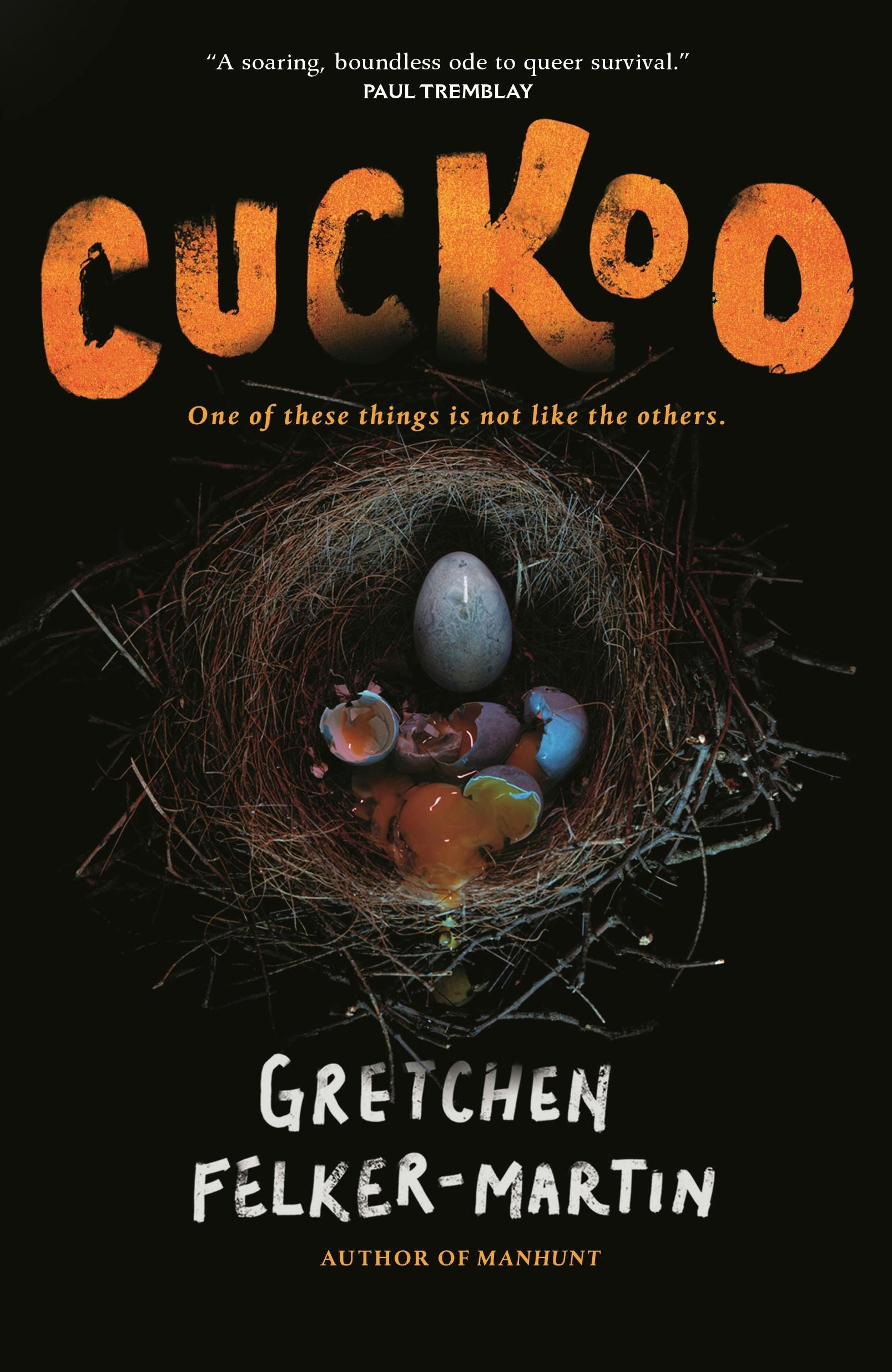
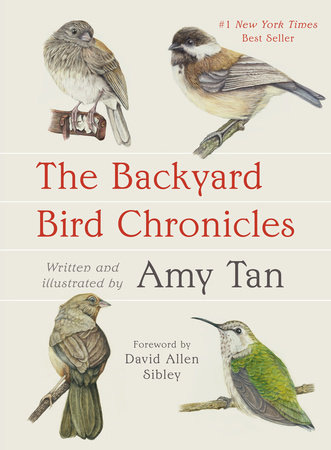
If it’s not clear that I have birds on the brain, I submit here the evidence that my two favorite reads from this summer were Gretchen Felker-Martin’s Cuckoo and Amy Tan’s The Backyard Bird Chronicles. Cuckoo, though it borrows the metaphor of the brood parasite—the bird that lays its eggs in the nests of other species—is emphatically not about birds. Rather, it’s an intense, graphic, fever dream of a novel in which queer kids who are sent to a conversion camp in the nineties encounter not only the horror you might expect from such a camp, but also a literal monster. The novel, which follows the protagonists both as teens at this remote desert camp and as adults reuniting to stop the Cuckoo once and for all, reads like a reinterpretation of Stephen King’s It, imagining how that book might be different if “The Losers Club” were all queer and trans kids. Cuckoo is not for the faint of heart—while it’s full of cinematic and sensory descriptions that conjure up settings with eerie specificity, those settings are also abhorrent, and the book is explicit in its representations not only of violence and gore, but also of sex, dysmorphia, and the legacy of trauma. But if you’re looking for a blistering, no-holds-barred confrontation with the horrors that live among us—including homophobia, transphobia, and child abuse—Cuckoo is a bold, unflinching journey into that hellscape.
However, if you’re feeling less ready for spooky season and still clinging to the dappled light of summer, The Backyard Bird Chronicles might be more your vibe. Tan’s book is about birds, following her routine observations of the birds that visit her home in California. Deeply influenced by nature journaling practices of noticing, wondering, and making connections to other observations, The Backyard Bird Chronicles is an inspiration for piquing curiosity about the world around us. Although there’s still the presence of illness and grief, both of which come with the territory of attending to the grizzly business of life among wild animals, it’s difficult not to be delighted by Tan’s detailed descriptions and drawings of the creatures in her midst. I would be surprised if this book doesn’t result in a wild uptick in the construction of DIY birdfeeders and an even more prominent rise in the number of folks who start journaling about the birds, squirrels, and other creatures who visit their neighborhoods. Highly recommended both for bird enthusiasts and for folks who have been wondering, “What is up with all these people who go bonkers over birds?” If this beautifully illustrated book doesn’t clue you into what all the fuss is about, it will probably at least inspire you to pick up a pencil and sketch whatever’s in front of you, which is not such a bad outcome for any of us authors to aspire to.
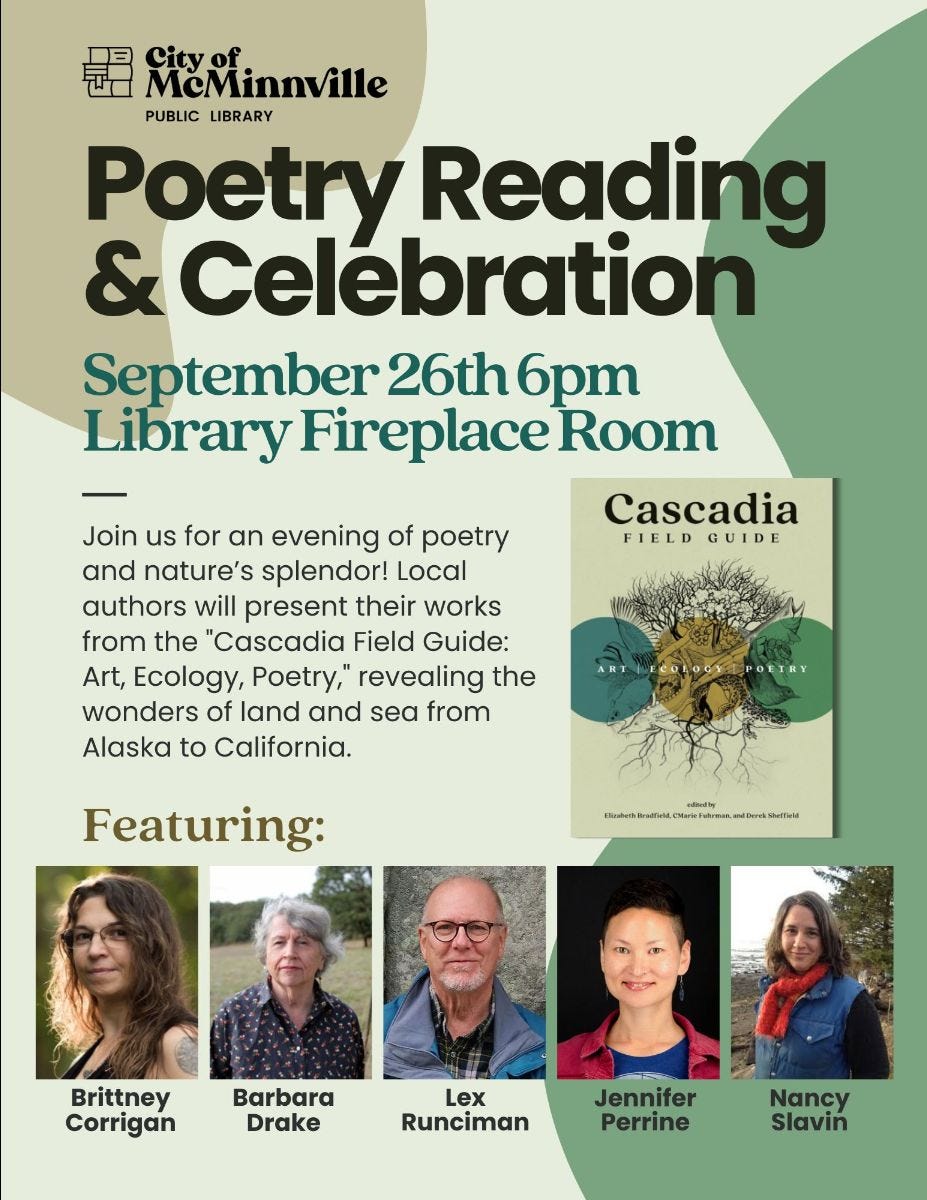
After taking a few months away from most things writing-related, I’m plunging back into the fray, beginning with a Cascadia Field Guide Poetry Celebration this Thursday, September 26, 6pm PT at McMinnville Public Library in Oregon. I’ll be reading alongside Brittney Corrigan, Barbara Drake, Lex Runciman, and Nancy Slavin, sharing writing about some of the many beings included in Cascadia Field Guide: Art, Ecology, Poetry.
The following week, on Thursday, October 3 at 6pm CT, I’ll be reading at another celebration, this one at the Poetry Foundation in Chicago, in honor of the 50th anniversary of Kelsey Street Press, the experimental feminist press that’s publishing my new book. The reading, which also features Kiran Bath, Rena Rosenwasser, and Metta Sáma, is free and will be followed by a free reception. If you’re near Chicago, I hope you’ll come say hello! And if you’re not in Chicago, you can livestream the event by registering here.
After that, I’ll be back in Portland, but reading poems by Midwest authors as I judge the Kate Sommer Memorial Poetry Prize for adults writing and living in Nebraska. The contest awards a $1000 prize and is free to enter—just send up to three of your best poems via Submittable by Sunday, October 20.
If all my discussion earlier in this newsletter of how I navigate shaping a manuscript piqued your interest, I’ll be offering an online class on how to Assemble Your Poetry Manuscript. In the three-hour class, you’ll practice curating and organizing your poems into a chapbook or book-length manuscript by identifying themes, experimenting with sequence and structure, and locating opportunities to further develop your collection. The class meets online on Saturday, October 26, 10am-1pm PT. More details and registration are available on the Hugo House website.
Looking for a more generative-focused, in-person class? I’ll be teaching at Northwest Writers’ Weekend in Port Orchard, Washington, Thursday, November 7-Sunday, November 10. The camp includes classes on songwriting, poetry, creative nonfiction, cross-genre writing, and art, led by Cosy Sheridan, Nova Devonie, Kate Gray, Jenny Rose Lara, and yours truly. I’ll be teaching two classes: “Writing with Our More-Than-Human Kin,” and “Poetry Is a Party, and You Are Invited.” Registration covers classes, housing in a cabin in the woods by a lake, and scrumptious meals. It’s my fourth year teaching at this camp, and I can’t say enough good things about the warm, inviting gathering of writers I meet here each time.
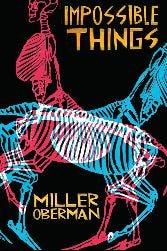
And then it’s back to Portland for a poetry reading on Saturday, November 16 at 6pm with Miller Oberman at Bishop and Wilde bookshop. The reading celebrates the release of Miller’s new book, Impossible Things, which I can’t wait to read. Miller is not only a brilliant poet but also the person who introduced me to the Beautiful Outlaw form, without which my new book would be an entirely different creature.
Other opportunities I recommend:
For Portland Area Folks Who Need Some Forest Nourishment (aka All of Us):
Tia Ho is leading two half-day forest bathing workshops at Oxbow Park in Gresham, Oregon (which is, amazingly, one of the places I get to work!). I wrote a bit about learning forest bathing skills from Tia in a previous newsletter, and I still can’t adequately describe how life-changing that experience was. Each workshop involves a guided forest bathing walk, an interactive series for building sensory invitations, and a communal sharing of offerings to one another and to the land. The Saturday, September 28, 9am-1pm PT offering is for folks 60 and over, and registration is available here. The workshop on Saturday, October 26, 9am-2pm PT is open to all, and you can register for that one here. Participants in both sessions will also receive a bonus e-course about forest bathing, including elements of sensory invitations.
For Oregon Writers:
Oregon Humanities' Community Storytelling Fellowship is awarded annually to Oregonians who belong to communities that are underrepresented in Oregon media. Each fellow receives $5,000 to support the creation of true stories—including journalism, creative nonfiction, video, audio, and other media—about those communities. Stories are shared in Oregon Humanities magazine and other publications. Three fellowships are reserved for storytellers living in rural communities. To apply for the fellowship, share a little about yourself, your community, and the kinds of stories you hope to tell through this application form. The application deadline is Friday, October 1. I was awarded this fellowship a few years ago and would be happy to chat if you’re thinking about applying!
For Visual Artists in the Portland area:
The Precipice Fund will award artist grants of $500–$5,000 to unincorporated visual art collectives, alternative spaces, and collaborative projects in and around Portland, Oregon. A total of $60,000 in grants will be awarded in this round. Applications are due Friday, October 1.
For Portland-Area Artists, Curators, and Folks Involved in Arts Programs and Businesses:
The Regional Arts and Culture Council is currently accepting applications from individuals interested in serving as Community Panel Reviewers for Portland Arts Project Grants. Reviewers will perform and complete their work between November and December 2024, serving on 1-3 virtual grant panels. Reviewers receive a stipend of $250-$325 per panel. Reviewers should be practicing artists and/or have experience facilitating or curating arts programming or managing an arts-based business. Community members who have not recently or have never served on a RACC panel are strongly encouraged to apply. Applications submitted by Friday, October 1 will be given priority. Apply here.
For Performing Artists in Oregon:
The Miller Foundation Spark Award for Oregon Artists will provide $25,000 awards to artists who are at a midpoint of their career. The program supports individual artists in Oregon, and this year’s awards are open to performing artists. Applications must be completed in the Individual Artist Grants Portal by Saturday, October 2, 5pm PT.
For Portland Metro Area Placemakers:
Metro's Community Placemaking Grants support arts and culture based, community-led, equity-centered efforts that strengthen people’s connections to each other and places they care about. Up to $450,000 is available in this grant cycle. with grants ranging from $5,000 to $25,000. Applications are due Tuesday, October 4, 2024 at noon PT. Learn more and apply here.
For Writers Interested in Body Horror:
One of my favorite local writers, Cal Angus, is teaching an online class on Body Horror. Part workshop and part survey of what makes effective body horror in literature, comics, cinema, and video games, the class meets on Tuesdays, October 22-November 26, 5pm-7pm PT. Registration is sliding scale.
For Pacific Northwest Creators of Tiny Works:
The Stacks Coffeehouse in Portland is hosting a gumball machine that recently held some of my poetry in its whimsical orb. Want one of your creations featured there next? Send your poetry, micro fiction, love notes, artwork, or something else lovely and smaller than 2” diameter to Gumball Poetry. Open to creators anywhere, though there’s an emphasis on people based in this region. Reprints welcome.
If you’ve got an opportunity you’d like me to include in a future newsletter, please let me know.
No posts
Comments
Nothing yet. Say the first thing.
Sign in to join the conversation.