
Happy Sagittarius season to all you hybrids, you healers, you archers who always hit your marks! I offer that initial “happy” as an aspiration, a gesture toward what I might feel, what I hope you might, too, in a season that’s felt increasingly grim.
Shortly after the election, I called my dad to wish him a happy birthday, and as always, we ended up talking about the weather, not as an avoidance of serious topics, but as an acknowledgment that weather is a serious topic, as anyone who’s stewarded land knows. I observed that it had been unseasonably dry here, that the maple in my front yard was still flush with leaves, a flaming cerise abundance. And then, just a few days later, a single rainstorm brought all that abundance to the ground, and I was bereft, staring at those bare branches, at the gray looming in the negative space between their limbs.
Today, weeks after that phone call, that rainstorm, I went for a walk, and noticed that plenty of maples in the neighborhood are still clinging to their green, their samaras, that they’ve barely even begun to flirt with turning golden. Is there a metaphor in all this? Am I trying to say that things aren’t as bad as they seem, that just around the corner beauty awaits, that even when things seem bleak, those bare branches are still alive, ready to leaf out when the time is right? No, there are no easy metaphors, no platitudes I can offer. Just a reminder to myself to keep noticing, to look beyond my own window, to get out among my neighbors and see some version of what they’re seeing. Whether your own arbors are unfurling or shaken, lush or barren, may you have the space to stop and study the weather within and around you. May you keep stewarding all that lives there.
xo
JP
In my last newsletter, I wrote about the process of revising the last few sections of my manuscript, of trying to build a journey from the book’s reckoning with violence, racism, and grief toward a sense of hope and healing and the possibility of joy in spite of all that pain. I wrote about waiting for the click, the sense of inevitability that signals a book or poem is finished, and how, though I’d revised and revised and gotten much closer to where I wanted the book to end up, that click never came. Shortly after I sent that last missive, I heard back from my editors, and they, too, hadn’t felt the click, pointed out that though the ending felt hopeful, it also felt too generic, too distant, more like an idea of hope or joy or resistance than an experience of it.
So, back to the drawing board I went. I revised some of the final poems, grounding them in more specific details, more memorable language, more overt attention to rhyme and cadence and other elements of sonic joy. I pulled back into the manuscript some poems I’d previously cut, reordered the sections over and over. The book was getting better, getting closer, but something was still missing. Maddeningly, there was still no click.
For the life of me, I couldn’t figure out what else to do, and my creative energy had dried up. I was feeling overwhelmed, working too much at my day job, anxious about the election, and frustrated that I had zero ideas and only two more weeks before the final version of the manuscript needed to be sent off to the designer for typesetting. So, I did what any sensible person would do. I set aside my notebook and proceeded to binge-watch both seasons of Interview with the Vampire.
I’m not generally one to consume so much TV all at once, but I was hooked. When I finally came up for air, I wondered why I was so enthralled. There were the obvious reasons: the sharp and surprisingly comedic dialogue, the sumptuous set and costume design, the racebent and overtly queer take on Anne Rice’s book, the portrayal of vampires as campy, violent, vulnerable creatures, the Rashomon-like approach to questioning perspective and narrative reliability and memory (or “the odyssey of recollection,” as the titular interviewer puts it). But beyond all this, there was something else tickling the back of my brain, compelling me to see the series through to its end.
And that something else revealed itself when I finally came back to my manuscript, now with the stories of Louis and Lestat rattling around inside of me. When I looked at my poems about the terror and seductiveness of gun culture, I thought of the newly turned vampire Louis, wrestling with his bloodlust and the ease with which he could now take human life. When I revisited the poems about the end of a past relationship, it was hard not to see echoes of Louis and Lestat’s relationship, how easily their tenderness toward each other turned brutal and toxic, how both the love and the trauma of that relationship haunted Louis for years after. And when I pored through the poems about my mother and the decades of estrangement that preceded her death, I felt a jolt of recognition, thinking of Lestat’s maker abandoning him and leaving him to figure out how to navigate the world alone as a fledgling vampire.
Those stories let me look at my life, my poems, with some necessary distance—the distance of fantasy, the distance of the once-but-no-longer human. That distance allowed me to play the role of interviewer, questioning the veracity of my own tale, asking to hear the piece of my story that I’d left out.
In the show, the other main character is Claudia, a child turned by the vampire couple, who becomes a kind of daughter to them and—spoiler ahead, folks!—whose death they both grieve for decades in profound and sometimes destructive ways. Although I’ve never lost a child in that way, years ago, I wrote poem after poem as I came to terms with the fact that my efforts to conceive a child were never going to come to fruition. Although the grief of that time and those poems is bound up with many of the other griefs in my manuscript, it had never occurred to me before this last month to include those poems in this book. In fact, perhaps because memory was trying to do me a kindness, I’d forgotten altogether that those poems existed.
But the show had sparked my own odyssey of recollection, and upon returning to the real world, with its deadlines and doldrums and stunning lack of beautifully undead creatures, I dug through my files. I found all those poems in which I mourned that I was never going to have children, and as I sorted through them, pulling out the half dozen or so that held their own against my critical scrutiny, I began to see the final poems of my manuscript in a different light. As I threaded this new set of poems into the book, I saw that the sense of hope and possibility and joy with which I wanted to end the book was wrapped up with my desire to be someone’s ancestor, to offer some sustenance to all the young queer folks out there who, while not biologically related to me, are nevertheless my family. I wanted the book to end by reaching out to them, especially the ones who haven’t found their kin yet, who are navigating the world alone as fledglings. I wanted them to feel seen, the way that all the books and songs and shows I’ve loved best have helped me feel less alone, less monstrous. If any of them read my book, I wanted them to feel more than the idea of hope. I wanted them to have the experience of it.
So, I went back into those last sections one more time, with that in mind. I changed some poems to address all those young and/or isolated queer folks directly. I invited in a bunch of queer characters to romp around in the stanzas, trying to note the specific details of communities that have made me feel affirmed. I adjusted the tone, aiming to be overtly welcoming without resorting to cliches of “it gets better,” to name the ways we endure even when better feels a long way off.
With just a few days to spare before that final deadline, I read aloud the whole reworked manuscript. In it I heard a new howl of grief, a clear note of hope, and—at long last—the click.
This is usually the part of the newsletter where I write about a craft or hobby or something else that I’ve embarked on as a bit of rest from creative efforts. But in these last few weeks, hobbies have mostly fallen by the wayside, as I’ve devoted a lot of energy to navigating the aftermath of the election, which so far has mostly consisted of helping my allies and co-conspirators negotiate their fear. Much of this fear has manifested in ways I didn’t anticipate (but perhaps should have), as over and over I hear people express a desire to be cautious, to not rock the boat too much, lest we become the targets of emboldened racists, sexists, homophobes, transphobes, etc. But of course, most of us are already the targets, which is why we’re so afraid. That desire to play it safe—to not draw too much attention—is enraging, but I get it. There’s plenty right now to fear.
I've been doing my best to help folks slow down and reconnect with their values, the ones that guided them before their fight/flight response got kicked into high gear, but ultimately, I know it’s not in my control what decisions they make. But witnessing this sudden shift in the people around me has made one thing clear: trying to fly under the radar will become an increasingly seductive alternative to resistance, especially as the political landscape begins to feel more threatening, and I want to be vigilant about not letting my own fear—which is real and mighty and at times overwhelming—get the best of me.
And so, I’ve been taking stock of all the resources I have at hand to help me regulate my nervous system, so I can witness my fear and choose my response to it instead of resorting to my fine, time-tested habit of flailing about in panicked reaction. Many of those resources are practices I’ve written about in past newsletters, ones that often take the guise of hobbies: , , , , , . (And, of course, there are the more dissociative forms of coping, which on occasion also help me move through rough patches—see that whole spiel above about binge-watching gothic horror.)
In these last weeks, I’ve been trying out some new practices, too, ones I share here as an invitation, in case you, too, have heard the siren song of all your stress mechanisms luring you toward a rocky shore you didn’t intend to visit. Without further ado, here are this month’s top 5 ways of fastening myself to my ship’s mast:
Go outside, lie down, look at the sky, breathe. If it’s raining, stay indoors, lie down, close your eyes, imagine you’re looking at the sky, breathe.
Knit, crochet, or otherwise do something easy and repetitive with your hands. (Thread beads onto strings! Fold paper into simple origami or zines! Pet those animal companions who keep giving you the sad eyes!) If you’re a knitter/crocheter in the Portland area, you can pick up free yarn from Squares of Warmth, craft up an 8”x8” square, and my neighbor will sew it together with other squares to make blankets for houseless folks.
Dance, if you have the energy. If you don’t, stand and do a little five-second serpentine wiggle, a la Axl Rose. This has proved surprisingly helpful for when I’m feeling too rigid in my body or thoughts, but if you’re not feeling it, choose your own super simple movement and give it a go.
Repeatedly throw a pillow against the floor. The movement on its own is a perfectly good practice, but if it helps, you can also imagine the pillow is full of whatever or whoever is currently running your nervous system ragged, and really have at it.
Devote ten minutes to this mindfulness/art practice I learned from local artist Thi Doan: Set a timer for five minutes. Scan the sensations in your body while imagining yourself as a tree, from roots to crown, noticing what your tree looks like, whether it’s bent, branching, uprooted, leafy, bare, mossy, hollow, etc. Set another timer for five minutes and draw your tree, noticing what thoughts or feelings come up as you draw. This one’s especially good with crayons, so there’s no temptation to turn it into a magnum opus, and it’s been particularly useful when I’m so overcome with emotion that I can’t even name what I’m feeling. The tree always knows.
If you try any of these out, let me know how it goes! And if you’ve been leaning on another simple practice to help you through the hard times, to keep you anchored and present, let me know what’s been working for you.
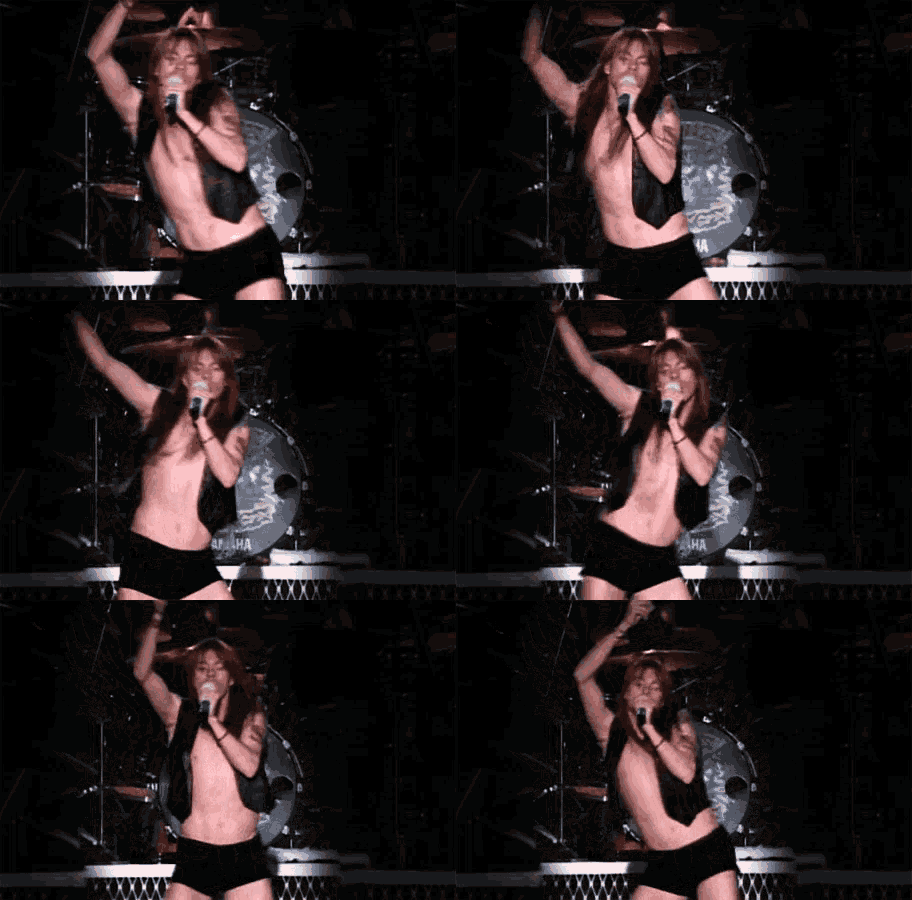
The vest and undies combo is optional, but if you want to try it out, I won’t judge.
You do you, boo.
In early October, I ventured out of my Pacific Northwest bubble to read at the Poetry Foundation in Chicago, in celebration of Kelsey Street Press’s 50th anniversary. It was a delight to meet some of the press’s founders, editors, and authors, including Kiran Bath, whose Instructions for Banno is stunning. My part of the reading felt a bit like a test run for the book launch that I’ll be setting up for when Beautiful Outlaw comes out in May 2025, and I got to try out projecting the poems behind me, so the audience could check out the visual aspects of the Golden Shovels and Beautiful Outlaws and Acrostic Karaoke forms I used in the book. This was also the first reading where someone has interpreted my poems into ASL, and I was floored when I watched the recording later. Drop in at 40:45 to watch the interpreter sign “Rage,” which I’m now convinced is meant to live in the world first and foremost as an ASL poem.
In late October, in the run-up to the election, Broadsided Press published an interview/review of my last book, Again, which I wrote in the first hundred days after the 2017 inauguration. The review, “The Language of Empire,” notes aspects of the book that, unfortunately, are relevant once more. I’d love for Again—for the language of empire—to be obsolete one day, but until then, I hope the book continues to do for readers what it did for me—help to make sense of a situation that can seem overwhelming in its senselessness, help to feel our way back from numbness into curiosity and courage.
And last week, I got to read alongside Miller Oberman, who introduced me to the Beautiful Outlaw form. Miller is the only other poet I know who’s writing in the form, and so of course the Q&A after our reading turned into us nerding out about extreme literary constraints and attempting to convince everyone in the room to try out the form. (I think we had a surprising number of folks interested in taking us up on the offer, and I can’t wait for this to become the hot new technique in Poetryland.) Craft nerdiness aside, what struck me most about the reading was how much laughter there was in the room, even though Miller’s book, Impossible Things, is in essence a book-length elegy, and my book is, well, a Big Ol’ Pile of Grief™. I’ve been thinking a lot about that laughter over the last week, how necessary and right it felt when, as I read “I Can Look at You From Inside As Well,” the response to the line, “my mother’s dead,” wasn’t silence or a sympathetic gasp or an awkwardly averted gaze but a throng of knee-slapping guffaws. I’m not sure I’ve ever had an audience really get my brand of grim wit before, and I felt so seen.
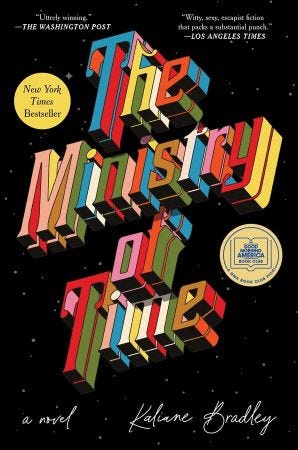
I also was able this month to devote a little more time than usual to reading other folks’ books, and the one that left the biggest impression on me was Kaliane Bradley’s The Ministry of Time. Probably, you don’t need me to tell you about this book, as it was a New York Times bestseller, is being adapted into a BBC television series, and got a lot of press, with everyone from Good Morning America to Barack Obama singing its praises. But, if you missed all that, the book is narrated by an unnamed British civil servant who’s offered a promotion to be a “bridge” helping expats to assimilate to their new home. Those expats turn out to be refugees from the past, scooped out of their own time periods by the government and now attempting to acclimate to the 21st century. This unnamed bridge is assigned to befriend, monitor, and live with Commander Graham Gore, who’s been dislodged from a harrowing Arctic expedition in 1847, and as their relationship unfolds, the book cozies up to a number of genres, including spy thriller, sci fi, romance, and even fan fiction, as Gore is a legit historical figure who Bradley was clearly obsessed with curious about. All this on its own would make for an entertaining read, but what lingered with me was the book’s exploration of the seductiveness of assimilation and colonialism, both for the time-traveling “expats” and for the narrator, a multiracial daughter of a Cambodian refugee who is often read as white, who works for the government, and who falls for a man who in many ways represents the heyday of the British Empire. I’m sure plenty of folks read the book without reflecting much on the questions about race and complicity in empire that it raises, but for me, I’ll always prefer my escapism with a little real-world thorniness, a sharp note to roll around on my tongue after I’ve had my fill of the fantasy.
On Friday, December 6 at 7pm PT, I’ll be reading with Shaley Howard and Vinnie Kinsella at BOLD Coffee and Books in Portland. The event is free, and proceeds from book sales will benefit Basic Rights Oregon’s efforts to secure and protect rights for LGBTQ2SIA+ folks in Oregon. Want to donate, but can’t attend the reading? No problem—check out this link for more info.
Other opportunities I recommend:
For DEI Job Seekers in the Portland Metro Area:
One of my colleagues at Metro is recruiting for an Equity Project Manager to guide organization-wide initiatives led by the Diversity, Equity and Inclusion (DEI) Department, including the effort to update the Strategic Plan to Advance Racial Equity, Diversity and Inclusion. This position will ensure the continued development of Metro’s budget equity strategies and partner with Metro staff to assess and track how programs and policies are advancing the Strategic Plan. The salary range for this position is $89,024-$103,064. Learn more and apply here by Monday, November 25.
For Vietnamese and SE Asian Diasporic Women and Nonbinary Writers:
The She Who Has No Master(s) Mentorship Program is a creative writing mentorship led by and designed for Vietnamese and SE Asian diasporic women and nonbinary writers. In 2025, the program is offering 5 mentorships in creative writing and/or visual arts. Mentorships are conducted remotely and will run through Spring 2025. The 2025 mentors are Cathy Linh Che, MyLoan Dinh, Abbigail Rosewood, Sophia Terazawa, and Nhã Thuyên. The application is open until December 15, and more information about the program and mentors is available here.
For Nonfiction Writers in Oregon:
Oregon Humanities is seeking essays about flourishing, blossoming, openness, and growth for their Spring 2024 issue. They hope to explore both literal blooms—agriculture, gardening, ecology—as well as metaphorical blooms, such as thriving communities and budding movements. Features generally range between 1500 and 4000 words, and contributors are paid between $750 and $1,500, depending on the length and complexity of the piece. If you are interested in contributing to the issue, please read past issues and the guidelines for writers, and send one proposal or full draft by December 16 to editors@oregonhumanities.org.
For Male-Identified Writers in the Portland Area:
Brian Benson, a fellow Portlander whose writing and teaching I greatly admire—and whom I’ve described more than once as a local treasure—is offering an in-person session of (Re)Writing Masculinity, a memoir workshop for male-identified writers interested in telling honest, vulnerable, curious stories about their experiences of masculinity. The class runs Tuesdays, January 21-March 11, 6-8:30pm PT, and a portion of the workshop proceeds will be donated to an organization serving women and nonbinary folks. Applications are due by Sunday, January 5. You can learn more about this class and Brian’s other upcoming nonfiction classes here.
If you’ve got an opportunity you’d like me to include in a future newsletter, please let me know.
No posts
Comments
Nothing yet. Say the first thing.
Sign in to join the conversation.