
Happy Aquarius season and a peaceful new year to all of you carrying the world’s waters in your cup, pouring feathers and forests from your overflowing vase. In these first few weeks of the new year, the word that’s kept coming to mind is fragile, whether my attention is landing on wildfires, on ceasefires, on the frost riming the tender green leaves in my yard. Everything—including my attention itself—seems especially tenuous, delicate, vulnerable.
If you’re in the same spot, feeling more like an eggshell than the slab of granite you long to be, I hope you can also sense the bird or snake or tortoise or platypus held safely inside you, the lovely creature that needs us to be easily broken in order to emerge.
xo
JP
This past fall, I was invited to write a short piece for an expanded edition of Uncertain Girls in Uncertain Times, an anthology edited by Joyce Chen and Donna Bellew, forthcoming from Red Hen Press. Like the other contributors, I was asked to choose a favorite poem and write an accompanying reflection on it, through which I would share essential advice and practical know-how that could help young women, femmes, and gender expansive folks “imagine deeply, create bravely, and find the confidence to build a meaningful life in this uncertain and chaotic world.” Sure. Easy peasy.
The editors had sent me a sample of the other authors and their essays. The contributors list included a lot of founders and directors, executives and presidents, and the examples I read clearly offered wisdom on how to navigate professional crossroads, how to move through the doubts and dilemmas that one might encounter, especially if you live in a body that dominant culture doesn’t look at and say, “Oh yes, you’re an obvious leader.” And so I wracked my brain for poems that could inspire, could activate, could rouse and uplift.
But truly, there was only one poem that declared itself to me, over and over, no matter how many books on my shelves I scoured. Elizabeth Bishop’s “One Art” rattled around in my brain, as it always does, and I had the same internal struggle I always do, wondering why I have to be so darn melancholy all the time, why the best advice I can offer to a young person is about how to navigate loss. Even when the editors wrote back, saying that the rights to the poem might be difficult to secure, I couldn’t think of any other advice I wanted to give, except what I’d learned from grief. Fortunately, the editors found a way to secure the rights, and last month I began writing my reflection, which begins: “I used to feel ghoulish for thinking that life is one long, continuous state of loss.” (Used to? Hah! Obviously, I still feel ghoulish. I am an uncertain ghoul in an uncertain time.)
Like Bishop, I go on to list my many losses, and then I offer what I learned by memorizing and reciting “One Art” to myself and in public, many times over many years. To find out what I gleaned from that poem, you’ll have to read the anthology (or, you know, invite me out for tea or tapas). But I’ll share here what I learned from writing about what I learned from the poem. I learned that, maybe, it’s not so bad that in my creative work, my attention always turns back to loss and grief. I don’t know if Elizabeth Bishop ever worried about being ghoulish, about not being upbeat enough. But if her best known poem is about “the art of losing,” why should I think I have to be more chipper than this ancestor whose work I admire so much?
There is plenty to grieve in this world—if not in our personal spheres, then certainly in climate crisis and colonial projects and systemic violence. And attending to that grief is necessary: for mental health, for learning what it is that we love, for choosing individual and communal actions that are rooted in the clarity and creativity that comes from truly knowing what we have already lost. If my inclination is to keep coming back to loss in my writing, it might be because there are so few other places I’ve found to hold and cultivate grief, to keep it warm and wet and nourished, to let it blossom into whatever fruit or flower might come from its sobering seed. Writing about grief is the most practical know-how I have—as useful and sensible as knowing what you’re growing in your garden—and I hope that for all of us in this uncertain, impermanent world, it gets easier to tend to that seed in its dark chamber and to imagine what will spring up one day, into the light.
I’m not sure that I’ve ever gone into a new year with a resolution in mind. It always seemed like a surefire way to set myself up for disappointment, making decisions rooted in shame, and oddly legislative besides: “Whereas I have gained ten pounds and watched over 1000 hours of TV in the last year, I hereby resolve to eat no sugar, go to the gym three days a week, and dedicate all my leisure time to reading books, learning languages, and keeping a gratitude journal.” I wouldn’t knock anyone else’s choice to use the turning of the calendar to make a resolution that feels important to them, but it just never appealed to me.
In the last few years, though, I have taken to the practice of devoting some time around the winter solstice to reflecting on the past year and setting some intentions for the year ahead. Is the difference between intention and resolution semantics? Maybe, but I’m a poet, and making meaning of the difference between one word and another is pretty much my bread and butter.
Along with the meaning of intention that’s commonly used—a direction that we’re stretching or moving toward—intention also has a specific use in medicine, to describe the healing process of a wound, either by the edges of the wound meeting each other or by new tissue forming across the span of the wound. (The former is known as first intention, the latter as second intention. Pop either or both into a search engine to discover lots of other evocative language about wounds, such as proud flesh and clotting cascade, and at least one image that you’ll wish you’d never seen.)
And so, when I sit in the dark days of December and mull over intentions for the coming months, I’m often, yes, trying to discern what I want to keep orienting myself toward when life inevitably drags me in a thousand other directions. But I’m also noting what feels injured or broken within me or around me, and how I might mend it, through contact or creation.
In 2024, my intention was to bring my creative work “behind the scenes,” to write and otherwise create for myself alone. I hadn’t truly done that for two decades or more, and I’d begun to feel curious and a little wary about why I’ve devoted so much of my life to making for an audience. So, last year, I opted not to send out new work for publication. I didn’t apply for grants or residencies or the other opportunities for recognition and funding that I’d usually grasp after. For several months, I even took breaks from this newsletter, itself a form of being public that I’d begun to question.
In that year of a more solitary creative practice, I learned plenty about my ego, about how much I’m driven by concepts of productivity and perfectionism that I purport not to espouse, about the extent to which publishing and performing are bound up with my desire to be in the spotlight, to be found worthy of attention, to be loved. And at the same time, I also came to the realization that the social aspect of creativity is part of what makes it feel so delightful and energizing for me, that I miss the connection and community that can come with making my creations public.
So, I recently returned to sending and applying and otherwise getting back into a more public, presentational mode. It had been so long since I’d sent out writing that I couldn’t remember the file name of my trusty spreadsheet, the one where I’ve kept a running log of all my submissions since 2008. (Is it called something obvious, like “poetrysubmissions.xls”? Why yes, it is. Did it still take me 15 full minutes of searching to find it? You bet.) When I finally found that document, and scrolled through it, it struck me how much of it was, though reaching toward an audience, still a record of a pretty solitary creative practice. And that led me to one of my intentions for the coming year, the place that feels in need of mending.
In 2025, I’d like to usher in more creative collaboration. I’ll have a new book out in a few months, and that seems like an opportune way to collaborate, through setting up readings and conversations with other authors and artists I admire and draw inspiration from. But I’d also like to teach alongside other folks more—something that I’ve only done a handful of times but have always enjoyed—and to work alongside other folks on shared projects. In grad school, some twenty years ago now, I had a friend who I sometimes co-wrote poems with. More often, we’d issue each other ridiculous challenges, swapping end-rhymes that the other must use to compose a sonnet, or giving each other titles or artwork or other prompts that the other had to use as the basis for their next piece of writing. I loved the energy of that process, which felt less about producing “good” writing and more about playing, encouraging, exchanging gifts.
If you’re reading this newsletter, you probably have a sense of my interests and eccentricities, so if you, too, are feeling the collaborative spirit and think our practices might complement each other, drop me a line! And if I know you outside of this little newsletter community, don’t be surprised if I reach out with an oddball invitation to exchange some creative provocations in the year ahead. In the meantime, I’ll be here dreaming up collaborative projects—I write, you play music! I offer a forest bathing ritual, you introduce folks to nature journaling! I make screen-prints, you do interpretive dance!—and being resolute about not transforming my intentions into resolutions, not worrying too much about turning all these delightful notions into grand plans.
The last few months have been quiet for me on the publishing front, so I’ve been able to devote more time to reading. The two books that I chose to enter the new year with could not be more different, though both explore the separate journeys of several intertwined characters, and both are reckoning in their own way with what we’ve wrought through our digitally mediated, artificially intelligent, late capitalist age.
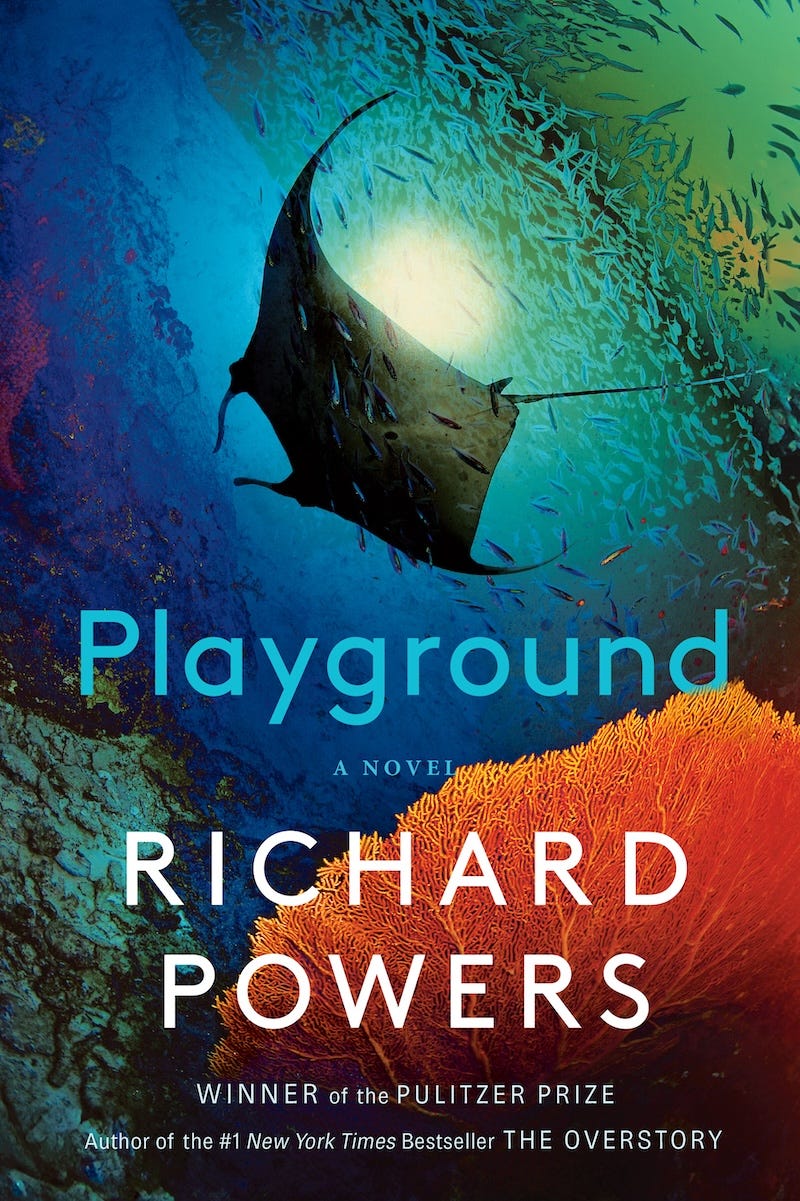
Richard Powers’ Playground is certainly the more encouraging of the two. In true Powers’ style, the book reveals the wonder and awe of the more-than-human world, focusing this time on the wilderness of oceans—and on the ways that human industry has affected both the lives of humans and all those who live in the watery depths. Though much of the story takes place in Chicago, where two characters, Rafi and Todd, go to school together and become both friends and adversaries, the point of convergence for Powers’ characters is the Pacific island of Makatea, where an adult Rafi now lives and where Todd—now a Zuckerbergian tech magnate—is part of a project to “update” the island to make it a home base for entrepreneurial seasteading. As the residents of the island wrestle with their decision whether to join the project and enjoy all the benefits that industry can bring or to reject the offer in the hopes of fending off the ills of industry that they’ve witnessed before, the novel takes a surprisingly even hand in describing both the advantages of technology and the harm it’s wrought. Yet, the novel still takes a stance in regards to the crisis we’re in, the crisis we as a species have created, and while it doesn’t provide hope, exactly, it does provide a kind of meaning, through the playfulness evoked in the title. While Todd may have tapped into play as a way to engage users on his social media platform, the other central characters—Rafi, a poet; Ina, an artist; Evie, an ocean explorer, marine biologist, and author—all reflect deeply on how play can be a means to other ends, or an end in itself. Play, it seems, is what Powers offers us as a way to destroy or mend this world, and he owns that both effects can be—and are—true.
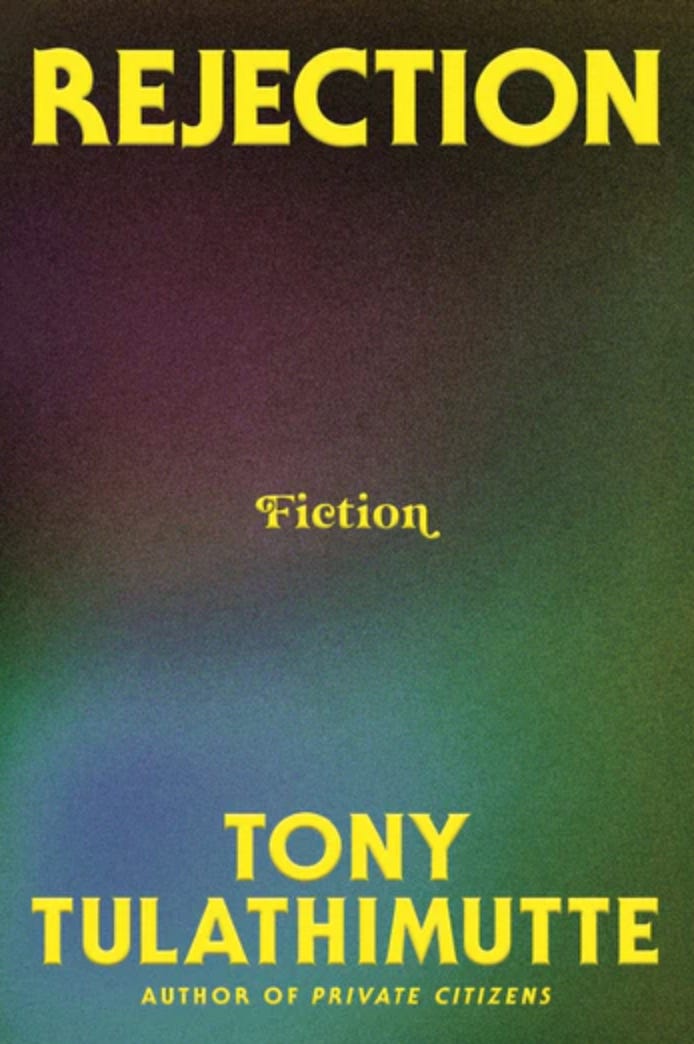
And then, there is the bleaker book. Tony Tulathimutte’s Rejection, a novel-in-stories, is one of those books that I did not enjoy and yet couldn’t stop reading. Focused as it is on the cringiest, most dismal outcomes of social media, the desire to “optimize” our lives, and the commodification of identity, it’s no wonder that Rejection hooked me the way that the worst algorithms do, keeping me fixed to the unfolding doomscroll of a novel even when I wanted to turn away. If all this sounds like a critique of the book, it’s not. It’s praise for how precisely the form is the content, how Tulathimutte understands that to really feel the despair and horror of these characters, we need to read every text they send as they spiral into obsession over an ex, every post they write as they veer toward becoming incels, every detail of one character’s fifteen-page, very NSFW email describing their sexual fantasy. If Powers’ book offers not hope but meaning, Tulathimutte’s offers not meaning but insight—a crystal-clear lens into exactly what hellscape we’re living in. (Take, for instance, this description of Twitter: “An improv class, press conference, intervention, Klan rally, comics convention, and struggle session all booked in the same conference room.”) If Powers invites us to think about how and why we play, Tulathimutte invites us to consider how and why and to what extent we put ourselves out there, whether that’s in naming our identities to others, publishing our thoughts in texts or posts or novels-in-stories, or being vulnerable about the desires and needs we’re most ashamed of.
On Saturday, March 1, 2:15pm PT, I’ll be reading at the Salem Poetry Festival on the campus of Willamette University in Oregon. I’ll also be part of a reading that evening with other authors and editors from Cascadia Field Guide: Art, Ecology, Poetry.
On Wednesday, March 12, 7pm PT, I’ll be co-hosting the first Incite: Queer Writers Read event in the new Literary Arts space at 716 SE Grand Ave, Portland. More details soon on our lineup for this reading that, as always, will be followed by a community discussion.
As I ready my book for publication in May, I’ve also been helping, in small ways, to ready other folks’ books, too. I’ve had the pleasure of blurbing several poetry collections that are coming out in the next few months, including Dawn Angelicca Barcelona’s Roundtrip, due out from Finishing Line Press on March 14 (and available for pre-order now!). I met Dawn a few years back in a class I taught on assembling poetry manuscripts, and so it was especially heartening to see that she’d found a home for her book. Here’s what I wrote about it:
The poems of Roundtrip are tethered to many places–New Jersey, the Philippines, South Korea, California–and reveal how one body can hold multiple “hearts // each beating in a different time zone.” In this collection, Dawn Angelicca Barcelona explores how locating “home” becomes complicated for diasporic people, especially for people who have inherited a history of colonization and imperialism. Roundtrip hungers for familiarity–for family–and recognizes that one way to find it is through tending to our wounds, both the ones that were inflicted upon us and the ones we were complicit in creating.
And if you don’t trust my two cents, you can also check out the glowing praise from the other folks who provided blurbs, including Poet Laureate Natasha Trethewey.
I’m still in the early stages of lining up events to introduce my own book to the world, but the first of these welcome parties will be on Saturday, May 10, 3pm PT, when I’ll be reading with Rivka Clifton and David Seung at UpUp Books, 1211 SE Stark St, Portland.
And way out on Tuesday, September 9, 5:30pm PT, I’ll be the guest speaker at the Central Oregon Writers Guild meeting, which is free, open to the public, and offered both in person at the Downtown Bend Library and via Zoom. I’ll be talking about “Finding the Freedom in Form” (aka, what I’m always talking about), and there will be a couple of opportunities during the talk for everyone to experiment with some unusual formal constraints.
I’ll be following that talk with an in-person workshop, “Contents Under Pressure: Using Constraints to Stretch Your creativity,” on Saturday, September 13, 1pm PT at the Downtown Bend Library. We’ll play with what I think of as “extreme” constraints inspired by everything from music to math, from dictionaries to daily walks, and invent some of our own constraints to try out after the workshop ends. Registration for the workshop will be available soon on the Central Oregon Writers Guild website.
Other opportunities I recommend:
For Artists and Writers:
Broadsided Press is accepting submissions for free through January 31. If you’re not familiar with Broadsided, each piece of writing they publish is paired with an artist who responds to the text. Designers combine writing and art into a broadside that anyone can print and post in their community, in a spot that could use a little more art. I’ve published a few poems with them over the years, and even had the good fortune to guest edit with them for a bit, and they’re one of my favorite publications out there!
For Artists and Culture Bearers in Oregon:
Applications are now open for Oregon Community Foundation’s Creative Heights initiative, which provides opportunities for artists and culture bearers to stretch their creative capacity, share new works, and test ideas. Up to $1 million in projects will be funded this year, with grants from $10,000 to $100,000 per project. For more information about eligibility, application process, review criteria, and FAQs, please visit the Creative Heights program webpage. An informational webinar and Q&A will be held online on Wednesday, January 22 at 1:30pm PT to provide an overview of the program and application. If you are interested in attending, please register in advance here. (A recording of the webinar will also be available afterward on the OCF website.) Applications are due on Thursday, February 13 at 5pm PT.
For Oregon Poets:
Last year, I participated in the Tele-poem project, a poetry phone line where anyone can call in during National Poetry Month to hear an Oregon poet read to them. (I wrote in a previous newsletter about the process of searching for an “uncontroversial” poem to offer to the hotline.) Oregon Humanities is gearing up to launch the phone line again for April 2025, and they’re currently reviewing submissions. If you’ve got something you’d like folks to dial up and listen to, you can review the full project guidelines and submit your poem here by March 1. Selected poets are offered a $50 honorarium for their work.
If you’ve got an opportunity you’d like me to include in a future newsletter, please let me know.
No posts
Comments
Nothing yet. Say the first thing.
Sign in to join the conversation.