
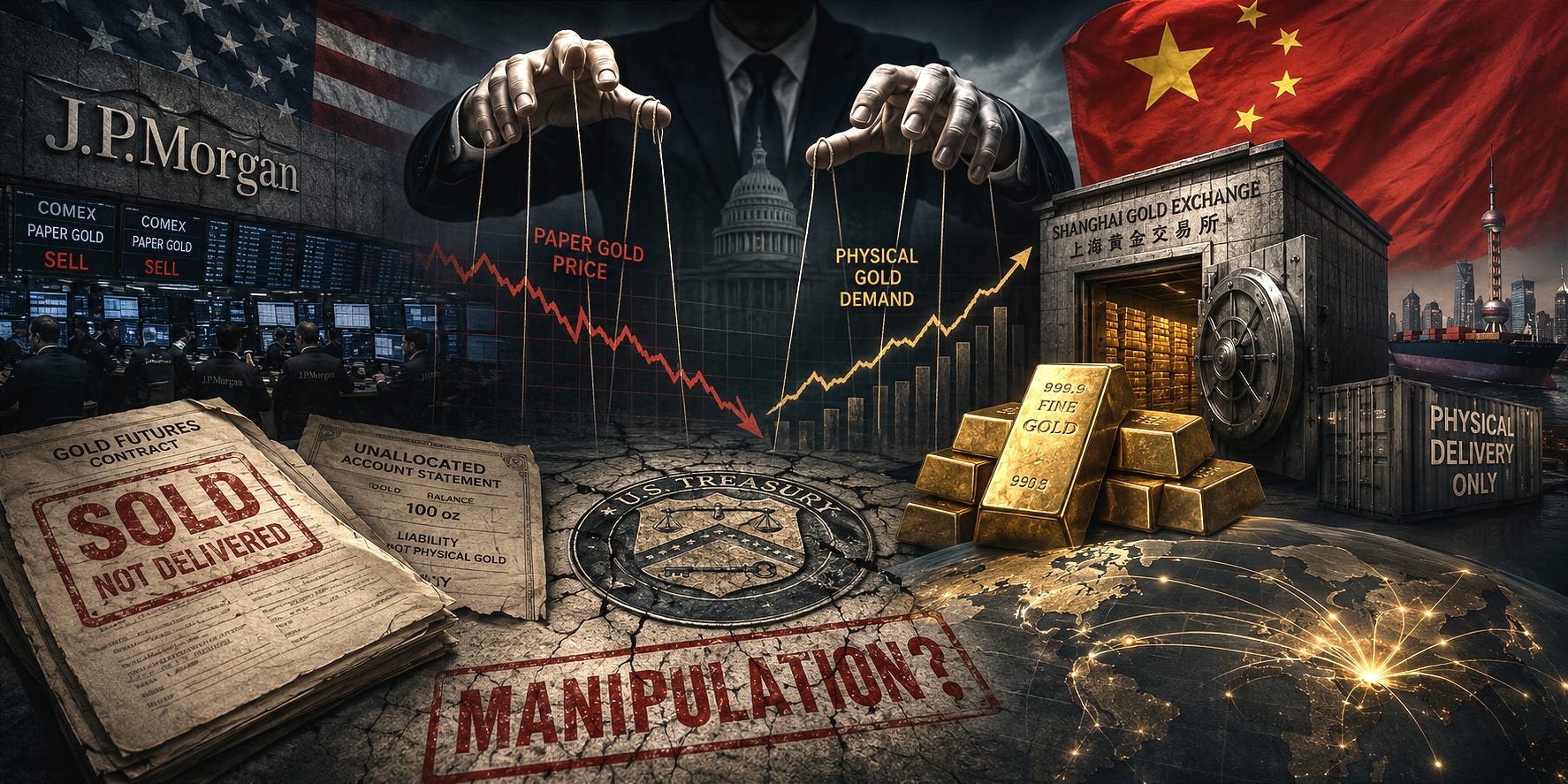
China’s gold policy is becoming increasingly difficult to dismiss as ordinary reserve diversification because Beijing is no longer behaving like a central bank merely adjusting the composition of a portfolio. It is behaving like a government preparing for a monetary system in which it intends to depend less on Western price discovery, Western custody and Western promises. China is aggressively accumulating bullion, expanding the Shanghai Gold Exchange, building physical-delivery links through Hong Kong, increasing vault capacity, strengthening renminbi-denominated settlement and moving more of the infrastructure surrounding gold into jurisdictions it controls. Any one of these developments might be explained as prudent financial modernization. Taken together, particularly alongside China’s reduction of exposure to American sovereign debt, they look much more deliberate. Beijing appears to be testing whether the Western financial system that has priced gold for generations can continue dictating its value once one of the world’s largest sovereign buyers begins caring less about exposure to gold and more about possession of the metal itself.
The question China is effectively asking should concern Washington far more than it does: what is gold actually worth when a buyer with the balance sheet of the Chinese state increasingly wants the bar rather than the certificate, the unallocated account, the ETF share, the futures position or another intermediary’s contractual promise?
That question reaches directly into the structure of the Western gold market. London and New York remain at the center of global price discovery, yet the market they dominate is vastly larger than the quantity of bullion physically moving between owners. Gold trades through futures, forwards, swaps, options, leases, ETFs and unallocated accounts that allow enormous quantities of economic exposure to be created without requiring an equivalent quantity of metal to change custody. Modern commodity markets could scarcely function without these instruments, and there is nothing inherently improper about them. The vulnerability lies in the assumption underneath the system: that exposure to gold and ownership of gold remain sufficiently interchangeable that the distinction almost never matters. Once a sovereign buyer with enormous financial resources decides that the distinction does matter and begins organizing its strategy around physical settlement, assumptions normally buried inside financial plumbing become testable.
China has already learned what happens when another country’s financial system determines the price of a commodity China buys in enormous quantities. Beijing became the world’s largest crude importer while the principal international oil benchmarks remained centered outside its jurisdiction, leaving China with extraordinary influence over physical demand but far less influence over the financial mechanism translating that demand into price. Its response was not to reject futures markets. China built its own renminbi-denominated crude contract linked to physical delivery because it understood that buying power is not the same thing as pricing power. Gold presents the same problem at a much higher level. Oil determines the cost of energy. Gold sits much closer to the foundation of the monetary system itself, where it competes with sovereign liabilities as a place to store national wealth.
The build-out around Shanghai and Hong Kong makes far more sense through that lens. China wants more bullion moving through infrastructure it can regulate, inspect and trust. It wants Asian physical demand reflected more directly in price formation instead of merely appearing downstream after London and New York have already established the quotation. It wants deeper clearing and settlement capacity, more vault space and a greater ability to transact without routing strategic assets through countries that increasingly treat financial access as an instrument of foreign policy. Most importantly, Beijing is creating the conditions in which it can compare the price assigned to gold by Western financial markets with the price actually required to persuade holders of physical bullion to surrender it.
China is not building this system in the abstract. It is filling it with metal. The People’s Bank of China has reported twenty-one consecutive months of gold purchases. Since the tariff confrontation intensified in the spring of 2025, its officially disclosed holdings have increased by roughly seventy-two metric tonnes, reaching about 2,366 tonnes by July 2026. Estimates of additional accumulation through state-linked banks and other institutions vary considerably and should not be confused with audited central-bank reserves, but the official figures alone establish the direction. Beijing is steadily replacing some exposure to foreign financial claims with ownership of an asset carrying no foreign issuer, no maturity date and no counterparty that must keep a promise for the asset to exist.
The timing is more revealing than the total. When gold suffered its violent decline this year, China did not behave like an investor whose thesis had failed. It accelerated its purchases. June produced the largest reported monthly PBoC addition in more than two years, and July was larger still. Beijing evidently did not interpret the falling dollar price as evidence that gold had become strategically less valuable. Its behavior suggests the opposite: Western financial conditions were offering China more ounces for the same amount of money, and China was willing to take them.
Trump’s economic policy makes that dynamic considerably more dangerous because the administration has created conditions in which China can exploit American-generated financial volatility while Washington mistakes a lower gold quotation for evidence of monetary strength. Gold has historically served as protection against inflation, currency debasement, fiscal deterioration and geopolitical instability, all risks Trump has intensified in one form or another. Yet modern market mechanics can produce an apparently contradictory short-term response. Conflict pushes oil higher. More expensive energy raises inflation expectations, strengthening the longer-term case for holding gold as protection against the erosion of purchasing power. Those same inflation fears, however, can reduce the Federal Reserve’s ability to ease, lift Treasury yields, strengthen the dollar and raise the immediate opportunity cost of holding an asset that pays no coupon. The quoted price can decline while the underlying reasons for owning physical bullion are becoming stronger.
Beijing appears to understand this distinction considerably better than the Trump administration does. Washington can look at a lower gold quotation and persuade itself that American paper has prevailed. China can look at the same quotation and calculate how much additional bullion it can acquire before the price reflects the deterioration in the conditions that caused the selloff in the first place. That asymmetry in time horizons is working in China’s favor. Trump remains preoccupied with the visible price of things. Beijing is increasingly focused on inventories, custody, refining capacity, clearing systems, physical delivery and control over the infrastructure through which strategic assets move.
Chinese skepticism toward Western gold price discovery also has a historical basis that Washington cannot simply wave away as conspiracy theory. The United States has intervened directly in the gold market before. The London Gold Pool was created to restrain the market price of gold and defend the Bretton Woods monetary system when private demand threatened the fixed dollar-gold relationship. When the credibility of the dollar system itself was implicated, Washington did not regard gold-price management as some intolerable corruption of market forces. It regarded the gold price as sufficiently important to American monetary power that coordinated official intervention was justified.
The modern record is no more comforting. JPMorgan admitted criminal wrongdoing and paid more than $920 million to resolve investigations involving manipulation across precious-metals and Treasury markets. American prosecutors documented years of spoofing in which traders placed orders designed to create false impressions of supply and demand and move prices in directions favorable to their positions. Former traders were convicted. Precious-metals manipulation is therefore not some exotic accusation manufactured in Beijing or confined to financial folklore. The United States government has prosecuted it inside its own markets.
None of that proves that Trump or Bessent secretly ordered a gold-suppression operation in 2026, and pretending otherwise would weaken a much more serious indictment. Beijing does not need a smoking gun from the Treasury to conclude that a price formed inside heavily financialized Western markets may be insufficiently trustworthy for long-term sovereign reserve policy. China can see the historical precedent for official intervention, the modern precedent for criminal manipulation, the political weaponization of Western financial custody and a derivatives architecture in which claims on gold can expand far more quickly than the physical metal available to satisfy them. For a government that spends enormous effort identifying strategic dependencies before they can be used against it, that is more than enough reason to construct an alternative and test the incumbent system rather than take its integrity on faith.
The elegance of China’s strategy is that the test requires no public accusation. Beijing can simply demand more delivery.
A Western market whose quoted price accurately represents the clearing price of physical bullion should be able to absorb Chinese accumulation without fundamental difficulty. Shanghai can grow, Hong Kong can warehouse more metal and China can increase its reserves while arbitrage keeps the major markets connected. If gold becomes too cheap in New York relative to Shanghai, physical bullion should move toward the higher-paying buyer until the discrepancy closes.
The dangerous alternative is a market in which financial selling can establish a paper price below the level at which holders of sufficient quantities of actual bullion are willing to sell. Any persistent gap eventually has to reveal itself somewhere, probably through rising regional premiums, tighter lease markets, unusual delivery demand, inventory migration, widening spreads and a growing cost attached to converting financial exposure into physical possession. The more China moves toward physical settlement, the more visible that friction becomes.
That is why the oil precedent should make Washington especially uneasy. Beijing learned that becoming the dominant physical customer of a commodity did not automatically provide control over its benchmark, so it built the institutional machinery necessary to make its physical demand matter more to price formation. Gold is the same contest migrating upward into the reserve system. This time, however, the competing asset is American sovereign debt.
The Trump administration is making the underlying problem worse with a strategy that repeatedly sacrifices long-term monetary strength for short-term financial optics. After decades of turning the dollar system into an increasingly powerful instrument of coercion, Trump is doing Beijing’s work for it, pushing China toward the assets, markets and settlement systems that reduce America’s ability to control the terms of global finance. Dollar clearing, correspondent banking, market access, sanctions and custody have all become instruments of foreign policy. The monetary lesson is now impossible to miss: assets held inside another government’s financial architecture remain exposed to that government’s political decisions.
China has not missed it. A Treasury security is a claim on the United States government. An unallocated bullion account is a claim on an intermediary. A stablecoin depends on an issuer, its reserve assets and the legal infrastructure supporting both. Physical bullion inside a Chinese sovereign vault requires none of those counterparties to remain cooperative.
Bessent’s enthusiasm for stablecoins makes the contrast particularly revealing. The administration has openly argued that the growth of dollar stablecoins can create substantial new demand for Treasury securities. Washington is therefore responding to pressure on the traditional dollar system partly by encouraging another financial layer capable of recycling capital into American government debt. China is doing the opposite, increasing its holdings of an asset whose defining monetary characteristic is that it is nobody else’s liability.
Trump inherited an extraordinary privilege that generations of American policymakers spent decades building. Foreign governments stored national savings in American assets because U.S. markets were deep, liquid, predictable and trusted. That willingness to hold American liabilities supported cheap financing at home and extraordinary geopolitical reach abroad. It was accumulated institutional capital, created over generations and enormously difficult to replace once damaged.
Trump is spending it as though it were his personal balance sheet.
Tariffs may produce negotiating leverage, but every escalation gives China another reason to reduce financial dependence on the United States. Sanctions can impose real costs on adversaries, but each successful use also teaches every reserve manager watching that access to assets held inside the Western system remains politically conditional. Fiscal expansion may juice nominal growth, but persistent borrowing eventually requires creditors to demand more compensation for carrying American duration. Higher Treasury yields can attract capital today while simultaneously advertising the increasing price Washington must pay for it. A strong dollar can look impressive while partly reflecting the restrictive monetary conditions created by inflationary policy choices. A falling gold price can be presented as evidence of confidence in American paper even while China uses that same decline to increase its ownership of the physical asset.
Trump has therefore created an extraordinary strategic asymmetry in which many of the policies intended to increase American leverage strengthen China’s incentive to build beyond that leverage. When gold falls because American yields rise, Beijing acquires additional bullion more cheaply. When Washington expands the use of financial sanctions, gold held domestically becomes more attractive because it cannot be frozen by a foreign custodian. When American deficits raise questions about the long-term supply of sovereign debt, an asset with no sovereign issuer becomes relatively more compelling. Trump keeps pulling the levers of American financial power harder while seeming not to notice that the other side is using the pressure to justify constructing a system in which those levers matter less.
The deeper danger is not simply that China owns more gold. It is that Beijing may be using its physical accumulation to test whether the Western paper-gold architecture has become part of the mechanism through which the United States can make the monetary alternative to its own debt appear cheaper than the underlying physical market would otherwise allow. That remains a hypothesis, not an established fact, but China is building exactly the kind of system capable of testing it without making the accusation formally. More physical settlement, more Asian custody, deeper local clearing and a growing pool of sovereign bullion create the conditions under which any weakness in the relationship between financial gold and deliverable gold becomes progressively harder to disguise.
A futures position can be created almost instantaneously, while new physical supply requires mines, capital, energy, labor, refining capacity and years of development. The stock of gold above ground is enormous, but the amount available for immediate sale at any particular price is not. If Western financial markets repeatedly establish a price low enough to persuade China to buy but not high enough to persuade sufficient existing holders to sell, the adjustment cannot be postponed indefinitely. Either the price rises until physical supply emerges, or the symptoms of scarcity begin appearing elsewhere in the market.
That is where the stakes become much larger than bullion. If Beijing succeeds in making physical settlement more important to global price discovery, China will have weakened one of the quiet structural advantages of the Western financial system: the ability to establish the international price of a scarce physical asset through markets dominated by financial claims. It would gain greater monetary optionality at precisely the moment Washington is becoming more dependent on foreigners continuing to accept an expanding supply of American liabilities.
Should China be wrong, the damage is limited. More bullion migrates toward Asia, Shanghai becomes a more important market and Beijing ends up holding considerably more gold.
Should China be right, America has a much larger problem. Beijing will have spent years converting financial claims into physical assets while Washington expanded debt, leverage and synthetic exposure throughout a system whose credibility still depended on the assumption that paper and physical remained economically interchangeable. The weakness would probably emerge gradually, through higher premiums, migrating inventories, more expensive physical settlement and a widening difference between the price quoted by financial instruments and the price required to obtain the asset those instruments supposedly represent.
By then, the question of whether a particular trader manipulated gold on a particular afternoon will be almost irrelevant. The much more damaging question will be whether the United States spent years defending the quoted price of gold while China quietly accumulated the thing itself, then built the market capable of proving that the quotation and the metal were no longer the same.
That is what Trump should have been worried about. Instead, he has spent his presidency treating markets as theater, celebrating the screen whenever it tells him what he wants to hear while Beijing accumulates the infrastructure, the optionality and the physical assets that matter when the theater ends.
China does not need a Treasury memorandum, a whistleblower or a confession from a trading desk. It can build a parallel physical market, accumulate bullion whenever Western financial conditions push the price down, insist increasingly on delivery and watch what happens as more of the available metal moves east.
Beijing is forcing the tide out.
Trump looks at the widening beach and boasts that America has gained more real estate, mistaking exposure for strength while the receding water reveals everything the system had kept hidden beneath the surface.
China wants to find out whether America’s paper economy has been swimming naked.
No posts
Comments
Nothing yet. Say the first thing.
Sign in to join the conversation.