
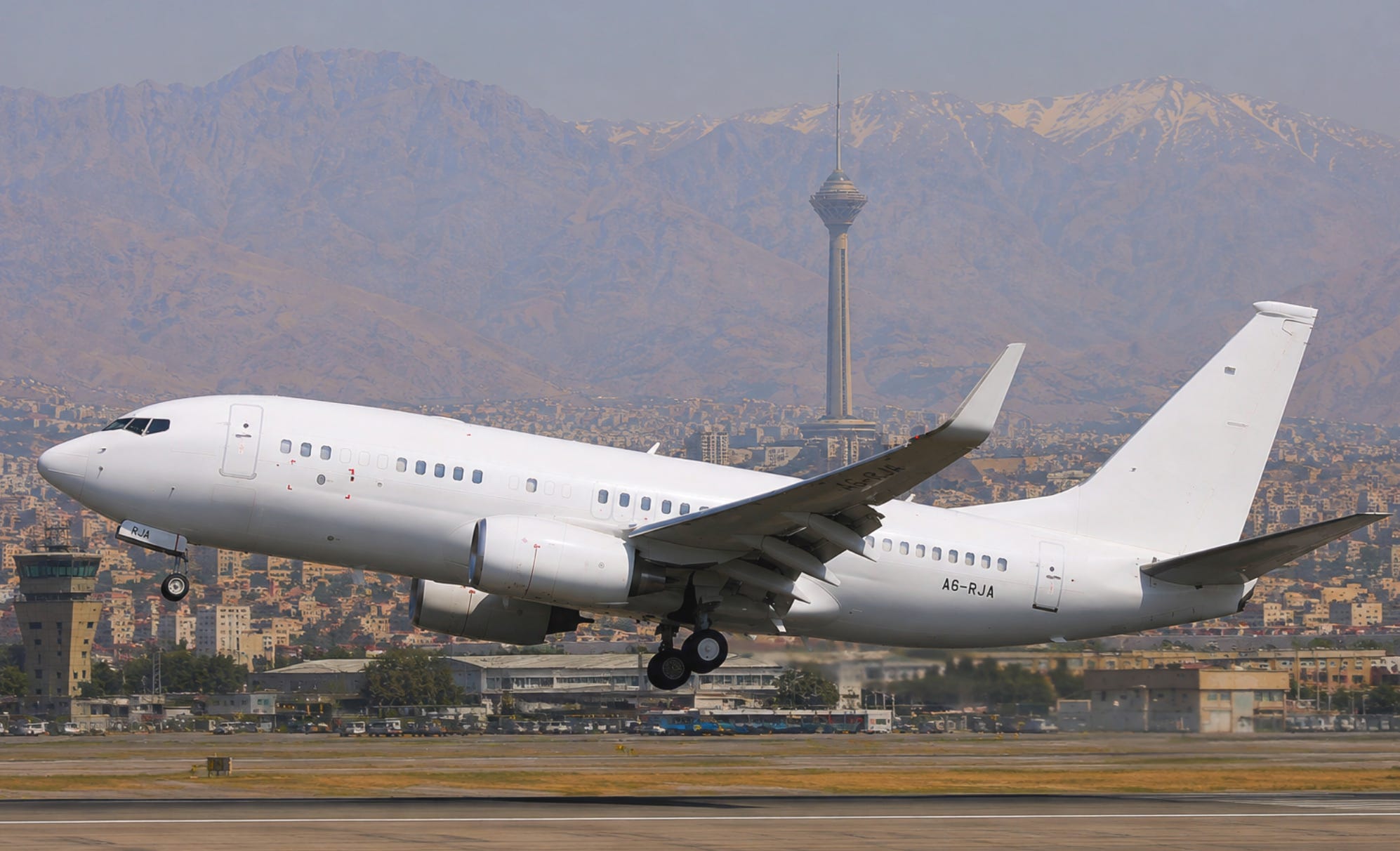
On Tuesday, August 11, a Boeing 737-7KK operated by RoyalJet departed Abu Dhabi and flew directly into Iran, landing at Tehran’s Mehrabad International Airport before returning to the UAE after roughly an hour on the ground. On Wednesday, the same aircraft crossed the Gulf again, this time landing at Payam International Airport outside Karaj before returning once more to Abu Dhabi. Its registration was A6-RJA, an otherwise forgettable sequence of letters and numbers that has become worth remembering because this was not its first appearance in Tehran at precisely the moment large quantities of previously frozen Iranian wealth were moving.
Senior sources in Tehran say the August flights coincided with the release of several billion dollars in Iranian assets held in Emirati banks, including approximately two tonnes of physical gold valued at $283 million. Flight tracking establishes where A6-RJA went, not what it carried, and the gold shipment has not been independently established in the public record. What makes the aircraft significant is its history. On June 8, A6-RJA flew from Abu Dhabi to Mehrabad during the same period in which the first $3 billion of a much larger financial accommodation with Iran was being delivered. Four sources familiar with those negotiations subsequently said Abu Dhabi had agreed to unlock between $10 billion and $20 billion for Tehran as part of an understanding intended to stop Iranian attacks on the Emirates.
Here we are two months later, and A6-RJA was back, twice in two days, only now senior sources in Tehran say the transfers have expanded beyond dollars into something considerably harder for Washington to control once delivered: physical gold.
The timing matters because Trump has spent the same week telling Americans an almost inverted version of what is happening in the Gulf. Iran, in his telling, has been financially broken. Tehran needs a deal more desperately than Washington does. The Strait of Hormuz is under American control. Trump has even described himself as Iran’s “banker,” as though Tehran were standing outside an American vault waiting for him to decide whether it could withdraw its own money.
Iran has not accepted Washington’s conditions for reopening Hormuz and continues demanding the release of frozen assets, sanctions relief and other concessions. On August 11, Iran’s top security official said the strait would remain closed unless Washington accepted Iranian conditions, including the release of frozen assets. Trump nevertheless announced the following day that the United States had “total control” of Hormuz.
Commercial shipping provides a rather more objective measure of control. A waterway that ordinarily handled roughly 130 to 140 vessels a day has been operating at a fraction of normal traffic because shipowners, insurers and crews continue making decisions based on what Iran can do to them, not what Trump says Iran can do. Whatever diplomatic language Washington prefers, the commercial world is still assigning Tehran substantial power over the risk of passage.
The defining pattern of Trump’s handling of the negotiations thus far has been remarkably consistent: announce progress before his negotiators have secured it, describe understandings Tehran promptly disavows, impose deadlines that expire without consequence, and ultimately declare “total control” over a Strait of Hormuz that commercial shipping still considers too dangerous to navigate. For a time, the strategy worked because modern markets move faster than diplomacy; trading algorithms ingest presidential statements in milliseconds and immediately reprice the probability of a reopened Hormuz, lower crude prices, easing inflation and reduced geopolitical risk across oil futures, Treasuries, currencies and equities, allowing Trump to move markets toward the price of an agreement simply by announcing one before it existed. But something has changed. After months of premature breakthroughs followed by Iranian denials and little change in the underlying crisis, markets increasingly appear less willing to treat Trump’s words as a substitute for reality, forcing his declarations to compete with shipping data, Iranian statements and the stubborn physical evidence coming out of Hormuz. The president who repeatedly moved markets by announcing victories before they happened is now discovering the cost of doing it too often: eventually traders, and the algorithms trading ahead of them, begin discounting the messenger.
His behavior over the past several days makes the discrepancy even more conspicuous. Trump has not disappeared from Truth Social, but his tone has changed unmistakably. The “last chance” ultimatums, accusations of Iranian duplicity and threats of overwhelming retaliation that dominated his rhetoric only days ago have largely receded, even though Tehran continues disputing his claim of control over Hormuz and the UAE accused Iran on August 13 of attacking two more ADNOC-owned vessels, the second such attack on ADNOC-linked shipping in less than a week. Yet Trump has responded to this open defiance with remarkably little of his customary fury.
That sudden restraint becomes much more interesting when placed beside the money.
Scott Bessent had previously argued that Iranian assets frozen abroad could be used to compensate America’s Gulf partners for damage inflicted by Tehran. The theory was simple: Iran could fire the missile, but Iran’s own money would eventually pay for what it destroyed.
The UAE arrangement turned that logic on its head. Iran attacked the Emirates, those attacks increased the cost of confrontation for Abu Dhabi, and the UAE entered negotiations under which billions of dollars in Iranian assets could be released in exchange for relief from further attacks. Money that was supposed to compensate Iran’s victims instead became part of the accommodation intended to stop Iran from creating more of them. Now the same aircraft that appeared during the June transfer period has made two more trips into Iran while senior Tehran sources say additional billions are being released and physical gold is part of the transaction.
Gold is particularly important because it changes the character of the asset. Dollars sitting in an Emirati bank remain vulnerable to American power because the institution holding them depends upon the dollar system. Washington can freeze an account or prevent transactions from clearing. Physical bullion in Iranian custody has no correspondent bank for Bessent to threaten and no electronic switch for OFAC to turn off. If the Tehran sourcing is correct, Iran is converting part of its frozen financial wealth into an asset Washington cannot simply freeze again.
The other side of the transaction presents Bessent with a different problem. Abu Dhabi controls immense sovereign wealth and substantial quantities of dollar-denominated assets, which means that if the Emirates needs dollars, it can obtain them by selling American securities it already owns. When the UAE and other governments sought dollar swap facilities earlier in the conflict, Bessent acknowledged that providing dollar liquidity could help prevent foreign governments from selling American assets “in a disorderly way.”
Iran does not need to own Treasuries to exploit that vulnerability. It needs only to impose sufficient costs on countries that do. The Emirates has concentrated extraordinary wealth into ports, airports, refineries, desalination plants, power infrastructure, financial centers and increasingly important data centers, all within reach of Iranian missiles and drones. Tehran does not have to defeat the United States militarily; it only has to make enforcing Washington’s policy more expensive for Abu Dhabi than accommodating Iran.
Trump appears to believe he can sell the result to Americans as Iranian capitulation while keeping the concessions safely outside their field of view.
His increasingly subdued behavior makes more sense in that context. A6-RJA has made two trips into Iran, billions in frozen assets are again moving through the negotiations, Tehran continues applying pressure, and none of it has produced the furious public response Trump normally reserves for far smaller provocations. Washington keeps negotiating while the president who spent weeks threatening Iran has suddenly become less inflammatory at precisely the moment the most sensitive financial accommodations appear to be taking shape.
With American weapons inventories already under strain, Trump may no longer be choosing restraint so much as having it imposed upon him by the limits of American capacity. Threats become less useful when carrying them out is increasingly costly, leaving accommodation with Tehran less a strategic preference than the narrowing path available to an administration running short of attractive alternatives. Trump can negotiate from that reality. What he cannot honestly do is quietly concede what Iran has forced onto the negotiating table and then tell Americans that Tehran was the party that capitulated.
The consequences reach well beyond Iran. America’s relationship with the Gulf has always rested on an exchange deeper than military bases or the currency used to price oil. Washington supplied security; Gulf governments accumulated dollars, Treasuries and American investments. Trump is now placing unusual strain on both halves of that bargain by asking Gulf governments to enforce American financial pressure on Tehran while those same governments absorb Iranian retaliation against their ships and infrastructure.
That is how dollar dominance actually erodes. Not through a dramatic announcement that the petrodollar is dead, but through smaller decisions made by governments trying to protect themselves: fewer Treasuries at the margin, more gold, additional currency arrangements, deeper bilateral settlement and enough financial independence that the next American confrontation does not force them to choose between Washington’s objectives and their own survival. Bessent’s concern about disorderly sales of American assets suggests Washington understands this danger better than Trump admits.
The administration is therefore trying to sustain two versions of the same negotiation. Behind closed doors, Washington needs Iran not to escalate, Hormuz normalized, Gulf governments protected from financial stress and their enormous portfolios of American assets kept inside the dollar system. In public, Trump needs Iran to have surrendered.
A6-RJA makes those stories increasingly difficult to reconcile.
Trump spent years turning Obama’s 2016 Iran payment into one of the defining accusations of his political career. The United States had not simply handed Tehran $1.7 billion; it was settling a decades-old claim involving Iranian money paid for military equipment that Washington never delivered after the Shah fell. The first $400 million was transported in foreign currency because sanctions prevented an ordinary dollar transfer. Trump stripped away that history because the image was politically much more useful than the truth: pallets of money, an airplane bound for Iran and an American president who looked as though he were paying tribute.
For nearly a decade, Trump told Americans that this was what capitulation looked like.
Here we are ten years later, and the airplanes are flying under his watch. Iran is still setting conditions over Hormuz, its frozen wealth is being negotiated back toward its control, America’s Gulf partner says its ships are still being attacked, and Trump’s own Treasury secretary is worried about preventing that partner’s American assets from becoming another source of financial instability.
Trump’s deception is therefore larger than pretending he won a negotiation he has not yet won. He has repeatedly made market-moving declarations of breakthroughs and control before the underlying reality supported them, while becoming conspicuously more restrained as the cost of preventing further Iranian escalation has begun to emerge.
Trump spent a decade telling Americans exactly what an airplane carrying money toward Tehran was supposed to mean. Now that the flights are happening under his presidency, he is hoping the markets believe his version, the media repeats it, and nobody asks too many questions about why A6-RJA flew into Iran twice this week.
No posts
Comments
Nothing yet. Say the first thing.
Sign in to join the conversation.