
Donald Trump has spent years describing China as the country most determined to weaken the United States, but Beijing could scarcely have designed a more favorable sequence of American decisions than the one his administration has supplied.
He has forced an economic confrontation before the United States rebuilt the supply chains required to sustain it, depleted extraordinary quantities of precision weapons that cannot be replaced on anything resembling the timetable on which they were consumed, drawn down strategic petroleum during a conflict that made the global oil system less secure, obstructed portions of the electricity build-out just as artificial intelligence begins demanding power on an industrial scale, and used sanctions and dollar access so aggressively that Beijing no longer has to persuade governments to consider alternatives to American finance. Trump presents all of this as evidence of strength because he has always confused the ability to spend power with the ability to create it. What he is actually doing is drawing against an inheritance accumulated over generations and calling the withdrawal income.
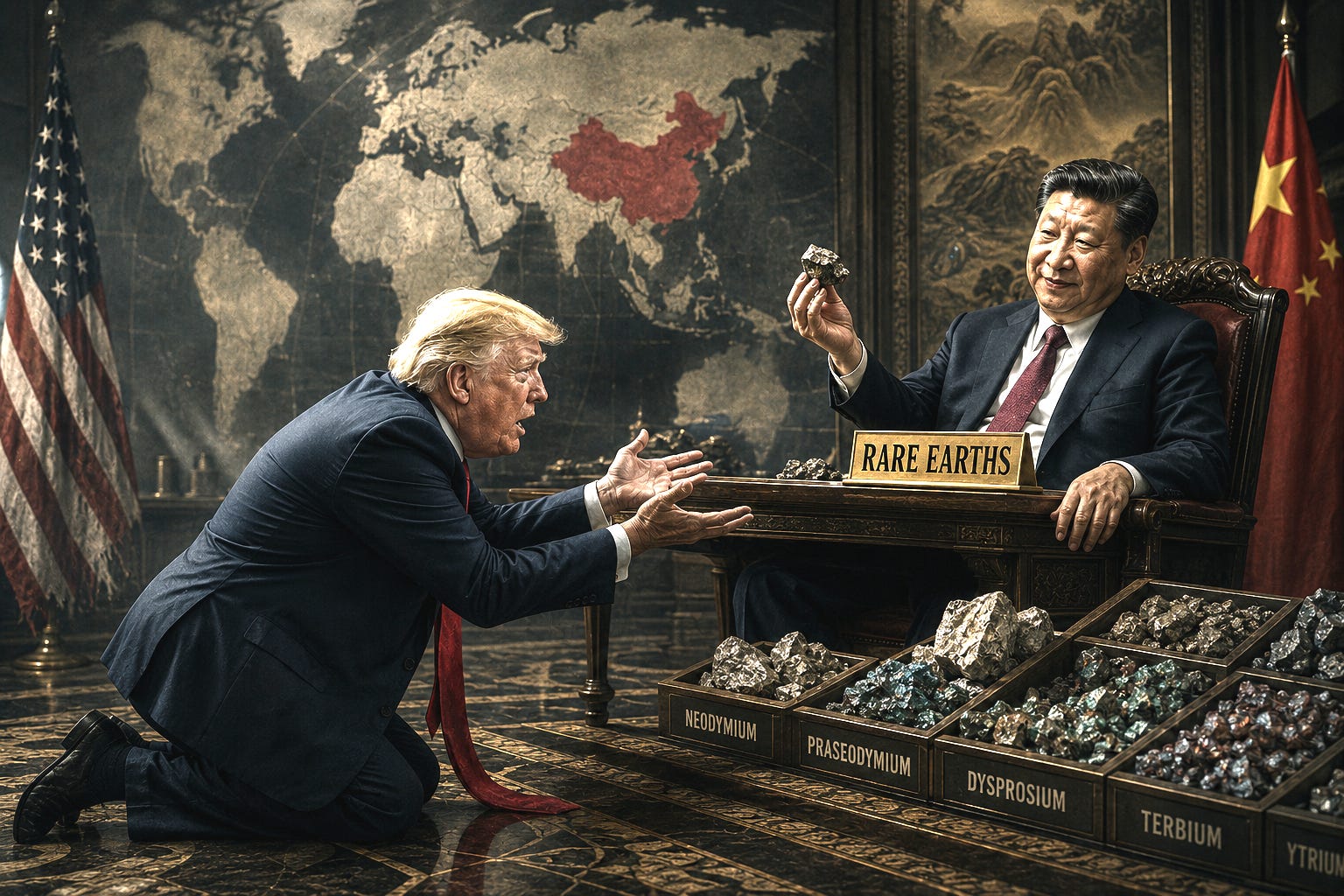
The rare-earth numbers alone should have stopped any competent administration from proceeding in this order. China controls roughly 91 percent of magnet-rare-earth separation and refining and about 94 percent of sintered permanent-magnet manufacturing, components that disappear into motors, aircraft, electrical systems, robotics and advanced weapons while representing a tiny fraction of the cost of the finished product. Beijing spent two decades acquiring enormous leverage in precisely the parts of the industrial economy Washington had decided were too dirty, too low-margin or too unsophisticated to matter. America kept the patents and the finance; China kept the processing plants. Washington is now rediscovering, at considerable expense, that a billion-dollar weapons system is not particularly useful if production stops for want of a magnet costing a few hundred dollars.
China’s share of sintered permanent-magnet production rose from roughly half of world output in 2005 to about 94 percent in 2024, and the International Energy Agency estimates that even by 2035 capacity outside China may satisfy only around a quarter of non-Chinese refining demand and less than 20 percent of magnet demand. This was not an obscure vulnerability buried in a classified annex. It was sitting in public data while Trump chose to escalate first and build replacement capacity afterward. The sane sequence would have been obvious to any government genuinely interested in reducing dependence rather than performing toughness for television: finance the mines, construct separation plants, build magnet factories, secure Australian and allied production, accumulate inventories and then confront Beijing once retaliation became survivable. Trump reversed the sequence because a tariff can be announced in an afternoon and industrial independence cannot, and his administration has repeatedly behaved as though the difference were someone else’s technical problem.
Artificial intelligence is now making that mistake more expensive. Global data-center electricity consumption is expected to roughly double from about 485 terawatt-hours in 2025 to around 950 by 2030, with the United States and China accounting for most of the increase, which means the AI competition is rapidly becoming a contest over electricity, transmission, transformers, land, cooling, semiconductors and the minerals embedded in all of them. Trump has chosen this moment to obstruct and cancel portions of America’s renewable-energy pipeline while simultaneously demanding more data centers, more semiconductor fabrication and more domestic manufacturing. The administration likes to answer criticism by observing that intermittent power cannot by itself sustain hyperscale computing, which is only partially true, and completely misses the point. A country staring at the largest power-demand increase in decades should be building nuclear, gas, geothermal, wind, solar, storage and transmission at the fastest economically sensible rate available, rather than allowing the president’s cultural hostility toward certain technologies to remove useful supply from an already constrained system.
China is not burdened by this ideological dysfunction. Beijing is building renewables, coal, nuclear, storage and transmission simultaneously because it is interested in having electricity rather than winning an argument about electricity, and that difference will matter when AI moves from an investment story into an operating-cost story. Even a modest power-cost advantage becomes enormous when multiplied across hundreds of terawatt-hours; combine it with cheaper industrial construction, integrated manufacturing, control of rare-earth processing and permanent magnets, and a state willing to build infrastructure at scale, and China acquires an operating advantage that compounds through the entire system. Trump has managed to declare AI supremacy a national objective while pursuing an energy policy that risks making American AI structurally more expensive to run.
His petroleum policy is equally incoherent. America produces more crude than any other country, but much of the shale barrel is relatively light and sweet while significant portions of the American refining complex were designed around heavier and sourer grades. That does not make domestic production unimportant; it makes the slogan “drill, baby, drill” an embarrassingly incomplete description of an industrial system that depends upon crude quality, refinery configuration and international flows. Trump nevertheless increased America’s political reliance on hydrocarbons, entered a confrontation with Iran that destabilized one of the world’s most important petroleum corridors, and then relied on strategic petroleum reserves to soften the domestic price consequences of the disruption.
China entered the same crisis having accumulated crude inventories estimated above 1.2 billion barrels and was able to cut imports sharply as prices rose. Beijing spent years buying itself freedom of action before the emergency arrived; Washington entered the emergency and began spending the freedom of action previous administrations had stored for it. Trump calls this energy dominance, although the more accurate description is that America is consuming insurance while China is accumulating it.
The Iranian oil trade makes the strategic inversion even worse. According to the U.S. Treasury, China now purchases roughly 90 percent of Iran’s petroleum exports, which means Washington attempts to isolate Iranian crude while Beijing becomes the customer that keeps much of the trade economically viable. Every one of those cargos gives China discounted energy and simultaneously gives refiners, traders, banks, shipping networks and governments more experience conducting commerce under American pressure. Trump appears to see sanctions only at the moment they impose pain; China is studying what happens after the pain, when the target begins building systems designed to make the next sanction less effective.
That is the danger in Trump’s abuse of dollar power. The dollar did not become indispensable because the United States bullied the world into using it. It became indispensable because the financial architecture around it was extraordinarily useful, deep, liquid, trusted and difficult to replicate. Commodities were overwhelmingly priced in dollars, banks needed dollar liquidity, governments accumulated dollar reserves, American capital markets absorbed enormous sums, and participation in the system was more valuable than avoiding it. That network gave Washington tremendous coercive power, and Trump has treated that power with the restraint of someone who inherited a loaded gun and concluded that ammunition must be unlimited.
Every sanction, asset freeze and threat of financial exclusion demonstrates American power in the present while simultaneously increasing the strategic value of reducing exposure to that power in the future. Beijing does not need to overthrow the dollar for this to matter. It only needs to make dollar infrastructure less compulsory in the transactions Washington most wants to stop. An Iranian barrel sold despite American sanctions does not end dollar dominance, but it does represent one transaction over which American dominance failed to produce the intended result. Enough transactions of that kind begin to change the system at the margins, which is where large monetary systems usually change first.
China’s push deeper into physical gold belongs in the same argument. Beijing is expanding bullion infrastructure connecting Shanghai and Hong Kong, increasing physical storage capacity and trying to strengthen yuan-centered price discovery at a moment when the freezing of Russian reserves has reminded every government outside the American alliance system that financial assets held abroad exist within somebody else’s legal jurisdiction. A Treasury security is an American promise; a bank deposit is somebody else’s liability; physical gold held inside one’s own jurisdiction is neither. China does not need to replace New York or London to benefit from building more of that architecture closer to home, and it certainly does not need to announce the death of the dollar. It only needs to make itself incrementally less vulnerable to Washington.
The larger pattern is impossible to miss once oil, gold and rare earths are viewed together. China is accumulating physical optionality while the United States increasingly relies upon financial optionality. Beijing owns or controls more of the processing capacity, inventories, generation, factories and commodity relationships that allow financial resources to become physical output. America still controls the deepest capital markets in the world, but Trump repeatedly behaves as though money itself can substitute for the industrial capacity money is supposed to purchase.
The depletion of American precision weapons is where that delusion becomes dangerous enough to stop being merely economic. Public reporting from the Iran war indicates that the United States has consumed virtually all available ATACMS and Precision Strike Missiles, roughly 65 percent of Patriot interceptors, at least 38 percent of THAAD inventory and somewhat less than half of the global Tomahawk stockpile, with more than 850 Tomahawks reportedly fired during the opening weeks alone. These are precisely the weapons American planners have spent years identifying as essential to a Pacific conflict, and Trump has burned through them while continuing to describe China as the country’s principal strategic threat.
This is not a question of whether Congress can spend enough money to replace them. Congress can authorize another enormous procurement package tomorrow. The problem is that a procurement package is not a missile. The money still has to pass through factories producing rocket motors, seekers, guidance electronics, energetics, warheads and specialty materials, many of which were already operating with inadequate capacity before the inventories began collapsing. The United States is relearning, in the most expensive possible way, the same lesson it ignored in rare earths and energy: financial resources can move almost instantly while industrial capacity cannot.
Trump has therefore left the country trying to do almost everything at once, including rebuilding precision-munitions stocks, rebuilding rare-earth refining, creating a permanent-magnet industry, expanding semiconductor fabrication, constructing hundreds of billions of dollars of data centers, adding enormous amounts of electricity generation and transmission, restoring petroleum inventories and reducing dependence on Chinese supply chains. These projects overlap in their demands for capital, skilled labor, electricity, electronics, specialty materials and industrial equipment, and the administration forced much of this work into the same decade because it preferred the immediate political gratification of confrontation to the unglamorous work of preparing for it.
That is why calling Trump “tough on China” has become intellectually meaningless. Toughness that leaves the United States materially weaker is not toughness; it is theater. A tariff is not a magnet factory, a defense appropriation is not an interceptor, an oil well is not a refinery, a dollar is not a transformer, and an executive order announcing strategic independence does not produce the industrial system required to make independence real. Trump repeatedly mistakes the capacity to announce, sanction, spend and threaten for the capacity to produce, while China has spent years accumulating exactly the physical capacity that becomes decisive when announcements stop mattering.
American exceptionalism was never a mystical property of the country and certainly was not something Donald Trump invented. It was an accumulation of very specific advantages built over generations: the reserve currency, the world’s deepest capital markets, technological leadership, military depth, strategic inventories, abundant energy, industrial capacity, trusted institutions and alliances encompassing most of the advanced world. Those advantages gave American presidents an extraordinary margin for error because the country usually possessed another reserve, another supplier, another ally or another financial instrument when a policy failed.
Trump inherited that margin and has spent his second term reducing it with reckless abandon.
He has drawn down petroleum reserves while China hoards theirs, depleted precision weapons while China dominates critical portions of the material-processing system needed to manufacture advanced equipment, obstructed portions of future power supply while Beijing builds generation at staggering scale, forced confrontation before American replacement industries exist, and weaponized American finance in ways that make China’s alternatives more attractive. He has treated inherited strategic depth the way he has treated leverage throughout his career: as something valuable principally because it can be borrowed against today, with remarkably little concern for what remains after the transaction closes.
The indictment is therefore much harsher than saying Trump has ‘mishandled’ China. He inherited a country with advantages Beijing could not reproduce quickly and proceeded to weaken several of them himself, while increasing the value of the advantages China had spent decades building. He did not have to consume the petroleum reserve while making hydrocarbons more strategically important, did not have to burn through weapons intended for a Pacific contingency faster than American industry can replace them, did not have to narrow parts of the power pipeline while AI demand explodes, did not have to confront Chinese mineral dominance before American capacity existed, and did not have to wield the dollar system so promiscuously that governments increasingly regard insulation from Washington as prudent economic policy. These were choices, made with access to every warning, intelligence assessment, production estimate and economic analysis available to the most powerful government on earth.
Trump promised to restore American exceptionalism and has instead demonstrated how quickly it can be squandered by a president who mistakes inherited power for personal genius. He has spent strategic reserves he did not create, fired weapons he cannot quickly replace, threatened financial networks built on trust he did not earn, impaired energy capacity required for a technological boom he wants to claim, and forced an industrial confrontation before America had rebuilt the industries necessary to withstand it, while China accumulates oil, gold, electricity, refining capacity, magnets, factories and alternative financial infrastructure. If Beijing comes out of this period stronger relative to the United States, it will not be because China somehow outfoxed an otherwise coherent American strategy; it will be because Donald Trump repeatedly converted long-term American strategic advantages into short-term political demonstrations, and China was disciplined enough to understand the value of what he was throwing away.
No posts
Comments
Nothing yet. Say the first thing.
Sign in to join the conversation.