
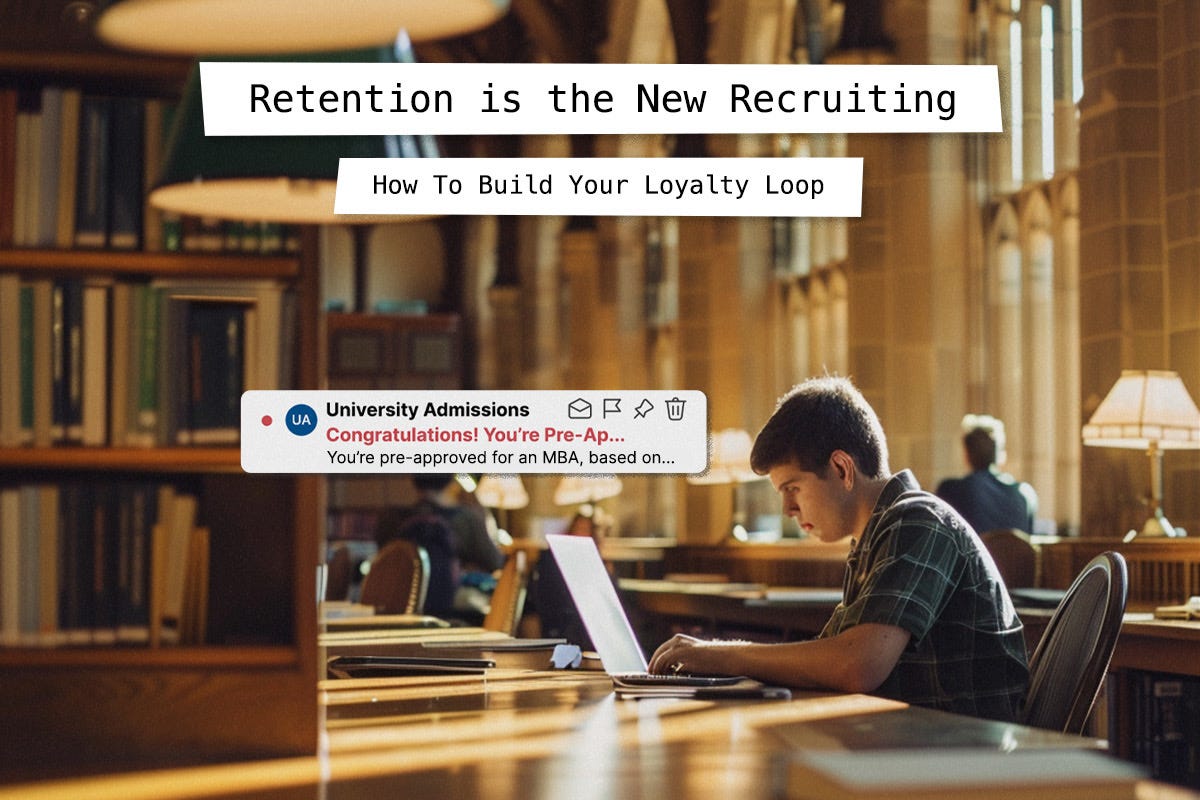
Imagine one of your seniors sitting in the student union between classes. Suddenly, they get a notification on their phone:
Congratulations on your 3.8 GPA in Accounting! You’ve been pre-approved for our MBA. Click here to claim your seat and your $2,000 Loyalty Scholarship.
Amid anxiously applying to graduate schools and trying to decide their next step, this student hears from a familiar voice––their soon-to-be alma mater: We see your success, and we have a place for your future.
Facing the “enrollment cliff,” the most innovative higher education leaders are relying less on recruiting new students from a shrinking pool and instead looking inward for strategies that support a new model of student success I introduced in my last article called student conversion.
The shift requires rethinking a core assumption: that graduation is an ending. What if it were an inflection point instead? What if it were a moment to re-recruit a proven student into their next chapter?
University leaders can challenge existing norms and shift from “one-and-done” enrollment thinking by creating loyalty loops that convert students into lifelong learners. Just as businesses create repeat customers, higher education can use student conversion to establish stability and weather volatility.
While the specifics will vary depending on context, here are some tips for building a loyalty loop at your school, based on our recent study published in Research in Higher Education.
Most colleges and universities use passive recruitment strategies with their own students, simply allowing them to stumble upon the advanced education opportunities they offer. Forward-thinking administrators can adopt predictive strategies using the classification tree analysis method from our study to identify and proactively re-recruit students with a high probability of conversion.

By looking at your student data, you can learn more about the “unseen” populations at your institutions—like online and transfer students, who were more likely to convert in our study—and build tailored communication strategies accordingly. For example, you might target online learners with convenience-focused messaging and residential students with “continuity of community” messaging. If your data show high conversion rates for transfer students, you can re-recruit them with reminders of why they chose your school in the first place.
At the institution we studied, Black and African American students converted at the highest rates (54.5%). This presents an opportunity to increase equity in student completion at this university. Looking for similar patterns in your institution’s data may uncover untapped potential among historically underserved student populations.
Treat belonging as a catalyst for conversion by developing mentoring programs that match students with faculty or staff from marginalized populations. An inclusive culture isn’t just socially responsible; it can also build institutional loyalty and increase the likelihood of student conversion.
In our study, humanities majors converted at 34%, while STEM majors converted at 19%. What can STEM leaders at this university learn from their humanities colleagues about keeping students coming back? How do conversion rates differ between majors at your university? Reaching out across departments can help identify loyalty-promoting strategies to borrow from the “stickier” disciplines.
To encourage undergraduate students to pursue advanced degrees, try integrating graduate-level research into undergrad capstones, or develop a program that pairs undergrads with graduate students to build bonds and familiarity early. Make the jump into a graduate program feel like a natural next step rather than a fresh start.
Why should a proven student have to reintroduce themselves to their own school? Remove barriers that discourage conversion and incentivize re-enrollment instead. Implement a streamlined application process to re-enroll—or even “automatic” admission to an advanced program—for graduates who meet minimum GPA or experience thresholds. Proactively identify and reach out to eligible undergraduate students for accelerated admission.

Create financial incentives by establishing loyalty scholarships or grants for returning students, or offer alumni tuition credits that make staying significantly cheaper than moving to a new city to attend a competitor. These students are already enrolled. What can you do to help them stay?
If you are like many “value entrepreneurs” at universities across the country, your institution’s raison d’être lies beyond simply meeting numeric targets. Whether expanding access for underserved populations, deepening students’ sense of belonging, or helping students discover their next level of calling, conversion can reinforce the values your school instills in its graduates.
At a religious institution, highlight how an additional program could deepen a student’s faith-based leadership. At an HBCU, frame conversion as strengthening the pipeline of Black excellence in professional fields. See the loyalty loop as a way to maximize your transformative impact on each student.
Whether in business or academia, it costs far more to recruit a new customer or student than to convert an existing one. Embracing student conversion can help higher ed administrators alleviate budget constraints by bolstering enrollment while reducing recruiting costs. And the benefits extend beyond the budget office. For students from marginalized groups especially, conversion can deepen belonging while sparing them the financial and logistical burden of starting over elsewhere.
Some schools are already experimenting with conversion strategies. When I arrived at the University of Virginia for my PhD, I learned about the prestigious “Triple Hoo” designation, which denotes someone who earned their bachelor’s, master’s, and doctorate degrees from the school. Staying put wasn’t a lack of ambition; it was a badge of honor and loyalty. That’s the mindset higher education needs to embrace.
I have shared a few general ideas about how to create a loyalty loop, but you know your context better than I do—what are some ways you can envision building one at your school? Share your thoughts in the comments!

WorkforceRx: I recently had the pleasure of joining Futuro Health CEO Van Ton-Quinlivan for an episode of the WorkforceRx podcast discussing Capitalizing on College and the future of higher education. Listen to the episode here.
ARC2026: A big thanks to WASC Senior College and University Commission for choosing Sal Khan of Khan Academy and me as the opening and closing plenary speakers for the ARC2026 conference in April. Sal offered a new vision for higher education that integrates AI and employs a fundamental paradigm shift away from the “credit hour” and toward “credit competencies.” He asked everyone to wait a few days for a big announcement, which was later revealed as the new $10k bachelor’s degree in applied AI offered in partnership with Google, ETS, and TED Conferences. In the closing plenary, I explained how Amazon made “The Power of the Periphery” famous through Amazon Web Services (AWS), but that this model of innovation had already been refined in the higher education sector—it had just remained hidden because most people have been focused on elite institutions and not tuition-driven universities, where it was devised.
Press play: The audiobook version of Capitalizing on College is out now! It’s narrated by the amazing Mitch Crawford and can be ordered now on Amazon or Audible.
Happy Anniversary: My book is officially a year old! To celebrate, it would mean a great deal to me if ten people would leave a short review on Amazon. For other ways to celebrate and support my work, you can:
Start a book club at your institution or in your community! If you have five or more people in your Capitalizing on College book club, please reach out to me so we can coordinate a time for me to join via Zoom.
Comment below with thoughts, questions, or just to say hi!
Follow me here on Substack, LinkedIn, X, or my website.
Comments
Nothing yet. Say the first thing.
Sign in to join the conversation.