
I have committed myself to writing every week, preferably a piece that may be useful to the people who appreciate what I have to offer. I do not want to write simply because the internet demands fresh content from all of us at all times, nor do I want to add more noise to a world that already has plenty of it. I want to write when I have a message worth sharing, one that may help another person understand their life, their spirit, or themselves a little more clearly.
The trouble this week was that I had no idea what that might be.
While pondering it, I went out for what I affectionately call my Old Man Walk. To be clear, I call it that because I would very much like to become an old man someday, not because I am admitting to already being one. My Old Man Walk is part exercise, part outside time, and part daily showing up for myself. It offers me a chance to step away from my work, breathe some real air, feel my feet on the ground, and find out what’s happening inside me before the day gets away from me.
As I walked, I had the distinct feeling that I was either going to receive a message or be shown a sign. I did not know what it would be, and I was not demanding that the heavens part over the back roads of Vermont. I simply felt that a message would present itself if I stayed open enough to notice it.
I walked and let my mind wander. Before long, I found a feather.
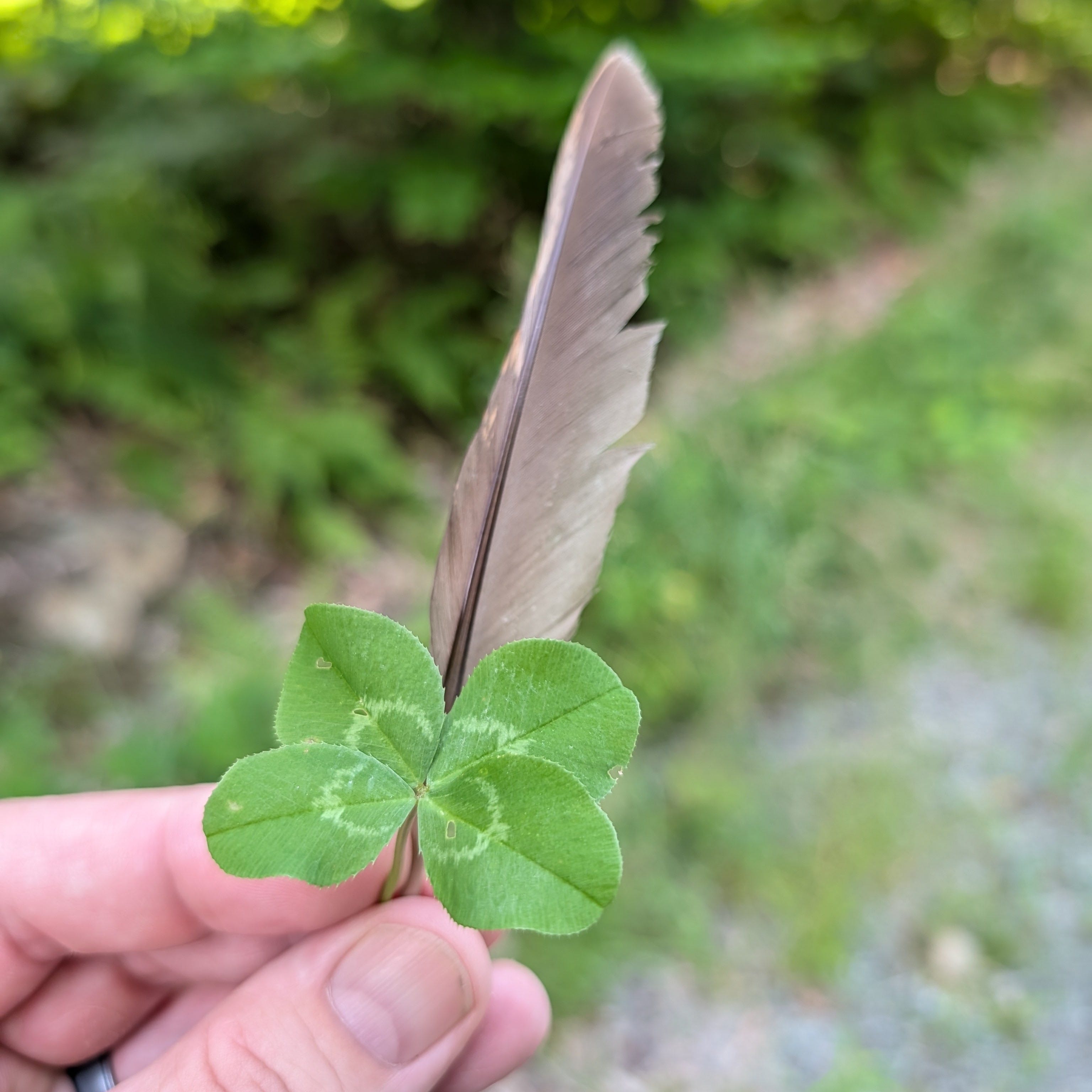
I took a picture and sent it to my friend Maria, a wildlife biologist and therefore much more qualified to identify mysterious woodland objects than I am. With her help, I learned that it had come from a ruffed grouse, the bird that many of us around here grew up calling a partridge.
Whenever an animal makes an unusual appearance in our lives, or leaves a feather, track, bone, sound, or other small calling card behind, people often want to know its spiritual meaning immediately. We search for its symbolism, its message, or what some people might call its totemic meaning. Those words carry histories and traditions that I don’t want to flatten or insult, so I tend to think in terms of animal messengers. An animal doesn’t have to become our lifelong sacred mascot to teach us, and sometimes it just crosses our path at the right moment and asks us to pay attention.
When I want to understand what an animal messenger may be saying, I begin with the animal itself. I look at where it lives, how it behaves, what it eats, how it survives, how it attracts a mate, how it raises its young, and what makes it different from every other creature around it. Science does not take the magic away from the message, but instead gives it a life of its own.
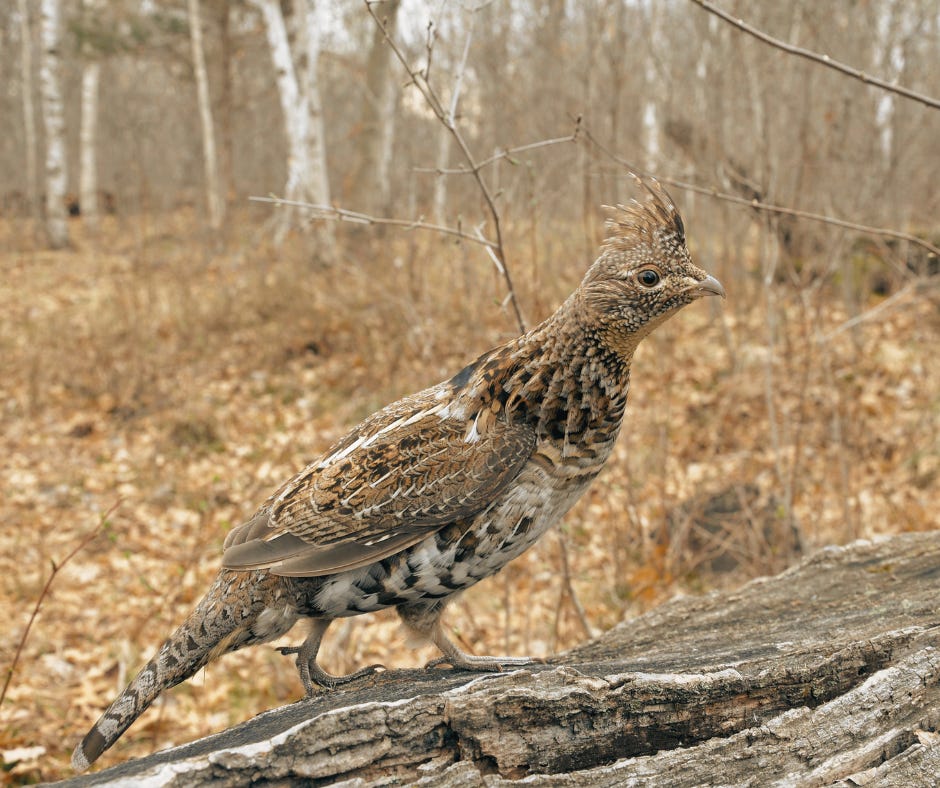
The ruffed grouse is a secretive, chicken-like bird of the forest floor, beautifully patterned to disappear among the forest and shadow. It belongs to the same broad family as pheasants, quail, turkey, and partridges (which aren’t actually ruffed grouse, and not native to North America), which is probably why it feels so much like a wild little chicken wandering through the woods.
The feather also reminded me that this was not my first encounter with a ruffed grouse that summer. A week or so earlier, we had come across a mother with her babies nearby, and the moment she saw us, she hurried away from them, drawing our attention toward herself so that we would follow her instead. She was willing to make herself visible, vulnerable, and seemingly easy to chase to lead two potential predators away from her young. That instinctive act of protection was deeply moving, and spoke to me of courage, devotion, and the lengths we go to protect our young.
The males are best known for drumming. A male will climb onto a log, stump, rock, or other raised place, brace himself with his tail, and begin beating his wings back and forth. The sound starts slowly and then gathers speed until it becomes a low, rolling thunder that can be heard through the forest. The sound comes from the force of his wings moving the air, creating an accelerating series of deep thumps that announce his presence to females and warn other males away from his territory.
There was my message.
Remember the strength of courage and devotion, and most importantly, march to the beat of my own drum.
It’s a familiar saying, almost a cliché at this point, but the grouse gave it new life for me because this bird literally makes the drumbeat from his own body. He doesn’t wait for someone to hand him an instrument, teach him the proper rhythm, or permit him to make noise in the woods. He stands on his chosen ground and creates the beat himself.
Many of us spend too much of our lives listening for someone else’s drum. We learn the rhythm our parents expect us to follow, the rhythm our partners prefer, the rhythm of our workplace. We learn the rhythm of our religion and our community, or whatever version of success happens to be fashionable at the moment. We can become so accustomed to keeping time for everyone else that we no longer recognize the sound of our own life.
My research also led me into the courtship dances of other grouse species. Sharp-tailed grouse move in small circles or arcs during their displays, and traditional Indigenous dances incorporate the movements of grouse and prairie chickens. The Prairie Chicken Dance is associated with the Blackfeet and Cree of the Northern Plains and imitates the strutting courtship display of the prairie-chicken grouse.


The Grouse Dance of the Northern Tutchone people is another example of human beings watching the natural world closely enough to let an animal’s movement become a story and ceremony through which they learn.
That brought me to the spiral.
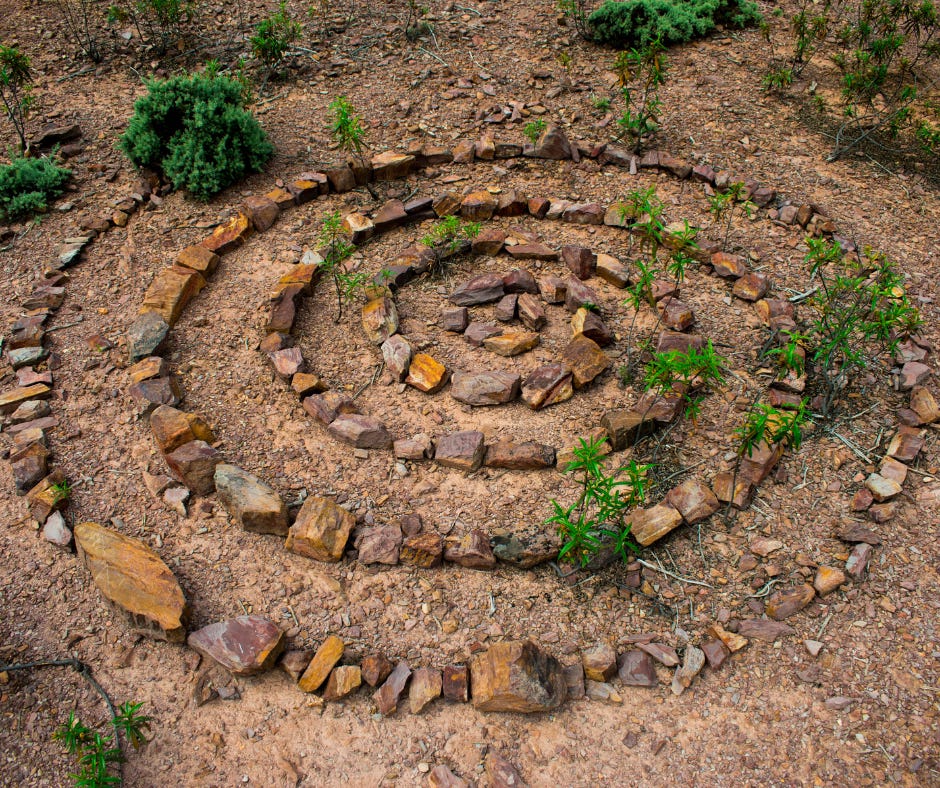
A spiral returns to familiar territory at a different depth, a different height, and from a different point of understanding. We may find ourselves revisiting the same fears, relationships, dreams, or questions throughout our lives, but that does not necessarily mean we have failed to grow. We may be meeting the same part of ourselves with more wisdom than we had the last time we passed that way.
The spiral is very much a symbol of rebirth.
Rebirth is not always bright or beautiful, and very often, begins in darkness. Persephone does not experience renewal without first entering the underworld. Her return became connected with the renewal of vegetation and the movement of life through barren seasons into growth once more.
Our own underworlds may come to us as a divorce, the death of someone we love, the ending of a friendship, menopause, retirement, illness, an empty nest, a lost career, or the realization that the life we built no longer fits us. Sometimes the underworld is not a single terrible event at all, but a long, quiet season when our old sense of purpose disappears, waiting for the new one to be born.
We do not need to wait for a major life crisis to begin again, however, and we do not have to schedule our rebirth for New Year’s Day, our birthday, the first day of spring, or the Monday after we finally finish what’s on our to-do list. Every morning offers a small return from the underworld. Every decision gives us another turn around the spiral, and every ordinary day contains a doorway through which we may step differently.
We can choose to speak more honestly today, and we can stop apologizing. We can change the way we speak to ourselves, or admit that something we once wanted is no longer what we want now. These decisions may not look dramatic from the outside, but the ruffed grouse is not concerned with whether the entire forest applauds. He climbs onto his log and makes the sound he was made to make. She’s devoted and has courage.
Perhaps that is the invitation for all of us.
Find your ground. Listen for your own rhythm. Let yourself return to places you have visited before, knowing that you are not the same person who stood there last time. Allow the darker seasons to change you, but don’t convince yourself that darkness is the only doorway into change. Follow your spiral with courage and devotion, and remember that every turn carries the chance to meet your life anew.
March to the beat of your own drum.
No matter what the other creatures in the forest might think.
No posts
Comments
Nothing yet. Say the first thing.
Sign in to join the conversation.