
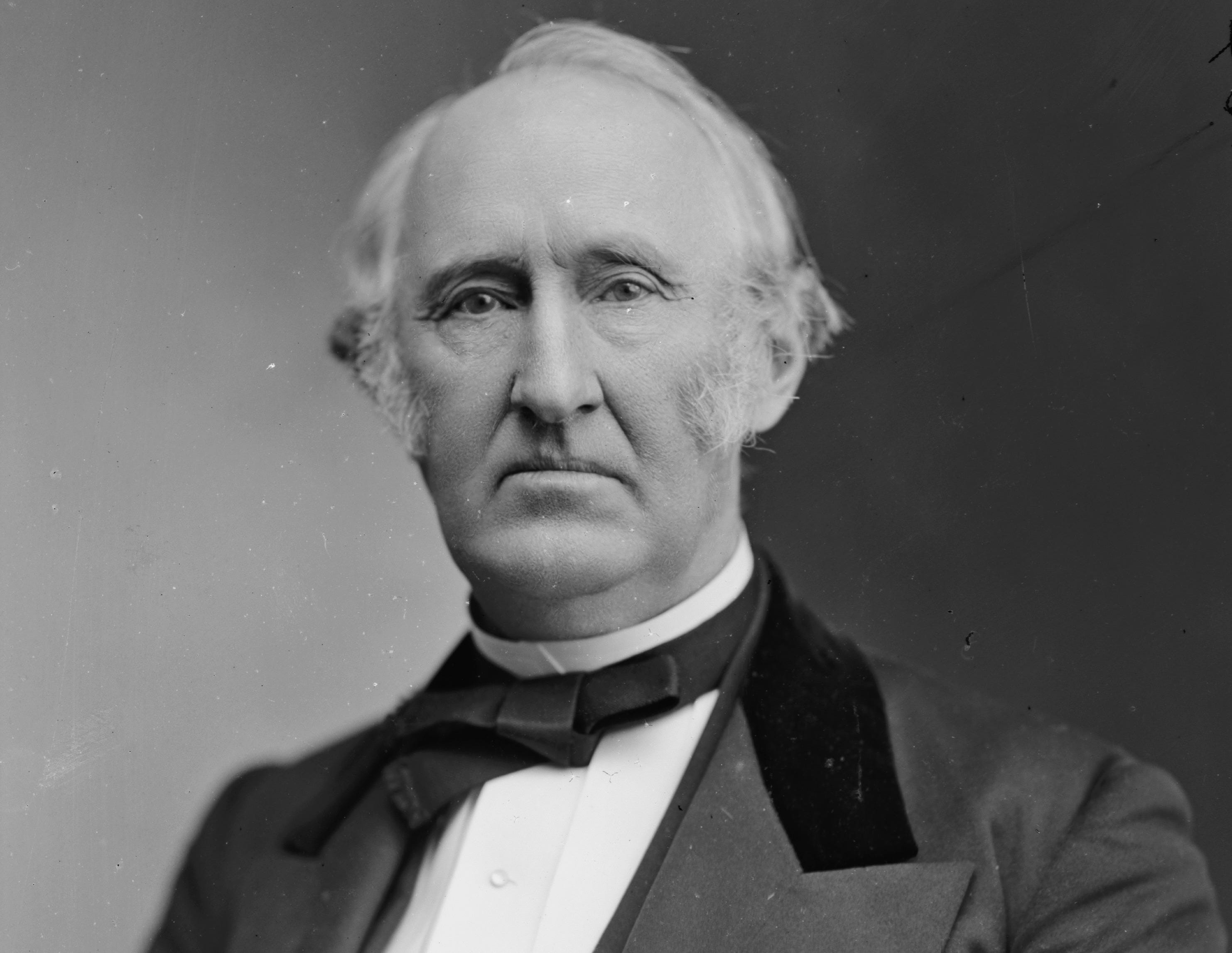
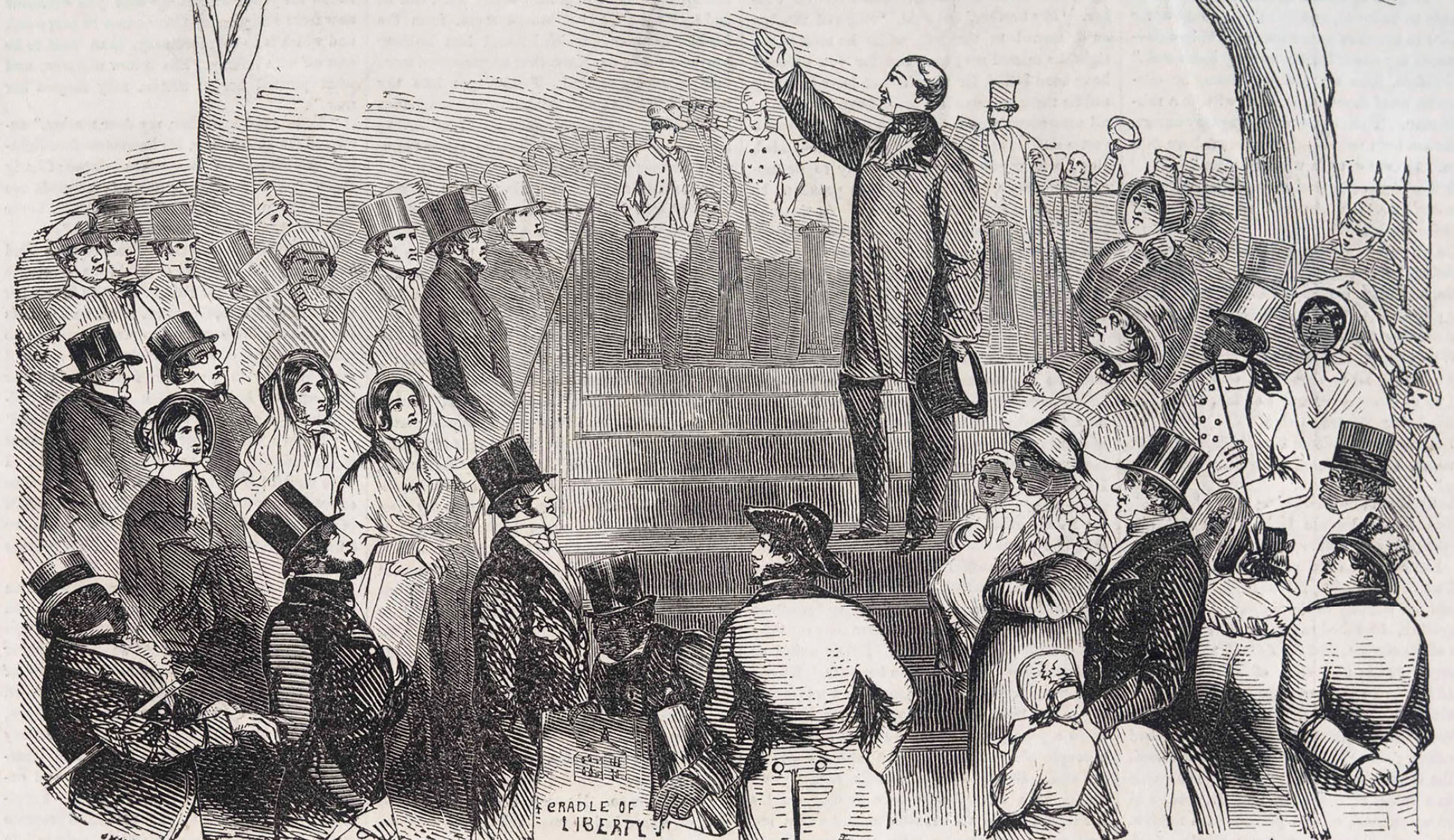
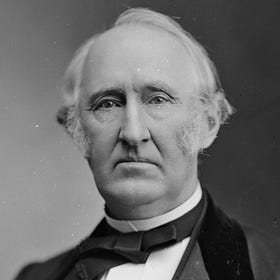
Part 3: In the years marching up to the Civil War, Wendell Phillips continued his anti-slavery campaign with unmatched zeal, intellect and eloquence, earning the moniker of abolition’s “golden trumpet”—or, as one critic declared him, an “infernal machine set to music.”1
A Southern slaveholder inadvertently illustrated his gripping appeal: “I have been to hear Wendell Phillips speak, and such words, such abuse…the rascal deserves to be hung,” the man complained. When asked why, if he was so offended, he had sat through Phillips’s lengthy, hour-long remarks, he responded, “Confound the fellow, I couldn’t get away from him.”2
As the legend of Phillips’s celebrated oratory spread, his frequent lectures, public speeches and “abolitionizing trips,” paired with his fierce views on disunionism, racial equality, and social reform, earned him a national audience on par with Garrison and Frederick Douglass. It also earned him plenty of enemies. Threats, acts of violence and mobs were now a reoccurring feature wherever he spoke. Phillips thrived before antagonistic audiences but did still fear for his safety, and at one point, he began to carry a revolver and surround himself with bodyguards for protection.
“His precious life is in very great danger.…We are quite sure of a mobocratic outbreak,” Garrison wrote of his friend after learning of a plot against him. Another memorable message was delivered via package to the Phillips home. Ann Greene Phillips saw the unusual square box, neatly packed, and at first feared it might be detonating powder. Her adopted daughter, Phoebe, carefully opened the lid and peeked in, where she found a dead tabby cat coiled up inside. “There lay the poor dear fellow creature…cold and breathless!”3
Behind the scenes, Ann continued to play a pivotal role in her husband’s work as trusted counsel and advocate, occasionally nudging him when she felt it necessary—all despite the constant health woes that kept her secluded and often confined to bed. She also kept up a regular correspondence with Maria Chapman and the Weston sisters, as well as Garrison and other leading abolitionists, and did not shy from dispensing her advice on political matters.
As the Civil War began, Wendell Phillips remained intensely skeptical of Abraham Lincoln, once referring to him as “the slave-hound of Illinois.”4 Even after the Emancipation Proclamation, he worried that the president was too much of a compromiser, too ready to sacrifice his principles for a “sham peace.” Phillips broke with Garrison in opposing Lincoln’s reelection in 1864 and proposed a formal resolution at the state anti-slavery convention denouncing the president’s actions. Garrison, for once, preferred a more diplomatic approach and tried to amend the resolution with softer language.
In this case, Phillips’s hardline views prevailed. He may have been a slower convert to the abolitionist cause, but his views were at least as uncompromising as Garrison’s—and now perhaps more. Critics pounced, claiming a “schism in the Abolition Church,” though Garrison was quick to downplay any division.5
The episode portended a permanent divergence in tactics. Following the war, and the passage of the Thirteenth Amendment to abolish slavery, Garrison stepped back into semi-retirement. “My vocation, as an Abolitionist, thank God, has ended,” he told the American Anti-Slavery Society in the spring of 1865.6
Phillips, on the other hand, was just getting his second wind. He vigorously objected to Garrison’s push to dissolve the society and instead took over as president, staking out absolutist positions on Black enfranchisement and Reconstruction that were sometimes at odds with his old friend. The tension continued into the following year, even after Garrison reached out with a conciliatory letter stressing their shared views.7
The hoped-for reset of their relationship did not go as planned. Bitter dissension at another meeting of the Massachusetts Anti-Slavery Society, followed by a spate of pointed letters in the press, dragged the breach further out into the public eye. Garrison, who had recently published his final issue of the Liberator, continued to believe that the apparatuses of the antislavery movement were “happily obsolete” and preferred to focus on other ways of supporting newly freed Black citizens.
Phillips saw things entirely differently. Abolishing slavery was not merely ending the practice of human chattel, he argued; “the object was to put the negro on an equality with the white race.” He believed that universal male suffrage should be an absolute pre-condition before any Southern state be readmitted to the Union and continued to press for strong-worded resolutions against anything less.
“The Rebellion has not ceased,” he announced. “It has only changed its weapons.”8
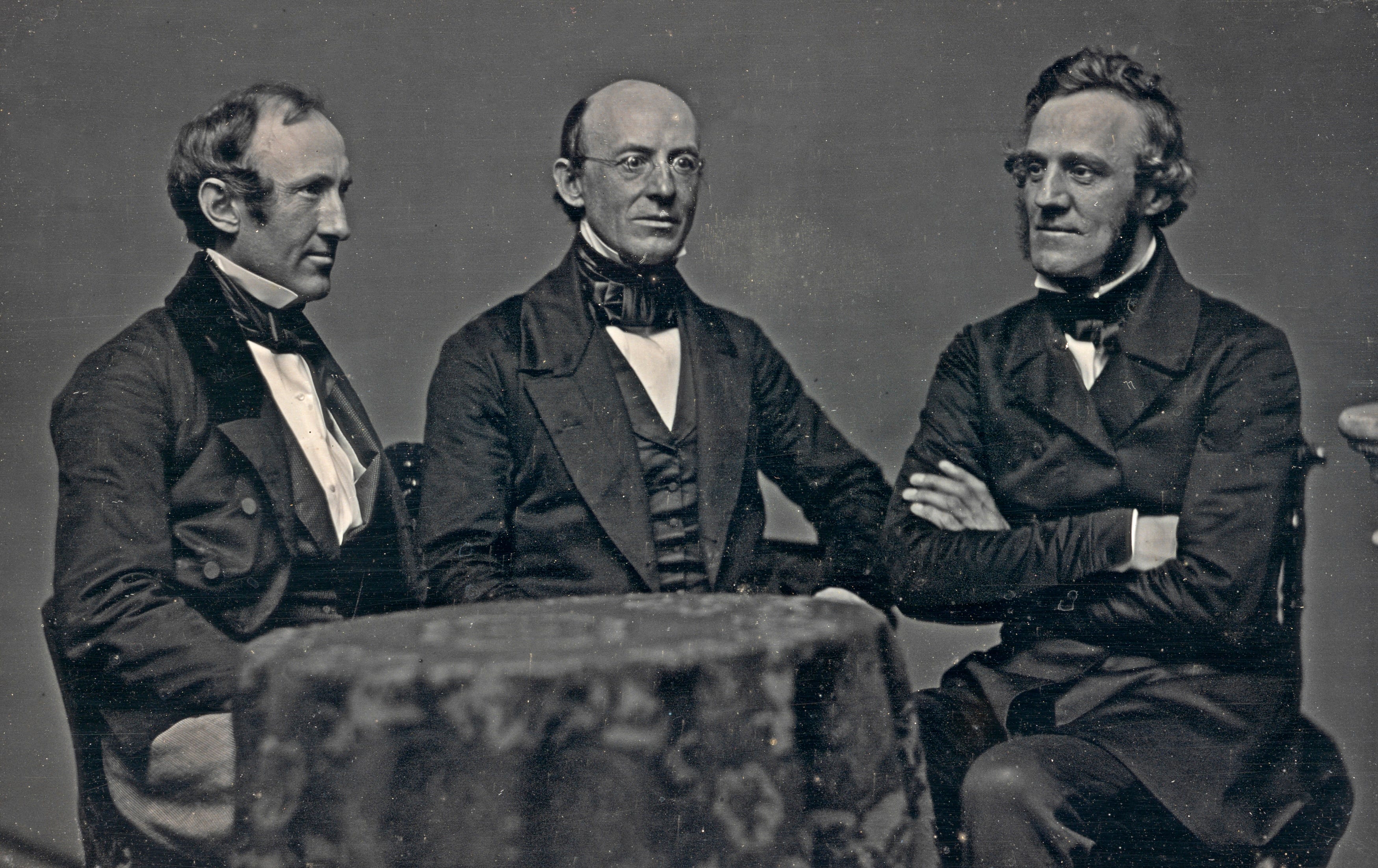
What finally helped thaw the ice between the two aging titans was a blast from the past: the publication of a pamphlet by Mayor Lyman’s son in 1870 defending his father’s role in the Gentlemen’s Mob. Both Garrison and Phillips took great offense and joined in correspondence to discredit the effort. Sharing a common agenda and foe—in this case, Lyman’s son— may have been therapeutic to their strained friendship. Eventually, the two men would patch up their differences, and Phillips prominently eulogized Garrison’s wife at her funeral, and later Garrison himself, following his death in 1879.
While Phillips never took his eye off his life’s mission against racial discrimination, he increasingly poured his energies into a range of social reforms. He championed temperance, fair labor practices, women’s rights, the plight of Native Americans, penal reform, and the exploitation of Chinese immigrants.
“We sheathe no sword,” he declared in 1870 at the final meeting of the American Anti-Slavery Society following passage of the Fifteenth Amendment. “We only turn the front of the army upon a new foe.”9
The inherent conflict between labor and capital was a recurring theme in his work, and Phillips left no doubt that he came down on the side of the worker. Many of his arguments would resonate more than a century later in contemporary political discourse. He advocated for an eight-hour workday and currency reform, railed against the corrupting influence of “moneyed corporations” in the political process, and loudly decried growing income inequality.
“This system of finance by which one man at sixty years old has gathered fifty millions of dollars, and of the ten thousand men that work for him, seven thousand get up every morning not knowing where dinner is coming from—that system of finance belongs to the bottomless pit, and the sooner it goes home the better,” Phillips declared during a speech in Newburyport, Massachusetts, in the fall of 1871. “For, gentlemen, the great danger that threatens us in the future is the money power.”10
Phillips’s twilight years were not all filled with glory and accolades. A lifetime driven by the pursuit of social reform rather than financial gain had depleted his savings, leaving him struggling to manage his debts while continually caring for Ann, who was now partially paralyzed.
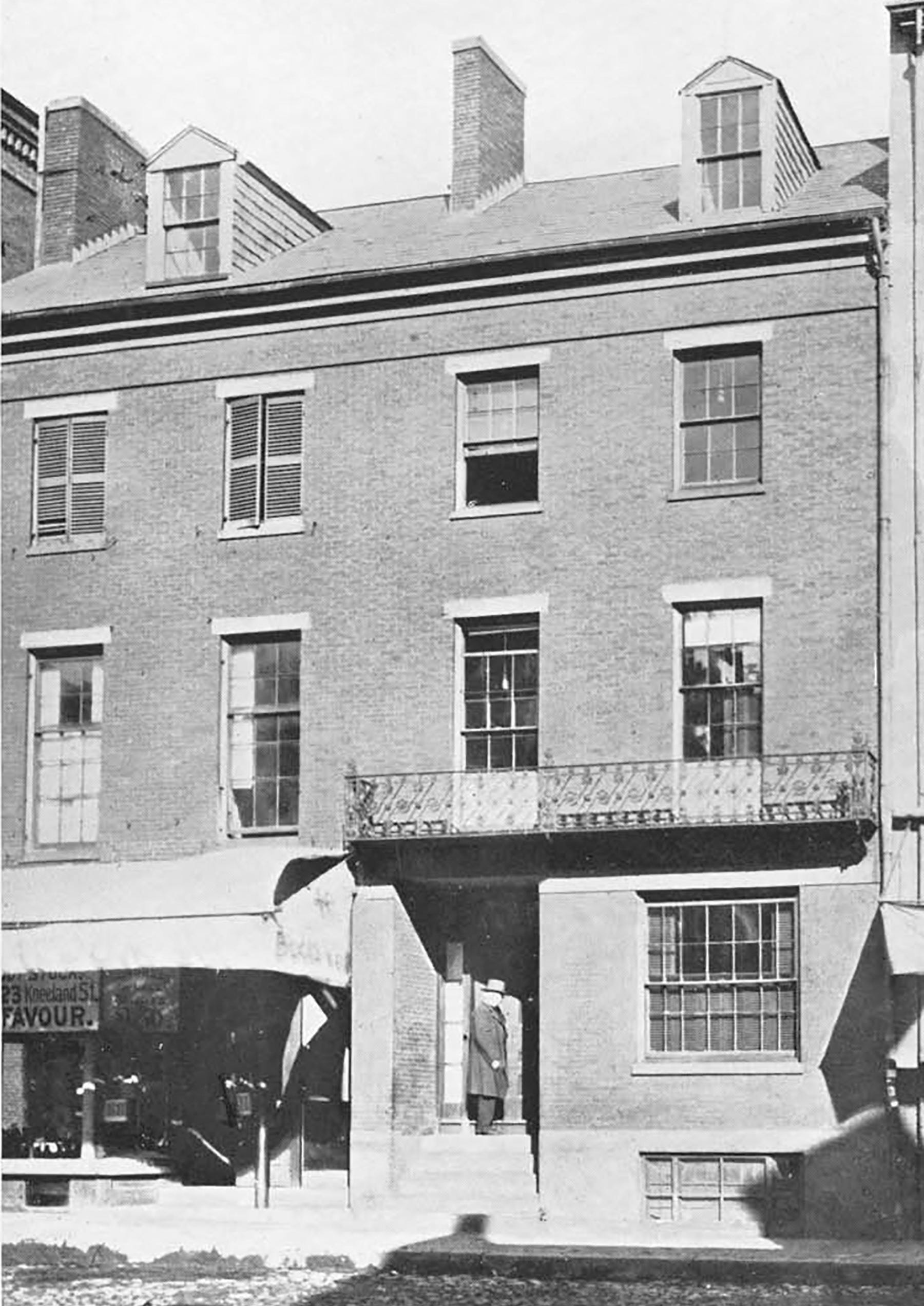
A far worse indignity came courtesy of his own native city of Boston, which, beginning in 1880, commenced plans to demolish the Phillipses’ home on Essex Street to pave the way for a street expansion. After unsuccessful appeals and delays, the Phillipses were eventually forced to decamp their home of four-plus decades to make way for an expanded Harrison Avenue. The relentless march of commerce and business interests that Phillips had railed against for so long had claimed his own home as a victim.
One of Phillips’s final public acts was to speak at the dedication of a statue of Harriet Martineau in Boston in December 1883. In his remarks, he referenced her passing through the city on the same day as the Gentlemen’s Mob. “She came here to gain a personal knowledge of the Abolitionists, and her first experience was with the mob on State Street,” he recalled. Though he was now in his early seventies with silvery hair, Phillips’s voice remained strong, and he appeared still vibrant. The assembled crowd could not have known that they were witnessing the final public speech of his extraordinary career.
The following month, Phillips began to experience severe chest pains. His doctors prescribed various remedies, but the pains persisted and spread. He remained in bed in a weakened state for most of January. After a night taking mutton broth and beef tea, Phillips temporarily felt better, but the pain soon returned. On the afternoon of Saturday, February 2, 1884, he fainted while trying to lift himself out of bed. “I’m dying,” he told his physician, speaking truth to his very last breath.
For Wendell Phillips, his manner of death came in marked contrast to his manner of life: he passed calmly, quietly and without struggle, “as if he was just going to sleep,” his doctor noted.11
News of Phillips’s death soon carried in newspapers across the nation. A public memorial was held at Faneuil Hall, and the sidewalks overflowed with thousands of mourners. Tributes poured in from pulpits, political leaders, and newspapers across the country. The Boston Globe published a full page of memorials from leading citizens, including Frederick Douglass, Julia Ward Howe, Lewis Hayden, Henry Ward Beecher and Lucy Stone.
“In his death New England has lost its most eloquent orator and its most courageous and brilliant reformer,” wrote Douglass. He was one of the nation’s “most daring and uncompromising leaders,” Howe added.
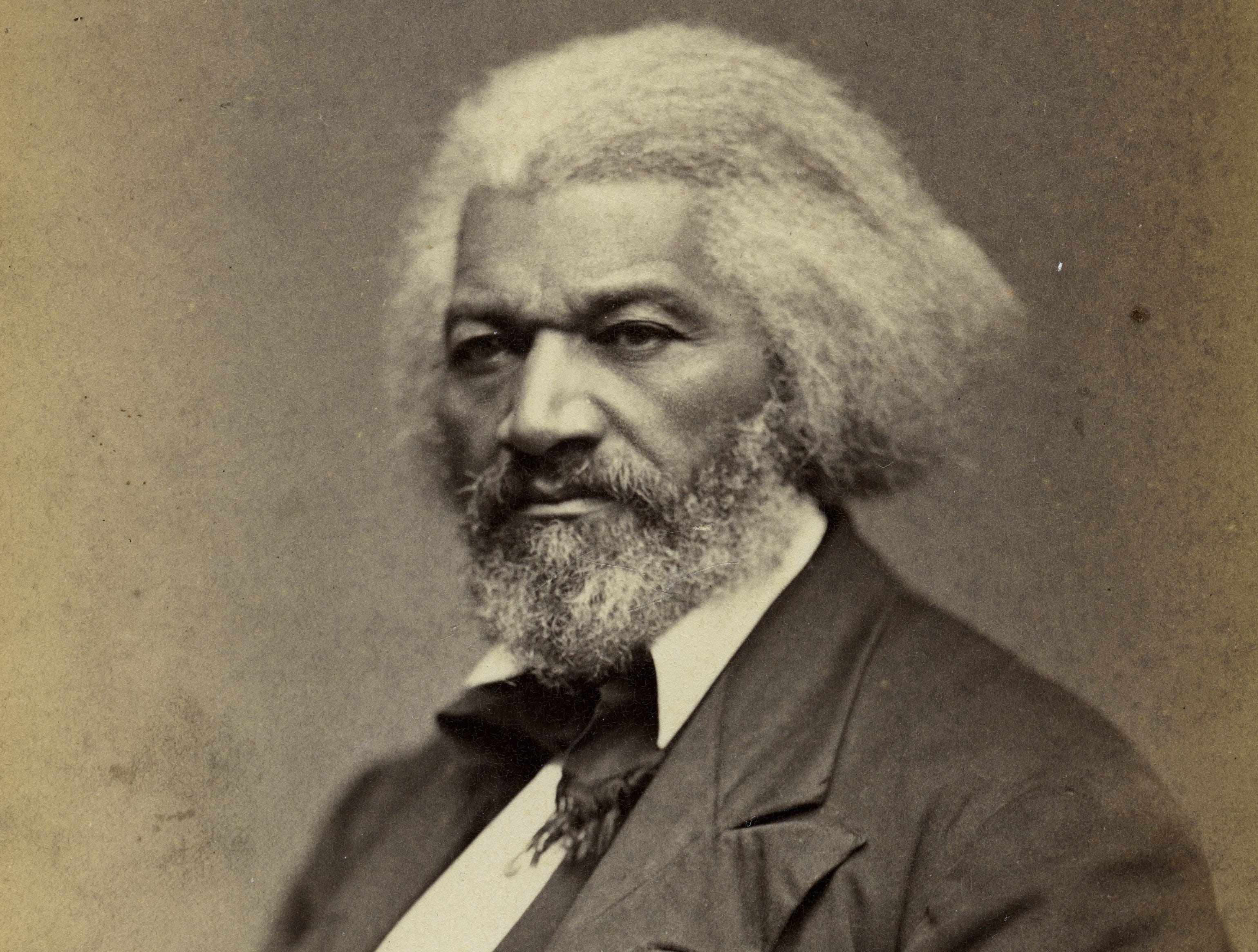
The Massachusetts State Senate interrupted an afternoon session to allow members to offer their own words of praise. “Phillips belonged to the small class of men who can be called both great and good,” said one state senator, while another called him the “apostle of equal rights.”12
Prominent African American newspapers also sounded off. Lucretia Newman Coleman, a Canadian-born writer whose father escaped enslavement, penned a poetic tribute to Phillips in the Christian Recorder that referenced his early experiences with mobs and praised him for displaying that “rarest type of bravery.” She wrote of Phillips:
“Thou canst say of negro slavery, ‘I sat by its cradle, I lived under its roof, I administered its bane, I followed its hearse, I shouted o’er its grave.’”13
Other eulogists noted the direct line between the Gentlemen’s Mob and Phillips’s conversion to the cause. As a young man watching the “merciless mob” drag Garrison through the streets of Boston in 1835, “his pure soul was stirred within him,” one minister recounted. “At once he became the champion of the oppressed colored men of his own native land.”14
In April, another public memorial service was held at the Tremont Temple, and Archibald Grimké, a prominent author and attorney who had grown up in enslavement in South Carolina, delivered an emotional eulogy. He retold Phillips’s transformation from Puritan patrician attorney to antislavery agitator, recalling the day that free speech and the freedom of the press were dragged through the streets by the Gentlemen’s Mob. Phillips had watched as only Maria Chapman and the other brave women had stood up for liberty on that day.
“His eyes thus anointed,” Grimké told the crowd, “he began to see things as they were.”15
Grimké sang the praises of Garrison and Charles Sumner but maintained to the audience that “tonight we are standing by the open grave of the greatest of the three.”
Ann Greene Phillips, despite her lengthy and debilitating illness, outlived her husband for another fourteen months. She arguably deserved the greatest credit for directing her husband’s chosen vocation. If the Gentlemen’s Mob had planted the radical seed in the young attorney's mind, it was Ann who had carefully nurtured its lifelong growth.
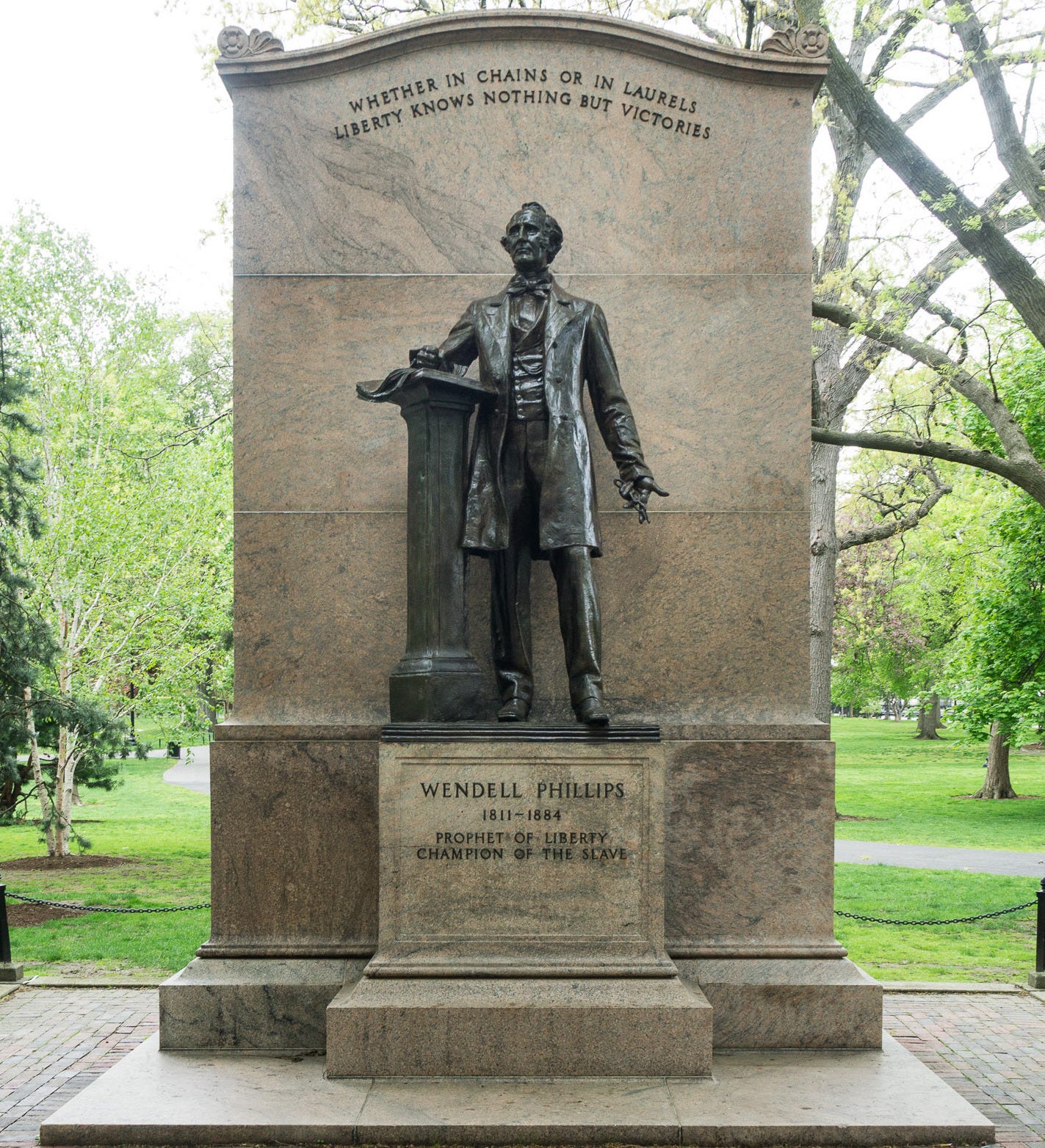
Three decades later, a bronze statue of Wendell Phillips was unveiled in the Boston Public Garden, a short distance from where the mob once gathered. He stands immortalized with a broken chain in one hand, his fist clenched. Yet, as one Boston writer put it the day after the dedication: “Today there is a monument in Boston to Wendell Phillips. It is not a statue in the Public Garden. It is a memory and a hope in the hearts of living women and men.”16
“Today there is a monument in Boston to Wendell Phillips. It is not a statue in the Public Garden. It is a memory and a hope in the hearts of living women and men.”
See Full Series:
·
Jun 26
October 21, 1835: Wendell Phillips was working in his law office on Court Street when he first heard the angry voices. The young attorney looked out and saw a crowd parading through the street. Whatever was happening had to be more interesting than the contracts, wills and workaday woes that normally comp…
Wendell Phillips and the Mob That Made Him, Pt. 2
·
Jun 26
PART 2: The spectacle outside the Old State House began to calm soon after William Lloyd Garrison’s departure, and within an hour the rowdy crowds had mostly dispersed. Some of the rabble reassembled around the jail, others caroused on the Common and some migrated to nearby taverns, wine cellars and coffeehouses to cap off a long day of rioting by quaffing pints of porter and ale.
Wendell Phillips and the Mob That Made Him, Pt. 3
·
Jun 26
PART 3: In the years marching up to the Civil War, Wendell Phillips continued his anti-slavery campaign with unmatched zeal, intellect and eloquence, earning the moniker of abolition’s “golden trumpet”—or, as one critic declared him, an “infernal machine set to music.”
(This series adapted from The Boston Gentlemen’s Mob.)
1. Waltham Free Press, June 9, 1867, 1.
2. The Index (OH), October 22, 1870, 7, quoting Boston Traveller.
3. Chapman letter, December 19, [1859], BPL.
4. Phillips said later that he regretted the remark.
5. Liberator, February 26, 1864, 1.
6. Liberator, “Speech of Wm. Lloyd Garrison,” May 19, 1865, 2.
7. Garrison letter to Wendell Phillips, January 1, 1866, as quoted in Merrill, Letters.
8. This was part of a lengthy series of resolutions read by Phillips and adopted by the American Anti-Slavery Society. See New York Observer, May 17, 1866, 6. New York World, January 29, 1866, 4.
9. Martyn, Wendell Phillips, 372, quoting April 9, 1870 speech.
10. Address of Wendell Phillips, “The People Coming to Power!” delivered at Salisbury Beach (MA), September 13, 1871, published by Lee & Shepard, 1871.
11. Boston Herald, February 3, 1884, 1.
12. Ibid., February 12, 1884, 6, quoting state Senator Loring.
13. Newman went on to have a prominent career as an author and poet. Tribute published in Christian Recorder (TN), March 27, 1884, 1.
14. Boston Herald, February 13, 1884. 1.
15. Grimké, Eulogy.
16. Boston Globe, July 15, 1915, 6.
Comments
Nothing yet. Say the first thing.
Sign in to join the conversation.