

0:00
-11:01
Ba-zang! I read this in a great article on AI and art, and it hit right between the A-eyes. Lurking behind this quote from music producer-filmmaker Lil Internet is a tension that’s everywhere but unseen.
Most AI usage is about completion. Find an answer. Assemble a deck. Execute a command. These are fun magic tricks, but ultimately dead ends. The real value will come when we learn to use LLMs to massively expand our creativity.
Asking AI to simply complete tasks is not worth the tokens, and the bill is already coming due. Uber burned its entire 2026 AI budget in four months. When their COO went looking for the return, he admitted that the link is not there yet.

When their COO attempted to find the benefit, he came up short. In three years, we’ll look back at this and shake our heads at how primitive our understanding was. AI is more powerful at opening us up than cinching down.
Lil Internet and the other artists featured in that article are creating some fascinating visual art and music. But I’m much more interested in exploring how we can use AI to foster creativity in business. Which is why I interviewed Aden Nepon—a leadership development coach and fellow improviser.
If you took Intro to Acting in college, you know that in improv, the whole goal is to create a story from nothing. With years of experience mastering this skill, people like Aden are excellent at thinking on their feet and generating ideas, and I’ve found, that’s a super power in business. In fact, I credit years of improv training with my ability to facilitate a room of unpredictable executives.
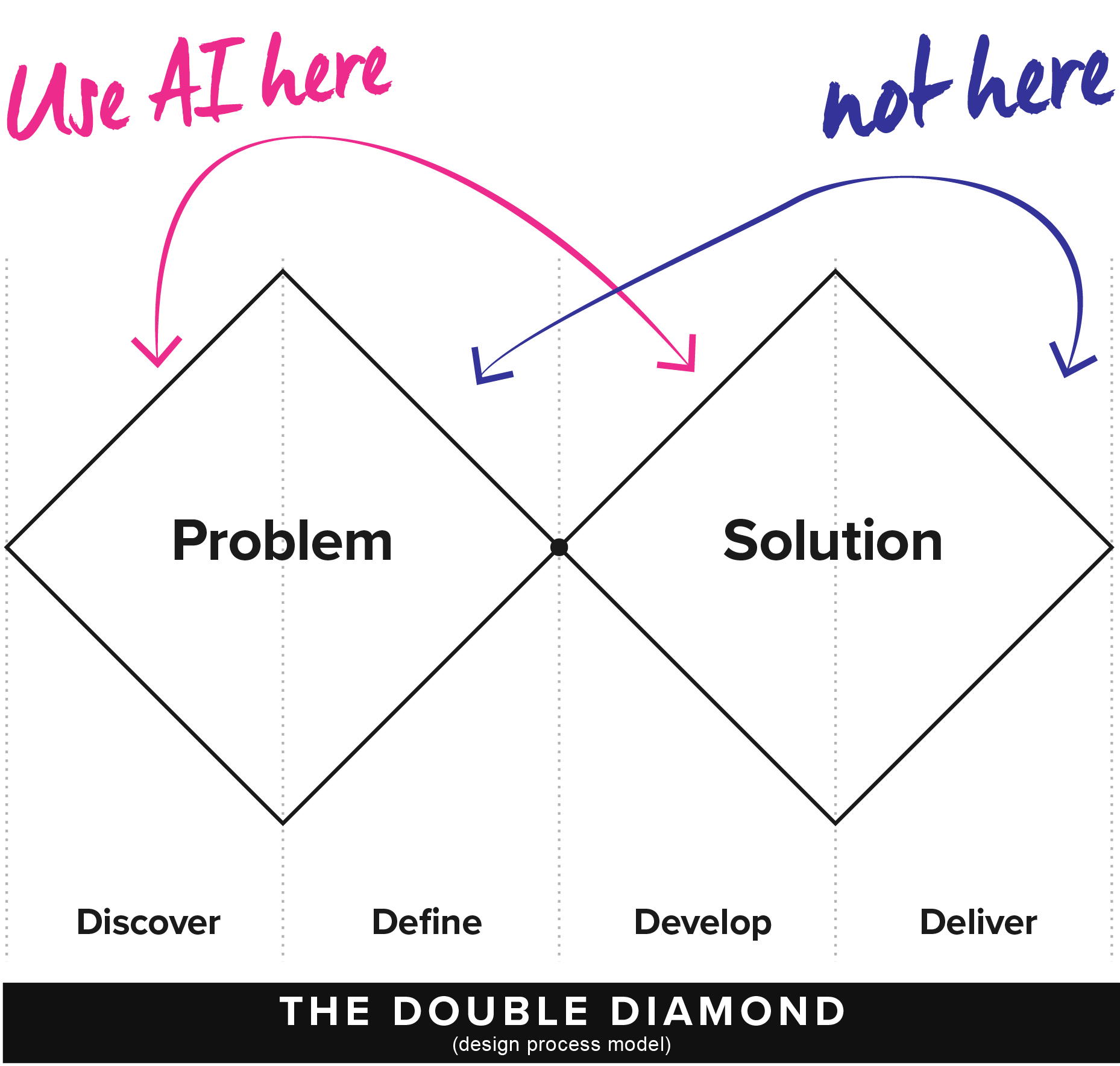
I want to poke at one piece of my conversation with Aden—the part about how Aden gets her clients to be more creative. Here are three tools (or games as they’re known in the world of improv) that Aden uses with her clients.
The first rule of improv: say “Yes, and.” This is called accepting and building on an offer. By now, you may have heard this language around the office. Personally, I love that the business world has adopted this. Here’s how Aden uses it: 1) Set a timer. 2) The first person presents an idea or solution to a problem. 3) Continue around the room, building on the previous idea. Every contribution has to open by accepting the last idea and adding one thing to it. No “but,” (that’s called blocking.) This helps train the humans in the room to stop self-editing. The point isn’t good ideas, it’s volume and momentum.
There’s power in personas. Which is why this one works. Aden was coaching a singing student—instead of giving them specific improvements to make, she told her to sing like Beyoncé. On stage or in the room it’s the same, the role loads everything at once. To explore ideas for a pitch, strategy, or campaign give people in the room different characters to play. “You’re a founder of a totally different industry, a chef, a video game designer, a theme park designer, who’s never seen how your industry does things and brings their own playbook.” or “You are the person who’s obsessed with this idea and wants ten more versions of it, right now, because one wasn’t enough.”
This one is more advanced, and likely not something your team will be able to do without support (he says, foreshadowing the next section.) That limitation is why Aden brought in fellow improvisers to help a Fortune 500 company explore some new ideas they were entertaining. Once the ideas were narrowed to the ten hottest, the improvisers acted out short scenes of each so the room could see and hear what the idea would actually feel like. Most people can’t picture what doesn’t exist yet, so you build the feeling of it live.
I can see you know where I’m going next with this. AI can run these games with you, no room full of improvisers required.
Tell Claude “we’re playing Yes-And, your only job is to accept my idea and stack one more on top, don’t evaluate, keep going till I say stop.” You stay the source of ideas. AI keeps the scene from stalling and won’t let you kill your own thought halfway out. Great for the messy front end of developing a new strategy or campaign, before you narrow anything.
Likely you are already starting your prompts with the classic “Act as…”. If so, good start! Time to upgrade your game. Cast a specific, textured character and make AI stay in character. Instead of “act as a brand strategist,” try “you’re a 24-year-old who’s never heard of us and thinks all companies like ours are the same, react to this.”
Or develop a panel of agents each with a different role. Have a conversation with them about a specific challenge in Claude Co-Work. Each one highlights a different truth, path, or option. Casting a character isn’t a hack, it’s forcing AI to improvise. A role with a real bias forces your conversation away from the average.
Stop asking AI to write the final output—a good rule for this and pretty much all AI use. This was the improv game you needed professionals to help with, now you can explore this experience with Claude. (Granted it won’t be as fun or as experiential.) Ask it to play the thing out. “Let’s run this hard conversation ten ways” or “act out what this launch announcement sounds like to a burned-out employee.” The goal is to prototype the feeling, and to sharpen your own instincts. This is the antidote to outsourcing your judgment, which is one element Aden and other leaders are worried about.
Lil Internet’s solution to avoiding the averaging that AI wants is “introduce incoherence” with your prompts. I respect that—and for an artist, that makes sense. For the rest of us looking to expand our ideation in a business context, introducing structures like those from improv are better suited to the task. These games aren’t party tricks, they’re tools of constraint that ironically help create more divergent outputs. Each one helping us escape the pull of averages.
AI anxiety has primarily been focused on replacing human thinking. I don’t believe it. But we still need to put in the effort to avoid sameness. We need to invert our thinking. We need to learn to get AI to prompt us into new ways of thinking—like a great improviser can.
If you are on the Shit List (the paid tier) here’s this week’s cheat sheet. One page, all three improv games and their copy-paste prompts, condensed.
Print it, pin it, steal it for your next brainstorm.
Comments
Nothing yet. Say the first thing.
Sign in to join the conversation.