
Musician and sound artist Josh Mason has spent more than a decade developing a deeply personal approach to modular synthesis, guitar, and electronics. I first came across Josh’s music around 2017 and have been following his work closely since then, across albums such as L+, Coquina Dose, and Utility Music—which documents his yearlong engagement with a Doepfer-based modular system. Josh has established himself—to my ears, at least—as one of the most committed, original, and musical practitioners of modular synthesis working today.
Josh’s Greyfade debut, Kicking A Dark Horse, is out this Friday. The album is the third release in the label’s FOLIO format: a full-length album housed in a hardcover book. It’s also the first modular synthesizer-based recording Greyfade has released.
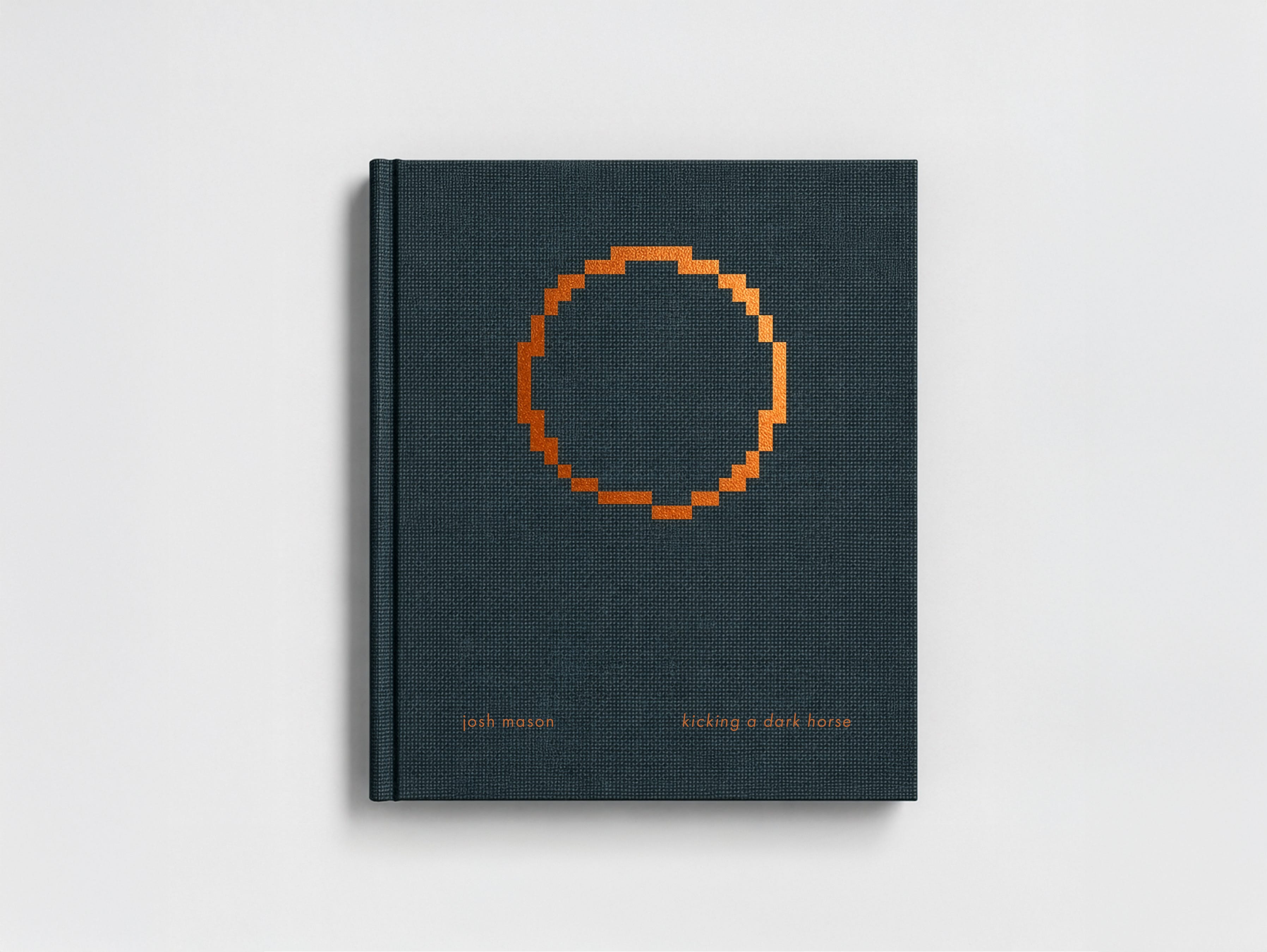
I sat down with Josh to talk shop about the music on the new album, his approach to system design and modular synthesis, his writing process, and the relationship between music & text.
Whereas the first two FOLIO editions used text largely as a critical and making-of apparatus—essays, study scores, and reflections built around music that already existed—Josh’s text is a different animal. Subtitled “a nonlinear travelogue of the states of Florida,” it’s a book-length work of experimental writing, co-conceived with the music from the very beginning.
It isn’t a document of the record so much as another instance of the same sensibility; as Josh puts it below, the two are “two sides of the same coin,” meant to be encountered at once.
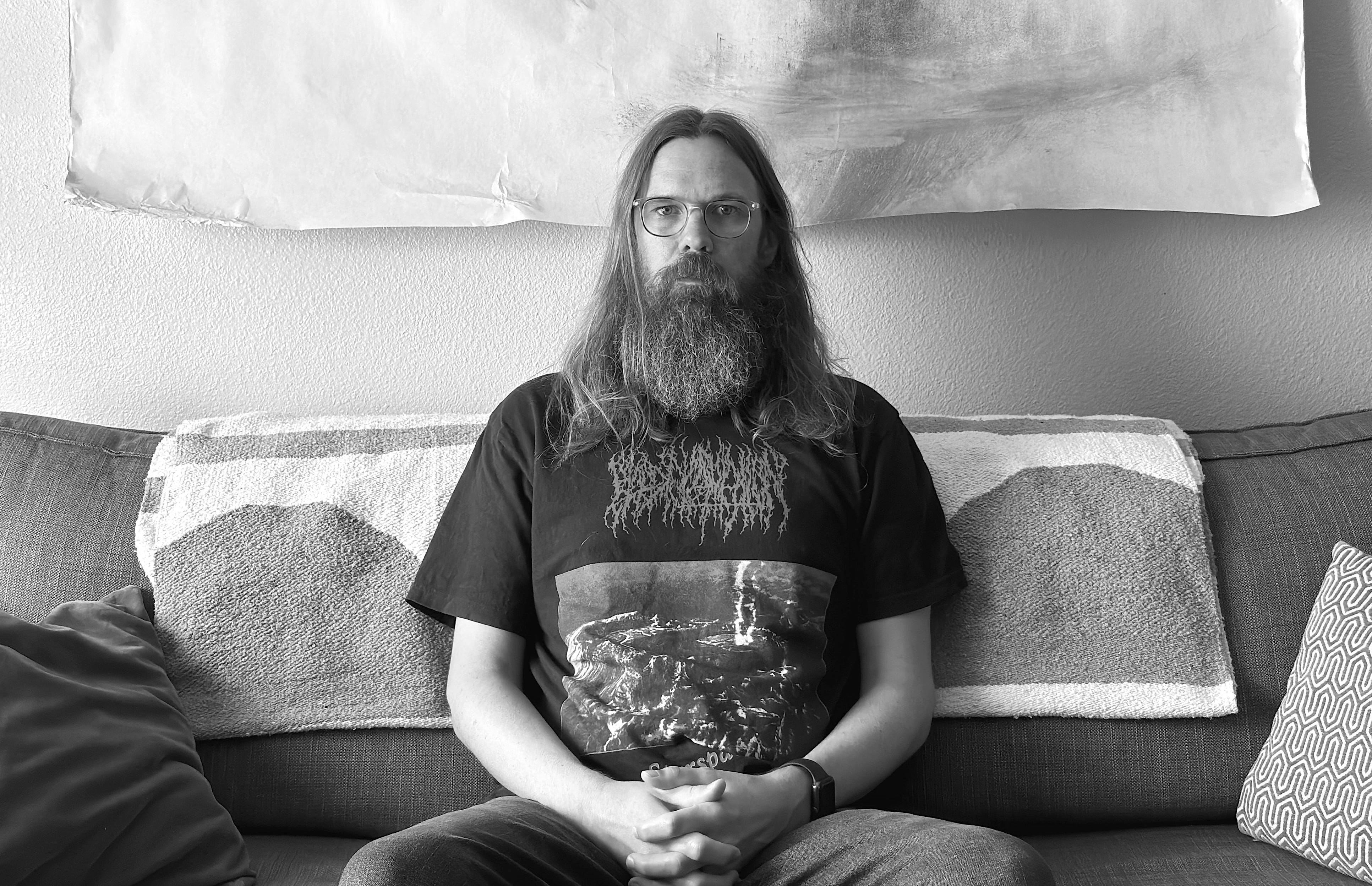
JOSEPH: Could you give an overview of what your journey with modular synthesizers has been like, and what specific approach differentiates this album from some of your others? JOSH:
This whole record was made using Xaoc Devices modules, specifically the Leibniz subsystem. It occurred to me that that was sort of the final boss for me, in terms of instrument design that made no sense to me. The whole binary thing—my brain does not work in binary. So when I was confronted with this rig, I was like, okay, how do I take this concept of binary states, take their design philosophy, and fold it back into the things I wanted to do? It was an exercise in figuring out how to wield this thing in a way that sounds like something I would do.
JOSEPH: So it’s almost this idea of resistance—of trying to baffle yourself, not being fully in control of all the parameters.
JOSH: Yeah, it’s a self-imposed impediment. It’s like saying, I’m going to make an album with a guitar and a looper—that’s it. Throughout my whole musical path it’s always been that way: how do I put some guardrails on this? Because otherwise, if you stick me in an Ableton environment, I’ll just Ableton the shit out of everything and it’ll never get made. So I find myself thinking, okay, the Harvestman stuff is designed for industrial, bright sounds, and I’m always like, “Yeah, okay, cool. But let’s find out if I can bend it to what I want.” While I hear what I hear in my head, I’m also fighting against the tool set, which sometimes works really well and other times doesn’t at all.
JOSEPH: At one point, when we were checking in on the progress of the book and the music, you said “I don’t have anything done musically yet, but once I finalize the modular system, the music will be done in a few weeks.” It reminded me of a Morton Feldman quote: once the instruments are decided, ninety-five percent of the piece is already written.
JOSH: Yes, one hundred percent. Most projects are that way now, especially because it’s how my music maintains its experimental nature. For me to have a happy accident now is really hard—I know what it’s going to do. So I tend to compose and conduct this in my brain first, figure out what I want the overall vibe to be, and then throw a system design at the idea. Ninety percent of it exists in my mind before I ever start recording—and that’s not just sonically. I know what the story is that I want to tell, down to track titles and album names.
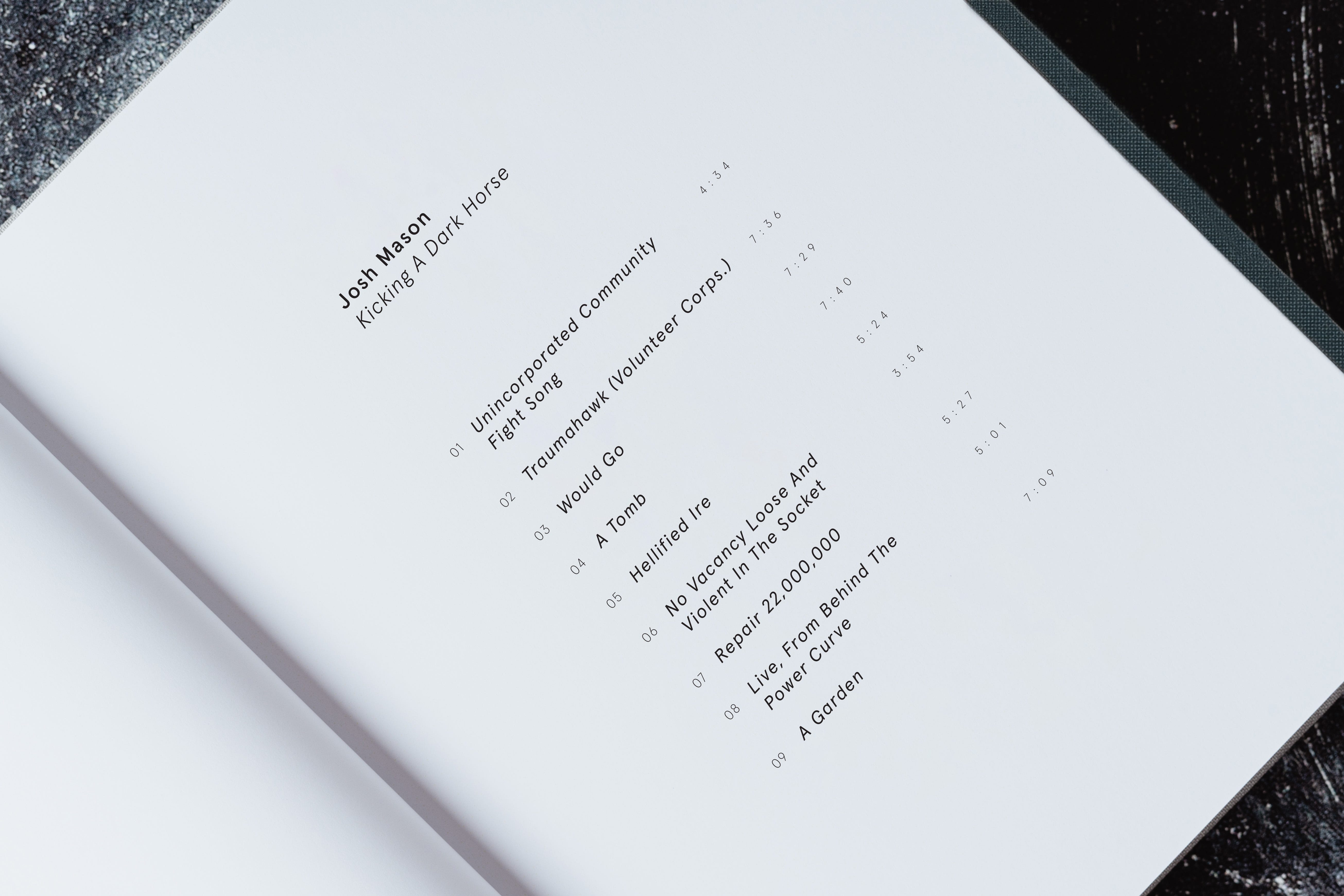
JOSEPH: Is there an intended relationship between each piece and its title?
JOSH: Generally there is some connection, even if it’s only known to me. The “No Vacancy” track title, for example—essentially what that’s describing is a loose bulb connection in a hotel sign. It’s coming in and out: “vacancy,” “no vacancy,” “no vacancy.” And that mental picture of however many hotels I can drive past along the beach went to inform how I thought about taking the binary on/off states of this system, and giving myself a way to think about how I wanted the sounds to come together. It’s thematically related to: how do I take this visual thing I see or experience and translate it into an audio event?
JOSEPH: It’s almost—and this is such an annoying word, but I want to repurpose it—cinematic, but not in the lame sense. It’s the expanded sense of scene. It’s often naming a place, demarcating a place, and the things in that place. Painting a scene, rather than being narrative driven.
JOSH: I think that’s why in my notes I made a mention of stage direction. It’s setting the stage. I want to give people the map or the directions, but not both—some frame of reference, a mood, something you can visualize. I could very easily make music that’s just “ocean light at dawn,” totally universal. But—
JOSEPH: That’s a great point. Your stuff is so specific, and in a literary sense I find that more compelling. A lot of ambient music uses these very generic tropes—“morning light,” etc. Your thing seems to be almost violently reacting against that. You want to drill down into the most granular details, the specificity of your own consciousness.
JOSH: Yeah, especially with this project, because it’s so hyper-specific to a place. I wanted to bridge the gap between something appreciated by people who live here and people who have never set foot in Florida, or don’t know anything about it except the crazy stuff they hear on the news.
With this kind of music, it’s often completely detached from that experience, so on past albums I was only left with song titles and album names to convey meaning. I wanted to drive home that I’m not just plonking around on stuff and then assigning meaning to it after the fact—it’s all a reaction to very real-world settings and visualizations.
I think part of it is also my background playing music with other people. I spent many years growing up playing in punk bands, and the words were at the core—that’s how you cross that divide between performer and participant.
If I had to boil it down—I am essentially making a flavor of punk rock music. Both in ethos and in execution.
What made punk rock so interesting to me as a kid was that there were no rules. You can do whatever you want—learn the chords or not, make up your own chords, play fast or slow, not even play, just throw your instrument against the wall—but if you do it with purpose and meaning and drive, you define what it is. All of the best stuff I ever wrote has been because I could not figure out how to do what other people were doing. That’s what experimental music was always, at its heart: there were no rules. There’s only a rule because somebody decided at some point to say something out loud about it.

JOSEPH: One thing I wanted to drill into on the music—and tell me if I’m off base—is that you don’t really ever use literal repetition. A lot of ambient music, from Eno on down, is a series of loops. Your music will stay in a key area, but it never seems to reveal a loop or basic pattern—it’s always shifting. What I love is that a track coheres as a thing, and yet if I zoom in at any point and try to tell you what the basic syntactical unit is, I couldn’t, because it’s always moving. The other extreme, which I don’t love, is modular music that doesn’t repeat but also doesn’t cohere—it’s just free. Your music doesn’t repeat, but it coheres.
JOSH: Yes, you are onto something. I don’t think I’ve ever talked to another person who has mentioned this about my music. There’s a word for this in writing—elision, the omission of a sound or syllable. And it’s partly that I just get bored listening to loops, because I hear the loop. It’s like why I can’t sleep to noise machines—I can hear when the memory buffer starts over. So I like to go back to my own record a year later and not be able to remember where it’s going to go in a thirty-second span. Then it was a success. It’s like going to see a band where you know what style of music you’re going to get, but what happens at any given moment is anyone’s guess.
JOSEPH: But let me push back—taken to the extreme, that could just be bleep-ity-bloop music, where you don’t know what’s coming next in some random noise set.
JOSH: But it’s not totally that, either. It almost loops. If you go and listen to a part of it, it almost loops—but not quite. A lot of people hear modular music that’s either completely true-random or just droning. Random is truly random: that’s where the bleep-ity-bloop thing comes from. But chaos actually has emerging patterns that occur naturally within that paradigm. And I think people mislabel those things. That was an important moment for me when I realized those were different—I always thought chaos and random were the same thing. You’re often told “it’s chaotic, it’s random, it’s all over the place.” But “all over the place” is relative.
JOSEPH: Are there specific tools you lean on to achieve these irregular patterns?
JOSH: A lot of it is feedback patching. But the main thing is inserting myself. A lot of people get stuck in a trap where they have a whole system applied—clocks, clock divisions, delays—and they let the machine do all the work and forget they have two hands. It’s not achieved through excessive programming. It’s me going in and manually turning steps off the sequencer. So a sixteen-step sequence that’s been running for thirty seconds is all of a sudden a thirteen-step sequence—and then randomly I’ll say, now it’s a seventeen-step sequence. And in situations where I can’t be hands-on, I give the system an approximation of hands-on—I’ll clock a clock divider with an irregular input.
JOSEPH: What does it look like when you actually record? Are these basically live improvsations?
JOSH: With this one, the majority of it is live—everything you’re hearing is happening in real time. It’s like spinning plates, where you’ve got all these sections running, and it’s the moment when you realize they all have the right amount of momentum and velocity that they’re all just running—and the moment I breathe is when I know it’s ready to go.
There are a couple of tracks where, out of nowhere, you hear a time-stretched segment of something that happens two minutes later in the song at regular speed. Moments like that are where I’m trying to play with the central question for this record: how do I represent nonlinearity in a linear format? It mirrors the writing, which is a nonlinear concept applied to what is essentially a linear format.
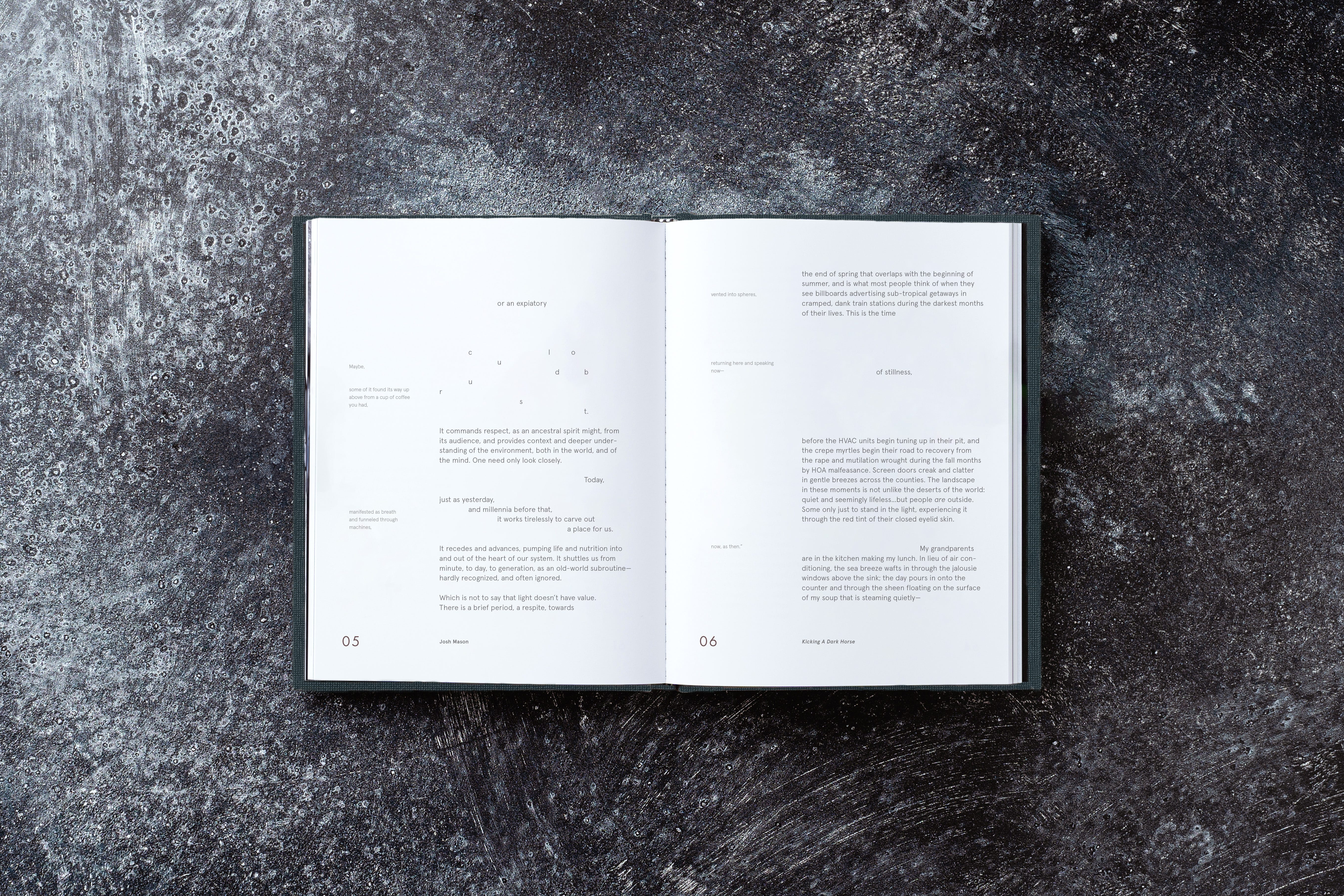
JOSEPH: For the book, you’ve subtitled it… what was it, “a nonlinear travelogue”?
JOSH: “A nonlinear travelogue of the states of Florida.” It really is a lot of different things slammed together, but for the most part it’s designed to be a travelogue—more than poetry or prose. It’s supposed to be a record of place. A lot of it is accurate, and a lot of it is complete fiction, and I would be hard pressed to find anybody who could easily tell which is which—because that’s the whole point.
JOSEPH: When you first told me what you were working on, it jarred my own sense of what the Greyfade book format could be—but in retrospect I couldn’t be happier with the direction you took it. How did you come to this particular solution?
JOSH: I’d already done a more academic type of thing before [Utility Music] and didn’t want to veer too much into familiar territory. It dawned on me that I could apply the same chaotic impression I put on the sound to the written word. So I just gave myself permission to write the same way I make music.
JOSEPH: Did you write the complete text before the music?
JOSH: The text was about ninety-five percent done before I started recording. But I was writing the music the whole time in my mind. I heard the sound and would respond to it with what I was writing on the page: how do I map what I hear to what I’m seeing? So technically the music didn’t exist as a hard copy, but it existed in a way that it was still being listened to and responded to as I was writing.
JOSEPH: Is it best to say they were co-conceived as dual branches of one single thought?
JOSH: Two sides of the same coin. It’s really supposed to be something you sit down with at the same time, together. The music punctuates the word. It’s all happening to you at once—your auditory and visual senses both being stimulated, and there’s room, both in the music and in the text, for the other one to step in.
Joseph Branciforte and Josh Mason, June 2026
Josh Mason’s Kicking A Dark Horse is out June 26, 2026 on Greyfade—in both hardcover FOLIO + digital formats.
SubscriptionsPatch Notes will always be free to read. If you’d like to support my work and access additional materials—including downloads of my full album catalog and patches featured in posts—there are a few ways to subscribe below.
FREE
Access to regular posts covering sound, design, technology, and process.
PAID ($5/month or $50/year)
Bandcamp download codes for my complete digital album catalog (past and future releases).
Downloadable Max/MSP and Pure Data patches featured in posts.
Access to subscriber-only posts, including interviews with artists, musicians, and composers.
Early access to pre-order Greyfade physical releases before they go on sale to the general public.
FOUNDING ($150/year or more)
Everything in the Paid Subscription tier.
A Bandcamp download code for each new Greyfade release (3-4 per year), with proceeds going to the artists.
Download of my custom Max/MSP utilities library—jb.utilities—along with help files. I’ve coded and updated these over the last 20 years and use extensively across all my Max/MSP work.
Directly supporting and sustaining the creation of new music, custom technology, and experimental design at the heart of my work.
No posts
Comments
Nothing yet. Say the first thing.
Sign in to join the conversation.