
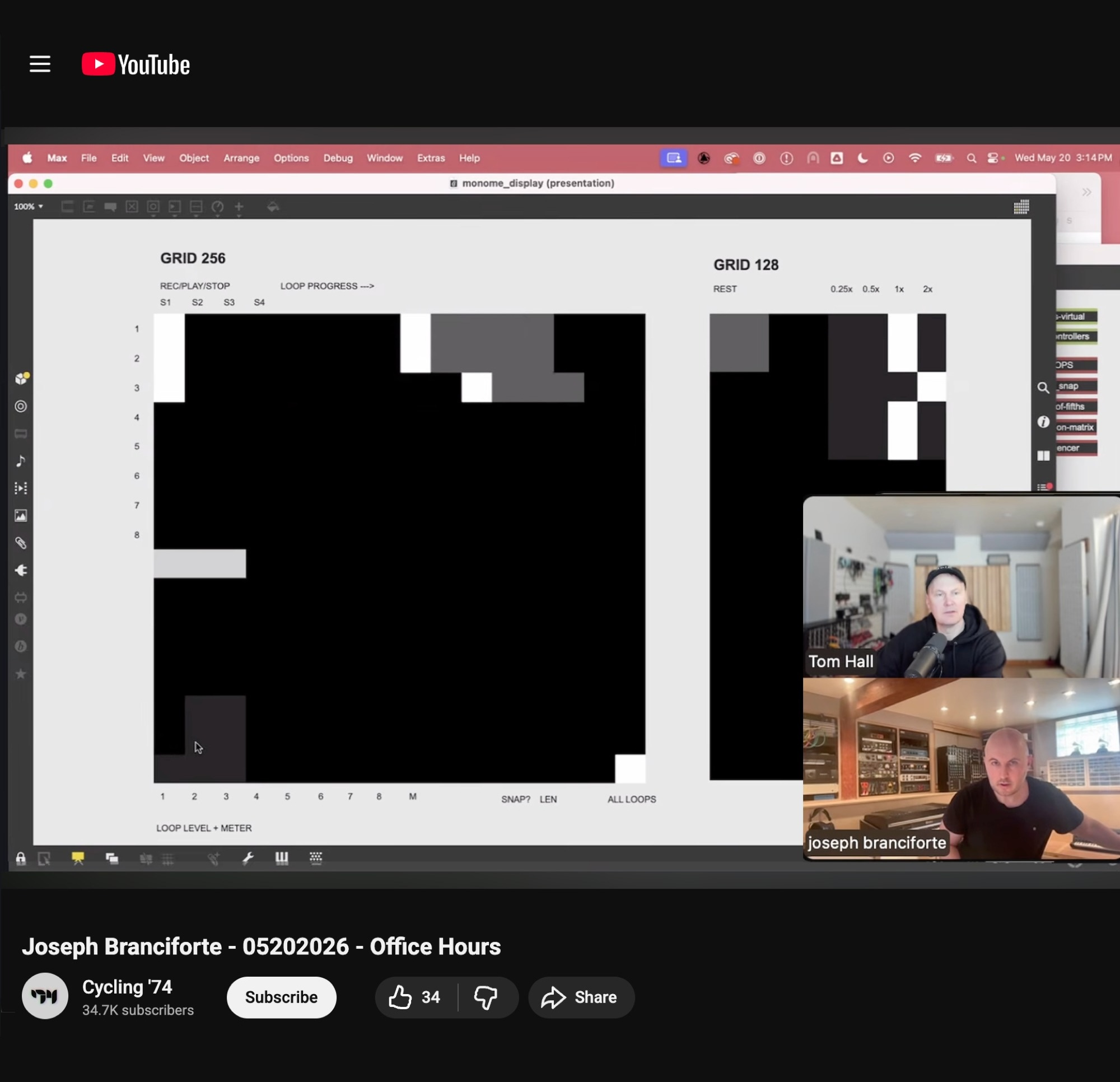
Last week I was a guest over at Cycling ‘74 Office Hours, a YouTube livestream hosted by C74’s Tom Hall. It was really lovely to chat with Tom, who is not only a Max/MSP super user, but also a great musician, thinker, and a super nice guy.
It was also an opportunity to reflect on my own history with Max/MSP: from my initial introduction to it back in 2004 in Chicago, to the important role it’s played in my own music, to some deeper questions about system design itself as a creative and philosophical category.
Around halfway through the chat, we stumbled on an area that I’ve been thinking about since. It has to do with two related areas: the concept of instrument design vs. instrument use and a subcategory of instrument design that might be called modular re-use—or what I called “cumulative design” when speaking with Tom.
Below is an excerpt from this section of our chat (from around 46:25 in the video), followed by a few additional reflections on what’s actually at stake when we choose to build rather than buy.
Joseph: You know, there are many musicians that use tools and don’t really understand anything about how they’re made. I’m of two minds about it. I think there’s a positive aspect, which is that you’re interacting mainly with the sound— and you’re not as precious about [the instrument design].
On the other hand, I think there’s something limiting about it. I guess it’s part of why I’m drawn to Max/MSP. I actually really enjoy being able to not only see what’s going on underneath the hood, but then tweak it and make it do something else. If you’re only using modular synth stuff where the modules are built by other people, there’s so much design philosophy and conceptual stuff that’s baked into that.
Often I’ll use a modular thing and I’m like, “Oh, this is great—how come I never thought to organize it this way?” But then I can go back to Max and build it in 15 minutes, because I understand the parts, you know.
Tom: Yeah, I’m right there with you. I’ve also spent many years asking myself “why do I have to do this?” Like it’s a chore, but I actually love it. But why am I not content just to use an off-the-shelf low-pass? Why do I have to program it in gen~? I just think there’s a certain type of person that is attracted to these elements.
I often think of this thing where I had a perfectly functional trail bike when I was a kid. And whilst I could have been enjoying it and riding it around the paddock, on a certain day I decided I needed to completely dismantle the carburetor and understand how it works. And then put it back together. And I somehow felt better about my trail bike because I did that.
Joseph: Well, it’s kind of empowering. You not only understand how it works, but you know how to make it now. In this consumerist society where everything is just like, oh, you want this? Here—just pay $400 and you can get this thing. Something I love about Max is that it’s not like that. It’s just like: how hard do you want to work to make it? There’s not a lot of limits. This comes up all the time with pedals or modular stuff where I’ll work with something and be like, “This is great.” But I don’t need to buy this, I can just—
Tom: Yeah, yeah. I mean, that is an empowering thing. Max has saved me a lot of money over the years. [laughter]
I come from an arts background first, before music, so if I feel like too many creative choices have been made on my behalf, and I’m not even entirely sure what they are, I don’t like it. When you get to a DAW, or a fixed hardware box, a lot of things have been locked in and cannot be changed. I live in two sides of this coin where maybe I’m even a little envious of folks who are able to just not see that, or not be concerned by that whatsoever.
Joseph: I mean there’s tons of amazing music where the person has no understanding of how to make the tool, right. Do you need to know how to build a hammer to build a house? Maybe not.
But the one thing that I do think is different is: when you get down to the core foundation of how things are made, you actually have the ability to change assumptions about what it should do. I think that’s a very different parameter space to be in. Because when you’re downstream of that—like with the looper example—it does one thing, you can rely on it, and you use it, and you make music that’s loop-based.
But where I want to be is on a more questioning, deeper, philosophical level. Like, why are we doing that? Why do we want to conceive of music in that way?
Most loopers have pitch shift that’s either free—where you can varispeed freely— or it moves by octaves—like half speed. But I actually want to be able to harmonically move the loops somewhere else. So my system uses pitch shifting around the circle of fifths. You can get moments where you introduce a little bit of harmonically-related crunch, but then you can start shifting them to this other harmonic dimension, and it moves and it modulates gradually. That’s an example where there’s no off-the-shelf looper that does anything like that. But if you build a basic looper in Max and you have that idea later, it’s just retrofitting.
What I’m getting at is—it’s empowering to build your own stuff, but I love the idea that things are cumulative. Deeply love that, because it’s not like a failed idea is a dead-end. It can be re-purposed for something else. Whereas, if you buy a pedal and you don’t like it, well, where are you? You just sell it—it’s not additive in any way.
Tom: You just touched on a big one for me—the cumulative knowledge aspect of Max. It’s like, yes, it’s a journey, but it’s not a journey where you’re constantly lost, right? You have this cumulative knowledge thing that builds and builds over time. And even better—if you were making those abstractions like we touched on earlier, you’re actually developing your own framework within Max to work with. And things evolve and progress.
Joseph: Exactly. And I’m not taking anything away from Eurorack—again, I have the stuff, I use it, but I treat it more like fun, like study and exploration. I’m going to make some cool sounds and mess around and explore, and maybe I’ll learn about a new synthesis method, or a new way of approaching interface design. “Oh look, this person designed their filter control this way.”
Even the idea of interface ranges: what is the user interface exposing? Is this control linear or exponential? If you never had a background in Max, would you even be aware that these are choices?
As I continue to meditate on the above, I come back to the title of a 2010 Douglas Rushkoff book: Program or Be Programmed.
As users of DAWs, synthesizers, modular synthesizers—even computers themselves—are we aware of the built-in assumptions that each design implementation brings? And is there any way to be aware of those assumptions—let alone question them or choose another path—without having some basic design experience oneself? This is precisely what Max unlocked for me all those years ago.
As intensely time-consuming as it is for me to continually insist on building everything from scratch—from simple list processing objects in Max, to live performance systems, to algorithmic composition tools, to my own studio, to physical release mediums, to the record label infrastructure I’ve been building for Greyfade—on some level I feel that it’s been worth it.
Of course, it’s significantly slower than using off-the-shelf tools. One could argue that deep engagement with a fixed tool yields its own fluency, and often it does—someone who has spent decades with the same Juno-60 knows things about that instrument no builder ever will. Committing to a tool’s limitations is its own valid path, and arguably the dominant one in the history of music.
Where it becomes problematic is when there is no commitment at all—when tools are simply consumed. The marketplace is organized around discrete acquisitions: a new pedal, a new plugin, a new module, each promising the sound you’re chasing. When they disappoint, the only recourse is another purchase. Building has a different shape entirely. Nothing is wasted, because every attempt deposits something—a sub-patch, a technique, an intuition about why a certain approach fails—into a structure that keeps growing.
There is something deeply satisfying about that kind of cumulative, critical knowledge: it allows one to understand design choices as choices, and to feel free to adopt or reject previous conventions. That is something that cannot be bought.
Joseph Branciforte
28 May 2026
SubscriptionsPatch Notes will always be free to read. If you’d like to support my work and access additional materials—including downloads of my full album catalog and patches featured in posts—there are a few ways to subscribe below.
FREE
Access to regular posts covering sound, design, technology, and process.
PAID ($5/month or $50/year)
Bandcamp download codes for my complete digital album catalog (past and future releases).
Downloadable Max/MSP and Pure Data patches featured in posts.
Access to subscriber-only posts, including interviews with artists, musicians, and composers.
Early access to pre-order Greyfade physical releases before they go on sale to the general public.
FOUNDING ($150/year or more)
Everything in the Paid Subscription tier.
A Bandcamp download code for each new Greyfade release (3-4 per year), with proceeds going to the artists.
Download of my custom Max/MSP utilities library—jb.utilities—along with help files. I’ve coded and updated these over the last 20 years and use extensively across all my Max/MSP work.
Directly supporting and sustaining the creation of new music, custom technology, and experimental design at the heart of my work.
No posts
Comments
Nothing yet. Say the first thing.
Sign in to join the conversation.