
For most musicians today, making an album available on the major streaming services is treated less like a decision than a fact of existence. Since founding Greyfade in 2019, I’ve been asked one question more than any other: why aren’t the label’s releases available to stream anywhere?
The answer was never meant as a provocation. I’ve always believed that an album is more than a collection of audio files. A release is a complete conceptual object: sound, album sequencing, visual design, text, physical form, the playback technology itself. Those things aren’t packaging around the music. They are essential parts of how the work is understood.
Mass streaming services ask artists to separate those elements from one another. Albums become data entries in an infinite catalog. Sequence becomes optional, context disappears, and visual stimuli compete continuously for attention. The experience is optimized for engagement with the platform rather than engagement with the music.
For years, my response was simply to opt out. Greyfade stayed off the mass streaming platforms because I didn’t believe it served the music, the artists, or the listeners particularly well.
But over time, something became increasingly obvious: streaming itself wasn’t actually the problem. The problem was that streaming had become synonymous with a handful of platforms whose priorities were never really artistic in the first place.
The underlying technology—the ability to instantly access a recording from anywhere—is actually extraordinary. It’s perhaps one of the defining musical achievements of the internet. I began to realize that what troubled me wasn’t the existence of streaming, but the assumptions built into nearly every implementation of it.
Why should an interface interrupt listening in order to encourage more listening? When engaging with sound, why does a listener need to see anything on the screen at all? Why should an album exist primarily as data for recommendation systems? Why should artists surrender control over audio quality, presentation, and context simply because music travels over the internet, instead of on a vinyl record?
Those aren’t technological necessities. They’re product decisions—and product decisions are design decisions.
Over the past 5 years, Greyfade has experimented with vinyl, CDs, books, downloads, bespoke physical editions, and combinations of all of the above. We have obsessed over sequencing, typography, paper, binding, packaging, manufacturing, and the many small details that shape a listener’s experience.
Streaming was the exception. It was the one medium we never seriously explored on our own terms—not because it wasn’t important, but because it never felt like something we were able to shape. You could upload the audio, artwork, and a small amount of metadata, but most of the meaningful decisions had already been made elsewhere.
The behavior of the interface, the quality of playback, the hierarchy of information, and the economic relationship with listeners—these all belonged to the platform.
The release might have been ours, but the listener experience of it was not.
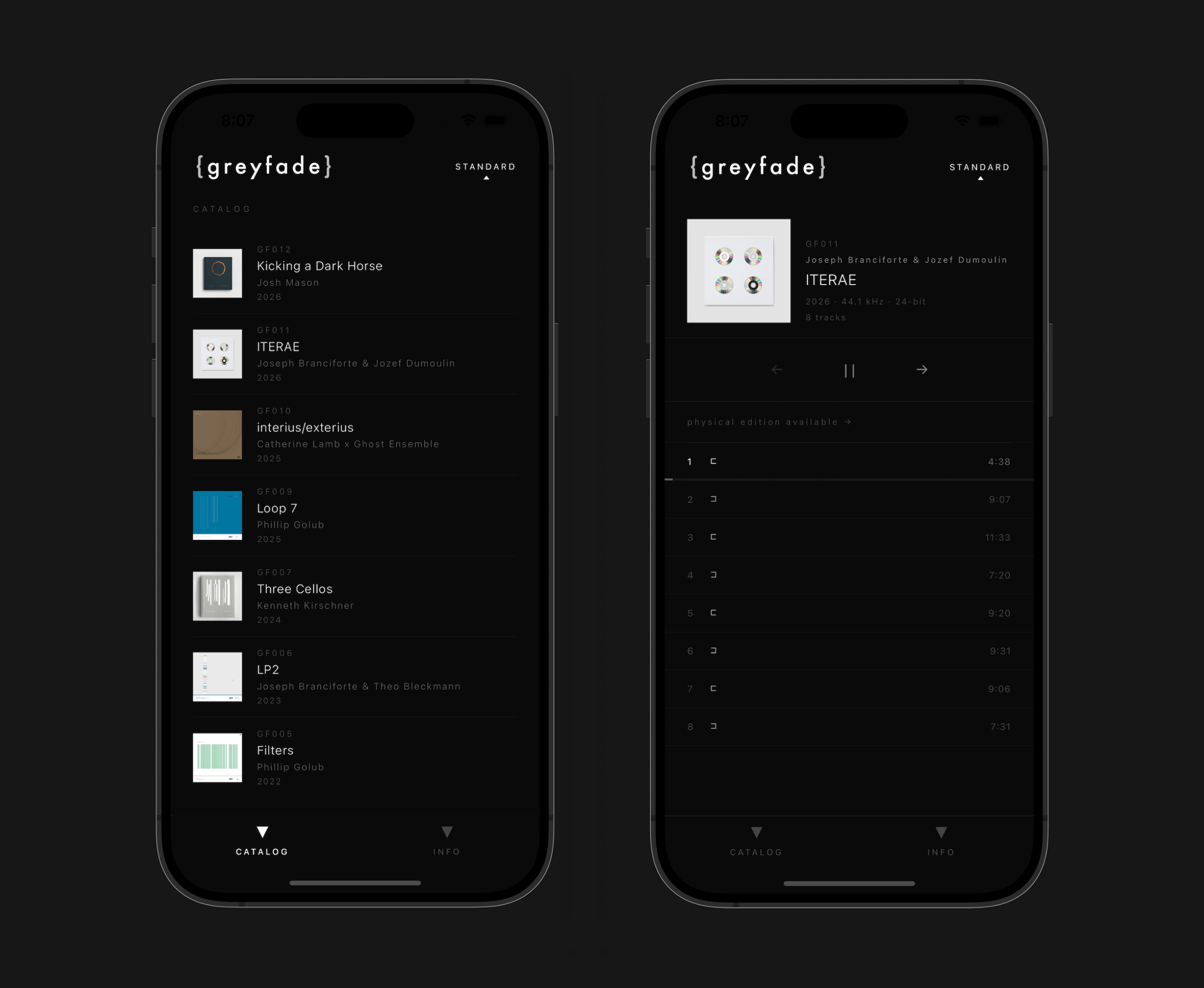
Over the last several months, I’ve been spending my nights—and early mornings—building something I’ve wanted to make for years: a direct-to-listener listening platform for Greyfade.
An early beta version will be opening on iOS and the web in the next few weeks.
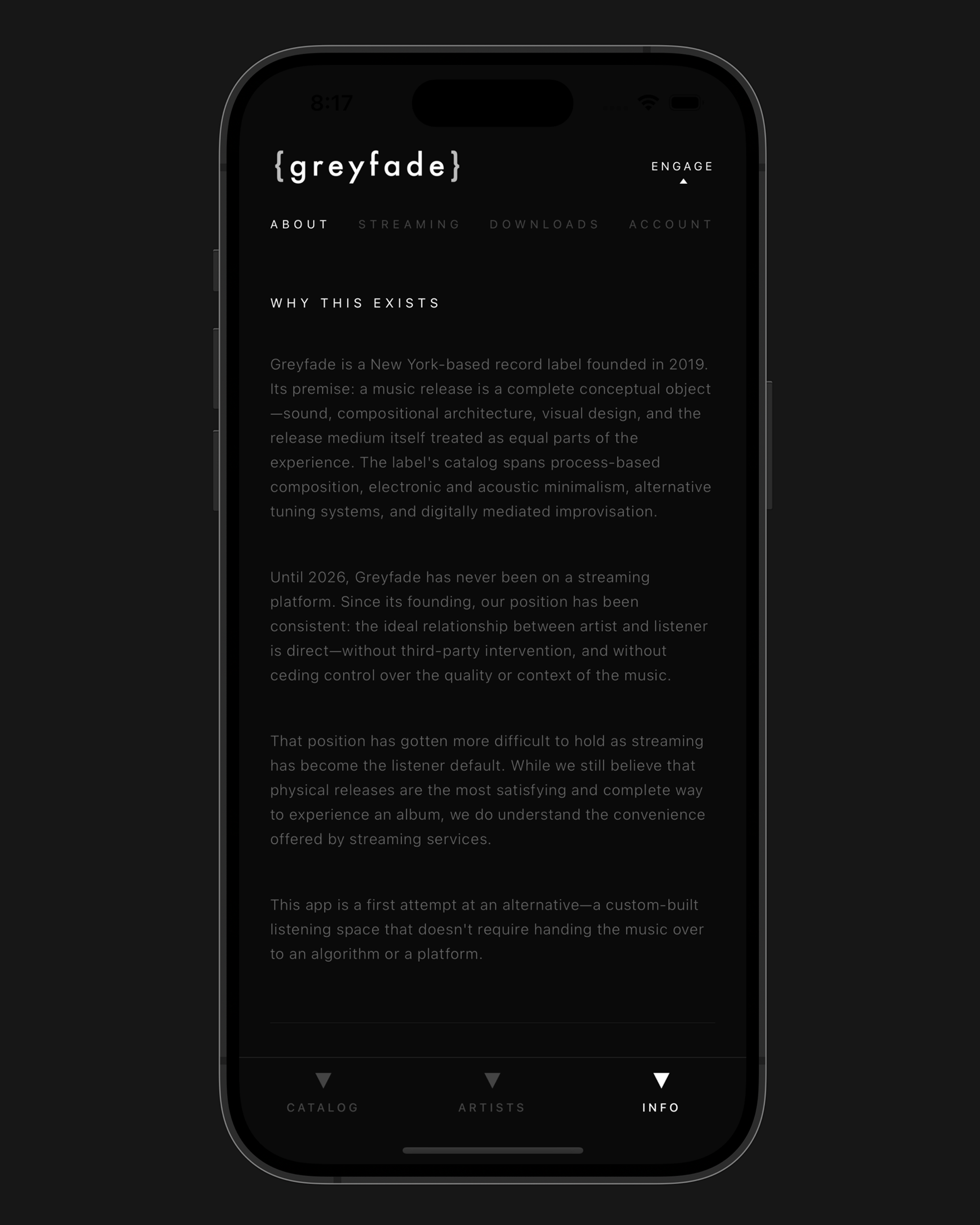
On one level, it’s intentionally modest. Every Greyfade release streams in full, uncompressed resolution at its native sample rate and bit depth, with gapless playback where the music requires it. Albums remain albums. There are no advertisements, recommendation algorithms, public statistics, play counts, playlists, or social feeds.
The platform is organized around three listening modes, each designed for a different intention. Standard mode is a relatively familiar way to browse the catalog and move between releases. Engage mode assumes that the listener wants to spend more time inside a particular album. This area can hold essays, interviews, photographs, scores, technical notes, and other artist-curated materials. Disconnect mode removes the interface almost entirely, leaving a single play control, no visual feedback, and nothing else competing for attention.
The point isn’t to enforce one supposedly correct method of listening. I listen differently at different times, and I imagine most people do. Sometimes music accompanies another activity. Sometimes it becomes an object of closer study. Sometimes the interface itself begins to feel intrusive, and I want it to disappear. Rather than collapsing those intentions into a single universal player, the different modes make the listener’s relationship to attention an explicit part of the design.
In other words, I’ve tried to make streaming feel a little less like social media and a little more like the way I listen myself at home.
One of the more revealing parts of this process has been recognizing how many conventions I had unconsciously absorbed from existing platforms. Again and again, I encountered a feature or behavior that initially seemed inevitable, only to realize that it was simply familiar.
Do I need to be able to skip forward or backward in a track? Should every album display how many times it has been played? Should listeners be encouraged to understand a record in relation to its measurable popularity? Should a listening history become a public identity? Should discovery be built around similarity? Should an interface begin displaying the next thing before the current thing has finished?
None of these questions necessarily has a single correct answer. But they reveal that software is never a neutral container. Every interface contains a theory of how people should behave, what they should notice, and what kind of information is valuable.
The dominant theory of streaming is built around abundance. There is always more music available, more content to move toward, another playlist to begin, another recommendation waiting. The listener’s attention becomes a scarce resource to be captured and retained, while the individual recording is placed inside a system whose primary scale is the entire history of recorded sound.
A small label begins from almost the opposite position. Greyfade’s catalog is limited, intentionally so. Each release is the result of a sustained relationship with an artist and a belief that the work deserves time, context, and repeat encounters. The purpose of the platform isn’t to persuade someone that there is always something else to hear. It is to create an environment where the particular thing already playing can be heard more fully.
That distinction has guided many of the app’s decisions. The most important design work has often involved removing things rather than adding them. A platform can technically do almost anything; the more difficult question is what it should decline to do.
There are also creative implications that extend beyond the presentation of conventional albums. Because the platform isn’t limited to playing a fixed set of audio files, it opens the door to forms of musical release that couldn’t really exist on mass streaming services.
I’ve been experimenting with non-linear and generative works whose structure is shaped by software inside the app. A piece might unfold differently with each listening, move between materials according to a set of probabilities, or exist as a collection of musical behaviors rather than a permanently fixed timeline. The “recording” becomes something closer to a living system, retaining its identity while producing a different realization each time it is encountered.
These experiments are still at an early stage, and I don’t yet know what forms will prove musically meaningful. Generative technology can easily become novelty: an impressive mechanism in search of an artistic reason to exist. But the possibilities are genuinely exciting, particularly for artists whose compositional work already involves indeterminacy, open form, algorithmic systems, site-specificity, or shifting relationships between fixed and performed material.
Recorded music has always been shaped by the possibilities and limitations of its medium. The duration of a vinyl side, the editability of magnetic tape, the capacity of a compact disc, and the non-linearity of digital files have each influenced the forms musicians create. A native listening application introduces another set of possibilities. It can present a fixed album beautifully, but it can also question what an album needs to be.
Some of the most interesting possibilities for digital music may emerge not from abandoning technology, but from finally treating it as an artistic material.
What has surprised me most during development is how quickly the project stopped being only about Greyfade. The larger question became: what happens when artists and independent labels own their listening environments instead of renting space inside someone else’s?
For years, artists have largely accepted the interfaces designed by technology companies as fixed realities. We debate royalty rates, recommendation systems, playlist placement, audio quality, and discoverability, but rarely question the deeper premise that the presentation and behavior of digital music must be determined by a small number of general-purpose platforms.
I’m no longer convinced that’s inevitable.
The tools available today make it increasingly possible for artists and independent organizations to build software themselves, or to work directly with people who can. This doesn’t mean every musician should become a programmer, any more than every musician needs to cut a lacquer. But it does mean that software design can enter the same collaborative field as studio production, photography, package design & fabrication.
Instead of continually adapting art to the requirements of existing platforms, perhaps new platforms can be built to adapt to particular kinds of art.
As I’ve built the listening app, I’ve also been developing the infrastructure beneath it: systems that connect a listener’s account, purchases, access to music, email communication, and relationship with the label. These functions are usually scattered across unrelated services, each holding a different fragment of the same relationship. A listener buys a record in one place, joins a mailing list in another, streams through a third, and communicates with the artist or label somewhere else entirely.
Bringing those pieces together creates the possibility of something more continuous. A purchase can become part of a listener’s permanent library. An artist or label can communicate directly with the people who have supported the work. Access, commerce, correspondence, and listening can all belong to the same environment without that relationship being owned or mediated by an outside marketplace.
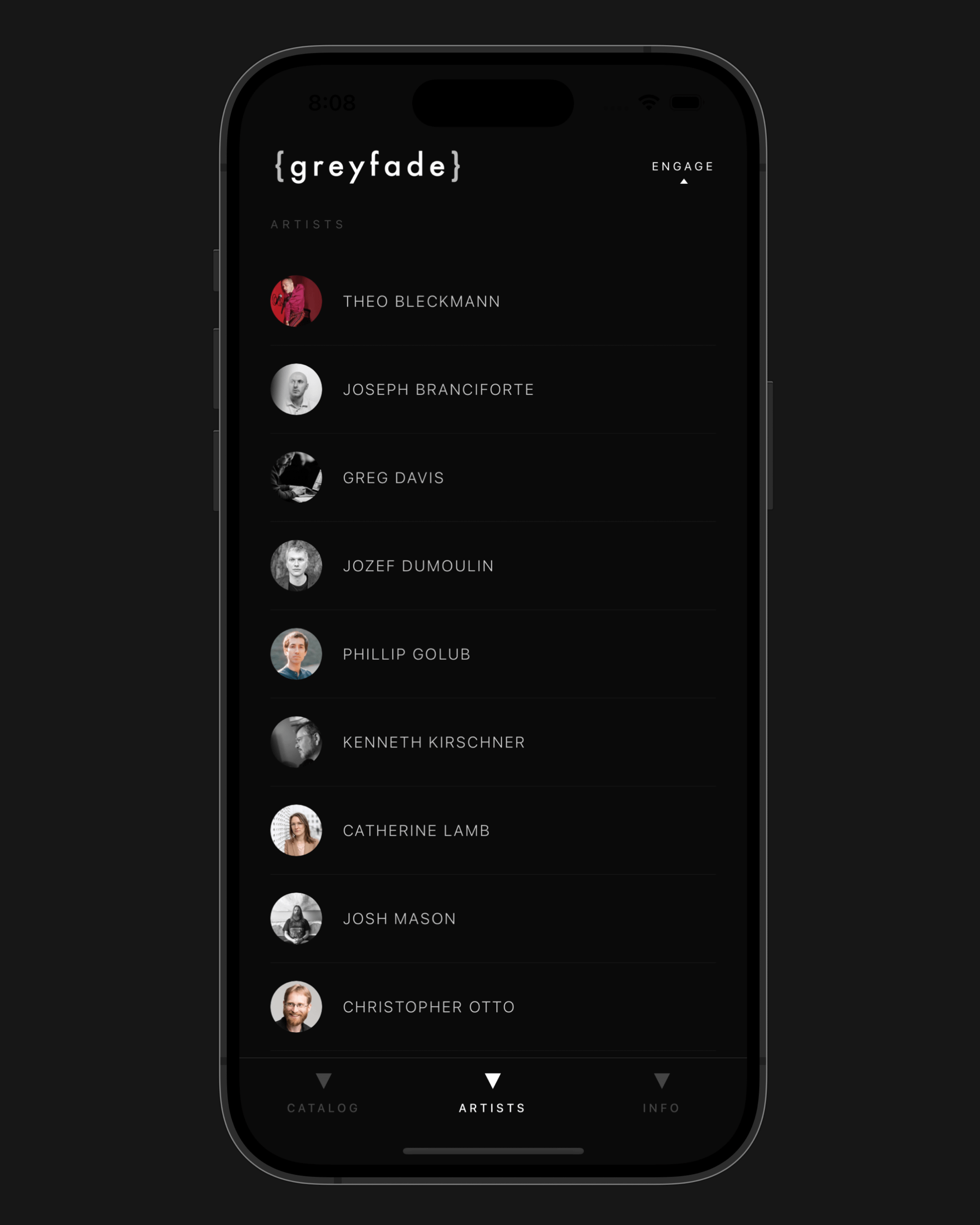
Greyfade is where these ideas are being tested, but I don’t know that it is necessarily where they end. I’ve been designing the underlying system with the possibility that another artist, label, publisher, or cultural organization could eventually connect it to its own catalog and listeners, while retaining control over its identity, presentation, data, economics, and relationship with its audience.
Whether it ultimately develops in that direction is still an open question. I’m wary of deciding too quickly what the project is before it has had a chance to be used, challenged, and shaped by real listeners. For the moment, I’m more interested in making something coherent for Greyfade and allowing the larger possibilities to reveal themselves through that process.
But the possibility matters. Independent artists have spent years talking about owning their recordings, publishing, mailing lists, and direct sales. Perhaps the digital listening environment itself belongs in that conversation.
For most of Greyfade’s existence, I found myself explaining why we weren’t participating in the existing streaming ecosystem. That conversation always felt unsatisfying.
At some point I realized I’d rather spend my time building an alternative than continuing to explain why the current one wasn’t working for us.
Whether this ultimately remains a Greyfade project or grows into something useful for other artists, labels, publishers, or cultural organizations, I honestly don’t know.
If you’d like to help shape where it might go—or if you’re thinking about similar questions in your own work—I would love to hear from you.
→ Join the beta at greyfade.com/app
Joseph Branciforte
6 August 2026
SubscriptionsPatch Notes will always be free to read. If you’d like to support my work and access additional materials—including downloads of my full album catalog and patches featured in posts—there are a few ways to subscribe below.
FREE
Access to regular posts covering sound, design, technology, and process.
PAID ($5/month or $50/year)
Bandcamp download codes for my complete digital album catalog (past and future releases).
Downloadable Max/MSP and Pure Data patches featured in posts.
Access to subscriber-only posts, including interviews with artists, musicians, and composers.
Early access to pre-order Greyfade physical releases before they go on sale to the general public.
FOUNDING ($150/year or more)
Everything in the Paid Subscription tier.
A Bandcamp download code for each new Greyfade release (3-4 per year), with proceeds going to the artists.
Download of my custom Max/MSP utilities library—jb.utilities—along with help files. I’ve coded and updated these over the last 20 years and use extensively across all my Max/MSP work.
Directly supporting and sustaining the creation of new music, custom technology, and experimental design at the heart of my work.
No posts
Comments
Nothing yet. Say the first thing.
Sign in to join the conversation.