
Part five of a short series for this year’s Norseman athletes. You will cross the line thinking the hard part is over. Your body has a different opinion. Here is what our research finds in the blood of a finisher, and why the hours after matter more than people think.
Every part of this series has carried the same quiet message. The danger is rarely where you expect it. The first minute of the swim, not the middle. The cold that catches you out on the bike, not in the fjord. The lungs. The heat down in the valley. And now the last one, the part I probably care about the most as Safety Director.
The finish line is not the finish.
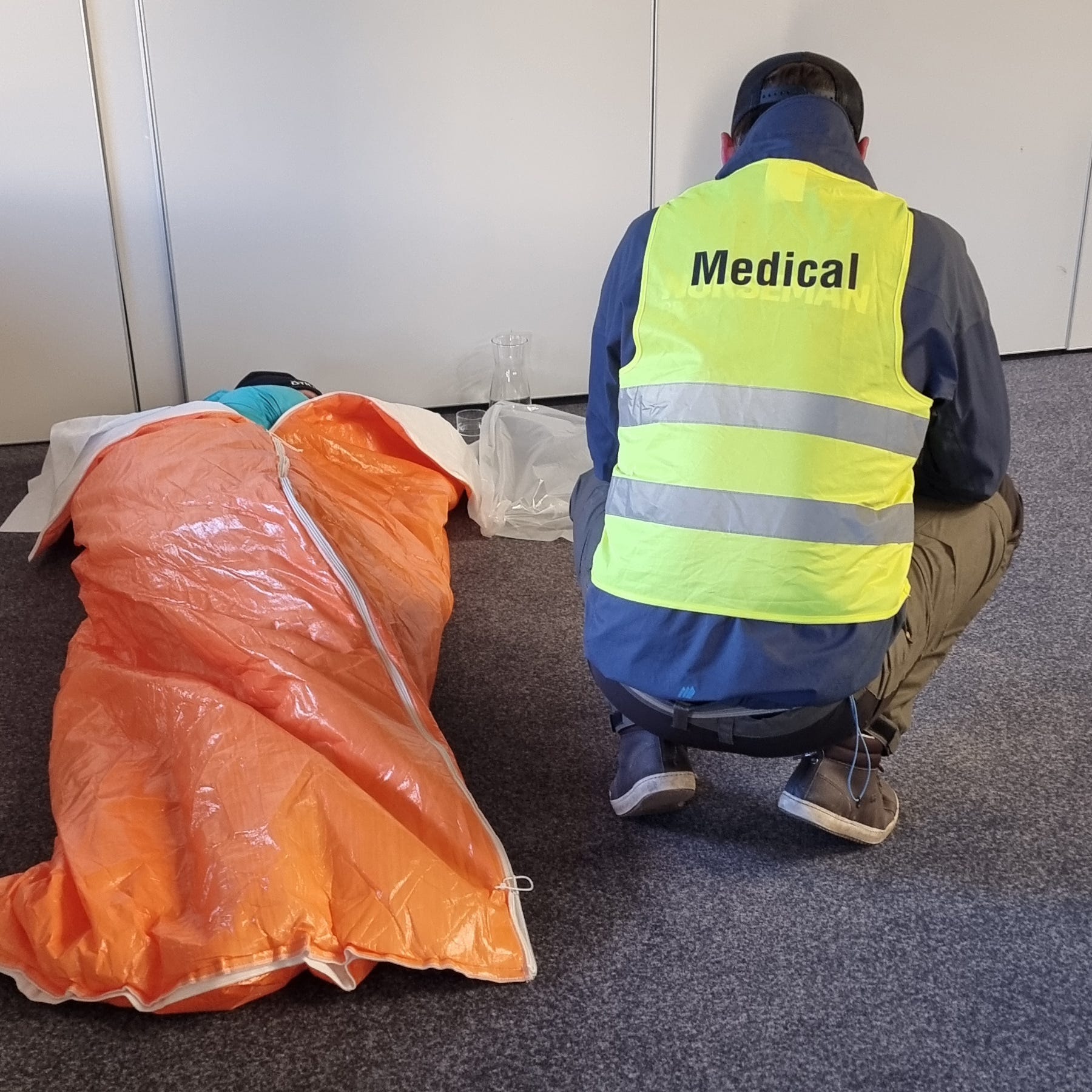
I have said this in every race brief for years. Many of our medical incidents happen after the athlete has crossed the line, not during the race. An athlete who looked strong all day can fold in the half hour after they stop. And when we take blood from our finishers, which we have done now for many years together with Maria Mathiassen, Christoffer Nyborg, Martin Bonnevie-Svendsen and the rest of our research group, the numbers tell you why. A body that has just finished Norseman is not a body at rest. It is a body in the middle of an enormous repair job.
Let me show you what we actually find.
The first thing you see is muscle breakdown. We measure an enzyme called creatine kinase, CK, that leaks out of muscle when the muscle is damaged. In an ordinary person a normal value is under about 200. In our Norseman finishers the median was around 2450, more than ten times the top of the normal range, and some athletes are far higher than that. That is the physical cost of 226 kilometres and 5200 metres of climbing, written straight into the blood.
This matters for a very practical reason. All that broken down muscle has to be cleared by the kidneys, and the kidneys need fluid to do it. It is one more reason we push you so hard on drinking after the race, and it is why very dark urine, the colour of cola, or not being able to pass water at all, is something you must tell our medical team about. That is not a thing to sleep on.
The next thing we see is inflammation. The white blood cell count jumps to levels we would normally connect with fighting an infection. The day after the race a second inflammation marker, CRP, climbs high as well. Nobody has an infection. The body is simply reacting to the damage of the race as if it were a wound, which in a way it is.
This is the part that gets peoples attention, and it should, but in the right way.
When somebody arrives in an emergency department with chest pain, one of the very first things measured is cardiac troponin. It is the marker of heart muscle damage, the blood test we use all over the world to diagnose a heart attack. In our most recent study, of 93 finishers, troponin rose sharply after the race. Troponin I went from a median of 3 up to around 69, more than twenty times higher, and it was still raised the next day. We also see NT-proBNP, a marker of a heart that has been working and stretching hard, climb steeply at the line.
We have also gone one step further and put an ultrasound probe on the heart itself, before the race, within a couple of hours of the finish, and then again five to ten days later. Right after the race the picture matched the blood. The hearts pumping function was clearly reduced. The squeeze we call strain, the ejection fraction, the amount of work the muscle was doing, all measurably down compared to the morning. The heart was holding its total output up mostly by beating faster, not by contracting harder, and it was doing that even though the blood pressure it had to pump against had actually dropped. In plain words, the heart muscle itself was genuinely tired, not just taking an easier ride. We sometimes call this cardiac fatigue. But here is the part I most want you to hold on to. When we scanned the same hearts again five to ten days later, every one of those measures was back to baseline. The fatigue was real, and it was temporary.
Now, read this the right way. It does not mean these athletes had heart attacks. Raised troponin after long endurance exercise is common, it is usually temporary, and in most people it settles over the following days, which is exactly what we saw. What its long term meaning is, we honestly do not fully know yet, and that is one of the things we are still studying. But here is the thing you need to understand. A perfectly healthy Norseman finisher can walk into a hospital with a troponin level that, out of context, looks like a heart attack. If the doctor treating them does not know what a race like this does to the body, that athlete can end up in a frightening and completely unnecessary cardiac workup. That is a big part of why we do this research in the first place.
There is one more finding, quieter than the others, but the one I find most interesting.
Your blood vessels keep themselves open and healthy using a molecule called nitric oxide, which the lining of the vessel makes from an amino acid called L-arginine. After Norseman we see L-arginine drop, and we see two related molecules, ADMA and SDMA, shift in the direction that makes nitric oxide harder to produce. In plain words, the machinery that keeps your arteries relaxed and open is running down for a while after the race. And when we followed these markers out further, some of them were still not back to normal a full week later. In other groups of people, these same shifts are known as risk markers for vascular disease. In healthy athletes after a race we believe they are transient, but they tell you something simple and true. Your body is still deep in recovery long after you have showered and pulled on dry clothes.
I am not telling you this to scare you off the start line. Norseman is safe enough, these changes are, as far as we can tell, the normal price of an extraordinary day, and they settle. I am telling you because it explains the single most useful piece of after race advice I have.
Take the hours after the finish seriously.
When you cross that line your muscles are broken down, your heart markers are sky high, you are inflamed, dehydrated and empty, and your blood pressure control is not what it was in the morning. This is exactly the moment when people make mistakes. So do not lie straight down and fall asleep. Keep moving gently, get warm, and above all eat and drink, properly and for real, before you rest. And if anything feels wrong, chest tightness, real breathlessness, confusion, that dark urine I mentioned, then you come and find us. We would much rather see you and send you away smiling.
This is where you come in, for the last time in this series. Most of what I have just described happens in your care, not ours. It happens out at the cabins and the hotels. You are the one who has to make sure your athlete eats, drinks, gets warm and does not simply collapse into bed. Which is exactly why, as I keep saying, you have to look after yourself across this whole long day as well, so that you still have something left to give in the quiet hours after the finish, when it matters the most.
So that is the whole arc of a Norseman day, from the first shock of the cold fjord to the strange, humming, half-broken state your body is in at the top. The line up on Gaustatoppen feels like the end of the story. For your physiology it is the start of a new one, that plays out over the next hours and days while you sleep and eat and slowly put yourself back together.
Respect that part too. And then enjoy every second of it, because there is nothing else quite like this race, and nothing quite like how it feels to have finished it.
That is the series. Thank you for reading along. Now come to Eidfjord, and let us do this properly.
See you there.
Jørgen
This blog post represents my personal views and does not necessarily reflect the opinions of my employer or any organizations. I have no affiliations with any companies relevant to this.
I’d love for you to join my Substack blog!
If you find this interesting and want to support my work, consider selecting the monthly paid option.
No posts
Comments
Nothing yet. Say the first thing.
Sign in to join the conversation.