
This month, the thermometer would not sit still.

On one side of it, cold water, because Norseman is now only four weeks away and my head is already in the fjord. On the other side, real heat, because Norway are on a World Cup run in the warmth of North America, and heat has suddenly become the most interesting problem in Norwegian sport. Two opposite ends of the same instrument, and the same human body caught in the middle. Let me take you through the month.
In four weeks I will be standing on the pier at Eidfjord again for the Norseman Xtreme Triathlon, watching the water and making the same call I have made for twenty years. Every year, race directors from many different races, ask me for our cutoff temperature. They want a number. A line on a thermometer that says safe above, dangerous below.
We do not have one. And that is deliberate.
A fixed number feels safe. But it can create false safety. 14.1°C is not automatically fine, and 13.9°C is not automatically a disaster. The swim decision is the sum of many things: air temperature, wind, current, expected time in the water, and above all whether you have a rescue and medical crew that can actually pull people out.
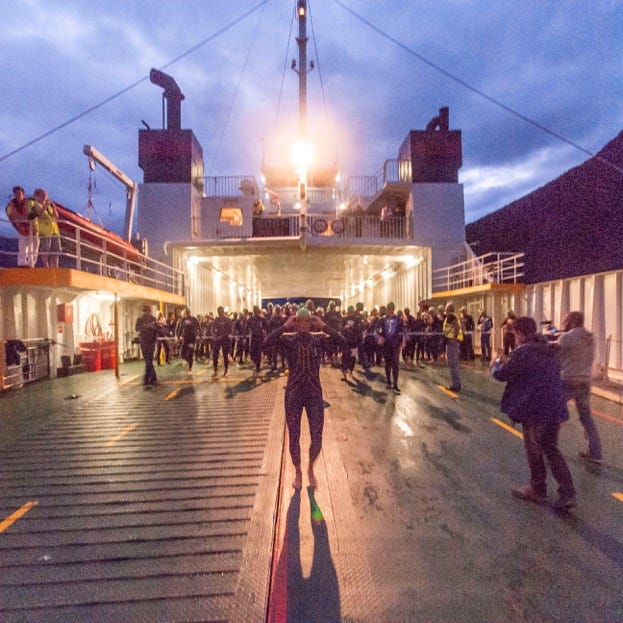
This one is personal. Back in 2015, days before the race, we measured 9.8°C in the fjord. The literature had no good answer for what that water would do to a wetsuited swimmer, so Jonny Hisdal and I swallowed ingestible temperature sensors and swam it ourselves before making the call. We shortened the swim that year. The data later proved it was the right decision, and that swim became the start of my PhD. So when someone asks for our number, I tell them the truth. Do not copy the number. Copy the system behind it.
The tool I have been most excited about this month sits a little deeper in the body. Muscle oxygen.
For years we have used heart rate to judge how hard someone is working. Heart rate is useful, but it is a whole-body average. It tells you how hard the heart is beating, not what is actually happening inside a working muscle. Two athletes with the same heart rate can have very different things going on in the tissue.
Muscle oxygen sensors change that. They use near-infrared light, a technique called NIRS, shone gently through the skin and into the muscle just below. Oxygenated and deoxygenated blood absorb that light differently, so the sensor can read, second by second, how much oxygen is arriving in the muscle and how much is being used. The number it produces, muscle oxygen saturation or SmO2, is a live window into the balance between supply and demand right where the work is being done.
Why does that help? Because it shows the moment a muscle starts to run out of headroom, often before the athlete feels it and before heart rate reflects it. You can see when a muscle tips from comfortable into trouble, how quickly it recovers between efforts, and how blood flow shifts under stress. For pacing, for interval design, and for understanding fatigue, it sits much closer to the real event than heart rate alone.
I am building two studies around it. One puts the sensor on the latissimus dorsi of open-water swimmers, to watch how blood flow to the working muscle tracks with how fast the body is cooling. The other moves onto the Brazilian Jiu-Jitsu mats, where I train, to see what really happens to a body in close combat. Grappling is a strange and beautiful laboratory. The heart says one thing, and the muscle very often says another.
I did not have to travel far this month to find both ends of the thermometer in a single day. I found them in one race.
Every year, the team that puts on the Norseman Xtreme Triathlon races the whole course themselves first, a dress rehearsal we call the Crew Race. It is the full Norseman: a 3.8 km swim in the cold Hardangerfjord after jumping off the ferry at Eidfjord, 180 km on the bike climbing up onto the Hardangervidda plateau past Dyranut, and a 42 km marathon grinding up toward Gaustatoppen. You start in near-freezing water and, several hours later, you are running in the heat. From very cold water to a very hot run, in one continuous effort.
That range is exactly why it makes such a good natural laboratory, the kind you cannot build indoors. So this year we put muscle oxygen sensors on the crew and lined them up, on a single clock, with heart rate, pace, altitude and temperature.
Then came the real work. Collecting the data is easy. Cleaning it is the job. Hours went into aligning clocks, hunting artifacts, and deciding what to trust before any of it meant anything.
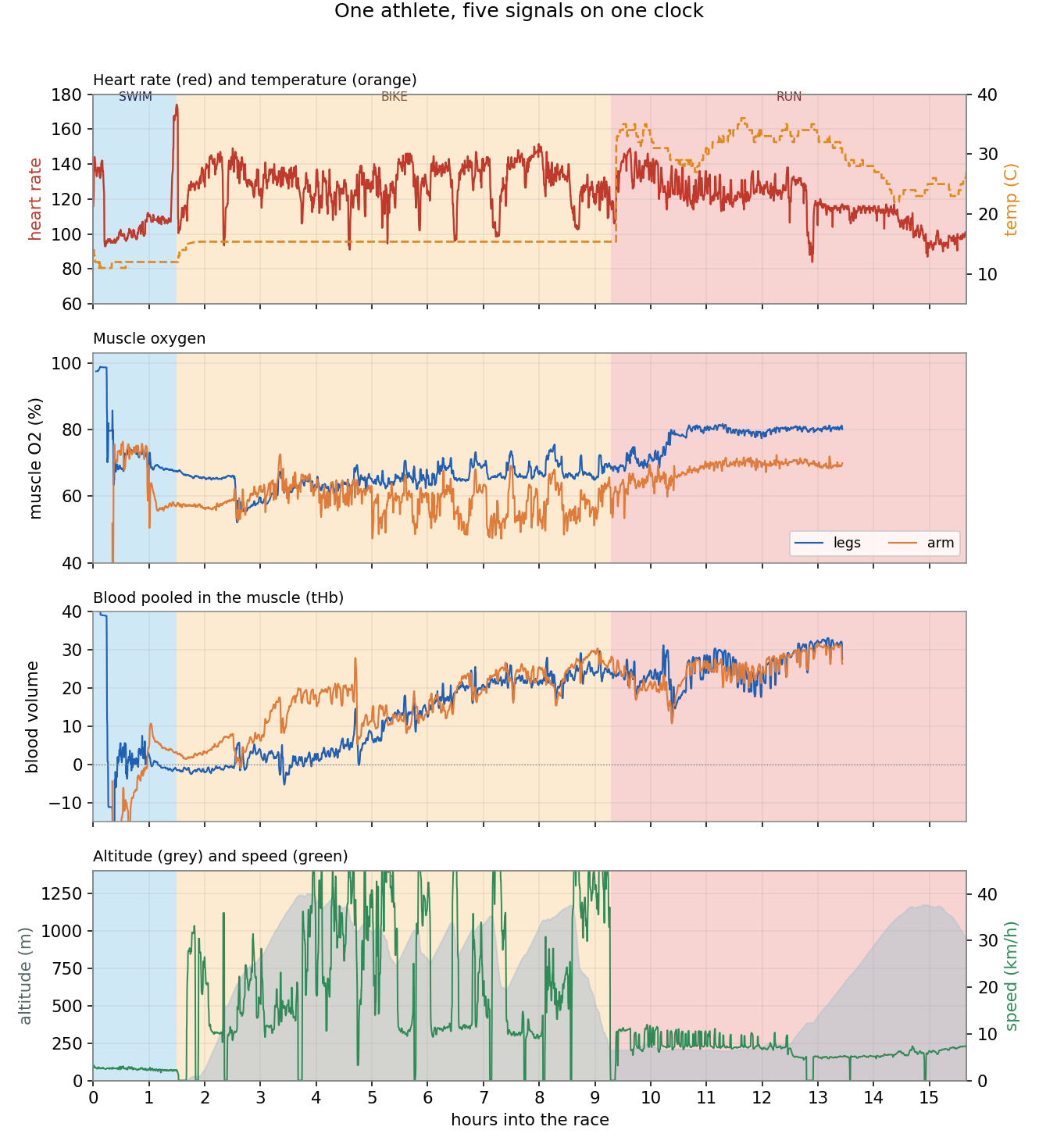
The reward was a picture you rarely get to see. The detail I keep returning to appeared in the heat of the marathon. The total blood volume in the working muscle, what the sensor reads as tHb, climbed as the athlete warmed up. Read simply, the body was pushing more blood toward the surface to shed heat, turning the muscle partly into a radiator. Cold water at the start, a body dumping heat at the end, and one sensor quietly catching the whole swing.
Now the hot end of the thermometer.
Norway are back at the World Cup after 28 years, and as I write this they have just beaten Ivory Coast to reach the Round of 16, with Brazil next. Wonderful for Norwegian football. But the tournament is being played through a North American summer, and heat, not the opposition, may turn out to be the hardest thing to beat. More than a third of the matches are at high risk of dangerous heat, and some could be played at a wet-bulb globe temperature above 28°C, the level at which players’ unions argue a match should be postponed. Norwegians are not built, and not usually trained, for that.
So if the national team asked me, a temperature physiologist, what to do, here is what I would tell them.
First, and most important, acclimatize. Heat acclimation is the single most powerful thing you can do, and it cannot be faked in a day. Ten to fourteen days of training in the heat teaches the body to expand its blood volume, to sweat earlier and more efficiently, and to hold a lower core temperature and heart rate at the same workload. If the players are already living and training in the heat between matches, they are banking exactly this adaptation. Protect it.
Second, cool down before you play. Lowering core temperature before kickoff buys thermal headroom for the ninety minutes to come. Ice slurry to drink, cooling vests, and cold towels in the final half hour before the whistle all work, and they are cheap.
Third, use every break to cool again. FIFA now mandates cooling breaks when it is hot. Treat them as tactical, not as a rest. Iced towels on the neck and face, more ice slurry, shade, and a cooling vest at half time. Do not waste them.
Fourth, make hydration individual. Every player sweats at a different rate, so weigh them before and after training, learn each man’s losses, and replace fluid and salt to match. Not too little, which invites heat illness, and not too much, which carries its own risk.
And finally, measure. This is the part I cannot resist. The same ingestible temperature sensors we swallow before a cold fjord swim work just as well in the heat. Let a few players train with them, learn how their core temperature actually behaves under match load, and then individualize everything above from real data rather than a rule of thumb. In the cold or in the heat, the principle is identical. Do not guess. Measure.
And the next cold-water project is already on the horizon. A crossing of the Skagerrak, from Denmark to Norway, is coming up. Open water, a long way over, and about as far from a warm football stadium as you can get. More on that when it is closer.
So that was the month. A near-freezing fjord four weeks out, a Crew Race that ran from cold water to a hot marathon, a football team sweating through a World Cup, and a stretch of cold sea still waiting on the other side. Both ends of the thermometer, one body, one question. How does a human hold its temperature where it needs to be, and how do we measure that in a way we can believe?
More soon, once the data has earned it.
Stay warm. Or cool. Whichever the day demands.
A good deal of this issue lives in cold water, so if any of it caught your interest, I have written some short, science-based books you might enjoy.
Cold Water Swimming: A Mini Book is a friendly, short guide to enjoying cold water safely, confidently, and with a big smile. It draws on years at the Norseman Xtreme Triathlon, research with elite military swimmers, and my published work in cold-water physiology. Calm, clear, trustworthy guidance for anyone curious about stepping in.
Get Cold Water Swimming on Gumroad →
This newsletter represents my personal views and does not necessarily reflect the opinions of my employer or any organizations. I have no affiliations with any companies relevant to this.
I’d love for you to join my Substack blog! You can enjoy all my newsletters for free, and I promise to keep it that way.
If you find this interesting and want to support my work, consider selecting the paid option.
Thanks for reading. If something here resonated, hit me with a reply.
No posts
Comments
Nothing yet. Say the first thing.
Sign in to join the conversation.