
Every July, my inbox fills up.
The messages come from all over the world, and underneath the different words they ask the same thing. The water. What about the water. How do I prepare for jumping four meters off a ferry in the dark into a Norwegian fjord and swimming 3.8 km through it. I have been the Safety Director at the Norseman Xtreme Triathlon since 2005, and I did my PhD on exactly this, on what cold water does to the core temperature of triathletes swimming it. So let me answer the question properly, for everyone racing this year, in one place.
First, the reassuring part. In more than twenty years and thousands of swimmers, the fjord is not where we lose people. The water is survivable, the swim is survivable, and if you respect it and prepare for it, you will most likely have one of the best swims of your life. But respect is the operative word. The cold is not something to out-tough. It is something to understand.
There are two separate problems in cold water, and people mix them up all the time.
The first problem hits in the first minute. It is the cold shock response, and it has nothing to do with getting cold. It is your skin, not your core, reacting to the sudden drop in temperature. You gasp, and that first gasp can pull in two to three liters of air in a single second. Your breathing rate jumps. Your heart rate spikes. And underneath it, cold on the face can trigger a second, opposite reflex that tells the heart to slow down at the very moment the shock is telling it to speed up. In a few unlucky people, including people with perfectly healthy hearts, that collision is what actually kills in cold water, not hypothermia. If your face is in the water during that first gasp, you can also inhale it. This is the genuinely dangerous window of the whole swim, and it is over in about a minute. Almost nobody gets hypothermic in the first minute. But the first minute is where the trouble is, which is why the entire Norseman start is built around it. I will come back to that.
The second problem is the slow one, the one my PhD was actually about. Your core temperature falls, but it falls slowly, and in a good wetsuit it falls a lot more slowly than people fear. Our data on Norseman athletes showed that a wetsuited swimmer in roughly 10°C water does not plunge into hypothermia over the swim distance. The body defends its core well. The cold you feel on your skin is real, but it is not the same as your core actually dropping. Knowing that difference is half of staying calm out there.
So the two things to prepare are almost opposite. Blunt the cold shock so the first minute does not own you. And insulate the core so the long swim stays comfortable.
Adapt to the cold. It is the one intervention that changes everything, and it cannot be bought or faked in the last week.
The cold shock response is trainable, and it trains fast. A handful of cold water immersions, even short ones, measurably blunts the gasp and the heart rate spike. The research here is clear and it is one of the most reliable effects in all of cold physiology. Somewhere between five and ten cold exposures and the response is roughly halved. That is the difference between a controlled first minute and a panicked one.
You do not need a fjord to do this. A cold shower, a cold bath, the sea, a lake, whatever cold water you can get into safely and repeatedly in the weeks before you travel. Get your face wet, because the face is where a lot of the shock is triggered. Practise slowing your breathing while the cold is telling you to gasp. Never do this alone, and never do it anywhere you cannot easily get out. But do it. If you take one thing from this whole piece, it is this paragraph.
You know this rule because I say it every year. Do not try anything new on race day.
That applies to the swim as much as the nutrition. Your wetsuit, your neoprene cap, whether you wear a second cap, gloves, socks, a swim skin underneath, all of it should be tested in cold water before you get to Eidfjord. Not tested in a warm pool. Tested in cold, open water, ideally more than once. A wetsuit that felt fine in September at home can feel different in a cold fjord at dawn with adrenaline running. Find that out at home, not at the start.
A well fitting wetsuit is the biggest single piece of insulation you have, so it has to fit. Too loose and it flushes cold water through on every stroke, which defeats the point. Too tight around the chest and neck and you add to a breathing problem I will come to in a moment. Neoprene caps and gloves are allowed within the race rules and they help, particularly for the hands and head, which is where a lot of people feel the cold most. But test them, because they change your feel for the water.
Start with the obvious thing people still get wrong. Get warm before you get cold. The ferry leaves the pier at Eidfjord in the dark, around four in the morning, and the car deck is cold. A raised core temperature going in buys you margin, so stay dressed until late, move, keep the blood warm, and do not spend an hour shivering in a wetsuit before we have even left the pier.
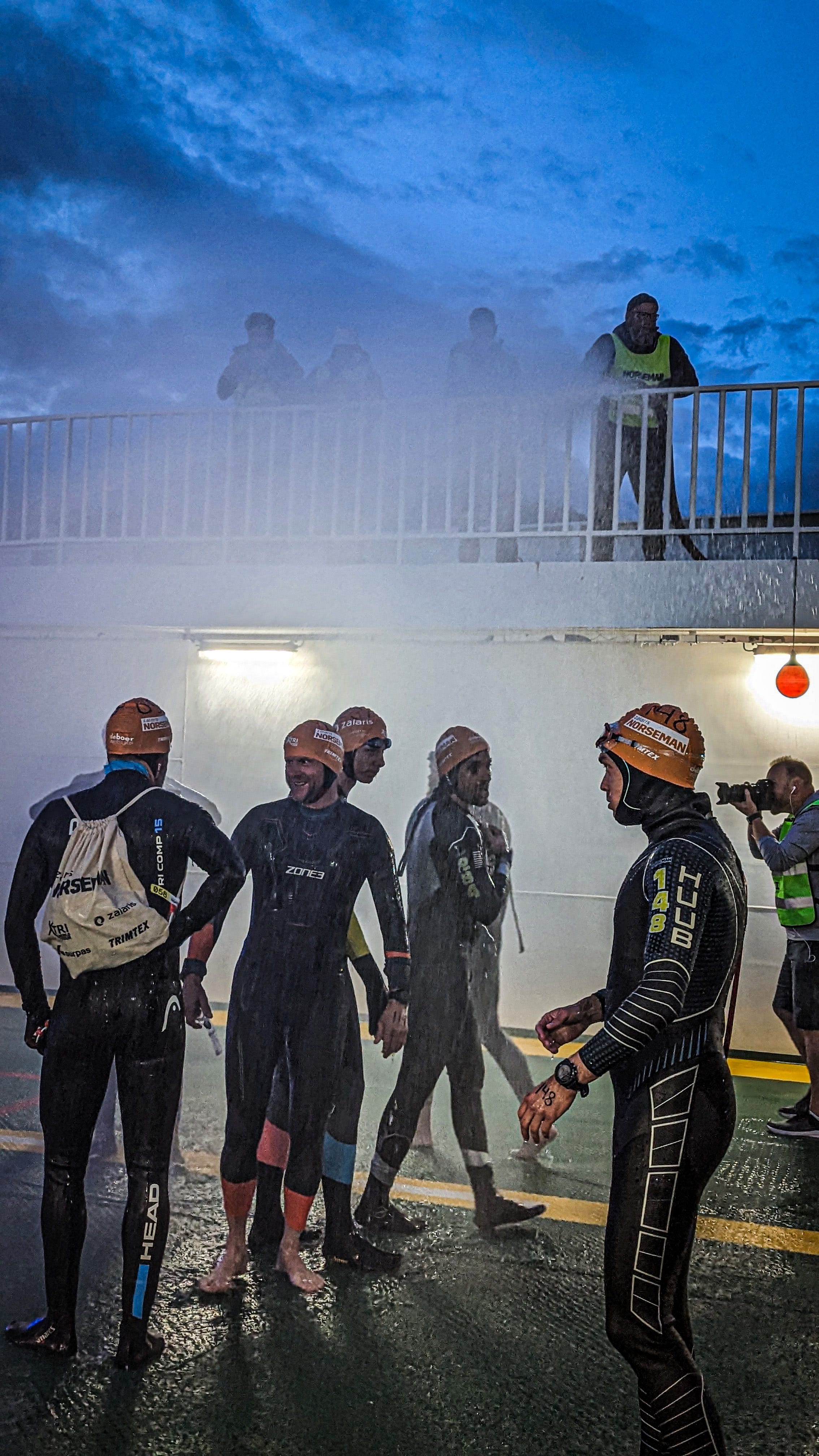
Now the part that matters most. The Norseman start is, on paper, close to the worst possible cold water entry I could design. Dark, cold, a four meter jump, 250 people going at once, adrenaline at the ceiling. That is exactly why we spray you with cold water on the deck before you jump. It is not theatre and it is not a wake up ritual. It is the most useful minute of safety we can give you. Standing on deck, the cold hits your face and neck, the gasp comes, your breathing quickens, and then within twenty or thirty seconds it settles. We have just fired your cold shock response once, in a safe place, while you are still standing on a boat. The next hit, when you actually go into the fjord a minute later, is much smaller. So when we spray you, lean into it. Get your face and neck properly wet. Let that first shock happen on deck, not in the water.
On any other cold water, my advice is always the same: do not jump, walk in, and splash your face first. At Norseman you cannot walk in, so the deck spray is your walk in. And when you do jump, the one thing I really need you to avoid is going in face first while holding your breath. Cold on the face plus a breath hold plus the shock of entry is the worst combination I know of for the heart. Go in feet first, let yourself surface, and expect the gasp. It is coming and it is normal. Get your breathing back under control before you ask anything of yourself, and only then start to build into the swim. Those first calm strokes cost you almost nothing on a swim of an hour or more, and they are the cheapest safety insurance in the sport.
If you want the full physiology of why that first minute is the dangerous one, and why a gasp reflex and a diving reflex arriving together can stop a healthy heart, I wrote it up separately in The First Sixty Seconds.
There is a condition we study closely at Norseman called swimming induced pulmonary edema, SIPE. It is fluid building up in the lungs during a swim, and cold water, hard effort, and an overly tight wetsuit all raise the risk. It is not rare in races like this and it is one of the things my medical team watches for most carefully.
You do not need to fear it, but you do need to recognize it. If you find yourself unexpectedly short of breath in the water, coughing, wheezing, or bringing up frothy or pink tinged sputum, that is not you being unfit and it is not something to swim through. Roll onto your back, signal, and get to a kayak or boat. Raise your arm. Our people are there for exactly this, all along the swim, and there is no medal worth ignoring those symptoms for. Loosening the wetsuit around the neck and chest and not swimming beyond your control both reduce the risk in the first place.
The swim is not over when you exit the water. Your core temperature can keep falling for a while after you get out, as cold blood from the limbs returns to the middle. We call it afterdrop, and it is why T1 at Norseman can feel colder than the swim did. Plan your transition for a cold, clumsy body. Warm clothes for the first part of the bike, a plan your support crew has rehearsed, fingers that will not work zips the way they usually do. Get moving, generate heat, and let the bike warm you back up.
None of this is meant to frighten you. The opposite. The fjord at dawn is one of the most beautiful things you will ever swim through, and the vast majority of you will love it. Prepare for the cold honestly, respect the first minute, get in cold water before you come, and you will be ready.
See you on the pier.
Jørgen
This blog post represents my personal views and does not necessarily reflect the opinions of my employer or any organizations. I have no affiliations with any companies relevant to this.
I’d love for you to join my Substack blog!
If you find this interesting and want to support my work, consider selecting the monthly paid option.
A good deal of this issue lives in cold water, so if any of it caught your interest, I have written some short, science-based books you might enjoy.
Cold Water Swimming: A Mini Book is a friendly, short guide to enjoying cold water safely, confidently, and with a big smile. It draws on years at the Norseman Xtreme Triathlon, research with elite military swimmers, and my published work in cold-water physiology. Calm, clear, trustworthy guidance for anyone curious about stepping in.
No posts
Comments
Nothing yet. Say the first thing.
Sign in to join the conversation.