
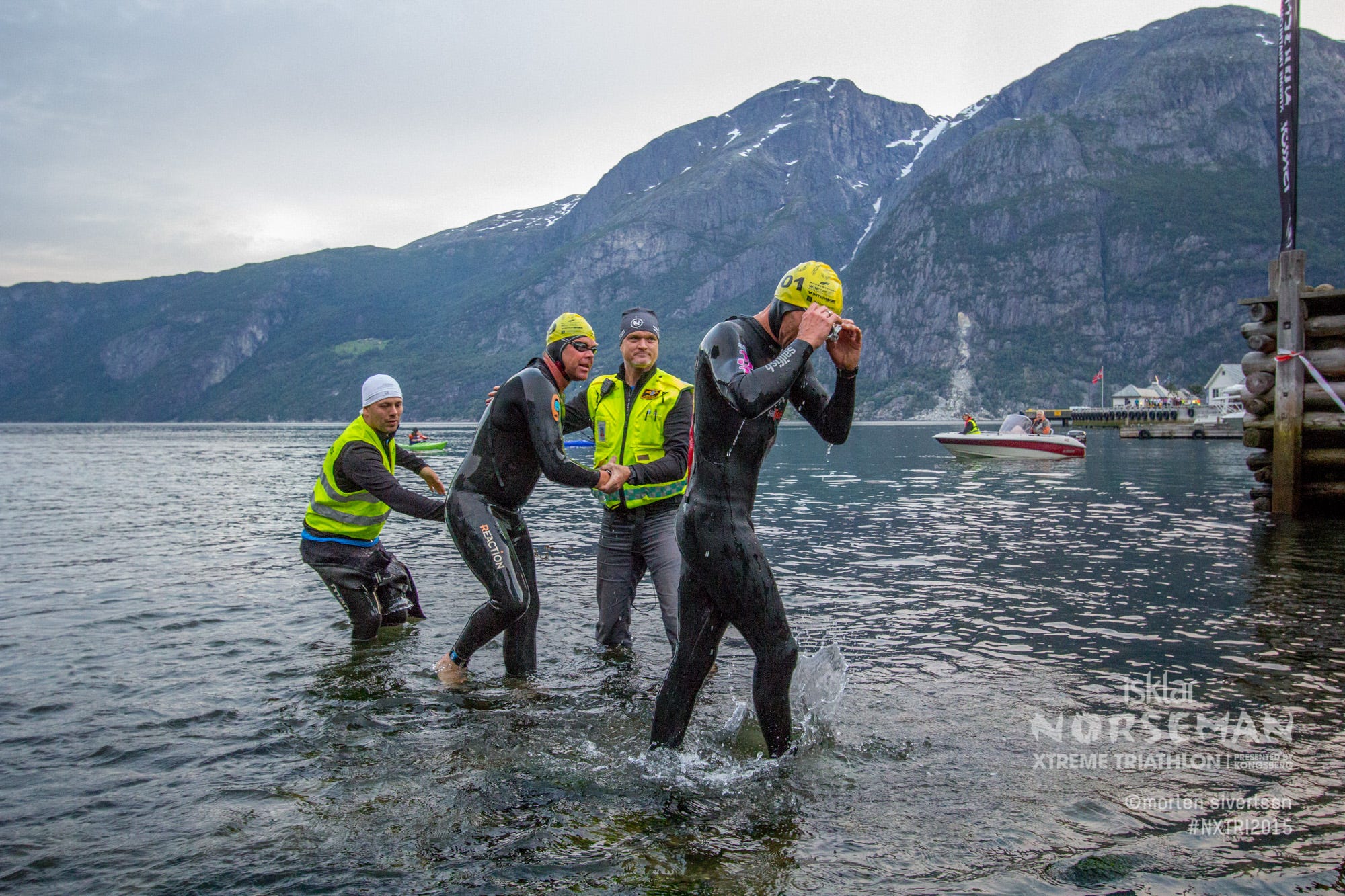
Photo by Morten Sivertsen
When you come out of the fjord at Norseman, the first two people you meet are me and our race director, Fredrik.
You will not climb a ladder or haul yourself onto a pier. The swim finishes on a small beach, and you wade the last few strokes and steps out of the water and up onto the sand, toward T1 and your waiting support crew. Right there at the waterline, Fredrik and I are standing. We greet every single athlete as they come out. To you it probably looks like a welcome, two familiar faces and a few words after a hard swim, and it is that.
To understand why we care so much about that exact moment, you have to know something that surprises most people. The swim does not stop being dangerous when you reach the beach. For many athletes, the coldest their body will get all day is not in the water at all. It comes later, out on the bike, around twenty minutes after they left the fjord.
That effect has a name. Afterdrop.
Afterdrop is the continued fall of core temperature after you leave the cold. It sounds like it should be impossible. You are out of the water, usually into warmer air, so surely you can only warm up from here. But two things keep pulling heat out of your core after you exit.
The first is simple physics. During the swim your body protects its core by clamping down the blood flow to your skin and limbs, building a cold outer shell around a warm middle. That shell does not vanish when you get out. Heat keeps flowing, by plain conduction, from the warm core outward into the cold muscle and fat and skin, and it goes on doing that until the gradient evens out. The core pays to warm the shell.
The second is circulation, and this is the one that matters most in a triathlon. In the water you are working, and moving muscles keep some blood flowing through the cold limbs. The moment you stop swimming, wade out, and stand still while your support crew works on you, those vessels begin to open again. Cold, stagnant blood that was sitting in your arms and legs washes back toward the middle of you. That returning blood is colder than your core, and when it arrives, core temperature drops further. Stopping is part of the mechanism. The athlete who exits and stands still cools more than the one who keeps the engine running.
This is not theory to me. It is something we have measured at Norseman.
In our studies, using ingestible temperature sensors that log core temperature continuously from inside the gut, we have followed athletes right through the swim and out the other side. We have done this on more than 100 athletes during the years. The sensors show it plainly. Core temperature kept falling after the athletes had already left the water, and on average it reached its lowest point about twenty minutes after they came out.
Think about where you are twenty minutes after the swim at Norseman. You are not on the beach, and you are not standing in T1. You are already well out on the bike, climbing away from Eidfjord, feeling good and picking up speed, while somewhere underneath all of that your core temperature is quietly bottoming out. The swim was over. The cooling was not.
That finding changed how I think about the swim exit. The beach is not the finish line of the cold. It is the start of the part nobody watches.
So now you understand what Fredrik and I are really doing standing on that sand.
As you come up out of the water and past us, we are watching every single one of you. Not casually. In those few seconds we are reading a lot. Who is moving well and who is not. Who is clear-eyed and who looks confused. Who is shivering hard, who is coughing or fighting for breath in a way that worries me, who simply looks too cold. It is the earliest point at which we can catch an athlete heading for trouble, whether that is a body still cooling toward afterdrop or a set of lungs that did not like the swim.
Most of you we send on with a smile, and that is the whole point. A quick, trained look at the waterline lets us find the few who need us before afterdrop and fatigue make things worse further up the road. It is a welcome and it is a checkpoint at the same time, and after twenty years I would not give up those few seconds with each of you for anything.
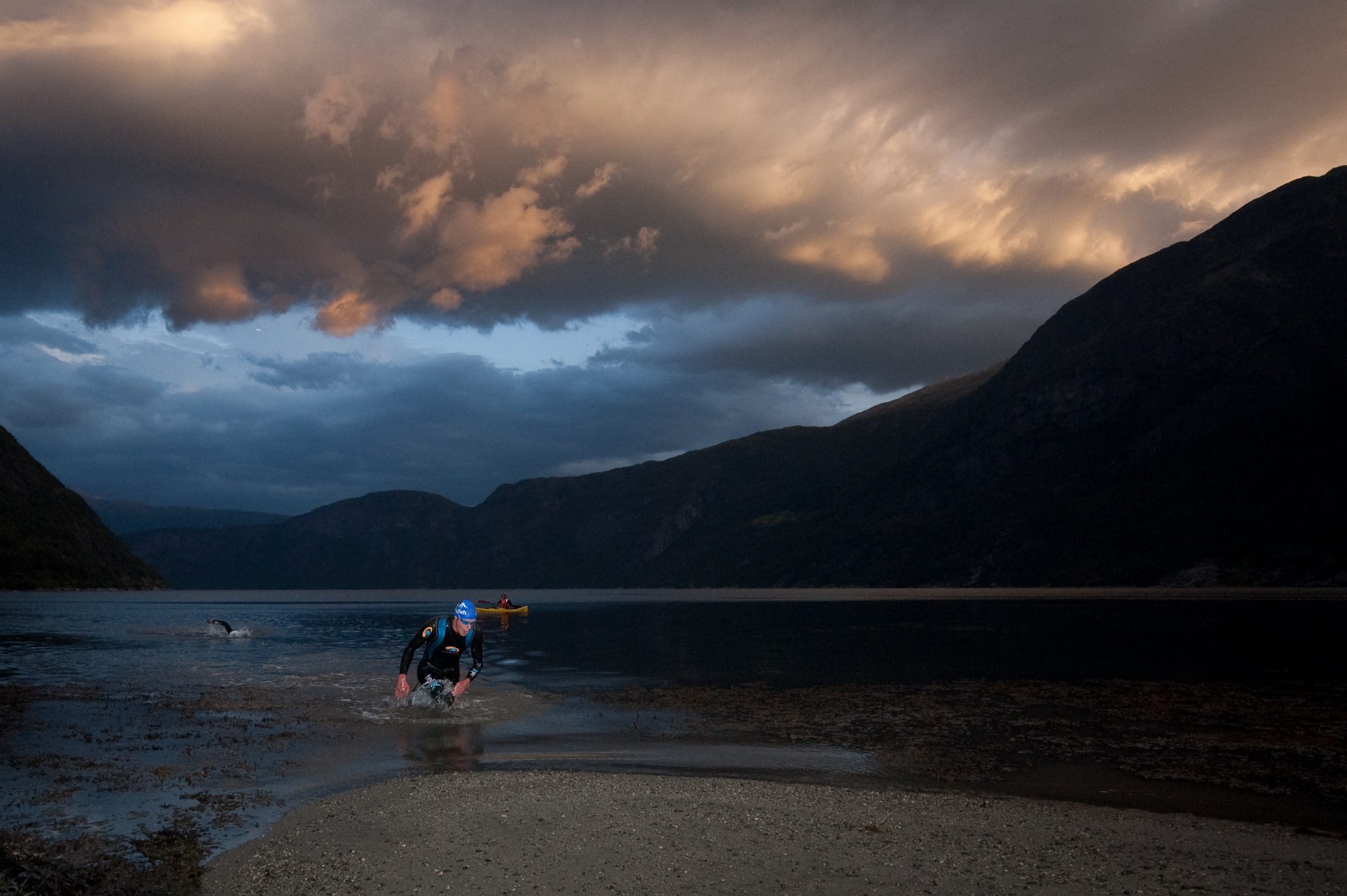
So treat T1 as a cold problem, because for your body that is what it is.
Plan it for a cold, clumsy version of yourself. Your fingers will not work the way they do at home. Zips, buckles, gels, and helmet straps all get harder. Lay everything out so it is simple, and rehearse it with your support crew until it needs no thinking.
Be your athlete’s hands, keep them calm, have the warm clothes ready, and get them moving.
And keep moving is the real instruction. Do not sit down and settle in. The bike is your best heater, so get onto it and let the work of pedalling turn your own muscles back into a furnace. Dress for the cold you feel now, not the warmth you hope for later, because the first part of the ride up onto the mountain is exposed and cold, and because your core is still falling toward its coldest point while you ride. That lowest moment arrives out on the road, not in transition, so the warm layer you put on in T1 is doing its most important work twenty minutes after you leave it. Get some warm fluid and a little food in early. Expect to shiver, and do not panic about it. Shivering is your body doing its job.
One honest warning. If an athlete comes out of the water confused, unable to function, slurring, or has stopped shivering while still clearly cold, that is not ordinary afterdrop and it is not for the support crew to manage alone. That is when you find one of us. That is what Fredrik and I are on the beach for.
This is only one piece of what we see and measure at Norseman. Over the next few days I will keep going, with more of the physiology and the research that comes out of this race. There is a great deal of it, and much of it started right there on the beach, with a temperature sensor in an athlete and a question we could not answer any other way.
See you in Eidfjord.
Jørgen
This blog post represents my personal views and does not necessarily reflect the opinions of my employer or any organizations. I have no affiliations with any companies relevant to this.
I’d love for you to join my Substack blog!
If you find this interesting and want to support my work, consider selecting the monthly paid option.
If any of it caught your interest, I have written some short, science-based book you might enjoy.
Cold Water Swimming: A Mini Book is a friendly, short guide to enjoying cold water safely, confidently, and with a big smile. It draws on years at the Norseman Xtreme Triathlon, research with elite military swimmers, and my published work in cold-water physiology. Calm, clear, trustworthy guidance for anyone curious about stepping in.
No posts
Comments
Nothing yet. Say the first thing.
Sign in to join the conversation.