
Ideas stay swirling through my head in abundance with all the newfound skills that Claude Code has given me. There’s absolutely zero zen during this era.
I thought to myself, “how cool would it be to have my own JARVIS?”
You know.. the one from Iron Man.
This is Wikipedia’s definition of what JARVIS is:
J.A.R.V.I.S. (Just A Rather Very Intelligent System) is a sophisticated AI acting as Tony Stark’s primary assistant, butler, and user interface for the Iron Man armor. He manages Stark’s infrastructure, provides combat data, and ultimately evolves into the Avenger known as Vision

That’s how my personal project to build a second brain began, which I’ve dubbed Gizmo.
The vision behind Gizmo
I wanted a personal command center that housed all the information about my startup and personal life– something I could open at 7AM daily to get a snapshot on what’s important.
It was going to need information from sources like my email accounts, Slack, iMessage, Notion and bank accounts to be able to surface it all.
There were a few other features that were real important to me as well:
I wanted to access this anywhere without a computer open 24/7
Act as an MCP that I can hook into any Claude instance
Ability to easily query all of the information in my life
With that vision, I poured myself some Equator cold brew at home and got to work on building this inside of Claude Code.
Here’s a preview (note: using dummy data) of how it looks before we get into how you can build this yourself:
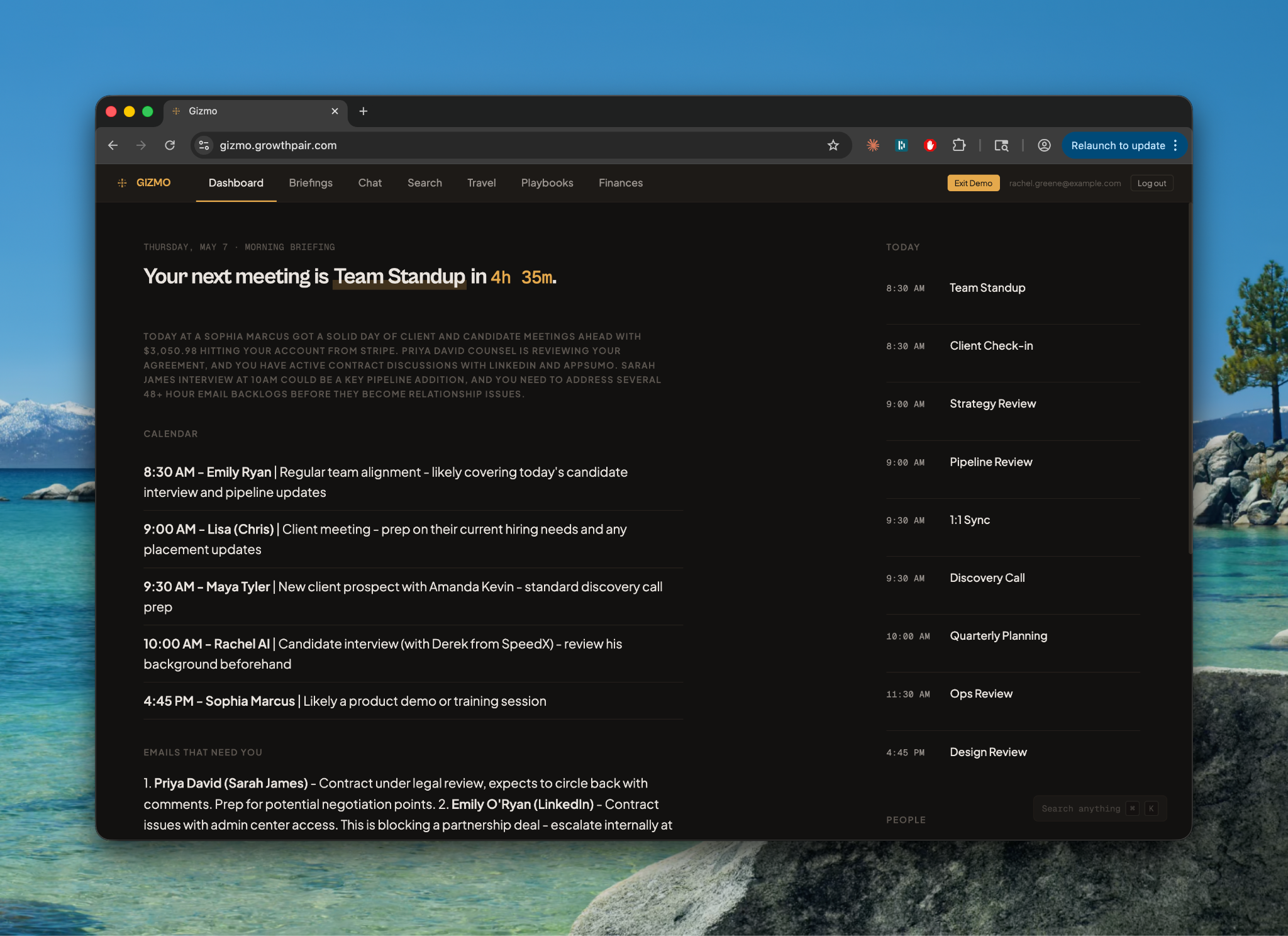
As you can see, it’s hosted on the GrowthPair domain as a subdomain that I can access anywhere across devices.
How I built Gizmo
I’m not an engineer, so I simply prompted Claude Code with my vision that looked a little something like:
“I want to build a personal command center with information about my life and startup that I can access anywhere, anytime, and will generate daily briefings for me. Ask me any questions necessary to build out a robust system.”
From there, Claude started asking me questions on what exactly I wanted and I had to decide on the tech stack for the project. To be completely honest, I usually go with what Claude recommends for backend/ frontend systems since I’m not the most qualified to make those picks myself. Going with what Claude recommends has worked out thus far across all my projects.
Here’s where we landed with the tech stack:
Backend: FastAPI (Python), PostgreSQL with pgvector extension, deployed on Railway
Frontend: React SPA with Vite, Tailwind CSS
Then came the infrastructure, and how everything was going to work together:
- Railway for hosting (auto-deploy from GitHub main branch)
- Resend for transactional email (briefing delivery)
- Plaid for bank account connections and transaction sync
- Google OAuth for Gmail and Google Calendar access
- IMAP for iCloud email sync
- Apple Contacts database for iMessage name resolution
- macOS launchd for local iMessage sync agent
As you can see, there are many connections and sources that were needed to aggregate all of the information and host it online for me to access anywhere.
But then, I needed AI to actually make use of the entire database I was creating. Here’s what that looks like:
- Claude Sonnet 4 (Anthropic API) — daily briefing generation, chat/RAG, weekly digests,
travel extraction
- Claude Haiku 4.5 — meeting prep briefs
- Google Gemini gemini-embedding-001 — 768-dimensional vector embeddings for semantic
search
- pgvector with HNSW index — vector storage and retrieval
All of this is just a fancy way of saying that Claude API is being used to create daily briefings (two models for separate use cases) and Gemini/ pgvector to create the embeddings needed for search. The vector embeddings are really important because it helps draw similarities with my searches. Here’s a quick explainer on how that works:
If I search “basketball” without semantic search, the results will look something like
basketball game
basketball score
If I search “basketball” with semantic search, I’ll get results like
basketball game
basketball score
NBA playoffs
Lakers game
It’s a smarter way to query. Gizmo can now draw connections between “basketball” and “NBA” in this scenario.
How I’m using Gizmo daily
I wake up to an email every morning which preps me for my meetings that day and surfaces any high priority items that I should immediately tackle. It’s doing this by going through all my connected data sources and running it through Claude’s API for parsing/ intelligence on all the data.
Here’s what one of those emails looks like:
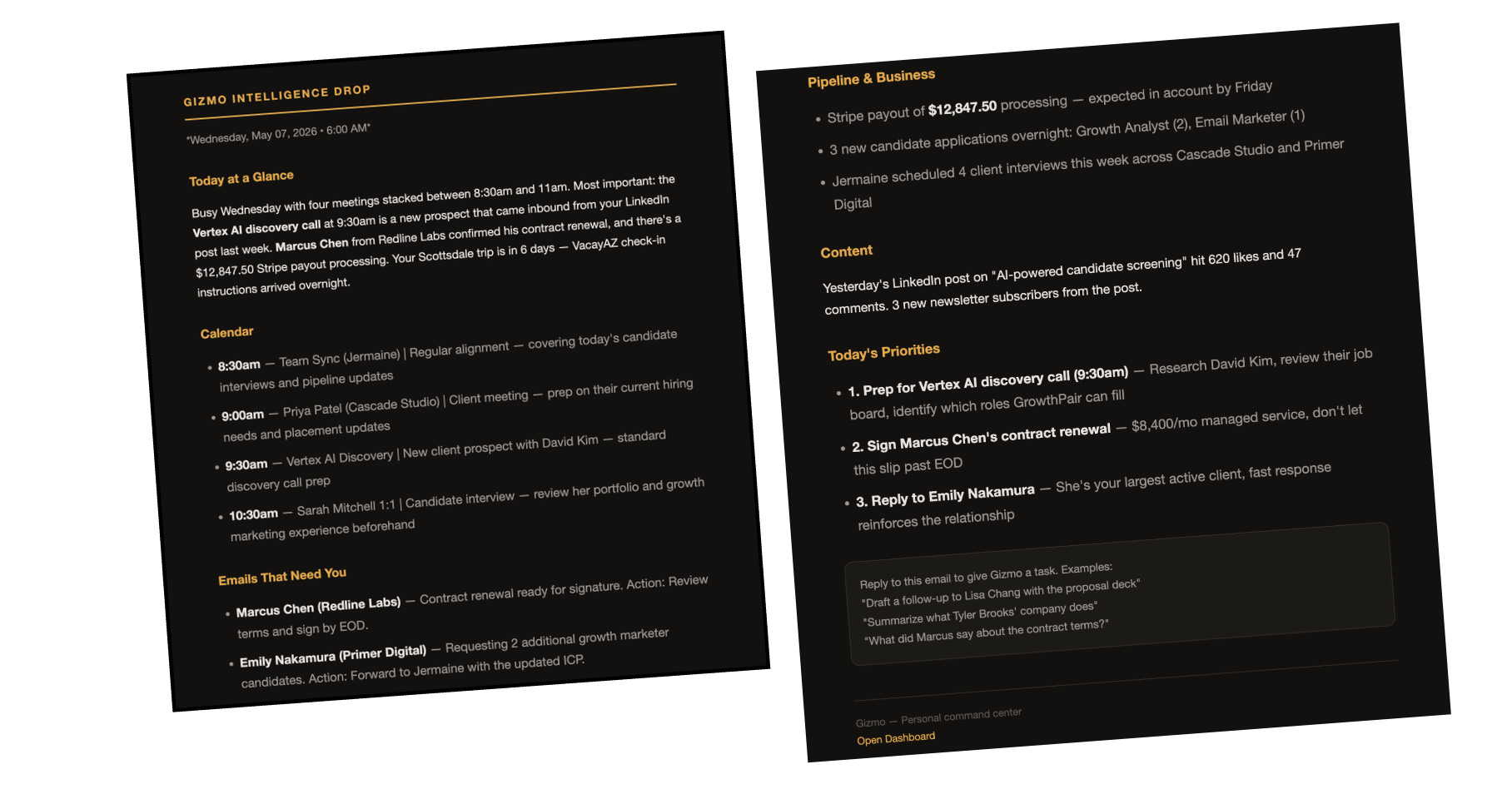
I can reply to the email and task Gizmo to draft emails for me, or provide me even more information on anything I need.
Throughout the day, I always have Gizmo in its separate tab that I can view for my daily briefing, search anything and ask it questions like:
“When’s the last time I spoke with Sean?”
“What did Sean and I discuss last week?”
“How many discovery calls did I take over the last month?”
“What are the top restaurant recommendations friends have sent me?”
I also get a snapshot on my upcoming reservations (restaurants, travel, etc) and how my finances are looking across investment accounts. I prefer this over looking through emails or logging into multiple investment accounts.
As I continue using Gizmo, it ingests more data and creates vector embeddings making it more useful. If for whatever reason, I need to jump to a new Claude account, the Gizmo MCP enables Claude to query my context lake within any instance.
Still need to incorporate health data
One big item that I still need to add are health syncs across my Function bloodwork results, Ezra MRI results, Apple Health and hospital records. I want to be able to query anything about my health and get instant information. Things like how my bloodwork has fluctuated over time, my allergies, vaccine records and why I’m potentially feeling a certain way in a given week.
With all of this new healthtech coming out, we have more data than ever to be able to take action on in our daily lives. I also think it’ll be easier to incorporate this data via Claude Connectors/ APIs that these companies release.
How to get started building this
I’ll be completely transparent– this wasn’t something I built over the course of 1 hour, or even 10 hours. There were many bumps in the road, including Claude’s API spending $10+ per day until I optimized it to use cheaper models (Sonnet) for tasks where it didn’t need the latest and greatest (Opus 4.7).
I’ve probably invested ~30 hours over the course of the last few months building this out, adding features, optimizing and ideating on what else I wanted.
If you’re okay with the lift and find something like this useful, my biggest recommendation would be to copy this entire essay and paste it into Claude with a prompt right after that goes something like:
“Build me my own Gizmo using the guidelines from this essay.”
With all of the information packed in here, you’ll be able to avoid many of the mistakes I made and likely build it in ⅓ of the time.
This has been such a fun project that’s taught me so much about API connections, vector embeddings and building a project with various interconnected tools. I highly recommend building this if you want to learn more about technical infrastructure.
If you don’t have the time for this, I do think that there’ll be startups which build a SaaS platform personal sidekick for like $19/ mo. This’ll help you avoid the upfront time investment and ongoing maintenance of the platform.
Looping this into your marketing org
While this isn’t a tool for marketing orgs specifically, I think there are many parallels that can be drawn here. If I was leading a marketing team, I’d take Gizmo and build it to be marketing specific. Some of the features would include:
- Dashboard that pulls in all growth metrics, channel data, experiments, etc
- Paid ad spend budgets, metrics and overall pacing
- Daily briefing on experiment status across channels
- Self-improvement database of all the wins/ losses from our experiments
- Master skills repo for the team to pull from
This would be a dashboard that the entire team could access daily to get a pulse on how everything is going. Again, I feel like there’ll be a SaaS platform that gets built to do exactly this for various orgs within a company.
Any additional questions
For those still reading to this point, you’re a real one and I appreciate you reading through my coffee-buzzing thoughts. If you want to learn more in video format, check out the Claude Marketers video academy that I’ve built as a labor of love.
Claude on,
Jonathan - your AI whisperer
No posts
Comments
Nothing yet. Say the first thing.
Sign in to join the conversation.