
A community can give hundreds of hours of service and still struggle to turn that service into neighborhood power.
Picture it is a Tuesday afternoon. A community member in Homewood is returning from work and goes straight to the Homewood Children’s Village to provide tutoring to local students. They sign a paper timesheet and drop it in a folder that already holds hundreds of others.
Those hours mattered. A child showed up. A neighbor showed up. The work was real and had a real impact. .
But by Friday, that hour is maybe a line in a grant report. It is not a live input into what the block and community may need next.
That gap is why The Village exists.
Most community organizations already know this problem in their bones. Community members give of their time and resources. Some community needs are met. Others are missed or unspoken. Sometimes,they fall through the cracks. Staff become increasingly responsible for administrative overhead ranging from programs, aid, relationships, and reporting at once. Funders ask for proof and community members look for results. Sometimes the story gets lost and people lose faith and confidence. The community seems to need more than activity. They need stability, dignity, and a visible path toward something better.
In this manner, the value created across the various efforts often stays disconnected, untracked, and hard to turn into neighborhood reinvestment.
Thus, the simplest description is this: The Village turns local service into community power by converting verified service hours and contributions into transparent support for real neighborhood investment and revitalization. Some of that record can be on-chain. Some of it should remain off-chain. Some of it can be made clearer through A.I.-assisted reporting and pattern recognition.
But the point is not to put new tech 1st, but to use it to amplify the community.
The point is to give trusted community organizations a stewardship system that links service, small contributions, aid, project funding, reporting, and visible milestones directly to real properties and families in their neighborhood, with flows that residents, staff, and funders can understand.
This is where the ideas behind The Digital Tithe and Faith & Cryptocurrency become concrete. Transparent stewardship, digitized service, benevolence, community wealth, shared governance, and A.I.-supported clarity are not abstractions. They have to land somewhere.
For The Village, the first place is Homewood
.
The first deployment is being built with Homewood Children’s Village, a trusted multiservice anchor in Pittsburgh’s Homewood neighborhood.
That detail matters.
The Village is intentionally designed around real institutions and real residents. It is not an abstract idea. Homewood Children’s Village already has programs, staff, relationships, and a real operating environment. It serves families and youth, coordinates community engagement, carries local trust, and knows the difference between a dashboard metric and a family trying to make it through the month.
Too much technology development starts with a mechanism and then looks for a community. This creates a situation of a token seeking out users. An A.I. product existing in a vacuum of need or a dashboard needs a customer. Sometimes it is even a protocol in search of narrative. While this can lead to success, especially when massively funding, The Village starts in the opposite direction.
A community already exists. The work already exists. The trust already exists. The question is whether the infrastructure can help that trust carry more weight.
The design principle is anchor first, protocol second.
That means the first job is not to create a speculative asset, launch a token, or ask residents to become protocol users. The first job is to understand the workflows a serious community institution already manages: participation, attendance, service validation, family support, reporting, neighborhood projects, privacy, funder communication, and trust.
Only then does technology have a role.
This work matters to me because I have watched faith-shaped vision become realized, not just a sermon on sunday or cool ideological exercise. .
At Bible Center Church in Pittsburgh, I saw a community that refused to divorce the dream from implementation. Mission statements became models for how the organization actually ran. Sermons became foundations for systems and structures. The Ministry House tied reduced rent to service. Everyday Cafe became a third place built for local value and dignity. S.H.A.P.E. was more than an acronym on a slide. Spiritual gifts, heart, abilities, personality, and experiences were something the community could organize around.
It was a micro-economy held up by a shared framework.
That is the posture The Village is trying to carry forward.
The goal is not to invent a community. The goal is to give existing service, trust, and mission a system that can carry more weight.
That is the difference between inspiration and infrastructure.
The Village is not trying to invent community activity. The activity already exists.
Homewood Children’s Village logged 21,157 service hours in a recent two-year period. At $34.79 per hour, that represents roughly $736,000 of social capital that could have been recognized as Time Dollars and routed into neighborhood projects.
Today, service can be appreciated, reported, and summarized. That matters, but it is not enough.
The next question is whether service can become a live input into community reinvestment.
If residents already serve, if staff already validate participation, if homeowners already face needs, if funders already want measurable impact, and if A.I. can help staff make sense of scattered information faster, then the missing layer is not motivation.
The missing layer is infrastructure that connects those realities into one loop.
That is why The Village focuses first on timesheet, attendance, learn-and-earn, and Time Dollar Banking flows. They are operationally concrete. They can be validated against real programs. They make the larger thesis testable without asking anyone to believe in an abstract future.
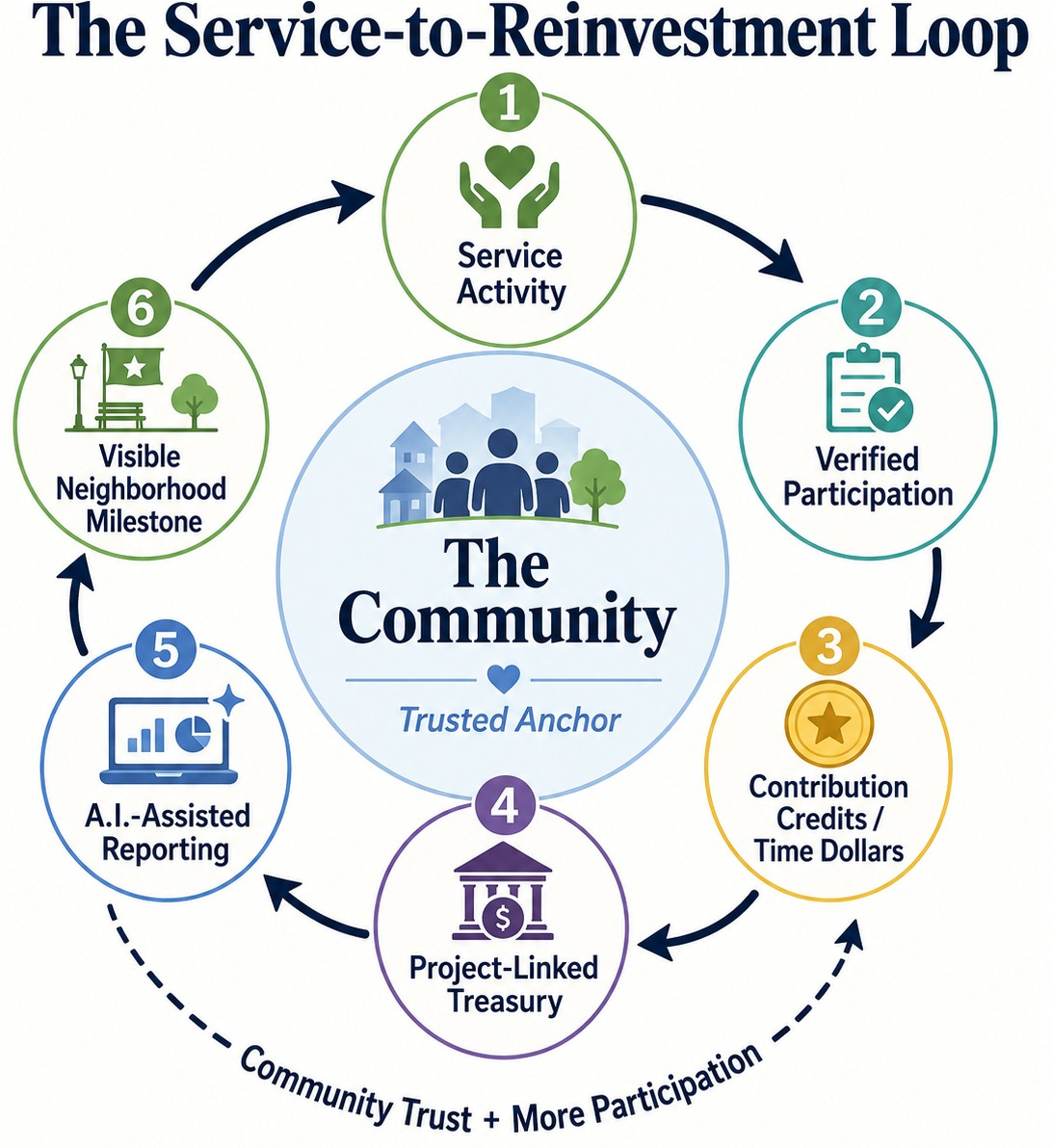
The Village links four moves that usually live in different silos.
First, a service ledger. Community leaders define activities such as food preparation, tutoring, cleanups, attendance, or other validated community actions. Staff approve participation. Approved participation can mint controlled, policy-bound contribution credits, called Time Dollars in the Homewood pilot.
Second, a community reinvestment fund. Those credits, and later stable-value contributions, can be attributed to specific projects. The goal is to connect earned value, donated value, and project progress instead of letting them live in separate spreadsheets.
Third, dashboards and project views. Staff, residents, homeowners, partners, and funders need to see how service and contributions are flowing into real projects with clear goals and visible milestones.
Fourth, A.I.-assisted clarity. A.I. can help summarize service records, draft funder updates, identify missing documentation, surface patterns across programs, and reduce the reporting burden on staff. It should not decide who deserves help. It should not expose sensitive information. It should not replace the judgment of people who know the community.
The first pilot is designed to prove the smallest credible loop: HCV staff configure activities, residents participate, staff validate the activity, contribution credits are issued, credits are connected to a visible project, A.I. helps staff explain the pattern, and the project moves toward a milestone the community can understand.
If that sounds simple, that is the point. The hardest part of this work is not making the technology sound sophisticated. The hardest part is making the system usable by nontechnical organizations doing real work under real constraints.
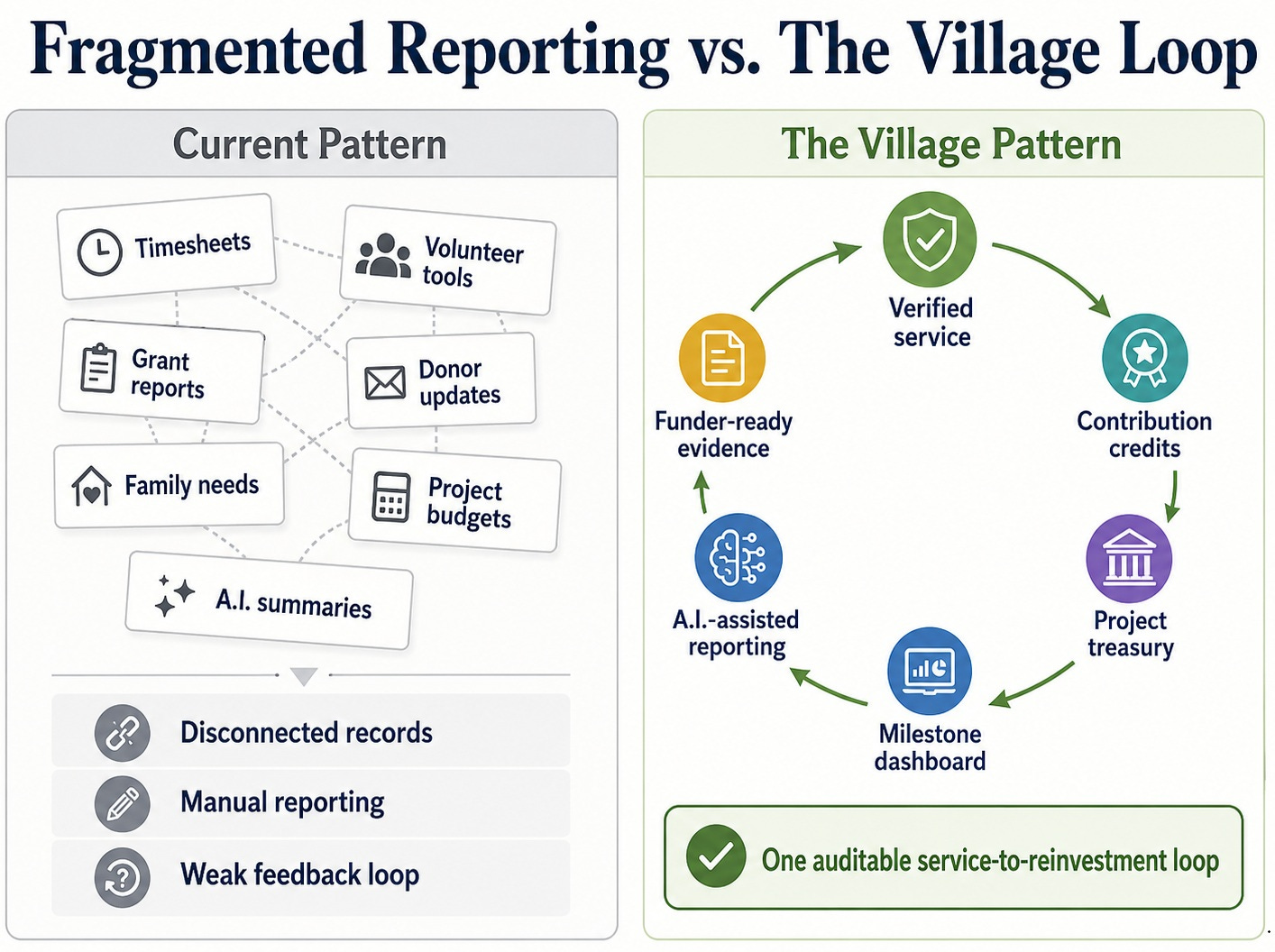
The Village is not competing with a single obvious replacement. It sits in the gap between several categories of tools that each solve part of the problem.
Web3 impact and grants platforms can route crypto donations or run grant rounds, but they usually stop at funding distribution. They do not connect day-to-day service, family-level stabilization, and specific neighborhood assets into one loop.
Crypto donation platforms help donors route digital assets to nonprofits, but they optimize for fundraising campaigns rather than ongoing, measurable ties between service, credits, and local project outcomes.
Traditional nonprofit CRMs and volunteer tools help track contacts, hours, and grants, but they are siloed databases. They rarely provide verifiable flows, shared ownership primitives, or a native way to translate service and aid into neighborhood-level investment signals.
A.I. tools can summarize, generate, classify, and analyze, but they do not automatically create trustworthy records. If the data is scattered, the output will be scattered. If the governance is unclear, the tool will not make it wise. If the system does not know how service connects to projects, A.I. may describe the activity more fluently without changing the architecture underneath it.
The Village is designed as a full loop system for one neighborhood first, with four pillars in one stack: immediate emergency stability, the ability to serve and earn, long-term wealth building through project-linked participation, and shared governance. The goal is not another point solution. The goal is a repeatable civic finance pattern.
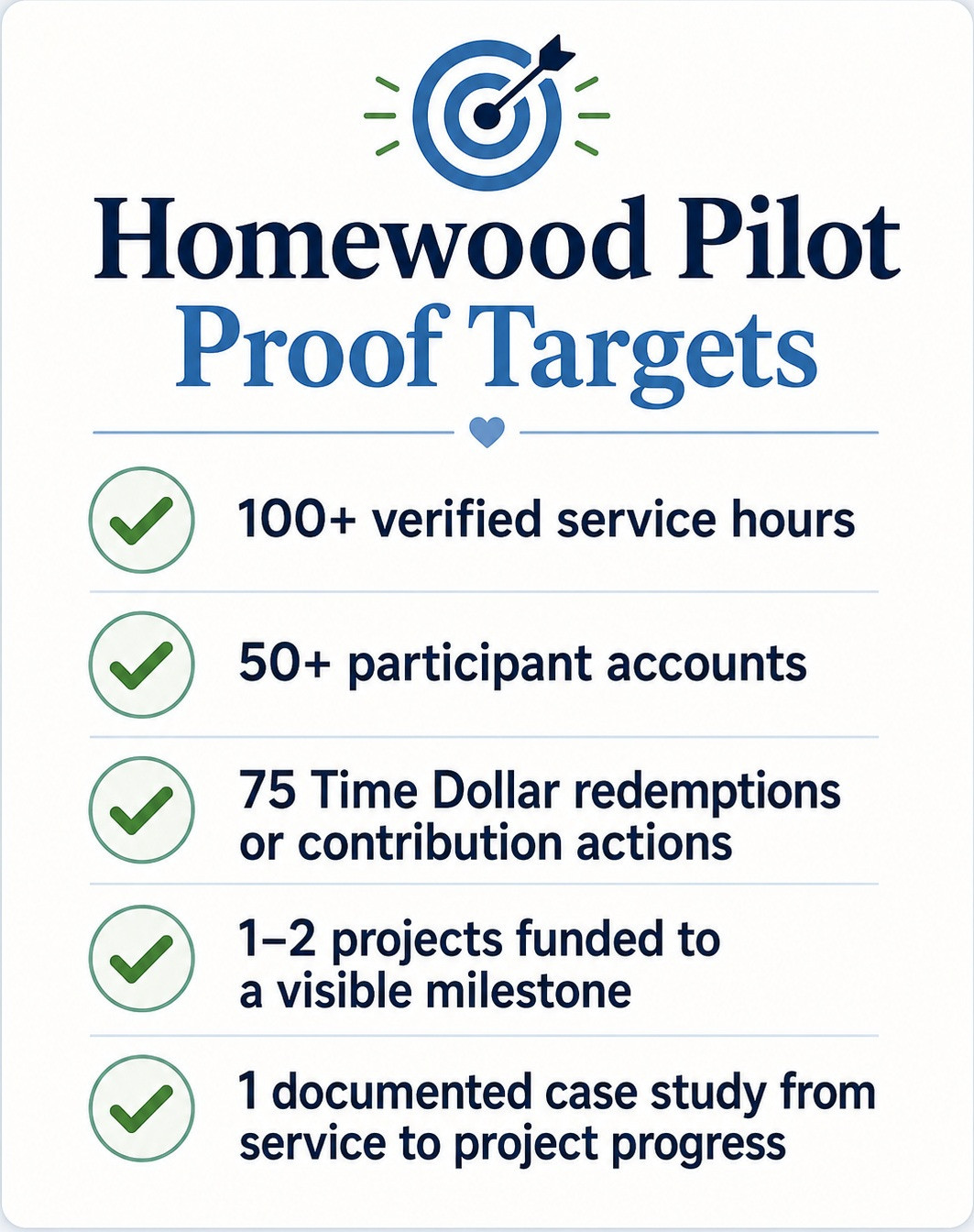
The first pilot does not need to prove every future use case. It needs to prove that a trusted community organization can turn existing service and support into a verifiable reinvestment loop.
The near-term metrics are intentionally concrete: at least 100 verified service hours logged, 50 or more unique wallets or participant accounts activated across staff, volunteers, and residents, 75 Time Dollar redemptions or contribution actions, one to two pilot projects funded to a clear milestone, and a documented case study that shows the path from service to project progress.
Those metrics matter because they combine operational proof with narrative proof. They help answer the cynicism that often surrounds both technology and philanthropy. A funder should be able to see more than a dashboard count. They should be able to understand the story: a resident participates, that participation is validated, a contribution record is created, the contribution is connected to a project, staff can explain the pattern without rebuilding the report from scratch, and the project reaches a visible milestone.
That is the difference between activity and infrastructure.
Funders already support housing, youth work, faith-based service, civic technology, economic mobility, and community development. But many grants fund program activity without changing the infrastructure underneath the activity. The same organizations remain dependent on disconnected tools, manual reporting, and fragile stories of impact.
The Village gives funders a different kind of opportunity. It supports infrastructure that can make invisible service visible, connect participation to project milestones, reduce reporting burden, and create an auditable record of how community value moves.
For foundations and civic partners, that matters because the same architecture can become reusable.
Homewood is first. It is not the only place this pattern could live.
Once the loop works in one neighborhood, the playbook can be adapted for other community-based organizations, faith networks, housing ministries, and civic coalitions that already coordinate volunteers, aid, and neighborhood projects. The pattern is not limited to one organization. It belongs anywhere trusted anchors are trying to move from program activity to visible community power.
This is the field-building opportunity: not a single app for one nonprofit, but a template for anchor institutions that need to verify participation and coordinate resource allocation across multiple domains.
Technology is not the headline. It is the accountability layer.
On-chain records matter where flows should be verifiable. Contribution credits matter where service should be recognized as value. Role-based approvals matter where vulnerable communities need guardrails. Dashboards matter because residents, staff, and funders need human-readable evidence. A.I. matters where staff need help making sense of information, drafting reports, and seeing patterns across programs. Off-chain privacy matters because sensitive identity and program logic should not be exposed just to make a system look transparent.
That balance is central to the design: on-chain transparency with off-chain practicality and A.I.-assisted clarity.
This is also why The Village fits the broader argument of Faith & Cryptocurrency and The Digital Tithe. The book argues that Web3 tools should be evaluated by whether they restore trust, modernize benevolence, build community wealth, digitize service, and help communities avoid predatory traps. The expanded conversation has to ask the same thing of A.I. Does it clarify the truth or distort it? Does it support staff or replace wisdom? Does it make the work more intelligible or just more automated?
The question is not whether Homewood needs more technology for its own sake.
The question is whether a trusted anchor institution can use better infrastructure to make service, aid, funding, and neighborhood progress visible enough to strengthen trust.
That is what The Village is building.
Not a speculative asset.
Not a dashboard for its own sake.
Not A.I. theater.
A service-to-reinvestment loop.
A way to make existing value visible.
A system that helps trust survive scale.
Call to action: If you fund housing, youth, faith-based work, civic technology, public goods, or community wealth, reply for the funder memo. If you know a foundation, donor, ecosystem grant program, or civic partner that should see this, make the introduction.
No posts
Comments
Nothing yet. Say the first thing.
Sign in to join the conversation.