
Many mission based organizations, like churches and nonprofits have a trust problem. This is not because their leaders lack integrity. They have a trust problem because their systems were never designed to make stewardship understandable. Their inner workings are hidden behind a veil.
This mystery and hidden nature is usually not due to bad character or intent, but bad architecture.
Leaders can act with integrity, but they are often working within a cathedral of systems that were built to be discerned and accessible to members, donors, residents, boards, and funders at once. A pastor can be faithful. A treasurer can be careful. A board can approve every expense. A finance team can do honest work with the tools it has. Yet, the community can still feel left in the dark.
This is the issue that continues to darken the hearts and perception of non-believers and believers. This organizational problem has led to a negative cultural perspective of faith institutions.
This is a problem.
Most churches and nonprofits were built on ordinary administrative tools: bank accounts, spreadsheets, donor databases, committee notes, accounting software, board packets, staff memory, and annual reports. Those tools can handle basic administration. Yet, they are much weaker at showing how giving, service, aid, volunteer labor, and long-term community outcomes connect.
That is where the trust in faith based organization often begins to thin. The lack of clarity breeds distrust. Then every example that proves that distrust is true is magnified.
There are times when a person gives, but cannot always see the path from gift to impact they begin to wonder. You have probably witnessed someone volunteering without recognition or support. Over time they disappeared because they were not recognized and they couldn’t see the fruit of their labor. Some have witnessed a family receive help, but there were open questions by members about how that family was identified, approved, and exactly what needs were being met. The people who operate and support these organizations make hard decisions, but the logic behind those decisions is difficult to communicate after the fact. Funders ask for proof, and already stretched organizations spend more time reconstructing the story than doing the work.
For example, a church raises $25,000 for emergency benevolence. Three families receive support. Volunteers deliver groceries. A donor gives restricted funds. A board approves additional relief. Six months later, the pastor knows good work happened, but the story is scattered across bank statements, texts, spreadsheets, meeting notes, and memory. Nothing corrupt happened, but the system cannot easily show the path from gift to impact. Yet, the community only remembers the money being asked for.
Transparency is one layer of the issue.
Accessibility is another.
A church can publish a budget and still have a trust problem. A nonprofit can send an annual report and still leave donors unclear about how resources became outcomes. A board can approve every expense properly and still struggle to communicate the path from contribution to impact.
Numbers matter, but stewardship is more than numbers.
Stewardship includes how needs are identified, who has authority to respond, what constraints govern the response, how privacy is protected, how service is valued, and how outcomes are made visible without exploiting the people being served. It includes the difference between money sitting in an account and value moving through a community with wisdom.
Transparency means information is available.
Accessibility means the community can understand what the information means.
That distinction matters. A spreadsheet can be transparent to the person who built it and meaningless to everyone else. A budget can be accurate and still fail to show the relationship between giving, benevolence, volunteer service, grants, and changed lives. An annual report can tell a true story and still hide the operating system underneath the story.
This is where many institutions are underbuilt. They have tools for accounting, tools for donors, tools for volunteers, tools for grants, tools for case management, and now tools for AI-generated summaries. What they often lack is a shared operating view of value moving through the community.
That lack creates the feeling of a black box.
In Faith & Cryptocurrency, I write about Time Dollar Banking as one of the ideas that stayed with me because it felt so aligned with the kind of community the Church claims to be. Every hour of service is treated as valuable. One hour tutoring a child, repairing a neighbor’s car, cooking for a family, driving someone to an appointment, or mentoring a young person is recognized as a contribution.
That idea is powerful because it tells the truth about the community.
Money is not the only form of value. Our time and resources are often the economic engines of community.
But I also learned something sobering. Principles can be visionary, yet fail under the administrative weight of implementation. Paper logs. Spreadsheets. Manual reconciliation. Databases no one feels confident they can audit. A beautiful idea becomes fragile when the system underneath it cannot verify, explain, and sustain the work.
The same failure mode shows up in church finance.
Many churches and nonprofits have a stewardship vision that is larger than their administrative architecture. They want to care for widows, support families, disciple youth, stabilize neighborhoods, feed people, repair homes, fund missions, and build community wealth. They want to be faithful. But the operating system is often a patchwork of disconnected tools and institutional memory.
The heart may be right, but the architecture may still be too weak to carry the weight of the love being preached.
Community life does not arrive in neat software categories. A donor gives because they believe in the mission. A volunteer tutors a student, prepares food, joins a cleanup, or drives someone to an appointment. A family needs emergency help. A homeowner needs repairs but lacks safe access to capital. A staff member understands the context because they are close to the people. A board carries responsibility for oversight. A funder needs evidence that support produced more than activity.
Those are connected realities. The tools usually split them apart.
Traditional nonprofit CRMs and volunteer tools help track contacts, hours, and grants, but they are usually siloed databases. Donation platforms help route money, but they optimize for campaigns rather than ongoing ties between service, aid, and project outcomes. Accounting systems protect the books, but they rarely show the community a human-readable stewardship loop.
AI tools can summarize documents, draft appeals, and create reports. If the underlying data is fragmented, AI will only make the fragmentation sound more polished.
The result is a reporting burden that grows as the work grows. Staff stay buried in manual reconciliation. Funders receive snapshots rather than live evidence. Members hear summaries rather than see trustworthy flows. Residents experience programs, but not always power. Leaders testify about systems that are not understood.
This is not primarily a communications problem.
Better storytelling helps, but storytelling cannot permanently compensate for disconnected infrastructure.
When people hear “blockchain” in a church context, they often assume the question is whether churches should accept crypto. That frame is too narrow.
When people hear “AI” in a church context, the conversation often collapses into chatbot sermons, automated emails, or anxiety about fake content. That frame is also too narrow.
The better question is: what parts of our stewardship should become more trustworthy, more visible, and easier to verify?
For some institutions, the answer may be donor reporting. For others, it may be benevolence approvals, emergency aid, volunteer service, grant compliance, housing stabilization, community funds, AI-assisted administration, or shared governance. The point is not to force every organization into the same technology stack.
The point is to map the trust problem before choosing the tool.
This is the practical posture behind Faith & Cryptocurrency and The Digital Tithe. The argument is not that churches should chase market highs, submerge themselves in every new tool, or hand spiritual judgment over to software. The argument is that faith leaders need better questions.
What should be made visible? What must remain private? Who has authority to approve relief? Which flows should be auditable? How should service be recognized? Where does AI help staff understand complexity faster? Where could AI distort truth, flatten pastoral nuance, or expose sensitive information? Where are staff manually stitching together data that should be connected? Where do members, donors, residents, or funders lose confidence?
Those questions are more important than the name of any blockchain, model, dashboard, or donor platform.
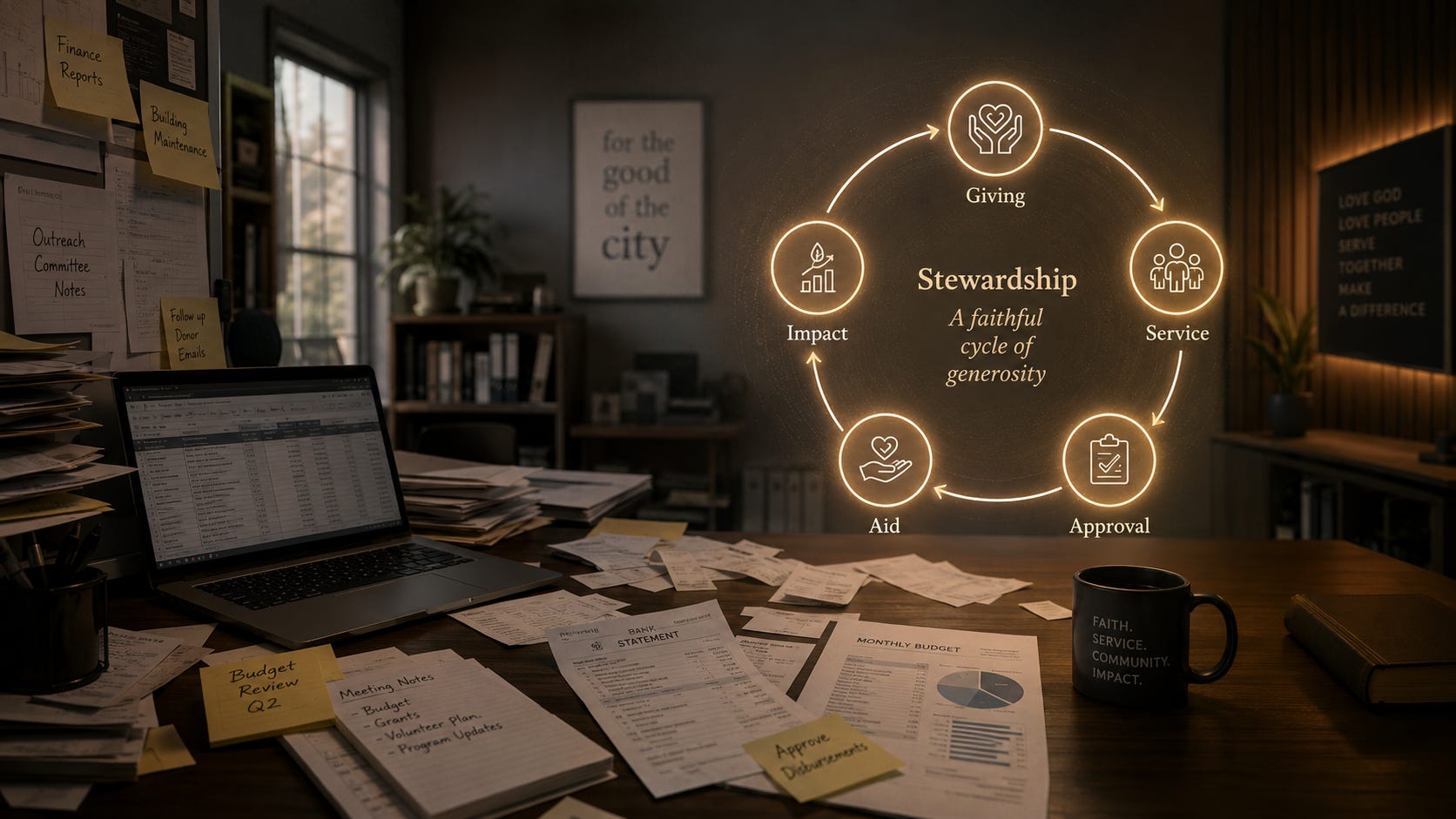
The shift is from black-box budgeting to visible stewardship loops.
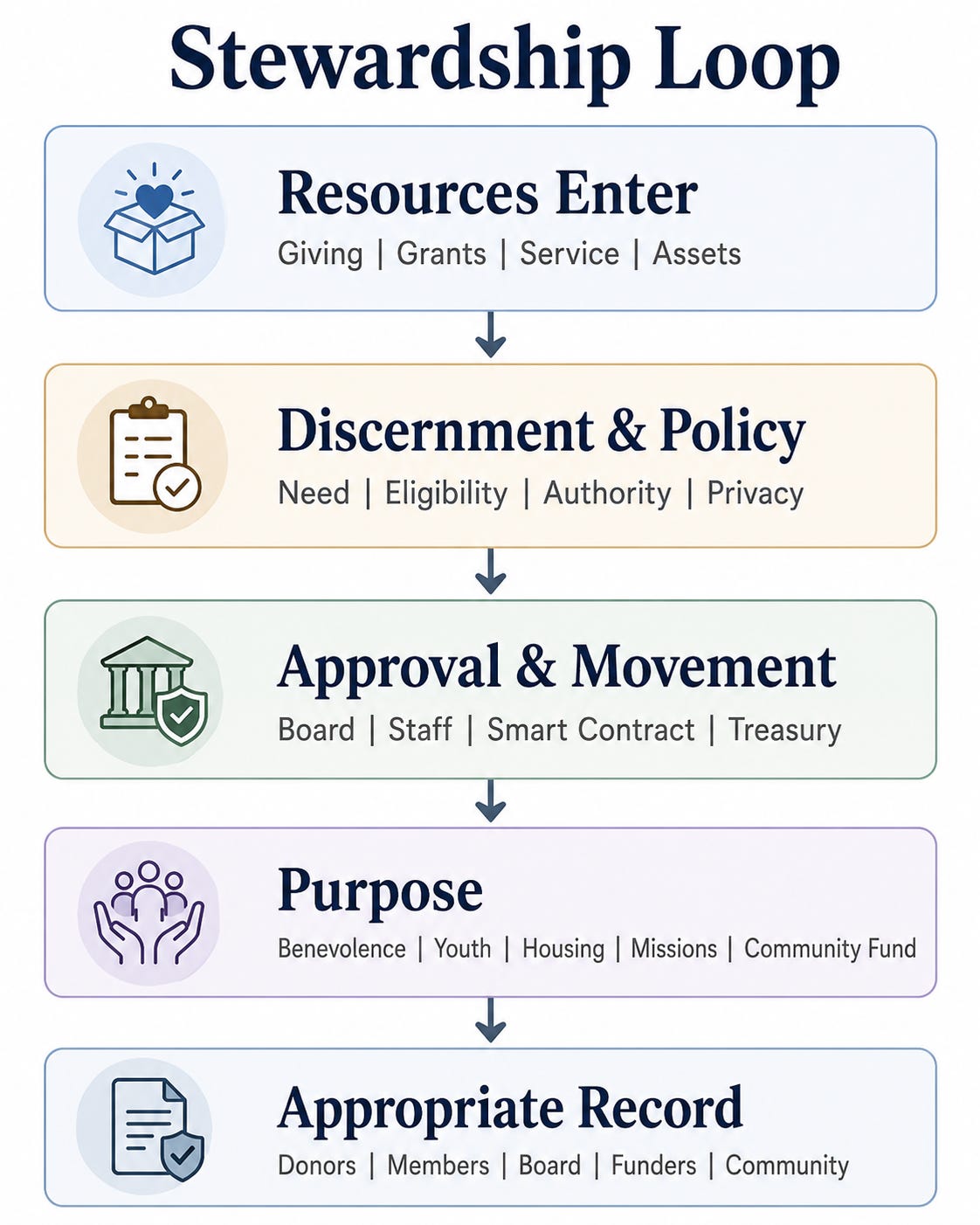
A stewardship loop connects resources, judgment, movement, and outcome. Resources enter through giving, grants, service, or other contributions. The institution applies policy and discernment: who is eligible, what need is urgent, who can approve, what documentation is required, what must remain confidential, and what kind of care is appropriate. Resources then move toward a purpose: benevolence, emergency support, a youth program, a home repair, a neighborhood project, or a community fund. Finally, the community receives the right level of record for what happened.
Appropriate is the key word.
Transparent stewardship does not mean exposing private pain. It does not mean turning pastoral care into public data. It does not mean feeding sensitive family circumstances into an AI tool because it makes reporting easier. It means designing the right level of visibility for the right stakeholders.
Blockchain is useful only if it creates trustworthy records where transparency is appropriate. Smart contracts are useful only if they enforce clear rules without removing human wisdom. AI is useful only if it helps leaders summarize complexity, detect inconsistencies, communicate clearly, and make institutional knowledge easier to access without replacing discernment. Dashboards are useful only if they tell the truth about the work instead of creating another layer of performance.
The ledger is not magic.
Neither is AI.
Used well, technology helps trust survive scale. Used poorly, it gives fragile systems a more convincing interface.
A modern stewardship system should create a trustworthy record of the flows that ought to be visible. It should show how funds moved, which approvals happened, which projects received support, how service contributed to progress, and what milestones changed. It should help leaders report without reconstructing the whole story from scratch.
It should also protect what should not be public. Sensitive identity information, pastoral care details, family circumstances, and private benevolence needs should not be thrown onto a public ledger, a public dashboard, or an AI system without governance. The goal is not radical exposure.
The goal is disciplined visibility.
That is why Web3 and AI tools have to be translated carefully for faith communities. Smart contracts may help enforce rules, but they should not replace human judgment. Digital assets may help recognize contribution, but they should not invite speculation. DAOs may help structure participation, but they should not create governance chaos. AI may help leaders make sense of scattered information, but it should not become an oracle.
The technology has to serve the stewardship model.
This is the difference between modernization and capitulation. Faith communities do not need to abandon their values to use better tools. They need tools shaped by those values.
Thanks for reading The Digital Tithe! This post is public so feel free to share it.
If you lead a church, ministry, or nonprofit, do not begin by asking whether you need blockchain.
Do not begin by asking whether you need AI.
Begin with a stewardship audit.
A stewardship audit asks five questions:
How does value enter our system (time, money and resources)?
Who approves how it moves/allocated?
What records are created?
Who can understand those records?
What must remain private?
Map the current flow of giving, service, benevolence, grants, approvals, reporting, and outcomes. Identify where trust depends on one person’s memory, where data has to be manually reconciled, where funders ask for proof, where members feel disconnected, where residents need a clearer voice, and where AI could help staff make sense of information without replacing their responsibility.
Then decide what should become more visible, what should remain private, and what kind of system could support both.
That is the practical bridge between faith and technology. It starts with stewardship, not software.
The black box is not inevitable. It is the result of systems that were never designed to connect giving, service, aid, governance, and community outcomes in one trustworthy loop.
Modern faith communities can do better.
But only if they treat transparency as architecture, not as a public relations exercise.
Not exposure. Not hype. Not automation pretending to be wisdom.
Architecture. Stewardship. Disciplined visibility.
No posts
Comments
Nothing yet. Say the first thing.
Sign in to join the conversation.