
Hey everyone! This article is all about how we don't really have free will, but something I like to call "unique will." It's shaped by our individual experiences and interactions, leading us to create our own subjective reality. I'll explain the differences between objective reality, perceived reality, comprehended reality, and subjective reality. Using some interesting scientific studies and psychological research, we'll see how our brain processes sensory information, adapts through neuroplasticity, and prioritizes what we need in the moment. By the end, you'll see how understanding our unique will and subjective reality can help us navigate life better and find more fulfillment in a deterministic world.
Friends,
Since my memoir was published on February 1, 2024, many of you have heard me talk about "unique will." I've been thinking about free will ever since I started writing my memoir back in 2011. Instead of free will, I believe we have something called "unique will." This idea is that our responses are shaped by all the unique experiences and interactions we've had in our lives. It's what creates our own subjective reality, which is different from the objective and comprehended realities we're used to hearing about. Let me break it down for you.
Objective Reality (Actual Reality): Objective reality is the world as it exists, no matter what we think about it. It's the stuff scientists study—like gravity. Gravity doesn't care if we believe in it or not; it's just there, doing its thing.
Cool Fact: Scientists use huge machines like the Large Hadron Collider to figure out what makes up this objective reality. They're looking at fundamental particles and forces that are out there, no matter what we perceive.
Think about how our understanding of the universe has expanded with tools like the James Webb Space Telescope. We've discovered distant galaxies, black holes, and exoplanets. These discoveries show us that objective reality is vast and often beyond our direct perception.
Perceived Reality (Sensory Input): This is all about how we see, hear, touch, taste, and smell the world. It's subjective because everyone's senses are a bit different. Think about how the color red might look slightly different to each of us.
Interesting Tidbit: Our brains don't just passively take in information—they actively process it. There are studies showing that blind people can "see" through touch with devices that convert visual information into tactile sensations.
Another example is optical illusions. They trick our brains into seeing things that aren't there or seeing them differently than they actually are. This shows how our brain processes sensory input and constructs our perceived reality, which can sometimes differ from objective reality.
Comprehended Reality (What We Know and Understand): This is where our brains make sense of the information we get from our senses. It's shaped by our education, culture, and personal experiences. For example, a scientist understands a chemical reaction because they've studied it in detail.
Fun Fact: Kids and adults process and understand the world differently. Jean Piaget's stages of cognitive development explain how our comprehension evolves as we grow up.
Let's dive deeper into this with the example of language acquisition. A child growing up in a bilingual environment will have a different comprehended reality than a child who only learns one language. Their understanding of the world is shaped by the languages they know, affecting how they think and perceive their environment.
Subjective Reality: This is the personal take each of us has on the world. It's influenced by our emotions, past experiences, and biases. No two people have the same subjective reality because no two people have the exact same experiences.
Research Insight: Studies show that our past traumas and emotional states shape how we perceive new experiences. It's why two people can have completely different reactions to the same event.
Consider how cultural background shapes subjective reality. For instance, a festival might be a joyous occasion for someone from one culture but might hold no significance or even be uncomfortable for someone from another culture. Our subjective reality is deeply intertwined with our personal and cultural histories.
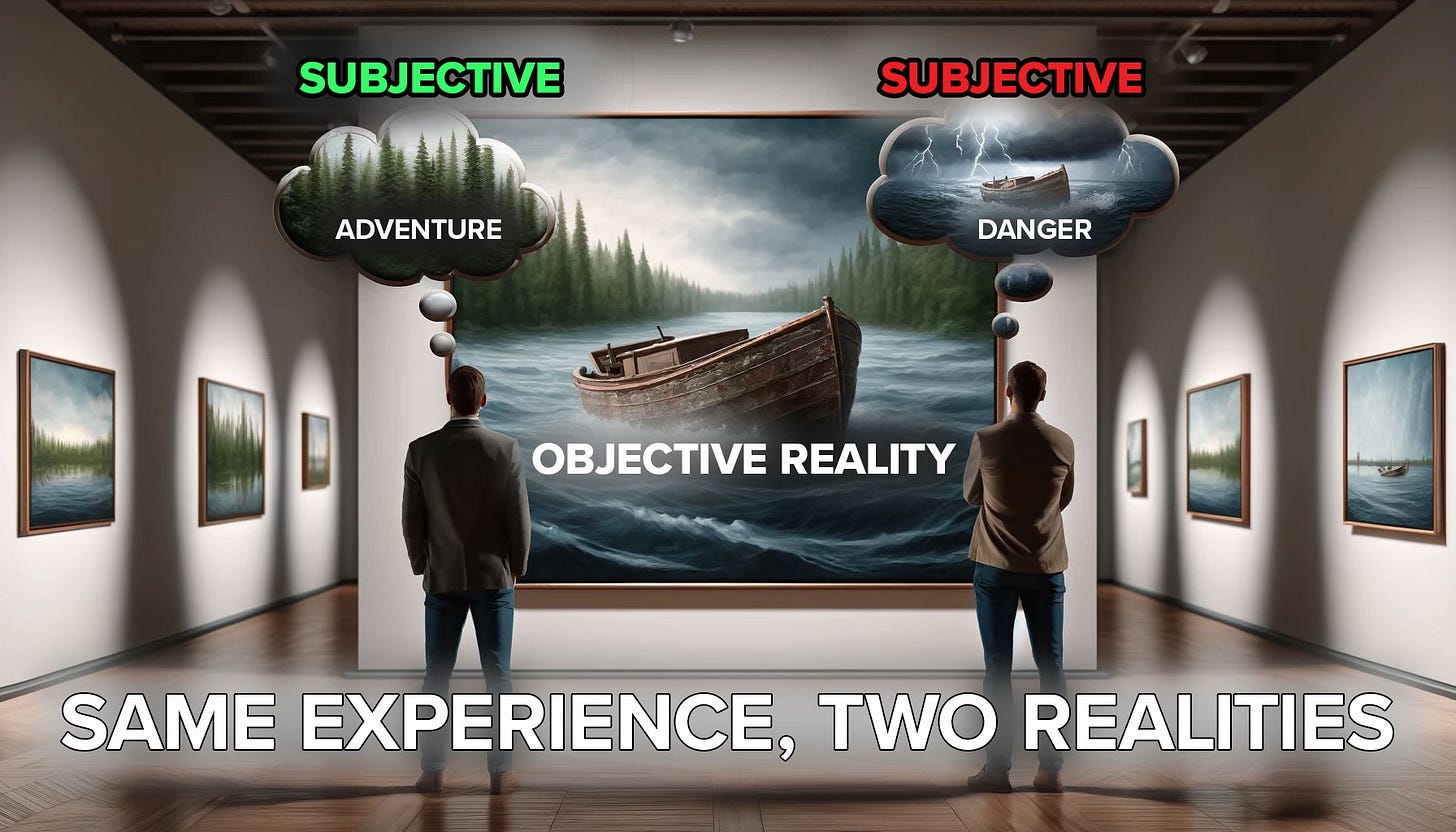
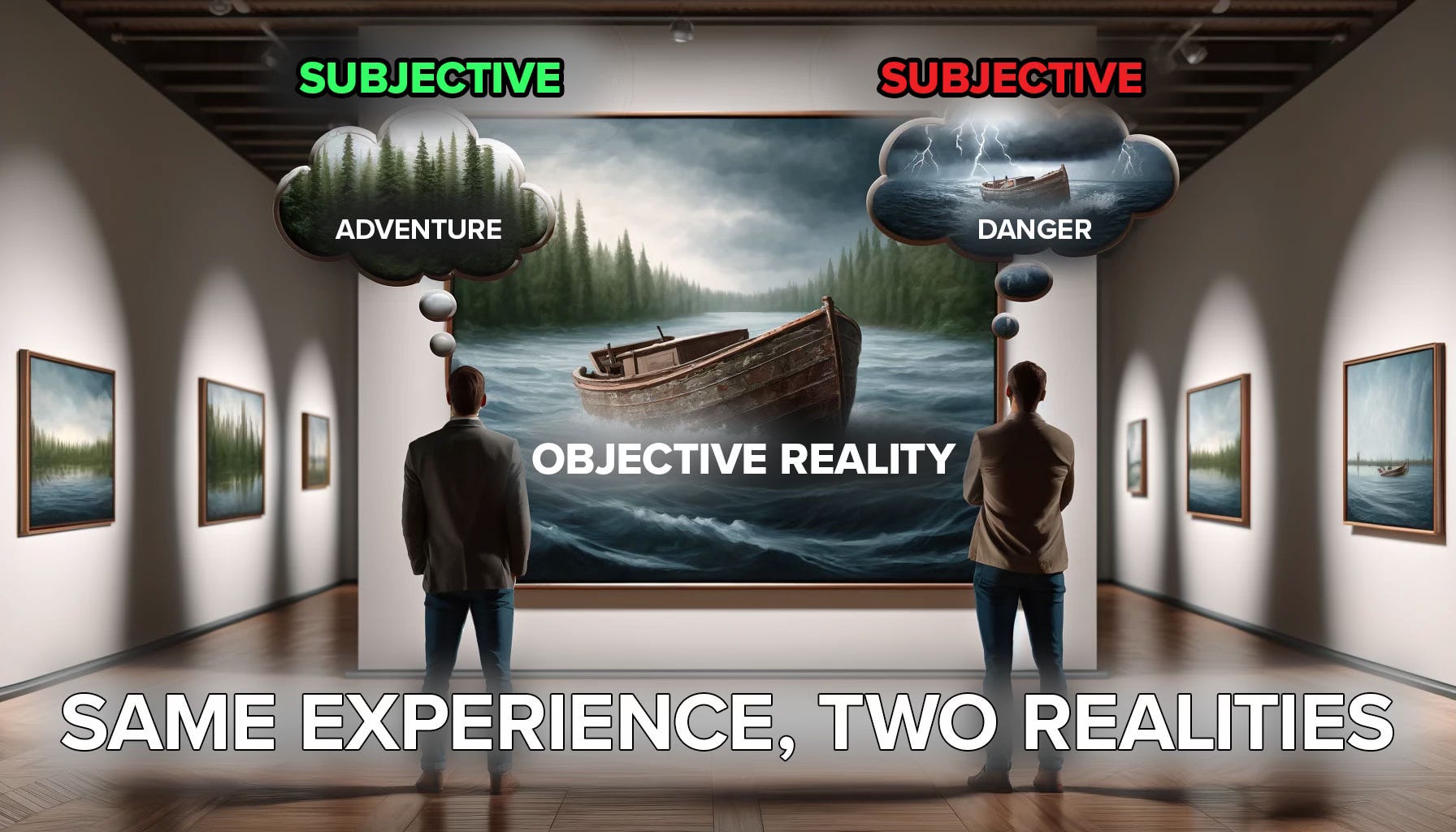
Two people looking at the same painting of a weathered motorboat on a lake. Different interpretations—one sees a peaceful scene full of adventure, while the other sees a stormy, dangerous situation.
Our brains are pretty amazing at shaping our subjective reality. They take in sensory information, store memories, and make decisions, often without us even realizing it. The brain's ability to change and adapt—neuroplasticity—means it’s always integrating new experiences and adjusting our perceptions.
Neat Study: Neuroplasticity shows us how the brain can reorganize itself. For example, in people who are blind, the brain can repurpose the visual cortex to process other types of information, like sound or touch.
Think about stroke patients who relearn how to use their limbs. Their brains form new connections to compensate for the damaged areas, showing just how adaptable our brains are in shaping our reality based on new experiences.
When we use tools like telescopes and microscopes, we're extending our sensory perception. These tools let us see things we couldn't see otherwise, like distant galaxies or tiny cells. This helps us get a more accurate picture of objective reality, even though our direct experience is just a small slice of the whole pie.
Tech Talk: Radio telescopes have allowed us to detect radio waves from space, revealing phenomena such as pulsars and quasars that are invisible to optical telescopes. On the other end, electron microscopes have revealed the intricate details of cells and microorganisms, changing how we see biological reality.
Consider how MRI machines allow us to see inside the human body in incredible detail. This technology has transformed our understanding of human anatomy and medical conditions, further expanding our perception of reality.
The idea of free will is that we can make choices independently of any influences. But what if that's not true? What if all our actions are determined by our past experiences and current environment? This is where the concept of unique will comes in—our decisions are shaped by our unique life story.
Science Behind It: B.F. Skinner's work on behavior shows how our actions are influenced by rewards and punishments. Plus, neuroscience research indicates that many decisions are made before we're even consciously aware of them.
Consider Benjamin Libet's experiment on the timing of conscious will. It showed that brain activity related to a decision occurs before we become consciously aware of making that decision. This suggests that our sense of free will might be an illusion, with our unique will being the true driver of our actions.
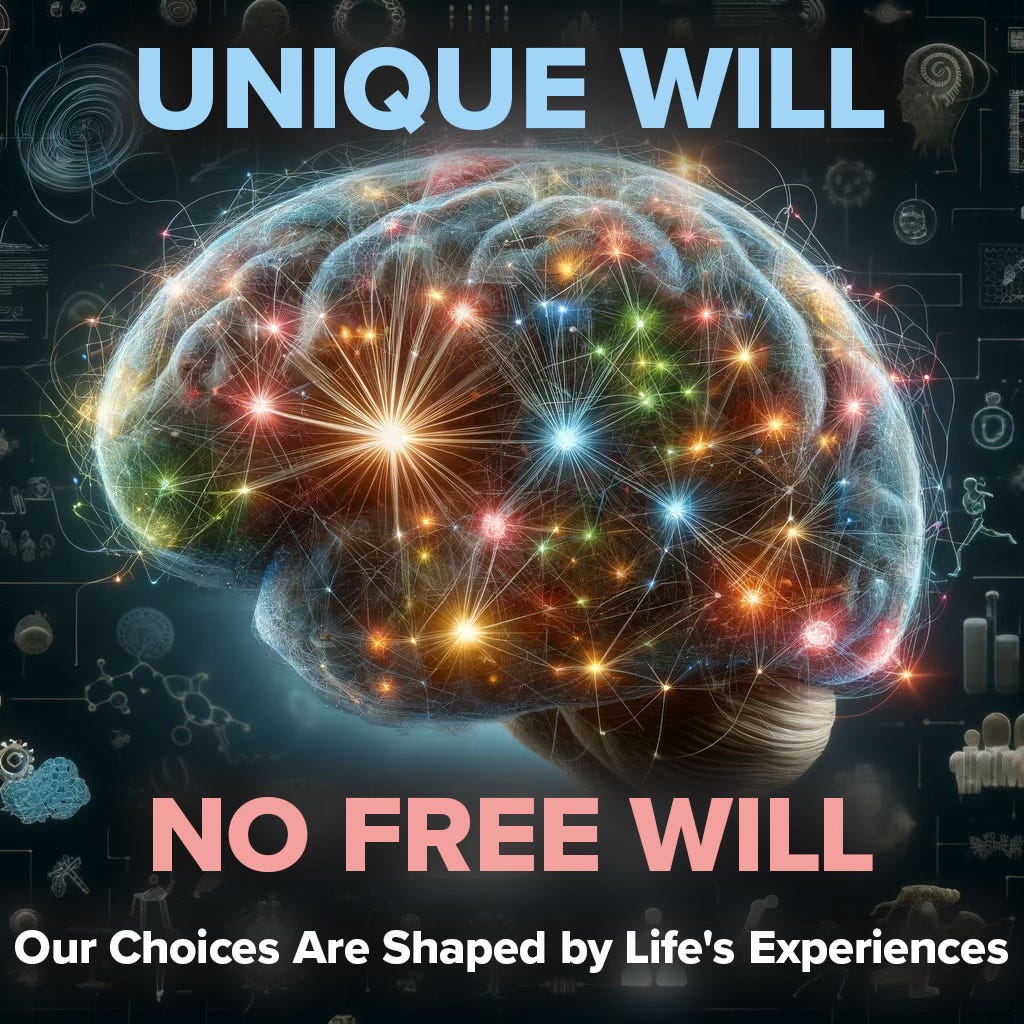
Several scientific explanations can account for why a unique will might appear to be free will:
Brain Activity and Conscious Awareness: Experiments have demonstrated that brain activity related to decision-making occurs before a person becomes consciously aware of making a decision, suggesting that our brain initiates actions subconsciously.
Complexity and Predictability: The brain's complexity and sensitivity to initial conditions make behavior appear unpredictable, mimicking free will.
Neuroplasticity and Learning: The brain's ability to adapt and form new connections based on experiences (neuroplasticity) gives the impression that we are making free choices as our responses change over time.
Decision-Making Processes: Dual-process theories highlight the interplay between automatic (unconscious) and controlled (conscious) decision-making processes, creating the impression of free will.
Subjective Experience and Introspection: Our introspective abilities often fail to reveal the subconscious influences on our behavior, reinforcing the belief in free will.
Social and Cultural Influences: Societal norms and cultural expectations teach us to view ourselves as autonomous agents responsible for our actions, strengthening the subjective experience of free will.
Buy "Accidental Motivation" on Amazon
Emotional Reactions: Our emotions are often automatic and based on past experiences. If someone had a bad experience with dogs, they might feel fear around them, while someone else might feel joy.
Brain Fact: The limbic system in our brain handles emotions and memories. Studies show that past traumas can create long-lasting changes in how we react emotionally.
An example, post-traumatic stress disorder (PTSD). PTSD sufferers often have heightened responses to triggers related to their trauma, demonstrating how their unique will shapes their emotional reactions.
Biological Needs and Prioritization: Our brains prioritize actions based on what we need right now. You might care about global issues until your own immediate needs take over. For example, you might be concerned about world hunger until you get really hungry yourself.
Evolutionary Insight: Evolutionary psychology tells us that our behaviors are driven by basic needs like survival and reproduction. Abraham Maslow's hierarchy of needs explains how we address basic needs before focusing on higher-level goals.
Think about how stress can shift our priorities. Under high stress, our brain focuses on immediate survival needs, often at the expense of long-term goals. This prioritization reflects our unique will in action, shaped by the immediate demands of our environment.
Cognitive Dissonance: This is when we have conflicting beliefs and change one to reduce the discomfort. For example, you might worry about plastic waste but still use a plastic razor because it's convenient.
Psych Study: Leon Festinger's theory of cognitive dissonance shows how we change our beliefs or behaviors to reduce the discomfort of conflicting thoughts.
An example from everyday life. Imagine you value health but love junk food. You might rationalize eating junk food by convincing yourself it's a rare treat or you'll exercise later. This adjustment in thinking reduces the discomfort from the conflict between your values and actions.
Using technology to extend our senses helps us understand more of objective reality. Telescopes let us see far-off galaxies, and microscopes reveal tiny organisms. Even though these tools give us a better picture, our direct sensory perception is still just a fraction of the total reality.
Research Highlight: Advanced instruments like particle accelerators will give us even more detailed views of the universe's fundamental building blocks. Microscopy techniques have revolutionized our understanding of cells and molecules.
Consider the role of augmented reality (AR) and virtual reality (VR) in extending our sensory perception. AR and VR can create immersive experiences that blend the real and virtual worlds, offering new ways to perceive and interact with reality. This technology expands our understanding of what is possible and further blurs the lines between different types of reality.
Our brain often lets us think we're in control until it needs something. Then it takes over and prioritizes actions based on immediate needs, like in fight-or-flight situations. By understanding what our brain needs, we can better manage our priorities.
Interesting Point: The autonomic nervous system handles a lot of this without us even noticing. Research on the fight-or-flight response shows how the amygdala triggers changes in our body to respond to threats.
Think about how our brain manages multitasking. While we might feel in control, the brain constantly switches attention between tasks based on what it perceives as most important. Understanding this can help us manage our focus and productivity better.
Recognize Biological Cues: Pay attention to your basic needs like hunger, sleep, and stress. Meeting these needs helps keep your brain functioning well.
Health Insight: Studies show that getting enough sleep is crucial for cognitive performance. Nutrition also plays a big role in how our brains work.
Chronic sleep deprivation can lead to cognitive impairments and emotional instability. Recognizing when you need rest and ensuring you get quality sleep can significantly improve your mental health and decision-making.
Create a Supportive Environment: Surround yourself with positive people and influences. This can help you maintain good behaviors and attitudes.
Social Science: Research shows that having strong social support can improve mental and physical health. Positive relationships help buffer against stress.
Consider how a supportive work environment can boost productivity and job satisfaction. Having colleagues who encourage and assist you can lead to better performance and a more positive outlook on your work.
Practice Mindfulness: Mindfulness helps you become more self-aware and reduces the impact of automatic reactions.
Mindfulness Research: Mindfulness meditation has been shown to reduce stress and improve focus. It can also help with emotional regulation.
Mindfulness practices can include meditation, deep breathing exercises, and mindful walking. These activities help you stay present, reduce anxiety, and improve your overall well-being.
Set Realistic Goals: Make sure your goals are achievable and align with your values. This keeps you motivated and gives you a sense of purpose.
Goal-Setting Science: Setting specific, challenging goals can boost motivation and performance. Aligning goals with your values can increase life satisfaction.
Break down larger goals into smaller, manageable tasks. This approach can make big objectives feel less overwhelming and help you track your progress more effectively.
So there you have it—our "unique will" shapes how we see and interact with the world. By understanding the different layers of reality and how our brain works, we can navigate life more effectively and find more fulfillment. Remember, our responses are shaped by our unique experiences, not by some abstract concept of free will. Embracing this idea can help us live better, happier lives.
Comments
Nothing yet. Say the first thing.
Sign in to join the conversation.