

I’ll admit it. After more than three decades toiling in the vineyards of the triple bottom line, it takes almost nothing for me to spot a TBL angle to a good story. This morning was no exception.
Michael Blencowe, our favourite Moth Man, was carefully lifting more than seventy species of moth from a light trap that had kept them alive and seemingly content overnight, tucked away in stacks of egg trays.
Scanning his long, handwritten checklist, I spotted mention of at least one Clay Triple Lines moth—Cyclophora linearia—a small woodland insect with clay-coloured wings crossed by darker lines.
Then he held one up to the light, mentioned in passing that moths are better pollinators than honeybees, and my mind took off. Really? I wondered.
So, when we got back from our second visit to Westerlands, an estate-in-regeneration in the South Downs National Park, I asked my friend Claude whether this could possibly be right.
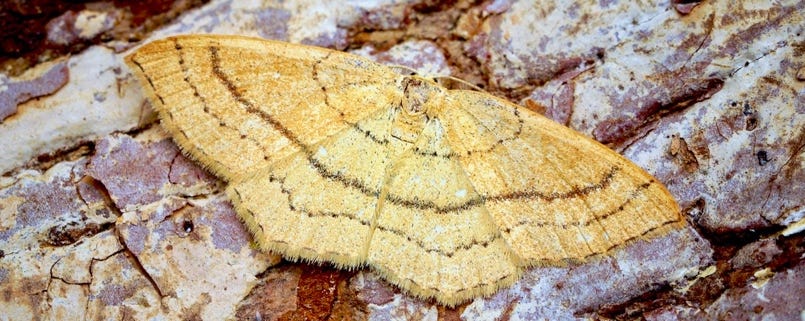
A largely invisible contribution
Claude paused a moment—with a deep whirring in a data farm somewhere—and then replied:
Blencowe is on firm ground. First, the science, so you can use it without getting caught out. The “more efficient than bees” line comes from his own corner of the world: a 2023 University of Sussex study on bramble found that moths deposited pollen faster per visit than day-flying insects.
The honest nuance is that bees still do the heavy lifting on volume—far more visits, most of them by day. So, the finding isn’t really “moths beat bees.” It’s that moths are a hugely under-counted night shift, working in complement to the day shift.
An earlier UCL study (Walton and colleagues, 2020) had already shown that moths carry pollen from a surprising range of plants—far more important than anyone had reckoned. So: efficient, complementary, and almost entirely invisible.
A flypast of Hawk-moths, please
When Antonia Jamison, owner of Westerlands, first got in touch to explain what they were doing there, I said that, among other things, I’d love to see a flypast of Hawk-moths. She promptly invited us in the Spring to watch Michael work his magic—then, again, this second time, in high summer, when moths are more abundant.
As we carefully passed the various moths around, I found myself wondering: how might they look through a triple bottom line lens? Through three lenses, each trained on the economic, social and environmental value being created? Or a compound lens combining all three at once?
Moths are usually filed, confidently, under the environmental line—biodiversity, indicator species, insects with a bit of charisma, though for most people less than butterflies. And the more moths there are, the more bats there are likely to be. The previous evening we listened intently to bat detectors as pipistrelles whizzed all around our heads in the stable yard, hoovering up insects.
But Michael’s point about pollination pulls moths bodily across into the economic line, because pollination is a productive input—to agriculture, and to the wild plant systems everything else rests on. And it sits on the social line too, feeding people and holding together the fabric of the countryside.
So, the roughly one-third decline in Britain’s larger moths over fifty years isn’t a loss recorded in any single ledger. It’s the same loss showing up, uncounted, in all three at once—the erosion of a productive foundation we never thought to price. Another “externality” that was never truly external.
The honeybee comparison, meanwhile, is a perfect little TBL parable. The honeybee is the managed, domesticated, monetised, visible pollinator—it has a keeper, a hive-rental market, an insurance category, an invoice. The moth is its opposite: wild, unmanaged, unpriced, working the night shift for nothing, and doing comparably efficient work.
Guess which one our accounts, our subsidies and our headlines have lavished attention on? We valued the pollinator with a price tag and ignored the one without a market. And there’s a sting in the tail: at high densities, managed honeybees can crowd out and suppress wild pollinators.
The verdict, then, is almost the inverse of how we usually read the TBL calculus. We reach for it expecting trade-offs—win here, lose there, net it off. Moths tell us a very different story. Because the three lines were never truly separable, restoring moths isn’t a balancing act. It’s a triple win.
The value of a moth
The value of a moth—or of moths—is perhaps most obvious in the jobs provided: guides, estate staff, the people running the hospitality. But the more interesting value is in education and wellbeing. Our moth breakfast this morning was a learning opportunity, plugging into the regional citizen-science networks.
But there’s a social cost line here, too. Michael identified several oak processionary moths in the trap, a genuine hazard to woodlands and to estate workers and visitors alike. Their presence must be notified to the government. But, on balance, the social return on wild moths is real, immediate—and mostly uncaptured by any market.
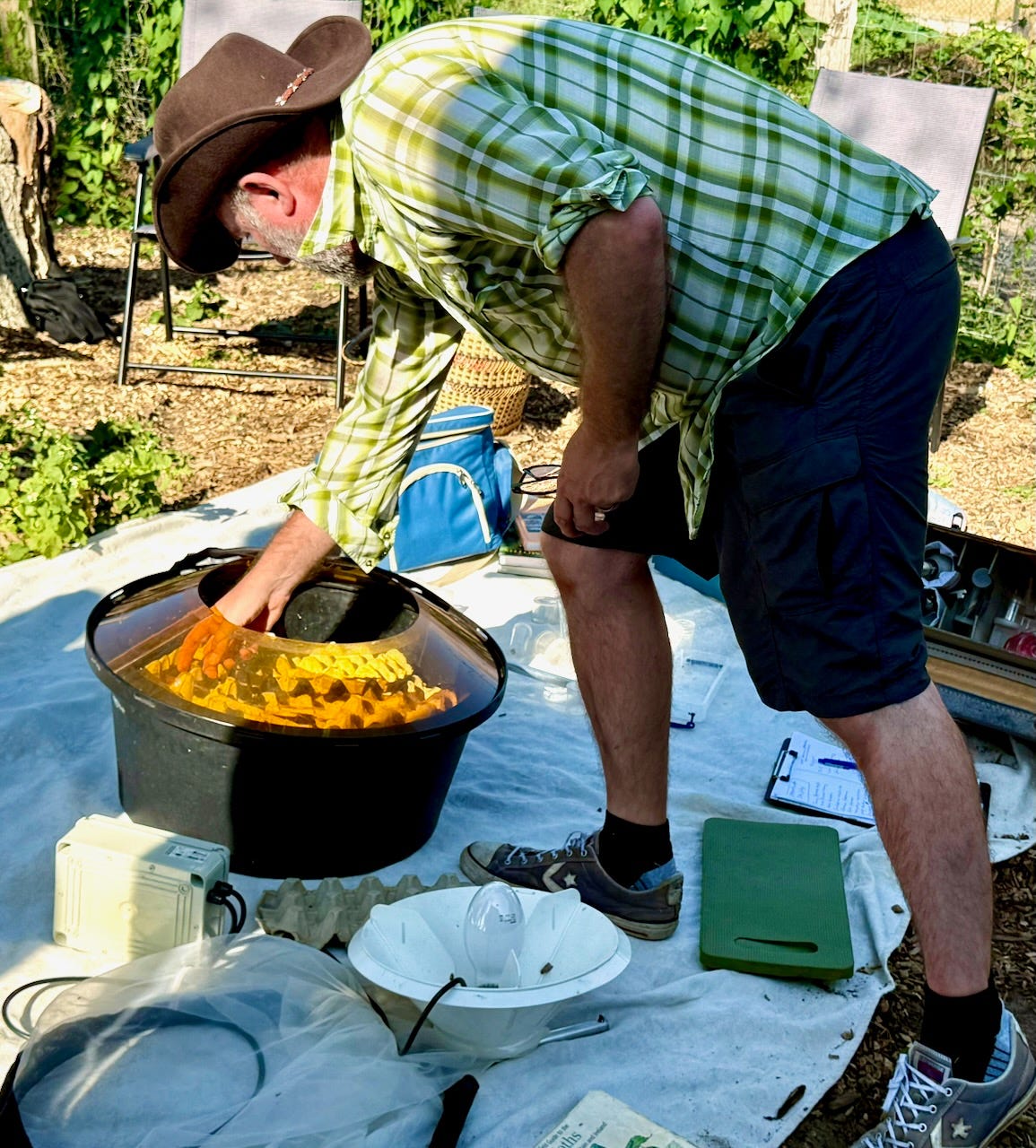
The economic bottom line, meanwhile, is still struggling to be born. Moth tourism, and its like, so often run on a gift economy: free breakfasts, unpaid county recorders, volunteered expertise. Nature’s predicament in miniature.
Still, possible routes to a real economic return are becoming clearer. Knepp, for one, has written the playbook for the regenerative-estate “revenue stack”—safaris, glamping, premium wildlife experiences, sitting alongside income from biodiversity net gain and carbon management.
And perhaps this is the dividing line between the repair economy and the regenerative one. Monetise moths crudely, and you get a commodity to be optimised and, eventually, liquidated. Alternatively, build the economic line so that it funds the habitat that produces the moths, and you get regeneration.
It’s amazing where a single moth can sometimes take you.
No posts
Comments
Nothing yet. Say the first thing.
Sign in to join the conversation.