

This is the story of a quiet piece of financial plumbing that is trying to do what a decade of pledges could not: make it more profitable for a Brazilian soy farmer to keep native vegetation standing than to bulldoze it. The piece is a bit more technical than most in the Rewilding Markets series. In headlines, however, the spotlighted approach works by re-pricing capital, not by shaming producers—which potentially makes it one of the clearest live experiments in rewilding a market.
The Cerrado is Brazil’s great tropical savanna—roughly a fifth of the country, one of the most biodiverse grassland-and-woodland systems on Earth, with a vast underground carbon store held in its deep-rooted vegetation. It is also the frontier of the global soy boom: soy farmland in the biome expanded from around 13 million hectares in 2000 to about 44 million by 2023.
Unlike the neighbouring Amazon, the Cerrado enjoys weak legal protection. Under Brazil’s Forest Code, a landowner here can legally clear up to 80% of a property, and by most estimates roughly 85% of Cerrado clearance is entirely lawful.
That is the crux: you cannot fix a lawful problem by tightening enforcement alone. In 2017, more than 60 Brazilian civil-society groups signed the Cerrado Manifesto demanding action; 23 global companies—Tesco, Sainsbury’s, Waitrose, Unilever, Nestlé, McDonald’s, Walmart and others—signed a Statement of Support (up to 57 by 2024). But a pledge not to buy deforestation-linked soy does nothing for the farmer working land he is legally entitled to clear. Someone must make keeping the trees the better deal.
Enter the Responsible Commodities Facility.
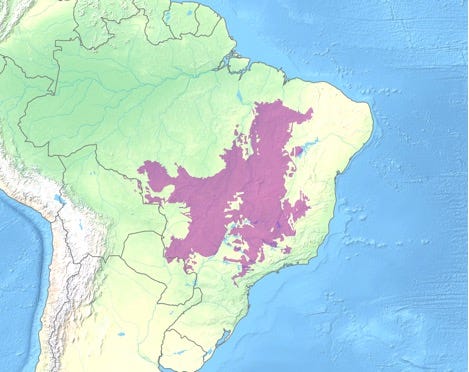
The Responsible Commodities Facility (RCF) is a farmer-financing mechanism that helps bridge the difference between unsustainable and more sustainable approaches. It offers soy producers in the Cerrado below-market-rate loans for their annual production costs—seed, fertilizer, inputs—in exchange for a commitment to zero conversion of native vegetation and to protect standing habitat beyond what the law requires. The cheaper credit is the carrot; the environmental commitment is the string attached.
It is run by Sustainable Investment Management (SIM), a UK-registered manager, and grew out of BVRio, a Brazilian NGO that designs market mechanisms for environmental problems. Both were co-founded by Pedro Moura Costa, a carbon-markets pioneer. His brother Mauricio Moura Costa directs the RCF in Brazil.
The intellectual bet is simple and central: the cheapest lever in land use is not the land; it is the cost of capital attached to it.
“The amount of cleared land already available for soy in the Cerrado is roughly three times what the industry needs. The problem was never a shortage of land—it was the absence of an incentive to use the land we’ve already cleared.” —Pedro Moura Costa, SIM
The idea predates the current fund. With US$150,000 of seed funding from the Good Energies Foundation and a cluster of Forest Positive Coalition companies, SIM developed the RCF through 2018–19 and was ready to launch a US$300 million debt fund—complete with a London Stock Exchange announcement—at the end of 2019. Then Covid arrived, and the launch became unviable. The fund was shelved.
It was resurrected in 2021 by a subgroup of the Statement-of-Support companies seeking instruments capable of delivering on their commitments. Rather than relaunch at scale, they started with a proof of concept: the Cerrado Programme, announced in August 2022. Tesco, Sainsbury’s and Waitrose bought US$11 million of four-year green bonds to capitalize a small debt fund, which then lent to 36 farms across nine large farming groups.
It was deliberately modest—a demonstration that the plumbing worked and the impact could be verified. Everything since has involved testing and scaling that template.
The financial engineering is the genuinely novel part, so it is worth walking through slowly. Brazilian farmers routinely raise working capital by issuing Rural Product Certificates (CPRs)—receivables backed by their future harvest. The RCF bundles these and, via the securitization company Opea, converts them into Agribusiness Receivables Certificates (CRAs)—tradable, fixed-income instruments broadly comparable to asset-backed securities.
Because the underlying loans carry binding environmental conditions, the CRAs are structured and verified as green bonds, issued in Brazil and registered on the Vienna Bourse and Brazil’s B3 exchange. Around this sit a set of specialist roles: Traive runs credit analysis and monitoring of participating farms; Pinheiro Neto structures the transaction legally; ERM-NINT provides independent environmental verification and a Second Party Opinion; and satellite monitoring (via providers such as EarthDaily Agro) checks compliance every crop cycle against the Cadastro Ambiental Rural (CAR) land registry.
The scaling solution involves “blended finance.” The fund is tranched: a subordinated layer, taken by corporates and development finance institutions, absorbs first losses and lowers the cost of capital for a senior layer aimed at mainstream institutional investors. That de-risking is what let the 2025/26 senior tranche to earn a sound credit rating from S&P on the Brazilian scale—a rating that, as Moura Costa notes, lets the facility “scale well beyond what impact-investor capital alone could support.”
Perhaps we see some form of Trojan Horse here? The environmental outcome is being smuggled inside an instrument conservative money can buy.
But why debt, not equity? Moura Costa is clear on the point. Currently fashionable “nature-based” equity funds end up owning land, he says—awkward or impossible where foreign land ownership is restricted (Brazil) or where land belongs to communities and Indigenous peoples (much of Southeast Asia and Africa). Debt touches many existing landowners without dispossessing any of them.
What keeps the RCF from being greenwash is that its rules were not written by the financiers. The eligibility criteria were developed with WWF Brasil, The Nature Conservancy, Conservation International, IPAM, Proforest and UN Environment. Those bodies formed the early Environmental Committee and now sit on an Environmental Advisory Board, reviewing operations, farm selection and impact claims.
The facility is also a member of IFACC (Innovative Finance for the Amazon, Cerrado and Chaco), the UNEP/TNC/Tropical Forest Alliance initiative, and operates in accordance with its criteria. This dense NGO scaffolding is critical: it is the difference between a marketing label and an outcome an institutional investor’s risk committee can underwrite.
To join, a farm must show no conversion of native vegetation since 1 January 2020; full Forest Code compliance; clear land rights; no overlap with protected areas, Indigenous or traditional territories; and no labour, agrochemical or embargo violations. Preference goes to land converted from abandoned pasture to soy after 2008—recycling already-degraded ground rather than opening up new areas.
The key metric is Excess Native Vegetation (ENV): habitat a farmer holds over and above the legal minimum and could therefore legally clear. By paying farmers to keep this ENV vegetation intact, the RCF prices the very thing the Forest Code leaves unpriced—the legal right to destroy. In the 2025/26 season, roughly 29,000 of the 90,000-or-so hectares conserved were genuinely additional, legally clearable vegetation. That additionality underpins the whole moral and accounting case for the model.
Growth in demand has been steep. The 2022 pilot’s three supermarkets were joined in 2023 by Santander, Rabobank and the AGRI3 Fund (US$47m); the 2025/26 round added IDB Invest and the Mobilising Finance for Forests programme (run by the Dutch development bank FMO, funded by the UK and Dutch governments), reaching US$60m.
In February 2026, McDonald’s joined as a corporate participant, and in March 2026, the Green Climate Fund committed US$85 million—secured through 2038, expected to be leveraged roughly fourfold, and intended to carry the facility toward half a billion dollars by 2028. In the process, it is intended to avoid over 25 MtCO2e of emissions.
There is at least one caveat worth keeping in mind, however. Most of the headline figures are forward-looking or avoided emissions estimates rather than audited results, and “conserved” hectares include land that was never realistically going to be cleared. The independent verification and the ENV concept are designed precisely to keep those claims honest—but a rewilded market still needs its outcomes clearly linked back to reality, not just to declared intentions.
The obvious comparator is the Round Table on Responsible Soy (RTRS), founded in Zürich in 2006 as a multi-stakeholder body of 160-plus producers, traders, financiers and NGOs. RTRS writes a certification standard and issues certified physical soy and tradable credits.
The two are complementary rather than rivals, because they act at different points in the chain: RTRS changes what a buyer can claim about a bean; the RCF changes what a loan costs a farmer. Certification verifies practice and lets buyers pay a premium after the fact; the RCF alters the economics before planting, at the moment of the clearing decision.
It matters, too, that certification has been criticized—by Greenpeace (”Destruction: Certified”) and by Earthsight’s 2024 Cerrado investigation—partly because producers can certify some farms while clearing others. The RCF’s farm-level monitoring, CAR checks, and ENV accounting are, in effect, an answer to that cherry-picking critique, and they borrow the Accountability Framework’s definitions to stay disciplined about what “no conversion” means.
The RCF explicitly complements the UK Soy Manifesto, the Consumer Goods Forum’s Forest Positive Coalition, and the Cerrado Manifesto, and is part of IFACC. In June 2026, SIM became a founding signatory of the Rotterdam Statement of Support for the Tropical Forests Forever Facility (TFFF), the Brazil-led standing-forest payment fund launched around COP30. That alignment is telling: like the RCF, the TFFF pays for forests to remain standing—both are wagers on protection finance rather than restoration.
SIM frames the RCF as a template, not a single fund. The intention is a series of commodity programmes, each capitalised through green bonds. The one Moura Costa names most often is low-methane rice: conventionally flooded paddy is among the largest single sources of agricultural methane—on the order of a tenth of the global total—and continuous flooding can be reduced through techniques such as alternate wetting and drying.
A finance facility that lowered the cost of capital for farmers adopting low-methane practices would extend the model from land to practice—and the March 2026 GCF backing was explicitly framed as an opening to adapt the mechanism “for different geographies and commodities.” Cattle, palm and other conversion-linked commodities are the obvious further candidates.
This is where the RCF gets structurally interesting for a rewilding-markets thesis. The soy work is a protection play—keep the habitat you have. Low-methane rice would be a mitigation play—farm the same land differently. The instrument (performance-linked green debt) is the same; what it rewards is not.
So, does the RCF only protect and conserve, or does it embrace regeneration? On the evidence, the honest answer is that the RCF is today overwhelmingly a protection-and-avoided-conversion model—a “keep it standing” machine—and only gestures toward regeneration at the edges.
Look at what it pays for and measures: deforestation- and conversion-free soy produced, hectares of native vegetation conserved, carbon stocks maintained, emissions avoided. Every headline metric is an avoided loss, not a created gain. Its land-use logic is land-sparing: push soy onto already-cleared, degraded pasture to spare intact habitat.
That is valuable and, in a biome losing ground every season, arguably the highest-leverage thing to do first. But it is conservation, not restoration, not regeneration.
Genuine regeneration—replanting cleared Cerrado, funding agroforestry, cover cropping, soil-carbon building, or actively rewilding degraded reserves—is not what the RCF currently finances. The nearest it comes is passive: paying farmers to hold Excess Native Vegetation lets some of that land regenerate on its own, and steering production onto old pasture can, over time, take pressure off recovering areas. The low-methane rice ambition points further toward practice change. But there is no line item today for putting nature back.
So why does this matter for rewilding markets? The RCF is best understood as rewilding the capital market more than the land. Its achievement is to make a mainstream financial instrument—a rated, tradable green bond—sensitive to an ecological variable it normally ignores: the standing value of native vegetation a farmer is legally free to destroy.
The big question is whether the same architecture can be expanded from avoided harm to active repair. Could a CRA one day be priced off hectares restored as readily as hectares retained? Nothing in the mechanics forbids it; the demand signal—buyers wanting “no deforestation” far more than “restoration”—is what holds it at protection.
The RCF will not, by itself, save the Cerrado. But as a demonstration that you can wrap an ecological outcome inside an instrument conservative money is happy to buy—and thereby change a farmer’s decision at the exact moment it is made—it is one of the more convincing examples going of a market being taught to feel what it touches.
No posts
Comments
Nothing yet. Say the first thing.
Sign in to join the conversation.