
Trite as it sounds, the insight that probably saved my marriage was realizing that my wife isn’t a mind reader. She has many other admirable qualities and talents — you’d like her — but telepathy isn’t among them. It was stunning to realize that, instead of getting into a fight because she didn’t somehow intuit what I was feeling, I could simply tell her.
Again, this is the most cliche relationship advice you can imagine, but you have to understand: I was in my mid-twenties and, thus, extremely stupid. I’ve gotten wiser with age, I hope, but still forget this critical insight with alarming frequency. Our arguments these days are few and far between, but most of them boil down to: Why didn’t you know what I was thinking without me having to say it?
You can blame this on any number of things, but I think it comes down to the essential contradiction in all human relationships: no matter how close you get to another person, they’re still another person. Yes, your spouse or partner might know you better than anyone else, and could probably place some lucrative bets on predicting your behavior. But they don’t think with your mind or feel with your heart and that means there’s always a level of separation, even if it’s very small. You’d think that sort of intimacy would make it easier to express yourself, but I’ve often found it make it harder. When someone knows you better than anyone else, it can be painful to have to voice your needs and hurts to them. Shouldn’t they already know that? If they don’t know that, do they even know you at all?
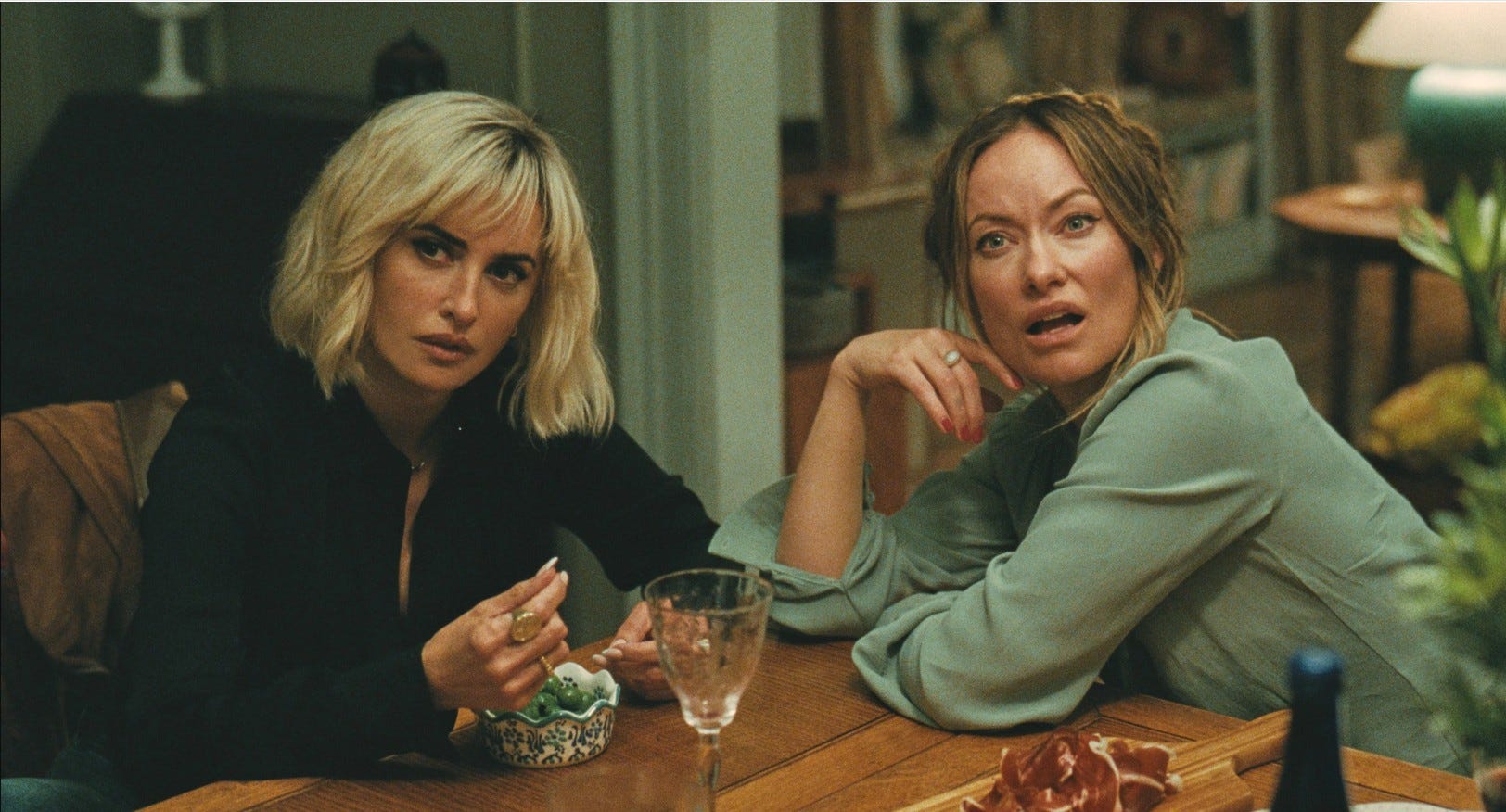
That’s the question simmering beneath the surface of Olivia Wilde’s third film, The Invite, an acerbic chamber piece about two couples hanging out in a San Francisco apartment and, in short, getting weird. It’s Who’s Afraid of Virginia Woolf? but directed by and centered on people born after 1980. For Wilde it’s a much-needed comeback after the disastrous response to her second film, Don’t Worry Darling (2022). But beyond that it’s a funny and bruising examination of what makes or breaks relationships.
Married 40-somethings Angela (Wilde) and Joe (Seth Rogen) have invited their upstairs neighbors, Pína (Penélope Cruz) and Hawk (Edward Norton), over for a night of wine and finger foods. Except there’s no wine, because Joe forgot to pick it up. Or maybe Angela never told him to pick it up. Maybe she never told him that their neighbors were coming over. You get the sense that these two get their lines crossed a lot.
Even before the neighbors arrive, the cracks in Angela and Joe’s marriage are obvious. Angela is anxious and controlling, Joe passive and resentful. They have frustrated artistic ambitions, a large apartment that wraps around their building’s central courtyard, and a 12-year-old daughter (sleeping over at a friend’s house). They bicker like it’s their first language.
Pína and Hawk are older, cooler, and seem much happier. Indeed, a point of contention is that Angela and Joe can hear their loud, enthusiastic sex through the ceiling — something that infuriates Joe, although Angela forbids him from bringing it up. That’s hardly the only awkward Chekhov’s gun that will be pulled from the mantle before the night is over; metaphorically, Angela and Joe’s apartment is practically an armory.
Things take a still more awkward turn when Pína and Hawk reveal that they are into group sex and invite Angela and Joe to join them. Awkward… but also an opportunity? As they move past their initial shock, Angela and Joe begin to wonder if this is what they need to shake up their stagnant marriage: a new experience that will expand and free them from years of calcified resentment and routine. Naturally, it’s not that simple.
The premise is stage-y (the film was adapted by Will McCormack and Rashida Jones from Spanish director Cesc Gay’s film Sentimental, itself an adaptation of his original play) but Wilde keeps things lively with creative visuals and a dynamic use of her space. While each character gets to sink their teeth into at least one monologue, most of the dialogue is rapid and semi-improvisational, but with a sharpness that feels more Mike Nichols than Judd Apatow. I was also relieved that this never turned into a thriller about psychotic neighbors with nefarious purposes (if anything, Pína and Hawk — while not perfect — come off as the healthier couple in many ways). The film does, weirdly, nod in that direction a few times. I would usually be more annoyed by how deceptive that seems, but (maybe paradoxically) I’m willing to forgive that red herring because it doesn’t pay off.1
Like any good chamber piece this is an acting showcase, with the four leads throwing off enough heat to get you through even the shaggier sections. This is also the best Norton has been in years!
The Invite is about sex but, more to the point, it’s about desire, and the communication of desire. That’s a stumbling block for, I believe, many marriages and not just in he bedroom. It takes an enormous amount of vulnerability to say to someone, even a spouse: “This is what I need to feel loved.” What statement confronts us more harshly with our essential human frailty and neediness? It’s the humiliating admission that, even after decades on this planet, you still can’t do it alone.
It’s such a painful thing to ask, in fact, that often we don’t and just hope that our loved ones will read between the lines. But no one can read minds. And — maybe an even more cliche but transformational realization — it’s not wrong to need. Or for those needs to change with time. But how can a relationship evolve if neither partner knows what the other needs, if they’ve lost track of how to love one another?
In a promotional interview for the film, Wilde said that she realized her marriage to Jason Sudeikis was over when she asked if he had bought her a birthday present and he replied: “What would I get you Olivia? I don’t know you.” She realized in that moment that it was true: over the years, they had become strangers. They couldn’t move forward together.
Angela and Joe’s disastrous dinner party reveals just how estranged they have become, but the film leaves them in a more ambiguous place. What happens when you realize that you’re married to a stranger? Do you say goodbye? Or do you reintroduce yourself?
Things Seen & Heard
Have I mentioned that your can pre-order my upcoming book, Finding God in All Films: A Contemplative Approach to Watching Movies? Because GUESS WHAT?

Maybe this is annoying to share in the review for a troubled marriage movie, but my wife and I just celebrated 15 years last week! We saw Paul Simon in concert in Queens and it was spectacular! Angela and Joe should have tried that.
Mild spoilers: presumably the reason Hawk is snooping around and Pína keeps poking sensitive spots is because they’re trying to confirm that these people would actually be good partners for group sex, but because that’s never explained it still feels weird? I kept waiting for the reveal that they were trying to freak them out so that they’d move out of the apartment, which it’s implied Pína and Hawk envy. Is that how Sentimental ends?
No posts
Comments
Nothing yet. Say the first thing.
Sign in to join the conversation.