
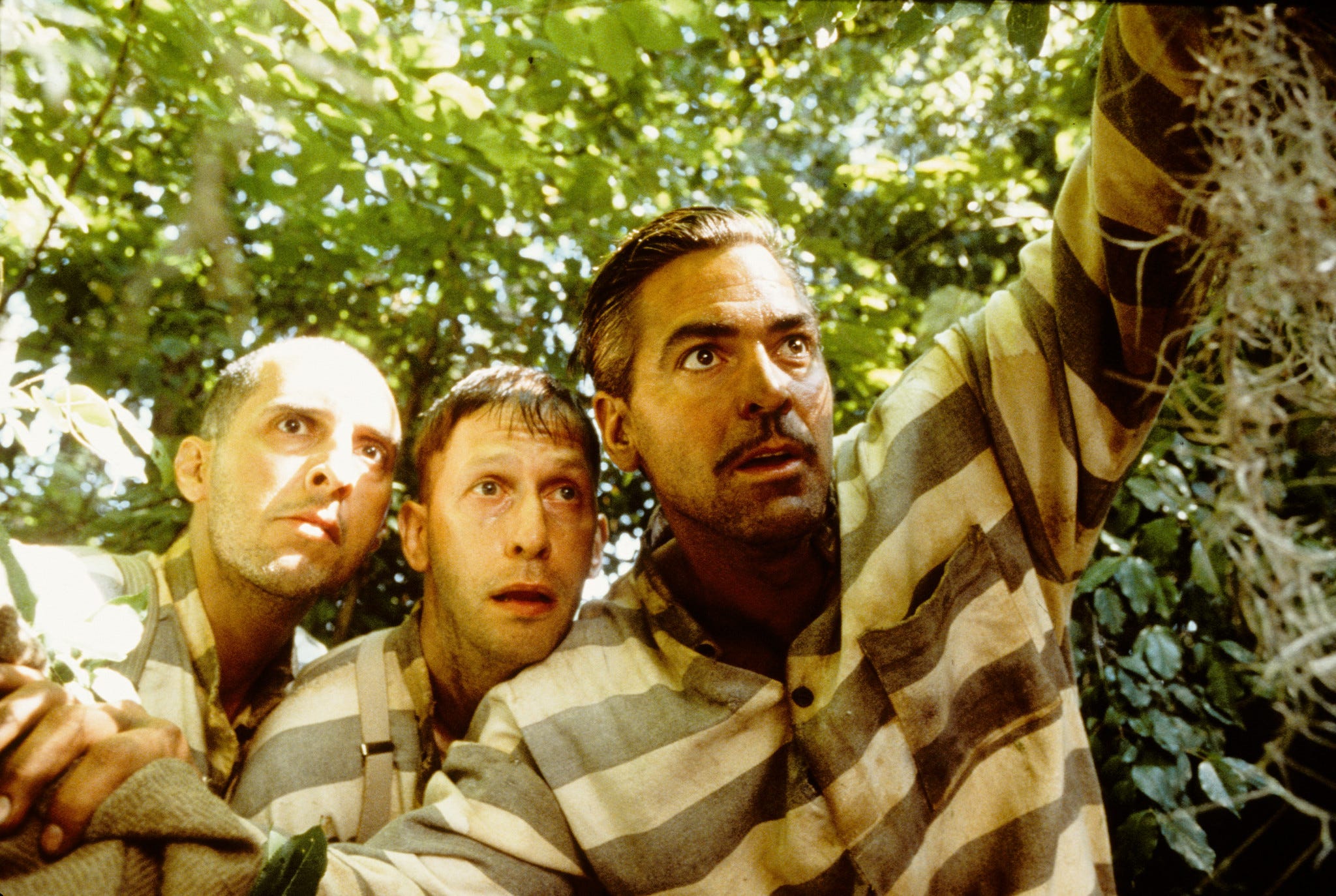
O Muse! Sing in me, and through me tell the story of three men, three very stupid men, three incredibly, comically stupid men, of their trials and travails and ob-stack-les, and the winding road that led them even unto their salvation.
A lot of people are talking about “Christopher Nolan’s The Odyssey.” Well I don’t know who ‘e is, but I would like to talk about the definitive cinematic adaptation of Homer’s Odyssey: Joel and Ethan Coen’s 2000 screwball bluegrass musical, O Brother, Where Art Thou?1
This is one of my favorite movies, and while I have written about it before I don’t know if I’ll ever have said enough. I love it so much: it’s hilarious, it’s gorgeous to watch (Roger Deakins, baby!!!), and it has one of the greatest soundtracks of all time.2 In a very loose adaptation of Homer’s work, we follow three moronic escaped convicts — Ulysses Everett McGill (George Clooney), Delmar O’Donnell (Tim Blake Nelson), and Pete (John Turturro) — through Depression era Mississippi as they hunt for a promised treasure and redemption. Along the way they unwittingly record a hit single, weave in and out of a contentious gubernatorial campaign, get baptized, are seduced by “sirens,” beaten by a cyclopic Bible salesman, run afoul of the Klan, and get banned from Woolworth’s.
It’s hardly the only Coens movie about a bunch of idiots. Most of their movies are: Raising Arizona, The Hudsucker Proxy, Intolerable Cruelty, The Ladykillers, Burn After Reading, Hail, Caesar!… idiots as far as the eye can see. Even some of their more dramatic features are about (or heavily involve) characters who are at least a little bit dumber than they think they are: Blood Simple, The Man Who Wasn’t There, Inside Llewyn Davis, and Fargo are all good examples.3
Some of this stems from the Coens’ enduring love of noir, a genre about people making a run for their dreams and crashing, often fatally, into the unyielding brick wall of their own limitations. But not all of these films are tragedies, and sometimes characters in a Coens movie have a gentler reckoning with their human fallibility. (“Gentler” being a wildly relative term in this case). In Raising Arizona, Hudsucker, and O Brother, the stupidity of our heroes grants them a degree of innocence, even virtue, that eludes the cannier, compromised world around them.
In O Brother especially, stupidity becomes a sort of holiness.
When I call the heroes of O Brother idiots, I’m not trying to be cruel or dismissive. Textually, they are very dumb. We see this early on, when Everett hops aboard a moving train and, with his typical verbosity, asks if any of the other rail-riding hobos can remove the chains binding his legs to those of his comrades. However, he hasn’t stopped to help said comrades onto the train. Delmar clambers aboard but Pete trips, and the chains drag Delmar, then Everett, out of the train and into a ditch. It’s not the last time something like this will happen.
The trio stand in for Odysseus and his crew, of course, but they also roughly equate to intellect (Everett), heart (Delmar), and Id (Pete). Delmar is soft-hearted to the point of total naivete and the most magical thinker of the group, capable of convincing himself that, say, that one of his friends has been turned into a toad by sex magic. Pete is short-tempered and libidinal, following his appetites unerringly into trouble. And Everett considers himself an educated man, unchained by the superstitions and follies of simpler men, and he’d be happy to tell you so. But you quickly realize he’s as dumb as the rest of them, just better read.
So is the point of the movie to laugh at these idiots, to enjoy their often self-made trials and travails? Well, yes, partially. But you also quickly come to love these fools and want to see them achieve their goals, no matter how unrealistic it seems. That’s because, clueless as they are, they really don’t mean anyone any harm. They’ll steal a car every now and then, but the only violence they do is to themselves. It would be too strong to call them anti-racist — these guys aren’t thinking about systems — but the concept of hate seems foreign and puzzling to them. When they encounter the Klan they’re horrified, and risk their lives to save a Black friend even though it would be easier to not get involved. “Not getting involved” doesn’t even appear to occur to them. There’s no complicated moral calculus or powerfully-held convictions here. They see a friend in trouble and move to help him; it’s as simple as that.
Like H.I. in Raising Arizona or Norville in Hudsucker Proxy, our heroes aren’t necessarily dumber than everyone else around them. But they are foolish about the ways of the world and that makes them less capable of cruelty than their fellow man. If this says something grim about the essential nature of the world, it also says something surprisingly sweet about the redemptive power of simplicity.
There’s a thread in the Coens filmography that, worryingly, sometimes makes me think of Forrest Gump. In their films, characters attempt to change their lives through ambitious plans or schemes; they almost always fail, thanks to either their own stupidity or the cruelty of the universe. The characters who fare best, and seem happiest, are also the simplest: I’ve already invoked H.I. McDunnough and Norville Barnes, but Marge Gunderson is another example.
You could, potentially, read a fairly conservative moral into that: trying to change the world or yourself is futile. Be content with your lot in life. A Serious Man, the Coens’ mid-century suburban Jewish riff on the Book of Job, opens with a bit of wisdom from the medieval rabbi Rashi: “Receive with simplicity everything that happens to you.” You can see why Forrest Gump, and its “be a feather in the wind” moral, comes to mind.
But I think that’s a misreading for two reasons. For one, it would be pretty hypocritical for two Minnesotan nerds who went from making indie films to having Hollywood repeatedly throw money and movie stars at them to make idiosyncratic passion projects to say “Don’t dream big.” Secondly, things don’t work out for every character who attempts to just go with the flow and (to quote A Serious Man again) “accept the mystery.” Larry Gopnik in that film, for instance, is extremely mild-mannered and, metaphorically, gets the shit kicked out of him by life and/or God. Llewelyn Moss in No Country for Old Men gets Anton Chigurh on his trail because he foolishly steals a big bag of money; but most of the people Chigurh kills are just minding their own business.
What the Coens seem to valorize is a posture of surrender. Not passivity, exactly; moral action is possible, and sometimes necessary (consider, again, the Klan scene in O Brother).
It’s surrender to the reality of not being the master of one’s fate. The fatal flaw of so many Coens protagonists isn’t that they fly too close to the sun, but that they fail to accept the reality of their situation. Llewyn Davis doesn’t have the temperament to be Bob Dylan; Jerry Lundegaard doesn’t have the smarts or aggression to be a high-stakes operator (and certainly not a master criminal). But more than that, they have good things in their lives that they fail to appreciate. Contrast Jerry in Fargo with Marge who, though she’s briefly tempted by romantic novelty, recognizes the worth of her quiet, simple life. Jerry can’t do that and, as he tries to write himself into a new story, ends up losing the very things that made his life worthwhile.
Surrender also means admitting that we never have all of the answers. That’s a big part of A Serious Man, and there’s a great conversation in The Ballad of Buster Scruggs about it.4 In the philosophy of the Coens’ films, reality is a question without an answer, and anyone who claims to have solved it is either a huckster or an idiot.
That idea fits comfortably in existentialism, but you can also find it in religion. That Rashi quote from A Serious Man, for instance, is from his commentary on Deuteronomy 18:13: “You must be altogether sincere with the LORD, your God.” In context, the authors of Deuteronomy are condemning anyone who “practices divination, or is a soothsayer, augur, or sorcerer, or who casts spells, consults ghosts and spirits, or seeks oracles from the dead.” (Deut. 18:11-12) These were all ways of attempting to divine the future or otherwise exert supernatural control over reality. Rashi cautions his readers against seeking knowledge that is meant for God alone and, essentially, rolling with the cosmic punches.
Everett in O Brother would scoff at anyone he found consulting spirits or seeking oracles. He sneers that “everyone’s looking for answers,” but believes that, because of his relative erudition, he actually has them. He sees himself as the modern man on the vanguard of progress, capable of subduing all of life’s mysteries by the power of his intellect. “Yessir, the South is gonna change,” he tells the others. “Out with old spiritual mumbo-jumbo, the superstition and the backward ways. We’re gonna see a brave new world where they run everyone a wire and hook us all up to the grid. Yessir, a veritable age of reason.”
Everett would despise the term, but it’s a kind of faith. It’s also a kind of stupidity.
This most recent watch of O Brother made me thinking of Matthew 11:25: “I give praise to you, Father, Lord of heaven and earth, for although you have hidden these things from the wise and the learned you have revealed them to the childlike.” That’s how the New American Bible, Revised Edition translates it anyway: I’ve always been partial to “you have revealed them to the foolish.”
“Childlike” is more to the point, though. Jesus isn’t criticizing knowledge itself but those who take pride in believing they have all of the answers, notably the dogmatic religious authorities of his day. Instead, he advises his followers to practice humility and curiosity.
In the scriptural reckoning of things, only God has all of the answers; in the Coens’ reckoning, there are no answers, no Truth, to find. Both reach the same conclusion: the reach of human knowledge is limited and some aspects of life will always remain mysterious. We can (and, I think, should) dig into those mysteries as much as we want but, inevitably, we reach a point of surrender.
In O Brother, Where Art Thou? surrender is salvation. Everett is a prideful man, the sort of guy Matthew 11:25 is talking about. He sees himself as essentially better than everyone he meets, including his friends. He’s the only one smart enough to see through all of the superstition and nonsense, to really grasp the truth of the world. When Pete and Delmar rush to a riverside baptism (believing, erroneously, that having their sins absolved means they’ll no longer be legally liable for them) he scoffs: “Baptism! You two are just dumber than a bag of hammers.”
You might expect that perspective to be privileged, considering that the Coens aren’t too keen on organized religion themselves (granted this was a long time ago, but in Ethan’s philosophy thesis at Princeton he wrote that belief in “an omnipotent, benevolent creator” was “the height of stupidity”).5 But the Baptists are portrayed, if not sympathetically (we don’t get to know them well enough for that), at least positively. They’re happy, pleasant, the light is warm and rich, the Alison Krauss version of “Down to the River to Pray” is stirring and beautiful, so much so that my high school used it on retreats for years with complete sincerity. If anything, Everett looks churlish for rolling his eyes at them.
Of course, Delmar and Pete’s mercenary motives undercut the sanctity a bit, and you can imagine that in the world of the film, the Heaven the Baptists are preparing for is just as fanciful as the “Big Rock Candy Mountain” in the old Harry McClintock song we hear at the beginning of the movie. But that’s not the point of the scene. The point is that Everett’s pride, his certainty that he knows it all, cuts him off from something that seems to be working just fine for a lot of other folks.
As the trio’s troubles build, Pete and Delmar theorize that God is punishing them for Everett’s impiety. It’s a Southern Gothic spin on the Odyssey’s story of divine retribution and, like Odysseus, our heroes can’t go home until they’ve made things right with the higher power. In O Brother that takes the form of Everett falling to his knees and praying for God’s mercy, in a moment when he’s bereft of all human help. Again, this could have been played for laughs, but Clooney and the Coens play it totally sincere.
It’s not that Everett has truly come to believe; moments after the act of possible divine intervention that saves them, he disavows his lapse into religiosity. But in that moment he does surrender. He repents of his pride, recognizes the harm he’s caused by insisting he had all of the answers, prizes his relationships over his intellectual vanity. He is, at last, sacrificing the illusion of control. He surrenders, and he is saved.
In her Letterboxd review of this film, novelist and Coens expert Megan Abbott wrote that O Brother, Where Art Thou? is “maybe the most warm-hearted in the Coens’ canon. You almost can’t believe it.” It’s true, and that improbable warmth is a huge part of why I love it.
The Coens have a reputation for being cruel storytellers, delighting in torturing their characters like a maladjusted kid pulling the wings off of flies. This is mystifying to me, because — while bad things undoubtedly do happen to their characters — they also clearly have so much affection for them. That’s especially evident in O Brother, Where Art Thou? The film wants you to laugh at these guys, but it also wants you to root for them. They have good hearts even if their intellectual faculties are somewhat lacking. If you only see them as idiots, that says more about you than the filmmakers.
In O Brother, it’s the stupid who inherit the Earth. Partially that’s thanks to the inherent humanity of human systems, but it’s also kind of aspirational. After all, aren’t we all idiots to some degree or another? We make stupid choices, we overestimate our abilities, we fall in love with the wrong people and make the same mistakes again and again. Since becoming a parent, I’ve often thought that the best image for God’s relationship with humanity is a parent’s to an infant. There’s a lot of love and care and support there. But also there’s a lot of good-natured laughter because infants are very stupid. I think God’s response to us is less often “Turn back, O Man!” and more “Haha, awwww, no, buddy, let’s not shove our faces through the crib bars, that’s not gonna end well.”
Stupidity can be its own kind of wisdom, primarily because stupidity is aware of its own lack. It takes humility to admit that we don’t know everything, that we can’t do everything, that we are — even just in a cosmic sense — a little bit dumber than we’d like to be. But that’s how we open ourselves up to grace: by surrendering to the fact that we’re incomplete, that we need others to make it through our world of constant sorrows. If that sort of foolishness means we’re out of step with the world, then that just highlights how compromised and cynical the world is. In a world like that, foolishness is holy and you only become a saint by being a little stupid.
I have so much more to say about this movie, I think I could quite literally write a book about it. But in keeping with the theme, maybe it’s appropriate to recognize my limitations and stop here. You can watch it on the Criterion Channel for, at least, the rest of the month and please join me in keeping fingers crossed that we’ll get an actual Criterion release of it at some point.
Things Seen & Heard
For America Magazine, the great Michael J O'Connell wrote about a weird thing that I thought only my sister’s high school did but apparently was a larger trend: a dramatic Christian skit set to Bonnie Tyler’s “Total Eclipse of the Heart.”
At some point I’m going to develop and pitch an essay about why the Coens resonate with me as a person of faith, and then you’ll all be sorry!!!!!!! Or maybe just happy for me, I don’t know.
I haven’t gotten to make my planned ridiculous cover art yet, but please enjoy a playlist I just made: The Coen Brothers Sing-Along. It’s a selection of songs performed in their movies, with a few non-diegetic exceptions (and some Another Day, Another Time tracks to compensate for how little of the Inside Llewyn Davis soundtrack is on Spotify). “But John, ‘Way Out There’ from Raising Arizona isn’t a sing-along song.” Yeah, not if you’re a coward.
Look out for Odyssey thoughts in the near future!
Obviously I know who ‘e is, and by the time you read this I’ll have seen The Odyssey (in 70 mm IMAX!) and will be working on my Substack review.
Yes, I own it on vinyl and yes, my kids can sing most of “In the Highways,” which should make me Father of the Century.
To be clear: I mean the criminals in Fargo. Marge Gunderson is very astute, despite her folksy nature.
The “certainty” conversation in The Gal Who Got Rattled. I should also note that while A Serious Man advises “accepting the mystery,” it also acknowledges that this won’t free you from existential angst. Yet another way that they overlap with Catholicism!
Based on Honey Don’t! that’s still his opinion, although the less said about that movie the better.
No posts
Comments
Nothing yet. Say the first thing.
Sign in to join the conversation.